What it is
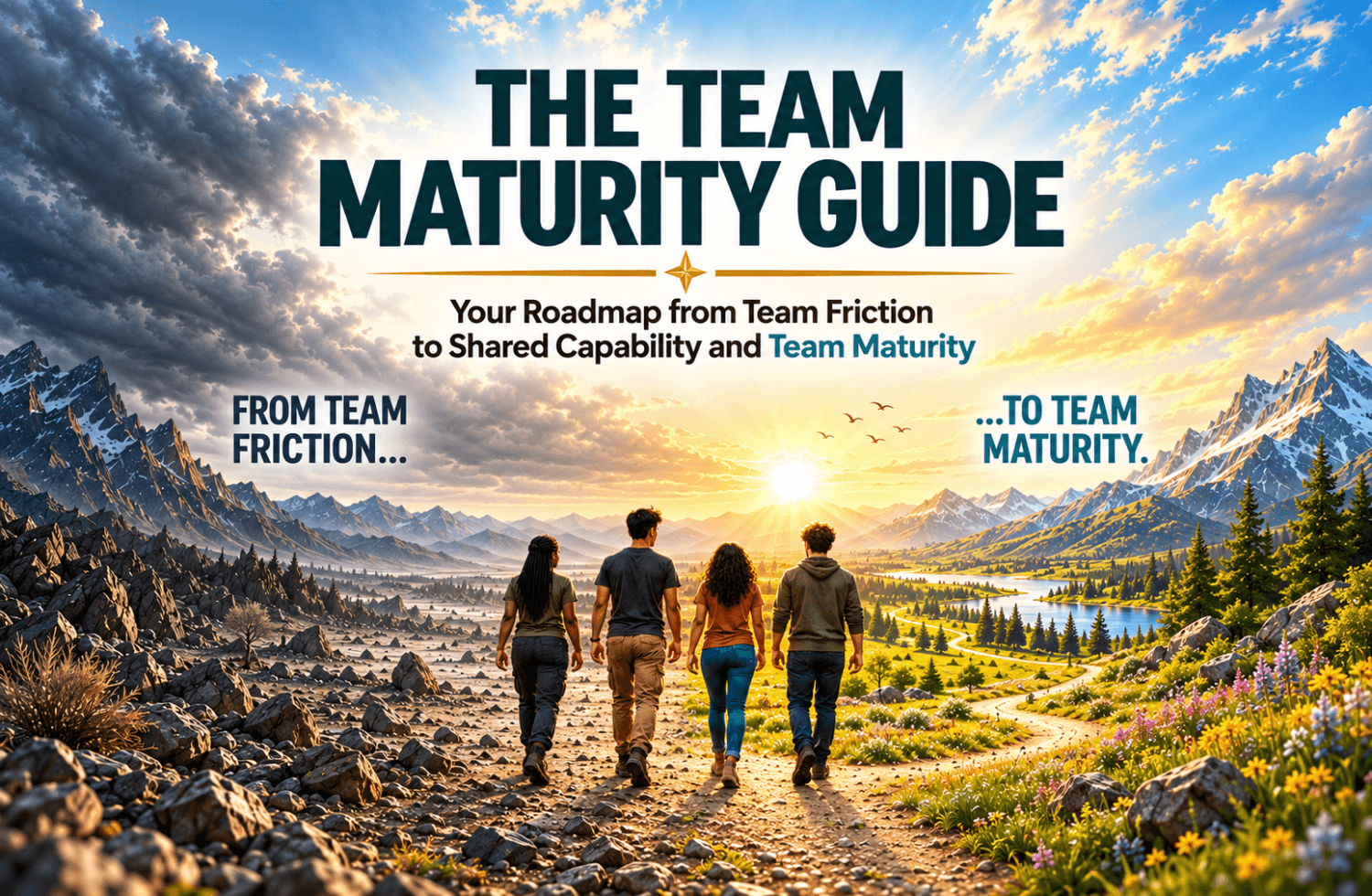
The Team Maturity Guide is a 15-page visual PDF Guide that helps teams see how team maturity develops over time.
It gives you a practical roadmap for moving from repeated team friction toward greater shared capability, clearer agreements, stronger accountability, and better ways of working together.
You can use it to ask:
- Where is our team already strong?
- Where does friction keep repeating?
- What is the team still expecting one person to carry?
- What capability should we strengthen next?
Team Maturity is not about becoming a perfect team. It is about becoming more capable, together.
Who it’s for
This Guide is for:
- Team Leaders who want their teams to handle more together instead of relying on one person to keep everything moving
- Team Members who can see that something in the way the team works needs to change
- Intact Teams that want to become clearer, stronger, and more capable together
- Teams that are functioning reasonably well but know they could work with less friction
- Teams that keep running into the same problems around communication, decisions, expectations, conflict, or accountability
A Team Leader does not have to be the only person who introduces this work. Team Members can recognize the need, share the Guide, and help start the conversation with their teammates.
What problem it solves
- Teams can have talented people and still struggle with how they work together.
- People may be unclear about where the team is going.
- Important concerns may stay hidden.
- Conflict may be avoided or handled poorly.
- Accountability may fall back on one person, instead of spread throughout the team.
- The same mistakes may happen again because the team never captures what it learned.
The Team Maturity Guide helps your team step back and see these issues as capabilities the team can strengthen, rather than isolated problems to keep fixing one at a time.
It gives you a shared way to talk about what is happening now and what the team may need to build next.
What’s inside
1. A visual Team Maturity roadmap
See how the major areas of Team Maturity fit together across three broad stages:
- Foundation
- Decision & Action
- Learning & Adaptability
The roadmap shows how teams build capability over time instead of treating each problem as a separate issue.
2. Shared Direction
Explore the questions that help a team become clear about its mission.
3. Clear Roles & Expectations
See why mature teams need more than job titles.
This section helps teams think about:
- Contribution
- Ownership
- Hand-offs
- Expectations
When roles are clear, people spend less time guessing their way through the work.
4. Psychological Safety, Voice, Communication & Conflict
Learn to recognize the difference between apparent agreement and real, important feedback from everyone on your team.
It also shows how Team Norms can create shared agreements for how the team speaks up, disagrees, raises concerns, and repairs relationships after problems occur. (Yes, you will still have some problems, but by the end of this Guide, you'll find that they're actually surmountable instead of a sticking point.)
5. Buy-In, Decision-Making & Shared Accountability
See why real buy-in is built before and during a decision, not requested after the decision has already been made.
The Guide then shows how commitment can lead to shared accountability, where Team Members hold one another accountable.
6. Learning, Capturing Learning & Adaptability
Learn how mature teams become more capable because of what they experience.
It also helps teams distinguish healthy adaptability from constant reacting, changing for its own sake, or casually throwing out the agreements the team has already made in the Norms Process.
7. A clear picture of what Team Maturity can make possible
See the shift from a team that depends heavily on one person to a team that increasingly learns to:
- Align around shared direction
- Clarify roles and expectations together
- Speak up and make space for voice
- Work through conflict
- Build buy-in
- Make and carry decisions forward
- Hold shared accountability
- Capture learning
- Adapt
- Refresh Team Norms when needed
You will also find links to the original Team Maturity LinkedIn Series, the free Quick-Start Team Norms Cheat Sheet, Team Norms resources, workbooks, and facilitation options if your team is ready to take the next step.
Why it’s worth it
You do not need to diagnose every problem on your team or fix everything at once.
This Guide gives your team a simple way to see the whole picture, identify the area that may need attention now, and begin a more useful conversation about what to strengthen next.
Instead of asking:
“What’s wrong with our team?”
you can begin asking:
“What capability does our team need to build next?”
That is a very different way to approach Team Development - this is the way of Team Maturity, not just Development.
And it gives the whole team, not just the formal Team Leader, a clearer way to help move the team forward.
The Key Idea
Team problems do not mean you have a bad team. They may mean your team has capabilities it still needs to build.
A team can have smart, committed people and still struggle with unclear roles, hidden concerns, weak buy-in, recurring conflict, poor follow-through, or too much dependence on one person.
The Team Maturity Guide helps you see those problems differently.
Instead of asking:
“What is wrong with our team?”
you can begin asking:
“What does our team need to become better at doing together?”
That shift creates hope because team maturity can be developed over time.
A Common Mistake to Avoid
Do not try to fix every team problem as a separate problem.
Communication problems, unclear expectations, weak accountability, poor decisions, conflict avoidance, and lack of follow-through are often connected.
Treating each one as a separate issue can leave the team constantly reacting without ever becoming more capable.
The Guide helps you step back and see the larger pattern.
You do not have to strengthen every part of the team at once.
You only need to identify where the team may be struggling now and decide what capability needs attention next.
The Confident Next Step
Choose one area where your team could work better together and start the conversation.
Ask:
- Where are we already strong?
- Where does friction keep repeating?
- What are we still expecting one person to carry?
- What capability would help us most right now?
Then begin creating clearer shared agreements for how your team wants to work together.
That is where Team Norms can become the practical next step.
By the end of The Team Maturity Guide, you should be able to look at your team and think:
“We may have some work to do, but this is not hopeless.”
You will not leave with every team problem solved.
You will leave with something more important at this stage:
A clearer way to understand what is happening and a path for what to do next.
Your Next Step
If your team is ready to move from understanding into action, start with Team Norms.
Our Team Norms resources can help your team begin turning assumptions into shared agreements about how you communicate, make decisions, handle conflict, solve problems, follow through, and work together.
Choose the level of support that fits your team:
- Start with the Free Quick-Start Team Norms Cheat Sheet
- Lead the process yourself with the Team Norms Workbook for Team Leaders
- Prepare everyone with the Team Leader + Team Member Workbook Bundle
- Bring in outside help with Team Norms Facilitation for Intact Teams
You can access all of our Team Norms Resources on my Creatyl portal.
Your team doesn't have to become perfect.
It just needs to become more capable, together.
And that can begin with the next conversation.