Click Here to Download the PDF.
Most people are exhausted by the way selling works today.
Buyers feel it. Sellers feel it.
Everyone is tired of long explanations, forced pressure, crowded offers, and conversations that feel more like a push than a real discussion.
What people want is simple:
They want clarity.
They want honesty.
They want to feel like the person speaking to them understands what they’re dealing with.
And the truth is much clearer than the sales world likes to admit.
You don’t sell more by pushing harder.
You sell more by seeing the person in front of you.
When you stop trying to convince and start trying to connect, you remove the weight that makes people hesitate.
You make the decision easier because you finally match the way people think, feel, and decide.
This is the heart of the No-Pitch Method.
It’s not about scripts or tactics or clever lines.
It’s about understanding people, timing, fear, clarity, and the small signals that guide their choices.
The more you learn how people buy, the less you need to rely on pressure.
The work becomes lighter.
The conversations become easier.
And the results become stronger — not because you forced anything, but because you made the path simple to walk.
This article walks through everything: understanding the buyer, the core steps, the myths that slow you down, the small cues people give, the practical tools that make buying feel natural, and a real workplace example of these ideas in action.
Everything is expanded with depth, detail, and human clarity so you can actually use it in your work and your team.
Stop Trying to Convince. Start Trying to Connect.
It’s easy to fall into the trap of thinking that buyers need more convincing.
Most sellers talk more when things get quiet.
They repeat the offer.
They add more points.
They try to fill the silence.
But silence is where the real buying decision is happening.
And buyers often slow down not because they don’t see the value, but because they don’t feel understood yet.
Connection is the thing that moves people.
When someone feels understood, they start to open up about the real problem, not the surface-level one.
They talk about the timing they’re scared to admit.
They reveal what they’ve already tried and why it didn’t work.
They share the fear that’s actually slowing them down — the fear they weren’t going to mention if you kept talking.
Convincing tries to control the buyer.
Connection frees them to decide.
The shift is simple but powerful:
Stop racing to explain.
Start listening for truth.
Stop stacking reasons.
Start naming the thing they’ve been trying to say.
Stop selling the whole story.
Start guiding the next simple step.
When your goal becomes clarity instead of control, the entire tone of the conversation changes.
You sound more grounded.
The buyer feels more relaxed.
And decisions feel less like a leap and more like a step they can actually take.
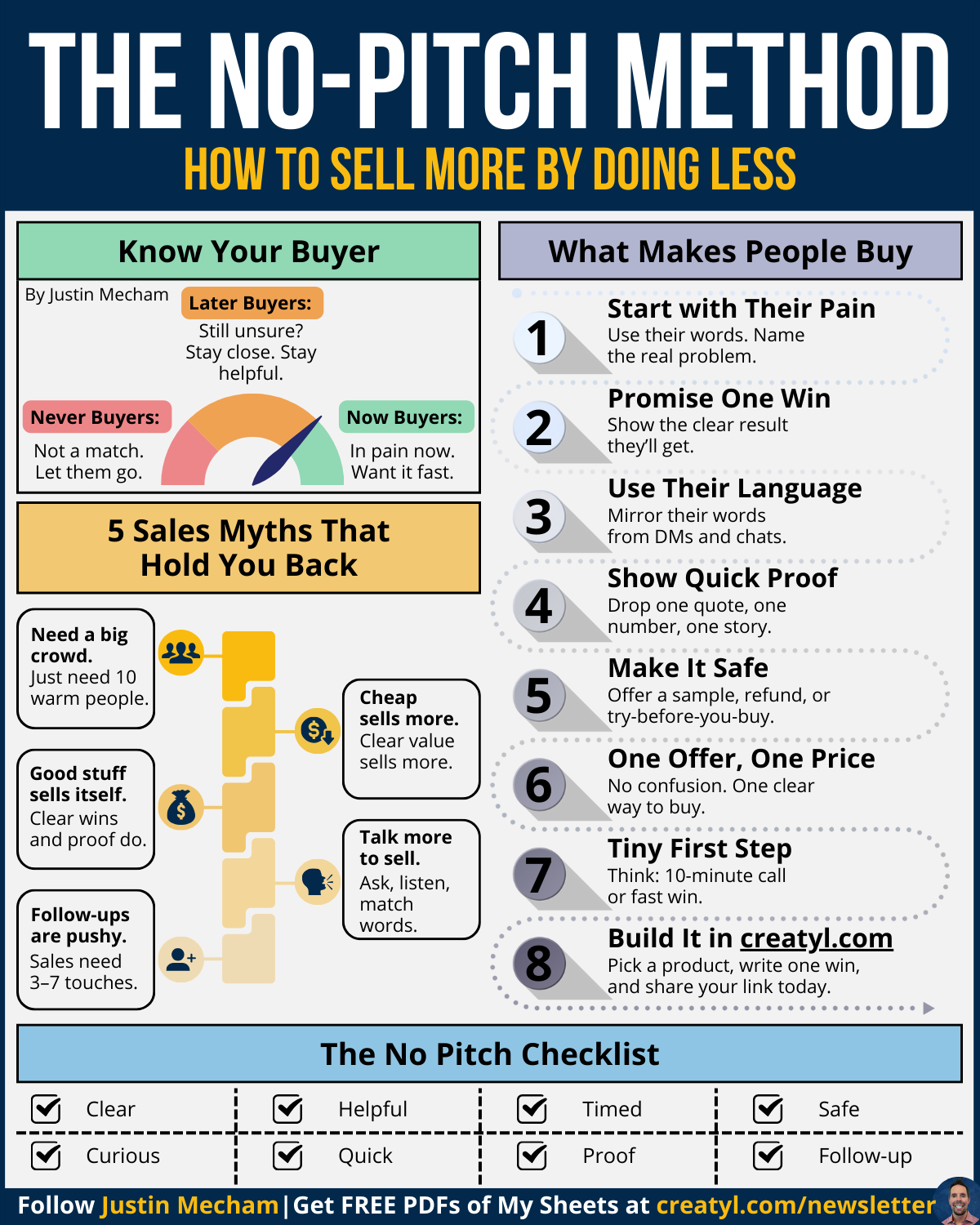
Know Your Buyer: The Three Types Most People Overlook
If you treat every buyer like they’re ready right now, you’ll burn out — because most people aren’t.
And the ones who are ready will lose patience if you take them on a long journey they didn’t need.
The strongest sales processes in the world follow one simple rule:
Match your approach to the buyer’s timing, not your timeline.
Now Buyers
These people are ready.
They feel the pain in real time.
They want to fix it today.
They don’t want long calls or pages of information.
They want the next step and the outcome.
If you slow them down with long stories, you lose them.
They want a quick path that feels clear.
Your approach: direct, simple, and fast.
Later Buyers
They’re interested, but their timing is still forming.
They might not be ready this week, but they’re still watching and deciding.
If you chase them, they step back.
If you disappear, they forget.
They need consistent clarity, not pressure.
Your approach: stay present, stay clear, stay helpful.
Never Buyers
Most people avoid admitting when a lead is not a match.
They keep trying.
They keep nudging.
They keep spending energy on people who will never say yes.
This drains progress.
Recognizing a Never Buyer saves your time and protects your energy.
Your approach: let them go without guilt.
Sorting buyers correctly is one of the highest forms of respect — both for them and for your time.
What Makes People Buy
Buyers decide based on clarity, safety, familiarity, and one simple question:
“Do I believe this will work for me?”
Here’s what actually drives decisions:
1. Start with their pain
Name the real problem, in their words.
When someone hears their own struggle reflected back, they feel understood.
That moment builds trust faster than any pitch.
2. Promise one win
Buyers move toward the first clear outcome, not the whole list of results.
One win creates motion.
3. Use their language
People trust what feels familiar.
When you use wording pulled from their own messages, calls, or posts, they feel seen without forcing anything.
4. Show quick proof
People want to know the win is real.
A short quote, a screenshot, or one number communicates more than a long case study.
5. Make it safe
Buyers say yes when the risk feels low.
Safety is more powerful than urgency.
6. One offer, one price
Choice creates confusion.
One clear path removes it.
7. Tiny first step
Big decisions feel heavy.
A tiny step feels possible.
8. Build it
Use simple tools that make it easy to create and deliver the result people expect.
When you combine these eight steps, you stop sounding like someone trying to close a sale and start sounding like someone helping the buyer make a decision that feels right for them.
The Signals Buyers Give (And Most Sellers Miss)
Buyers reveal a lot without saying it directly.
Your job is to notice.
Here are cues that change the entire tone of a conversation:
- When they talk fast or ask direct questions → they want quick steps.
- When they ask for examples → they need safety, not explanations.
- When they tell long stories → they need to feel heard before they move.
- When they ask for pricing early → they want to understand the path.
- When they ask, “What would you do?” → they want honest guidance.
Most sellers rush.
They jump ahead. They oversimplify. They assume.
But when you listen for these signals, the buyer tells you everything you need to know about how to guide the conversation from that point forward.
The 10-Minute Buyer Scan: A Practical Way to Read a Buyer Correctly
To make buyer clarity simple, use this quick scan:
- “What’s the real problem you want solved right now?”
- “How long has this been slowing you down?”
- “What have you already tried?”
- “What happens if nothing changes in the next 60 days?”
These four questions reveal:
- urgency
- fear
- frustration
- timeline
- motivation
- expectations
With this information, you know exactly how to help.
You’re not guessing anymore.
The One-Win Rule: The Simplest Way to Create Motion
Most sellers overwhelm people with too many promises.
Buyers don’t want the entire journey.
They want the first win — the one result that proves the rest is possible.
So ask yourself:
“What is one win a buyer can get within the first 48 hours?”
That win becomes:
- your hook
- your core message
- your clarity
- your conversion engine
A single outcome builds more movement than a long list of features ever will.
Using the Buyer’s Language: How to Make People Feel Seen in Seconds
Every time a buyer sends a message, they give you a piece of clarity.
Their words reveal the way they think about the problem.
Most sellers ignore this.
Skilled sellers create a Voice List — a running note filled with exact buyer phrases.
Take words from:
- DMs
- emails
- calls
- chat replies
- feedback
- survey responses
Then mirror these words in your messaging.
Not by copying — but by aligning your language with the way buyers speak about their own struggle.
The result is instant connection.
People trust what feels familiar.
The Safety Switch: How to Remove Fear from the Decision
Every buying decision comes down to one question:
“Do I feel safe saying yes?”
Use these four switches to lower fear:
- Show a small win they can get fast.
- Give the exact first step with no confusion.
- Share one example from someone like them.
- Remove one fear by explaining what happens if something doesn’t go as planned.
When people feel safe, they move.
When they don’t, they wait — even if they love what you offer.
The Tiny Step Method: Why Small Steps Lead to Big Decisions
A big step is heavy.
A tiny step is easy.
Replace heavy starts with light ones:
- a 10-minute call
- a sample page
- a short preview
- a three-question form
- a micro task that shows value quickly
When the beginning feels simple, people continue.
When the beginning feels heavy, they stall.
The Five Myths That Slow Your Sales Down
Here are the beliefs that make selling harder than it needs to be — and the truths that replace them.
Myth 1: “You need a crowd.”
Truth: You need clear value, not more numbers.
Myth 2: “Cheap sells more.”
Truth: Clear value sells. Confusion doesn’t.
Myth 3: “Good stuff sells itself.”
Truth: People need to see proof before they trust.
Myth 4: “Talking more is pushy.”
Truth: Talking without listening is pushy. Talking with curiosity builds real connection.
Myth 5: “Follow-ups don’t matter.”
Truth: People are busy. A thoughtful follow-up helps them finish the decision they already started.
These shifts change how you work, how you communicate, and how people respond.
Real Workplace Example
A company reached out because their sales were slipping despite having a strong offer.
Their team felt scattered.
Every call felt harder than the last.
Conversations dragged.
Buyers seemed interested yet rarely committed.
The team believed the answer was more effort — longer calls, more details, more follow-ups — but none of it changed the results.
Instead, it created pressure on both sides.
They were spending time trying to persuade people who weren’t ready and slowing down those who actually were.
Their message was packed with information buyers didn’t ask for.
Their introduction was long and unclear.
Their proof lived deep inside folders no one ever saw.
And because they treated every lead as if they were a Now Buyer, the entire process felt heavier than it needed to be.
As the weeks passed, frustration grew.
Team members felt nervous before calls.
Meetings became filled with questions about what was going wrong.
Everyone felt the weight of trying harder without getting better results.
The team started believing something was wrong with their offer, their skill, or the market.
But none of those things were the real issue.
The real problem was misalignment.
They were trying to force certainty instead of creating clarity.
They weren’t reading timing, language, or pain correctly.
They weren’t sorting buyers at all.
They were carrying the work the buyer should have been doing — and that is why everything felt heavy.
I introduced the No-Pitch Method and rebuilt their process one step at a time.
First, we sorted every lead into Now, Later, or Never.
This single change unlocked hours of lost time.
The team no longer chased buyers who were never going to decide.
They stopped forcing follow-ups that only created stress.
Instead, they gave their attention to buyers who were already leaning in.
Next, we rewrote their entire offer using the One-Win Rule.
Instead of presenting a long list of outcomes, we identified one result buyers could achieve within the first 48 hours.
That outcome became the center of the conversation, the headline of the page, and the theme of their calls.
Buyers understood the value quickly, which removed confusion and hesitation.
We then built a Voice List using real buyer words pulled from months of messages.
When the team began speaking the way buyers spoke, everything shifted.
Buyers finally heard their own thoughts reflected back to them.
Instead of pushing, the team started guiding with clarity.
We added fast proof in the form of short quotes and simple screenshots.
Nothing heavy.
Nothing complicated.
Just real results shown clearly.
We removed the heavy 45-minute introduction call and replaced it with a 10-minute starter call built only around three questions and one tiny first step.
Buyers said yes more often because the first step felt light.
We simplified their offer into one clear path at one price.
Buyers no longer had to choose between options.
They only had to decide whether the result was right for them.
Finally, we rebuilt their follow-up system to match buyer timing rather than pressure.
If a buyer said maybe, the team sent one small win and one short question.
Nothing else.
Three weeks later, their close rate rose higher than they had seen all year.
Buyers felt safe.
The team felt clear.
Conversations were shorter, smoother, and more direct.
The energy inside the company changed because they no longer carried the weight of trying to force outcomes.
They simply guided buyers toward decisions that felt correct for them.
The method didn’t just fix their sales. It fixed the way they saw their buyers.
And once that changed, everything else opened up.
The Choice That Changes Everything
Selling becomes lighter the moment you understand that people don’t need pressure to move.
They need clarity.
They move when they believe the person in front of them understands their struggle, respects their timing, and offers a step that feels possible.
When you shift from force to fit, everything becomes more steady.
You speak differently. You listen differently.
People respond differently.
There is something powerful about slowing down enough to see what the buyer is really asking for.
Most people don’t want a long pitch.
They want someone who can help them see their next step clearly.
They want someone who takes their situation seriously without making it feel heavy.
They want direction that respects where they are and where they want to go.
The No-Pitch Method works because it removes everything that complicates the decision.
It gives the buyer room to think. It gives the seller room to listen.
And in that space, trust grows in a way pressure could never create.
When you start working this way, you notice how much easier it is to speak with honesty.
You stop trying to fill every silence.
You stop fighting objections that were never the real issue.
You stop measuring success by how hard you pushed and start measuring it by how clearly you guided.
The most meaningful sales don’t feel forced.
They feel natural.
They feel steady.
They feel like the right fit for both sides.
Selling stops being something you try to win and becomes something you build with the buyer — one clear step at a time.
Download the Infographic
If you want a clear, simple way to review the No-Pitch Method at any time, you can download the full infographic as a PDF.
It includes every step, detail, and idea from this article in one place.