

Click Here to Download the PDF
There is a pattern you see over and over again when people talk about starting something new.
They are full of ideas, they have clear skills, and they can see the gap in the market.
But when it comes to actually putting something into the world, they stall.
They say things like:
- “I need to take one more course first.”
- “I should fix my website before I do that.”
- “I’ll start when I have more time.”
- “Let me get a little more experience and then I’ll be ready.”
On the surface, this sounds responsible.
It sounds thoughtful, even professional.
But underneath it is something else: a belief that readiness is a feeling that arrives before action.
And because that feeling never fully arrives, nothing real gets built.
What actually separates the people who move from the people who stay stuck is not talent or resources.
It is a different order of operations.
The ones who move do not wait for readiness.
They use what they already know, right now, to solve one clear problem, and they allow reality to teach them what to fix next.
Why Waiting Feels Wise, But Quietly Slows Your Life Down
Waiting can be comforting.
You get to feel like you are preparing.
You can say you are “researching” or “planning” or “getting ducks in a row.”
The problem is that none of those things give you the information you actually need.
You do not find out if people understand your idea.
You do not find out if the promise is clear.
You do not find out if anyone would pay for the result you offer.
You are building a picture in your head with no contact with reality.
Over time, this has a few side effects:
- Your idea becomes heavier and more complex.
- Your standards rise in your mind, but you have no proof to match them.
- Your confidence drops because you have no real wins to stand on.
- You start to question the idea itself, not just the plan.
The worst part is that your brain starts to link “starting something new” with “stress and delay,” instead of with learning and movement.
That makes every next idea feel harder.
The whole point of the Creator Roadmap is to flip that script.
Instead of waiting for a perfect moment, you use a simple system that helps you:
- move quickly,
- test safely,
- and learn from real people as early as possible.
The Real Message Behind The Creator Roadmap
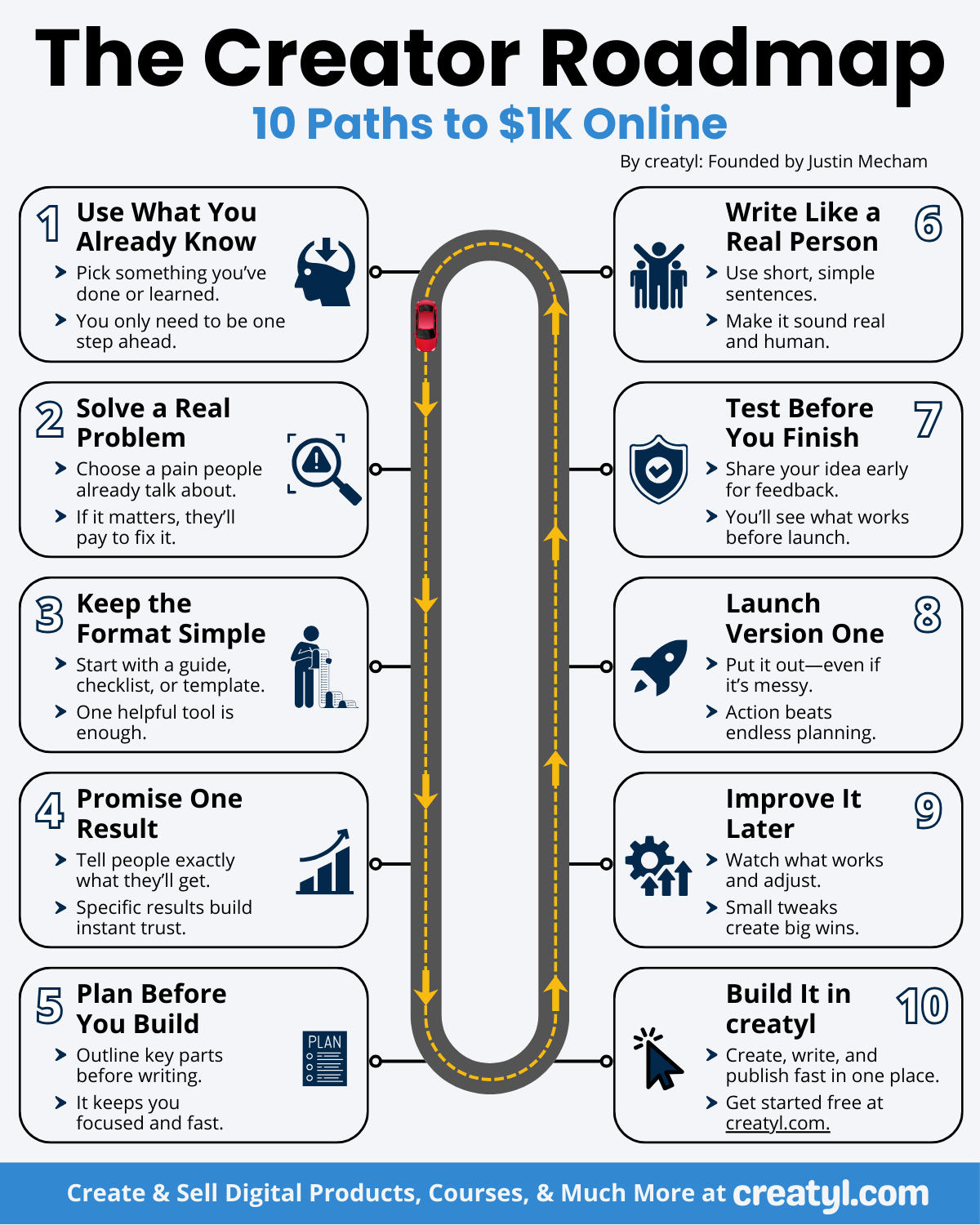
On the surface, the roadmap looks like a list of ten steps to earn your first $1K online.
Underneath those steps is one guiding principle:
Clarity comes from contact with reality, not from more thinking.
Every part of the roadmap is designed to reduce friction between your idea and the people it could help.
- “Use what you already know” removes the delay of chasing new skills.
- “Solve a real problem” keeps you grounded in what people actually care about.
- “Keep the format simple” keeps the first version something you can finish.
- “Promise one result” makes it easy for others to say yes or no.
- “Plan before you build” stops you from adding work that does not matter.
- “Write like a real person” keeps your message from sounding like a vague brochure.
- “Test before you finish” gets you real reactions before you sink weeks into the wrong thing.
- “Launch version one” gives you something you can observe, not just imagine.
- “Improve it later” allows you to refine based on real use, not guesswork.
When you follow this line of thinking, readiness stops being a feeling you chase.
It becomes a result of small proof collected over time.
The Clarity Sprint: Turning One Skill Into Something Real
Think of this as a short sprint rather than a giant project.
The goal is not to build a huge business in one shot.
The goal is to move one specific skill into the real world in a simple, useful way.
1. Start With What Is Already In Your Hands
Instead of asking, “What could I learn next?”, ask a different question:
- “What do people already ask me to help with?”
- “What do I do faster than most people at work?”
- “What have I done so many times that I could explain it in my sleep?”
Maybe you reorganize messy processes.
Maybe you write clear emails.
Maybe you can break down complex topics for new people on your team.
Maybe you have a knack for planning the first 30 days in a new role.
These are not abstract strengths.
They are skills that already produce results for someone.
You do not need a new course to use them.
You need a container.
2. Choose One Real Problem That Skill Already Solves
A skill becomes valuable when it removes a real pain.
Look for problems that:
- show up often,
- cause stress or confusion,
- and have already led people to try other fixes.
For example:
- New hires who feel lost in their first month.
- Managers who spend hours replying to the same questions.
- Freelancers who cannot explain what they do in one sentence.
- Teams who keep missing deadlines because steps are unclear.
You are not chasing a clever idea here.
You are looking for a pain that is already costing people time, money, or calm.
3. Pick The Smallest Format That Can Deliver A Clear Result
Most people imagine a full course, a complex community, or a big set of videos.
That is one reason they never start.
The first version does not need to be big.
It just needs to be complete for one outcome.
That might be:
- a guide that walks someone from step one to step seven,
- a checklist that shows what to do and in what order,
- a template they can fill in,
- or a small tool that keeps them on track.
The smaller the format, the easier it is to ship and refine.
4. Promise One Result In Plain Words
Ask yourself: “If someone used this fully, what would be different in their life or work?”
Then say that in one simple sentence.
For example:
- “Help a new hire feel clear and useful in their first 10 days.”
- “Help a manager answer repeat questions in two minutes instead of twenty.”
- “Help a freelancer explain what they do in one simple line.”
If you cannot state the result clearly, the product is not ready.
If someone else cannot repeat that result back to you, the message is not clear enough yet.
5. Outline Before You Build Anything
Before you open a design tool, a camera, or a slide deck, write the outline.
List the key points.
Decide what the person needs to know first, second, and third.
Leave out anything that does not push them toward that one result.
This step will feel simple, but it will save you days later.
6. Write Like You Are Talking To One Person
The more you try to sound official, the less clear you usually become.
Use short sentences.
Use normal words.
Write as if you are sending a voice note to a friend who asked for help.
People do not need perfect language.
They need a path they can follow without getting lost.
7. Test Before You Finish
Share a draft with one or two people who would actually use it.
Ask:
- “What part was confusing?”
- “Where did you stop reading?”
- “What do you still not know how to do after reading this?”
Listen more than you talk.
Do not defend the work.
Let their confusion show you where to make it simpler.
8. Ship Version One
At some point, you have to stop adjusting and let it live.
Version one is not your statement to the world about your worth.
It is a test.
It is the first time you get to watch what happens when your idea meets reality.
Once it is out there, you get better information than any brainstorm could ever give you.
9. Improve Based On What People Actually Do
Do they open it?
Do they finish it?
Do they reply with questions?
Do they ask for more?
Improve the parts that real people touch.
Remove the parts they ignore.
That is how you move from guessing to knowing.
The Team That Kept Rebuilding Content Nobody Used
In a large company, there was a small team whose job was to create “enablement content” for other departments.
They were smart, organized, and hungry to prove their value.
Every time a new product feature or internal process rolled out, someone would say, “We need a deck for this.”
So the team would get to work.
They gathered notes.
They sat in long meetings.
They wrote detailed explanations and layered in data charts to “show value.”
The slides looked sharp.
The colors matched the brand.
The content ticked every box in the template.
And then, the same thing kept happening.
The deck would get sent out once.
There would be polite thank-yous.
And then nothing.
A week later, people were back in Slack asking the same questions the deck was supposed to solve:
- “Where do I find the latest version of this process?”
- “Who approves this step?”
- “What do I tell a customer if they ask about X?”
The enablement team felt invisible.
Leaders kept asking for more content, and the team kept delivering, but the actual behavior in the company was not changing.
Inside the team, frustration was building.
They started to take the lack of usage personally.
They wondered if they just needed “better design” or “more detail.”
So every new deck got longer.
With every new project, the cycle got worse.
Stakeholders would ask for a big, polished “training resource.”
The team, wanting to show their worth, would over-deliver.
They would spend late nights finessing wording.
They would argue over chart layouts.
They would push their other work aside in order to create what they believed would finally be “the one” that everyone would use.
But adoption barely moved.
It created tension between teams.
Sales and operations rolled their eyes when a new deck arrived.
The enablement group felt blamed for confusion that, from their view, they had worked hard to solve.
Morale dipped.
The work felt like shouting into a void.
Everything changed on a random Tuesday.
One team member, tired of the cycle, did something different.
Instead of starting a new deck, they opened Slack and searched for the most common questions related to one specific process.
They saw the same questions repeating:
- “What is the first step when a client asks for this?”
- “Which form do I use in this situation?”
- “Who signs off if it’s above a certain amount?”
They printed those chats out and took them into a small meeting with the rest of their team.
They asked a new question:
“What if we stop trying to teach everything and only answer these exact questions as simply as possible?”
The team agreed to run an experiment.
They chose one narrow process and decided not to build a deck at all.
Instead, they wrote a one-page checklist called:
“Do This Next When A Client Asks For [X].”
The checklist had:
- A short intro in plain language.
- A step-by-step list with clear actions.
- Links to the exact forms people needed.
- A note at the bottom: “If you get stuck anywhere, tell us where in this list.”
They finished the draft in less than a day.
Instead of waiting for sign-off from every manager, they shared the checklist quietly with a small group of frontline staff who dealt with the process daily.
They posted a simple message:
“We pulled the most common questions about [X] and turned them into one page. Try this for a week and tell us what’s missing.”
At first, only a few people reacted.
But those few people started to actually use the checklist.
Something different happened:
Questions in Slack started to include screenshots of the checklist.
People answered each other by pointing to step numbers.
The team began to receive real feedback:
- “Step three is confusing. I didn’t know where to click.”
- “I think there should be a note about exceptions here.”
- “Can we add a link to this form directly in step five?”
This feedback was gold.
For the first time, the team was not guessing what to fix.
The users were telling them.
They updated the checklist, clarified language, added missing links, and re-shared it.
Within a month, the volume of repeat questions about that process dropped sharply.
Leaders noticed.
When a new request came in for a “big deck,” the team suggested a different path:
- Start with the top ten questions people ask.
- Turn those into a one-page checklist or short guide.
- Test it with a small group.
- Improve based on real use.
- Only then, if needed, create richer content.
The perception of the enablement team shifted.
They were no longer “the deck people.”
They became the group that made work easier.
Their work finally felt connected to real outcomes.
To keep this from becoming a book, the remaining examples stay shorter, but still have more narrative weight than quick bullets.
A team in operations kept presenting improvement proposals.
Every time, the document was long, the language was formal, and the reaction from leadership was the same:
“This is interesting; let’s revisit later.”
They were solving real issues—bottlenecks, confusing handoffs, messy approval chains—but the way they packaged the solution made it hard to see the win.
They decided to try a different method.
For their next idea, they wrote one single line that answered one question:
“What changes for the company if we do this?”
That became their anchor.
They built the entire proposal around that one outcome, using short sections and clear headings.
They showed before-and-after timelines, not just theory.
Before sending the deck, they walked a friendly director through the one-line promise and asked only:
“What makes this hard to say yes to?”
The director pointed out two small fears: a vague timeline and unclear ownership.
They fixed both before the formal meeting.
The proposal finally landed.
Not because it was more complex, but because the value was obvious and the risk felt contained.
Example 4: The Dashboard Nobody Trusted
A data team released a large dashboard meant to “give everyone visibility.”
Instead, it gave everyone a headache.
Numbers did not match what people saw in their own reports.
Filters were confusing.
Different teams interpreted the same chart in different ways.
The team stepped back and asked: “What is the single decision this dashboard is supposed to support?”
Once they answered that, they stripped the tool down to one main view with one key metric and a clear description of what to do when that number moved.
They sent a short weekly report with that view embedded and invited comments.
When people started using that report to make choices, the team slowly added more detail—but only when someone asked for it.
The new system did not look as impressive, but trust went up.
People actually used the data instead of arguing about it.
Example 5: The Team Waiting For More Data
A customer support unit watched their ticket volume rise.
They felt the pressure from leadership but also felt blocked by uncertainty.
They kept saying, “We need more data before we change anything.”
At one point, a new manager suggested something simple: “Let’s watch ten tickets live.”
For a few days, team members sat beside agents and watched how calls and chats unfolded.
They timed pauses, noted where people hesitated, and marked the questions that were hardest to answer.
A clear pattern formed.
A single product feature was responsible for a large portion of confusion.
Agents were using different phrases to describe it and often gave partial information.
Instead of designing a full training program, they wrote a short script and a small reference card just for that feature.
They tested it with a handful of agents and listened to how customers responded.
Call times shortened.
Escalations dropped.
The team finally saw that action could start before perfect data, as long as the focus was narrow and the feedback loop was tight.
Example 6: The Offer That Kept Getting Bigger
A consulting firm wanted to launch a new package for mid-level managers.
Brainstorm sessions were energetic.
Ideas piled up: coaching calls, group sessions, video modules, toolkits, live Q&A, custom reports.
The offer got bigger and bigger.
So did the timeline.
They still had no proof that anyone wanted the package in that form.
One consultant suggested a reset.
They wrote one promise line: “Help managers run their next 90 days with clear priorities and less stress.”
Then they created a simple landing page with that line, a few lines of explanation, and one button: “Request early access.”
They shared the page with a small list and watched.
Some people requested access.
Many wrote in with comments about what they would find useful.
No one mentioned video modules, but several asked for templates and examples.
When they finally built the first version of the offer, it was far lighter: a short planning guide, a few ready-to-use templates, and a live call to walk through them.
The first round sold out.
Not because it was flashy, but because it was focused on a clear result that people understood.
Tools And Resources That Support This Way Of Working
You do not need a huge tech stack to put these ideas into practice.
But a few resources can speed things up.
- Book – The Mom Test by Rob Fitzpatrick
- This book shows you how to talk to people about your ideas in a way that gives you honest information, instead of polite lies. It is especially useful when you are trying to figure out if your problem and result are clear enough.
- TED Talk – “How To Start A Movement” by Derek Sivers
- This short talk is a reminder that change starts when one person is willing to act in public, even when it feels early or imperfect. It is a helpful mindset shift if you worry about launching version one.
- AI Tool – ChatGPT by OpenAI
- Great for turning messy thoughts into outlines, rewriting complex text into simple language, and exploring different ways to explain your result. It will not decide for you, but it will help you work faster.
- Tool – Carrd by AJ
- A simple way to build one-page sites quickly. Perfect for testing a promise with a small group before you invest in a full site or platform.
Redefining What It Means To Be Ready
Readiness Is Not A Gift. It Is Something You Build.
Most people are waiting for a version of themselves that feels different: more confident, more capable, less afraid.
They imagine that once they reach that version, starting will feel natural.
But that version of you does not arrive on its own.
It comes from a series of small, honest experiments with the world around you.
You decide to use what you know, even if it feels basic.
You choose one real problem instead of chasing ten.
You give yourself permission to ship something that looks small on the outside, but carries real intent on the inside.
You listen.
You adjust.
You do it again.
Over time, something quiet and powerful happens.
Starting new things stops feeling like jumping off a cliff.
It starts feeling like a process you understand.
You know how to turn a skill into a result.
You know how to test an idea without putting your identity on the line.
You know how to read the signals that real people send back to you.
That is readiness.
Not a burst of courage.
Not a moment of magic.
Just evidence collected through action.
And once you have that, your first $1K is no longer the point.
It is simply proof that your skills, your choices, and your willingness to move are enough to create something real.
Download The Creator Roadmap Infographic (PDF)
If you want a clear, visual reminder of everything you just read, the Creator Roadmap infographic is available as a PDF you can save, print, or keep open while you work.
It walks through each step in a simple way, from using what you already know to launching version one and improving it over time.
You can refer back to it when you feel stuck, when an idea starts to feel heavy, or when you are tempted to wait for a perfect moment that never shows up.
Keep it close as a quiet reminder that you do not have to wait to feel ready.
You can start with what is already in your hands and let the next step appear as you move.