

Click Here to Download the PDF

Most people who feel behind are not lazy.
They are not unmotivated.
And they are not missing discipline.
They are carrying too much at the same time.
Too many ideas that feel unfinished.
Too many tabs open in their head.
Too many things they should be working on, with no clear signal for what actually matters next.
That feeling of being stuck doesn’t usually show up as panic.
It shows up as hesitation.
- As task-switching.
- As rewriting the same thing over and over.
- As doing “busy” work while avoiding the one thing that would move things forward.
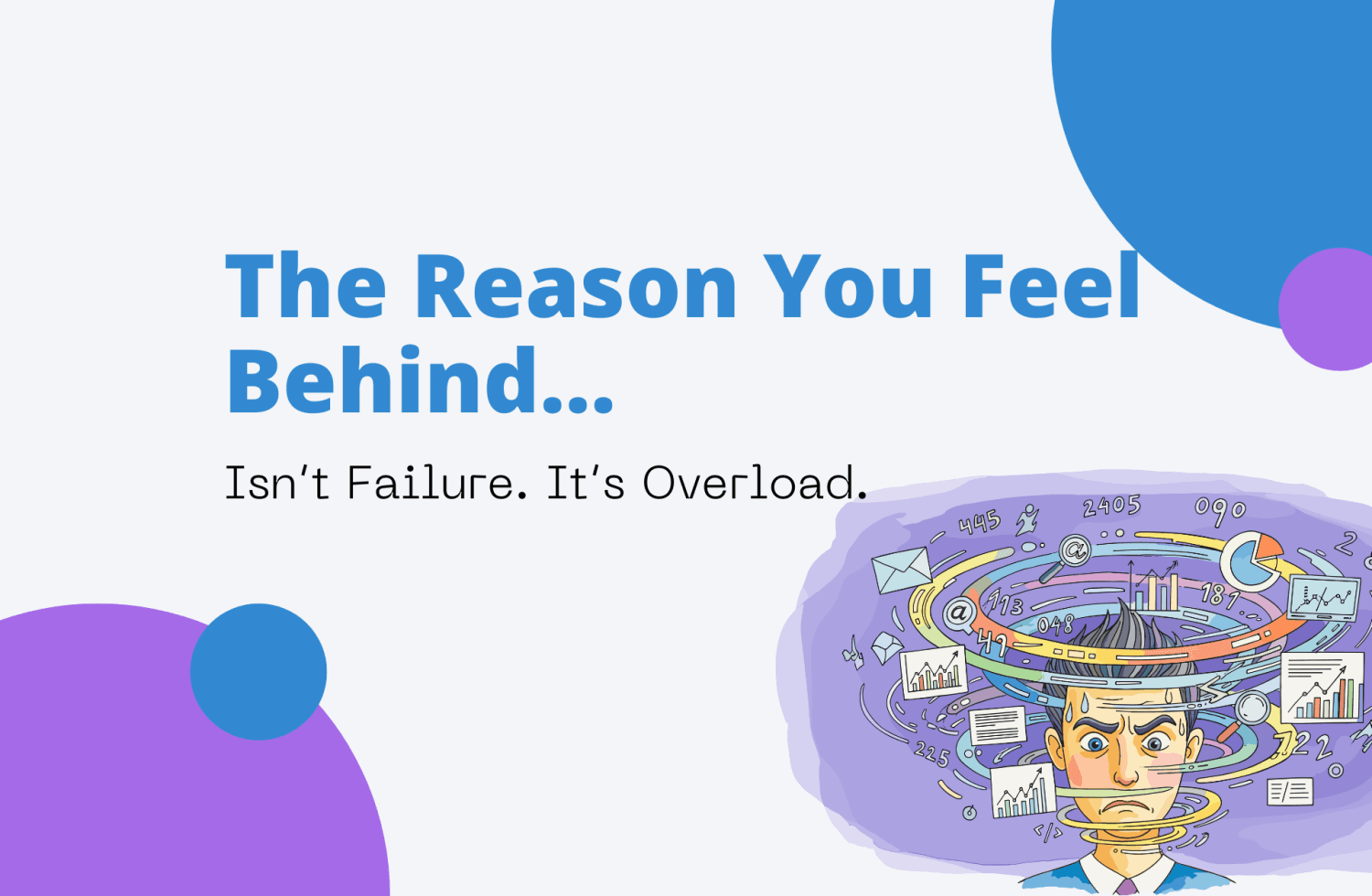
When people say, “I feel behind,” what they’re really saying is this:
“My mind feels crowded, and I don’t know where to put my attention without dropping something important.”
That’s not failure.
That’s overload.
And overload is a signal that something needs to shift.
Why Overload Quietly Breaks Momentum
Overload doesn’t just slow you down.
It changes how your brain works.
When you have too many unfinished things competing for attention, your mind keeps pulling you back to them, even when you’re trying to focus.
That mental pulling creates constant background tension.
You’re never fully present, because part of your attention is always somewhere else.
At the same time, overload forces you to make too many small decisions.
- What should I work on right now?
- Is this the right version?
- Should I finish this or start that?
- Am I wasting time?
Those decisions don’t feel dramatic, but they add up.
Eventually, your ability to choose drops.
And when choosing feels heavy, people default to what feels safest or easiest in the moment.
That’s how capable people end up stalled.
Not because they don’t care.
But because clarity disappeared under the weight of too much.
Momentum doesn’t return when you push harder.
It returns when your mind finally gets quieter.
The MIND Map: A Clear Way To See What’s Really Going On
The MIND Map exists to do one thing well:
turn a vague feeling of “I’m stuck” into something you can actually work with.
It breaks overload into four practical areas:
M — Motivators
What gives you energy that feels real, not forced.
I — Interference
What quietly drains you and keeps stealing focus.
N — Next Steps
Small, specific actions that restart motion.
D — Do This Now
One clear promise, acted on simply.
This isn’t a productivity trick.
It’s a way to stop asking your brain to hold everything at once.
M — Motivators: Stop Guessing What Drives You
Most people talk about motivation as if it’s something you’re supposed to summon.
In reality, motivation comes from evidence.
When I work with teams or individuals who feel stalled, I don’t start by asking about goals.
Goals are often too far away to create energy.
Instead, I ask about moments.
Moments when the work felt worth it.
Moments when effort didn’t feel heavy.
Moments when they finished something and felt quietly proud.
The answers are rarely flashy.
It’s often a message that says, “This helped.”
Finishing something cleanly.
Teaching something clearly.
Helping someone solve a real problem.
Working in a calm, focused way instead of rushing.
These moments matter because they remind you why the work exists in the first place.
A Real Example
One team I worked with kept starting new projects, then abandoning them halfway through.
They assumed the problem was boredom.
When we slowed down and looked back, a pattern emerged.
Every time they received direct feedback from a client saying something worked, their energy lifted.
- They worked faster.
- They argued less.
- They stayed focused longer.
So we stopped chasing new ideas and chose one simple motivator for the week:
create one small result that would lead to one real client response.
That shift didn’t add pressure.
It gave the work meaning again.
I — Interference: Name What’s Draining You
Interference rarely looks dramatic.
It looks familiar.
Too many open projects.
No clear finish lines.
Constant comparison.
Overthinking every detail.
Trying to do everything without support.
Saying yes when you’re already stretched.
These things don’t shout.
They whisper.
And because they’re familiar, people forget how much energy they take.
The Open Loop Reset
With that same team, I ran a simple reset.
They wrote down every unfinished task, idea, and obligation as short phrases.
No planning.
No organizing.
Just naming what was already pulling at their attention.
Then we tagged each one:
- Kill — Not worth attention anymore.
- Park — Assign a date and stop thinking about it.
- Play — The one thing that gets focus this week.
Out of fourteen items:
- Ten were parked with dates.
- Two were removed completely.
- One became the only active priority.
Within an hour, the team felt lighter.
Not because the work disappeared, but because their mind stopped trying to carry everything at once.
N — Next Steps: Make Starting Easier Than Avoiding
Most plans fail because they rely on motivation in the moment.
- “I’ll work on it later.”
- “I’ll start when I feel ready.”
- “I’ll get back to this tomorrow.”
Those statements feel reasonable, but they leave too much room for hesitation.
Instead of vague plans, we use clear rules.
If–Then Planning
With the team, we wrote simple if–then statements:
- If it’s 9:00, then we open the document and write for ten minutes.
- If editing starts too early, then we return to drafting.
- If someone feels stuck, then they write the rough version first.
These rules removed negotiation.
No debating.
No mood-checking.
Just starting.
Small steps done consistently rebuild trust with yourself.
And trust is what makes momentum sustainable.
D — Do This Now: One Promise Is Enough
Overloaded teams often try to solve everything at once.
They build full systems when a simple step would work.
They aim for polished launches instead of useful results.
I stopped the team mid-discussion and asked one question:
What single change are you helping one person make right now?
We wrote one clear promise.
Not a broad solution.
One specific outcome.
Then we built the smallest version that could deliver it.
A short checklist.
A simple page.
One share.
Nothing extra.
Shipping something small changed how the team saw themselves.
They were no longer “stuck.”
They were in motion again.
What Changed In Practice
Before this reset:
- Workdays felt full but unproductive.
- Projects kept stalling.
- Confidence was slipping.
- Conversations went in circles.
After one focused week:
- One project was finished.
- Decisions were easier.
- Work felt calmer.
- Energy returned without urgency.
The difference wasn’t effort.
It was clarity.
Tools That Support This Way Of Working
Some tools help reduce load instead of adding to it:
Getting Things Done by David Allen
A clear system for getting tasks out of your head and into a trusted place.
Inside the Mind of a Master Procrastinator by Tim Urban
A human explanation of delay that removes shame from the conversation.
Reclaim.ai
An AI-powered calendar tool that protects focus time and reduces scheduling friction.
Todoist
A simple task manager that stays usable when things pile up.
Tools don’t create momentum.
They support it once clarity exists.
Momentum Is A Quiet Return To Trust
Momentum rarely shows up as a sudden surge.
It usually returns quietly.
It returns when your mind feels less crowded.
When you’re no longer carrying every unfinished thing at once.
When one clear step replaces ten competing options.
You don’t feel behind because you lack ability.
You feel behind because your load is too heavy.
When you name what gives you energy, motivation stops feeling confusing.
When you remove one drain, you reclaim more focus than you expect.
When you choose one next step, your day stops resetting every hour.
When you do one thing now, you rebuild trust with yourself.
And that trust matters.
You don’t need to change who you are.
You don’t need to work longer.
You don’t need a perfect plan.
You need fewer open loops.
One clear promise.
And a start small enough to happen even on a hard day.
That’s how momentum comes back.
Not all at once.
But for real.
Download The MIND Map Infographic (PDF)
Some ideas are easier to work with when you can see them clearly.
The MIND Map is designed to fit on one page so you can step back, spot where things feel heavy, and decide what needs attention without adding pressure.
Many readers keep it open while they work or return to it when their day starts to feel scattered.
The PDF version makes it easy to revisit the framework whenever overload starts creeping back in.