

Click Here to Download the PDF
Most people don’t struggle because they lack ideas.
They struggle because they try to do everything at once.
They build systems before they have proof.
They polish before they finish.
They scale before they sell.
And when progress slows, they assume the problem is effort, confidence, or time.
In reality, the issue is usually order.
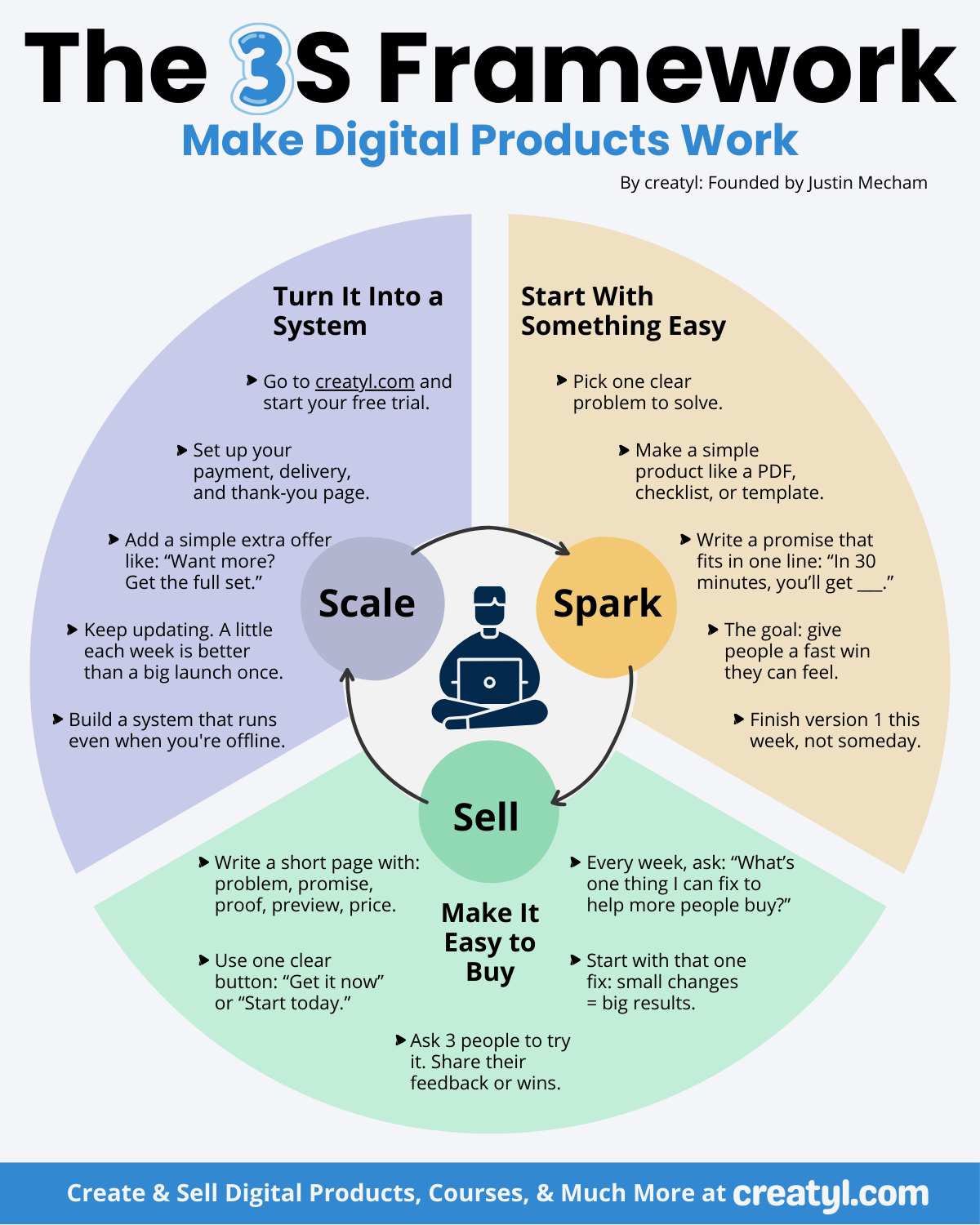
The 3S Framework exists to protect momentum by keeping work simple and sequential:
Spark → Sell → Scale
Not because simple sounds nice.
But because simple is what actually gets finished.
Why Order Matters More Than Talent
Digital products fail quietly all the time.
Not because they’re bad.
But because they were built in the wrong sequence.
When people skip Spark, they never finish.
When they skip Sell, they never learn.
When they skip order, they burn energy without results.
The 3S Framework removes that chaos by giving you one job at a time.
Nothing more.
Nothing earlier than it needs to be.
Spark: Start With One Small Problem You Can Finish This Week
Spark is not about ambition.
It’s about focus.
At this stage, your only job is to finish version one of something useful.
That means:
- One small problem
- One clear promise
- One simple format
- One finished result this week
Not next month.
Not after more research.
This week.
Spark works because it limits decisions.
When decisions drop, motion returns.
Sell: Make The First Exchange Simple And Real
Selling at this stage is not about volume.
It’s about clarity.
You’re not trying to convince everyone.
You’re trying to learn what makes sense to real people.
That’s why Sell stays simple:
- One short page
- One clear promise
- One price
- One button
Then you test it with real humans.
Feedback from real use teaches faster than weeks of guessing.
Scale: Build The System Only After Proof Exists
Scale comes last for a reason.
Only after:
- the problem is clear
- the promise works
- people buy
- do you build systems.
Scale is about removing effort, not adding complexity.
Payment, delivery, follow-up, and one clean upgrade.
Nothing extra.
Nothing early.
A Real Workplace Example: How Spark, Sell, Scale Fixed Stalled Progress
Problem
They were smart, capable, and busy—but nothing was shipping.
They had multiple product ideas in motion at the same time.
Some were half-written.
Some were outlined.
Some lived only in documents marked “final_v7.”
Every week looked productive on paper.
But there was nothing finished that people could actually buy.
They kept saying they needed:
- more time
- better tools
- clearer strategy
What they really needed was a simpler order.
Agitation
As weeks passed, frustration grew quietly.
Deadlines slipped because priorities kept changing.
Meetings felt repetitive because no decision ever closed the loop.
Confidence dropped because effort didn’t lead to results.
The biggest issue wasn’t skill.
It was that everything felt half-done.
Trying to build the “full version” of multiple products created constant mental weight.
And without real buyers involved, feedback stayed theoretical.
They were working hard—but learning nothing.
Solution
We reset everything using Spark, Sell, Scale—one step at a time.
Spark: Finish One Small Thing
First, they stopped trying to solve everything.
We chose one small, common problem people were already talking about.
Not a life overhaul.
A clear pain they felt weekly.
They created a simple PDF that solved that one problem.
No extras.
No perfect design.
Just clear steps.
What made this work
- The problem fit in one sentence.
- The product could be completed in days, not weeks.
- Anything not required for version one was removed.
The goal wasn’t polish.
It was completion.
Sell: Test With A Simple Page And Real People
Next, we made it easy to understand and buy.
They wrote a short page with:
- the problem
- the promise
- a short explanation
- a fair price
- one clear button
Then they asked three people to try it.
Not to be nice.
To be honest.
What they learned
- The promise needed simpler words.
- One section needed a concrete example.
- The title needed to say what it does, not what it is.
They fixed one thing at a time instead of rewriting everything.
Sales followed—not because they pushed harder, but because the message finally made sense.
Scale: Build The System After Sales
Only after people were buying did they build the system.
Payment and delivery were automated.
A short thank-you step was added.
One small upgrade was introduced that matched the original problem.
What changed
- Less manual work
- Clearer focus
- Steadier progress
The work stopped feeling heavy because it was no longer fragile.
What Actually Changed For Them
They didn’t suddenly become more motivated.
They stopped working out of order.
One finished product replaced five unfinished ones.
Meetings got shorter because decisions stuck.
Confidence returned because progress was visible and real.
Small wins turned into simple sales.
Simple sales made next steps obvious.
And the system came last—right where it belonged.
Order Creates Calm, And Calm Creates Progress
Why This Works When Nothing Else Does
Most people don’t need more ideas.
They need fewer decisions at the same time.
When you Spark, you finish something real.
When you Sell, you learn what matters.
When you Scale, you protect your energy.
This order does more than create results.
It rebuilds trust with yourself.
You stop starting over every week.
You stop carrying everything in your head.
You stop mistaking motion for progress.
Growth isn’t magic.
It’s finishing small things in the right order—until results become unavoidable.
Download The 3S Framework Infographic (PDF)
Some frameworks are easier to use when you can see them clearly.
The 3S Framework infographic shows Spark, Sell, and Scale on one page, so you always know where you are and what deserves your attention next.