

Click Here to Download the PDF
A Failed Launch Isn’t a Failure. It’s Feedback.
Few things feel worse than putting something into the world and hearing nothing back.
- You plan.
- You write.
- You prepare.
- You launch.
- And then… silence.
It’s easy to read that silence as a verdict on your ability, your idea, or your future.
But that reaction misses something important.
A failed launch is not a judgment.
It’s information.
Every “no,” every low response, every quiet inbox is pointing directly to what needs to change next.
When you know how to read that signal, a failed launch becomes a map instead of a setback.
Why Launches Fail More Often Than People Admit
Most launches don’t fail because the idea is bad.
They fail because the connection between the idea and the audience is weak.
That gap can show up in many places:
- unclear wording
- skipped conversations
- rushed timing
- mismatched price
- unnecessary tools
- giving up too early
None of these mean you should quit.
They mean the system needs adjustment.
The nine lessons below exist to help you diagnose what actually happened—without shame—and fix the right thing next.
Lesson 1: People Didn’t Get It
When people don’t respond, the first place to look is clarity.
If someone can’t explain what your offer does in one sentence, it’s too vague.
This isn’t about clever wording.
It’s about reducing effort for the reader.
How to Fix It
- Rewrite your offer as one clear result.
- Remove extra explanations until the outcome is obvious.
- Say what changes for them after they use it.
If people don’t understand the result, they won’t take the next step.
Lesson 2: You Didn’t Ask Real People
Many launches fail because they are built in isolation.
Guessing what people want feels faster than asking.
But it usually leads to missed expectations.
How to Fix It
- Ask three real people what they’re struggling with right now.
- Listen for exact words and phrases they use.
- Use those words in your offer.
People respond to language that sounds like them, not language that sounds polished.
Lesson 3: You Skipped the Warm-Up
Launching without context often feels abrupt to the audience.
If people haven’t heard you talk about the problem recently, they won’t feel urgency when the solution appears.
How to Fix It
- Share useful insights related to the topic 2–3 weeks before launching.
- Talk about the problem, not the product.
- Let people recognize themselves in the issue first.
When the launch arrives, it should feel expected, not surprising.
Lesson 4: Your Message Didn’t Stick
Attention is limited.
If your message doesn’t land quickly, it’s lost.
Many launch messages fail because they try to explain everything at once.
How to Fix It
- Start with the problem.
- Show the outcome.
- Give one clear next step.
If someone only reads the first few lines, they should still understand why it matters.
Lesson 5: No One Was Waiting for It
Silence often means there was no reason to pay attention yet.
People rarely act without a relationship or a reason.
How to Fix It
- Offer something helpful before the launch in exchange for an email.
- Make that item useful on its own.
- Build a small list of people who already trust your help.
Waiting is created before the launch, not during it.
Lesson 6: Your Price Didn’t Match the Offer
Price confusion can stop action even when interest exists.
Too high creates hesitation.
Too low creates doubt.
How to Fix It
- Clearly explain how the offer saves time, money, or stress.
- Match the price to the size of the result, not the size of the product.
- Adjust based on real feedback, not assumptions.
Price only makes sense when value is clear.
Lesson 7: Tech Got in the Way
Complex setups create friction.
If something breaks, loads slowly, or feels confusing, people leave.
How to Fix It
- Reduce the number of tools involved.
- Test every step before launch day.
- Choose one clear path over many options.
Simple systems convert better than complex ones.
Lesson 8: You Gave Up Too Soon
Most people need more than one reminder.
Not because they aren’t interested.
But because life is busy.
How to Fix It
- Follow up 5–7 times during launch week.
- Change the angle slightly each time.
- Focus on helping, not repeating the same message.
Consistency often matters more than creativity.
Lesson 9: You Used the Wrong Tools
Scattered tools create friction for both you and the buyer.
Switching between platforms slows setup and increases errors.
How to Fix It
- Build your offer, page, and delivery in one place.
- Reduce setup time so you can focus on clarity and feedback.
- Use tools that support speed and simplicity.
Tools should remove effort, not add it.
A Real Workplace Example (PAS)
Problem
They launched a digital product they were proud of—but almost no one bought it.
The idea was solid.
The content was helpful.
But the response was flat.
They felt discouraged and assumed the product didn’t work.
Agitation
They began questioning everything.
- Was the idea wrong?
- Was the timing bad?
- Did people even care?
Because they hadn’t tracked feedback clearly, every assumption felt personal.
Confidence dropped.
Momentum slowed.
The silence felt like rejection instead of information.
Solution
We treated the launch as data, not judgment.
We reviewed it using the nine lessons.
They rewrote the offer into one clear sentence.
They interviewed three people and updated the wording.
They shared helpful content for two weeks before relaunching.
They simplified the page and clarified the outcome.
They adjusted the price to better match the result.
They tested the full flow.
They followed up consistently instead of stopping early.
On the second launch, people responded.
Not because the product changed dramatically.
But because the message finally matched what people needed to hear.
Tools That Support Better Launches
Book: Launch by Jeff Walker
A clear breakdown of how anticipation and messaging affect response.
TED Talk: How Great Leaders Inspire Action by Simon Sinek
Explains why clarity of outcome matters more than features.
AI Tool: Notion AI
Useful for rewriting offers, headlines, and messages with clarity.
Tool: Creatyl
Keeps product creation, pages, and delivery in one place to reduce setup friction.
Feedback Is the Shortcut Most People Ignore
What a Quiet Launch Is Really Telling You
A failed launch feels heavy because it’s quiet.
But quiet doesn’t mean useless.
- It means specific.
- It means something didn’t land yet.
- It means something needs adjustment.
- It means you’re closer to clarity than you think.
Most people quit at this point because they think silence is a verdict.
It’s not.
It’s a signal.
When you learn to read that signal, progress becomes steady instead of emotional.
- You stop guessing.
- You stop starting over.
- You start improving the right thing.
That’s how launches get better.
Not through pressure.
But through attention.
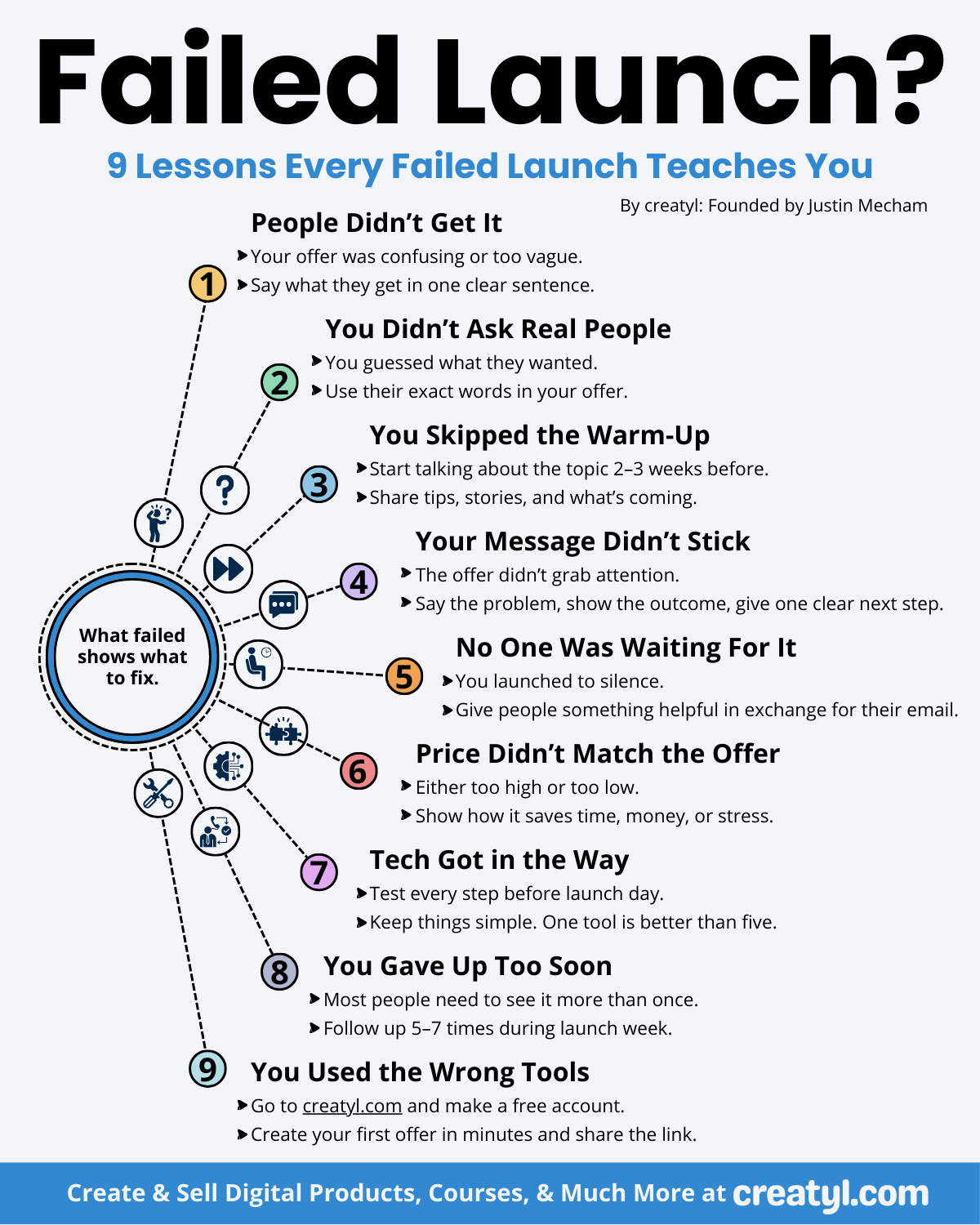
Download the “Failed Launch Lessons” Infographic (PDF)
Some lessons are easier to work through when you can see them clearly.
This infographic lays out the nine signals every failed launch gives you, so you can quickly spot what went wrong and what to adjust next—without overthinking or starting from scratch.