
What Is a Digital Product?
A digital product is a product that can be created once and sold repeatedly online.
Examples include templates, guides, courses, and digital tools.
Unlike physical goods, digital products do not need inventory or shipping.
They are usually delivered through downloads, email access, or member areas.
Because they can be sold again and again, many creators, professionals, and small businesses use digital products to share knowledge, solve problems, and create new income streams.
But there is an important truth many people miss.
Most digital products fail not because they are poorly made.
They fail because they solve the wrong problem.
Understanding that difference changes everything.
The Real Reason Many Digital Products Fail
Many creators start with the wrong question.
They ask:
What should I make?
So they begin brainstorming formats:
An ebook
A course
A planner
A template
A toolkit
This seems logical, but it often leads to products people do not need.
The better starting point is not the format.
The better starting point is the problem.
People do not wake up wanting a PDF.
They wake up wanting relief.
They want to stop wasting time.
They want to stop making the same mistake.
They want to feel confident about a decision.
They want to finish something faster.
The strongest digital products exist to remove friction from everyday life.
The Shift That Makes Digital Products Valuable
A useful digital product is not just information.
It is a shortcut.
It helps someone move from confusion to clarity faster than they could on their own.
For example:
A freelancer might need a clear client proposal template so they stop rewriting proposals every week.
A job seeker might need a guide that shows exactly how to answer difficult interview questions.
A manager might need a meeting structure that keeps team conversations productive.
In each case, the product solves a specific moment of difficulty.
The more specific the moment, the more useful the product becomes.
The Rule That Changes Everything
Here is one rule that separates strong digital products from weak ones.
Sell an outcome, not information.
Information is easy to ignore.
Outcomes are easy to want.
For example:
Instead of selling a guide about organization, sell a weekly system that helps people keep projects on track.
Instead of selling a general productivity planner, sell a planner designed for people balancing work and family schedules.
Instead of selling a course about communication, sell a toolkit that helps people prepare for difficult conversations.
When the outcome is clear, the value becomes obvious.
Examples of Digital Products
Digital products come in many forms. Some of the most common examples include:
Templates that simplify repeated tasks
Guides that explain how to complete a specific process
Mini courses that teach a focused skill
Checklists that prevent mistakes
Swipe files with ready-to-use scripts or messages
Toolkits that help someone complete a project
Spreadsheets that help people make decisions
Prompt packs that remove blank-page stress
The best digital products are usually simple.
They focus on one problem and one result.
Large, complicated products often feel overwhelming.
Small products that solve real problems are easier to use and easier to sell.

The “Before, During, After” Product Method
One of the most practical ways to design a digital product is to think about the real moment when someone struggles.
That moment usually happens in three stages.
Before
Before the challenge begins, people often need preparation.
This might include:
A planning worksheet
A checklist
A decision guide
A step-by-step outline
During
During the moment itself, people need clarity.
This could be:
Scripts
Reference sheets
Quick instructions
Real examples
After
Once the task is finished, people often need follow-up guidance.
This might include:
Review questions
Tracking sheets
Next steps
Improvement tips
When a product supports people through these stages, it becomes far more practical.
It does not just explain ideas.
It helps people act on them.
Why Digital Products Are So Popular
Digital products have become popular for several reasons.
They can be created once and sold many times.
They are delivered instantly to customers.
They allow creators to share knowledge at scale.
But there is another reason they work so well.
People value speed.
They want answers quickly.
They want simple systems.
They want tools that remove unnecessary steps.
A digital product that saves someone time or prevents mistakes can be extremely valuable, even if it is small.
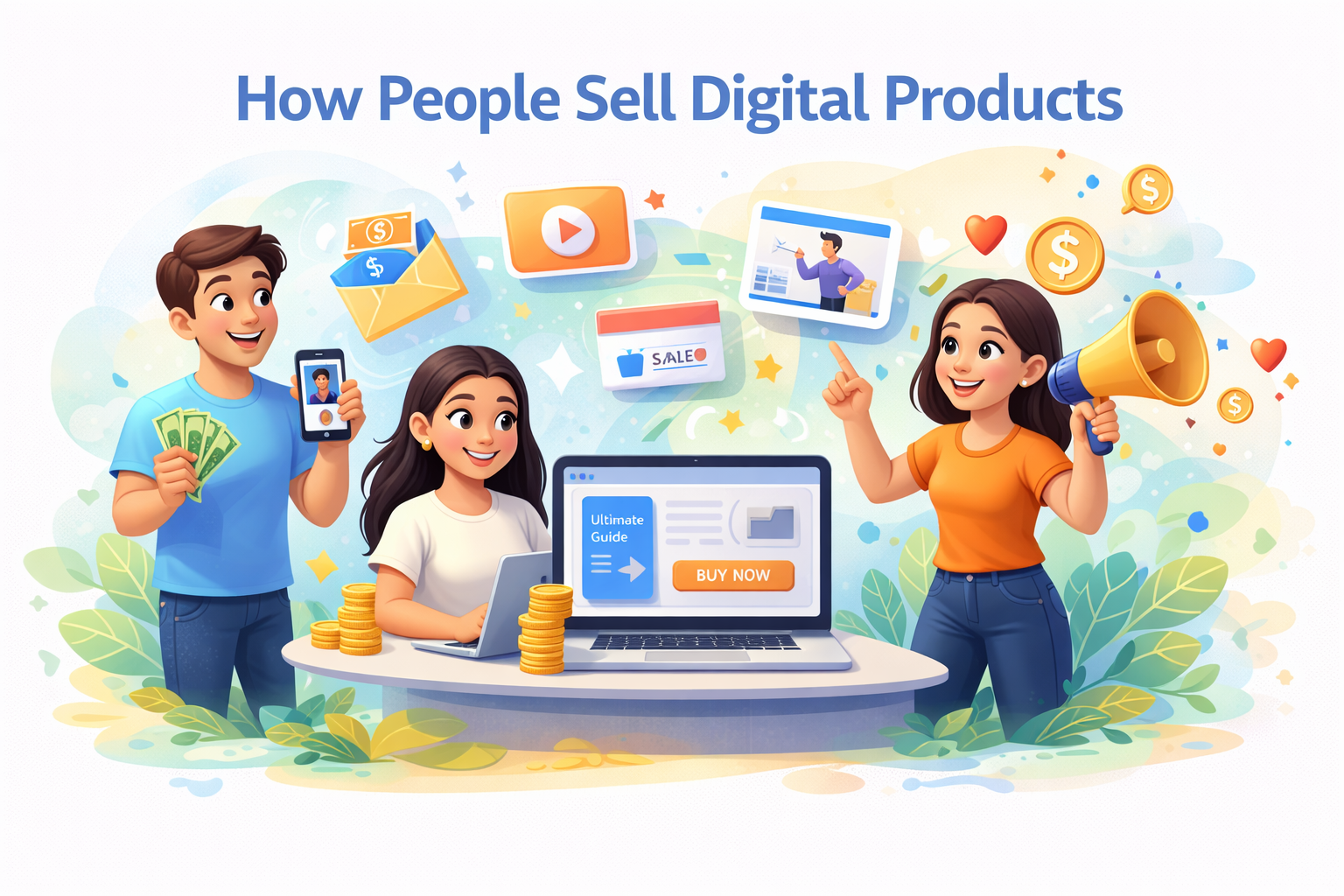
How People Sell Digital Products
Creators sell digital products in several ways.
Some sell directly through their own websites.
Others use digital marketplaces.
Many creators connect their products to newsletters, social media content, or online communities.
Often the most successful approach is simple.
Content helps people understand a problem.
The digital product provides the solution.
This creates a natural path for readers or viewers who want deeper help.
Platforms Creators Use
Several platforms make it easy to sell digital products online.
Shopify allows creators to run full online stores and sell digital downloads alongside other products.
Etsy is widely used for downloadable items such as templates, art prints, and planners.
Gumroad offers a straightforward platform for selling digital goods such as guides, tools, and courses.
creatyl allows creators to sell digital products, courses, coaching, and communities in one place - no tech skills needed.
Each platform has different strengths, but the most important factor is not the platform itself.
The most important factor is whether the product solves a real problem clearly.
The “Use Tonight” Test
Before creating a digital product, ask one simple question.
Can someone buy this today and use it tonight?
If the answer is yes, the product likely solves a real need.
If the answer is no, the idea might be too broad or too abstract.
The best digital products are immediately useful.
They help people take action quickly.
A Simple Framework for Creating Your First Digital Product
If you want to create a digital product that people actually use, follow this structure.
Start with one clear problem.
Identify one type of person who experiences that problem.
Focus on the exact moment when the problem occurs.
Design a product that helps that person finish the task faster.
Keep the solution simple.
When the problem is clear and the solution is practical, the product becomes naturally valuable.
The Real Purpose of a Digital Product
Digital products are often described as tools for generating income online.
But their deeper purpose is simpler.
They make life easier.
A good digital product helps someone move forward.
It reduces confusion.
It shortens the path between problem and solution.
That is why the most useful digital products are rarely complicated.
They are practical.
They solve real moments of difficulty.
And when a product makes someone’s day easier, people are glad they found it.