Click Here to Download the PDF.
The Quiet Leadership Mistake That Breaks Trust
There is a version of leadership that looks good on the surface but quietly weakens everything underneath.
It is polite.
It is agreeable.
It avoids tension.
And it is often praised.
This is what most people call being “nice.”
At first glance, it feels like the right approach.
It keeps conversations smooth, reduces friction, and creates a sense of short-term comfort.
But over time, something subtle begins to shift.
People stop being honest.
Problems stay hidden longer.
Performance plateaus.
Not because the team lacks ability, but because the environment lacks truth.
This is where the distinction between being nice and being kind becomes critical.
Because they are not the same.
And confusing the two is one of the fastest ways to lose trust without realizing it.
Why “Nice” Feels Right—But Fails Over Time
Nice behavior is often rooted in good intentions.
Most leaders who default to it are not trying to avoid responsibility.
They are trying to maintain harmony.
They do not want to upset people.
They do not want to create tension.
They do not want to be seen as difficult.
So they soften feedback. They delay hard conversations. They say “it’s fine” when it is not.
In the moment, this feels like leadership.
But teams are more perceptive than we give them credit for.
They notice when something is being held back.
They notice when feedback is vague.
They notice when decisions are made to avoid discomfort instead of to move things forward.
And over time, they adjust their behavior accordingly.
They stop bringing real issues forward because they do not expect a real response.
They stop pushing themselves because expectations are unclear.
They stop trusting the leader to guide them through difficulty.
The result is not a calm, high-performing team.
It is a quiet, disconnected one.
What Real Kindness Looks Like in Leadership
Kindness in leadership is often misunderstood because it does not always feel comfortable.
It is not about making people feel good in the moment.
It is about helping them grow over time.
That means telling the truth when it would be easier to stay silent.
It means addressing issues before they become patterns.
It means making decisions that are fair, even when they are unpopular.
Kind leaders are not harsh. They are not careless.
They are clear.
They combine honesty with empathy.
They respect the person while still addressing the behavior.
They focus on outcomes, not ego.
And most importantly, they create an environment where people know where they stand.
That clarity is what builds trust.
The Hidden Cost of Avoiding Hard Conversations
One of the most common patterns in “nice” leadership is avoiding difficult conversations.
It might look like giving softer feedback than necessary.
Or choosing not to address a recurring issue because it feels uncomfortable.
But every avoided conversation has a cost.
When feedback is unclear, people cannot improve.
When problems are ignored, they compound.
When expectations are not stated, they are guessed—and often incorrectly.
Over time, this creates frustration on both sides.
The leader feels like the team is underperforming.
The team feels like they are not being guided properly.
And neither side fully understands why.
The reality is simple.
Clarity was sacrificed for comfort.
Kindness Creates Safety—Not Comfort
There is an important distinction between safety and comfort.
Comfort avoids tension.
Safety allows truth.
Nice leadership prioritizes comfort.
Kind leadership prioritizes safety.
A safe team is not one where everything feels easy.
It is one where people can speak honestly without fear of being dismissed or judged.
It is a place where feedback is expected, not avoided. Where disagreements are handled directly, not buried.
That kind of environment does not happen by accident.
It is built through consistent, intentional behavior from the leader.
The Five Shifts From Nice to Kind Leadership
Moving from “nice” to “kind” leadership is not about changing your personality.
It is about changing your standards.
1. From Avoiding Conflict to Addressing It Early
Nice leaders hope problems resolve themselves. Kind leaders step in early.
They recognize that small issues, when ignored, become larger ones.
Instead of waiting, they create space for honest conversations while the stakes are still manageable.
2. From Vague Feedback to Clear, Actionable Guidance
Nice feedback often sounds supportive but lacks direction.
Kind feedback is specific.
It identifies what is working, what is not, and what needs to change.
It removes guesswork and replaces it with clarity.
3. From Protecting Feelings to Supporting Growth
Nice leadership tries to shield people from discomfort.
Kind leadership understands that growth often comes with it.
This does not mean being blunt or careless.
It means being honest in a way that helps someone improve.
4. From Popular Decisions to Fair Decisions
Nice leaders often make choices based on how they will be received.
Kind leaders make decisions based on what is right for the team and the work.
Fairness builds respect, even when it is not immediately liked.
5. From Surface Recognition to Genuine Acknowledgment
Nice leaders give praise to maintain morale.
Kind leaders recognize real effort and meaningful progress.
This makes recognition more credible and more impactful.
A Real Workplace Example
When “Nice” Leadership Slows Down a Team
A team was consistently missing deadlines, but no one was addressing it directly.
The manager was well-liked, supportive, and easy to work with.
But feedback was always general. Issues were mentioned lightly, if at all.
Over time, the team became less accountable.
Deadlines felt flexible.
Expectations felt unclear.
High performers started feeling frustrated because the gap between effort and recognition was growing.
The manager sensed the decline but did not want to create tension by being more direct.
The shift began with one change.
Clarity.
The manager started addressing missed deadlines directly in one-on-one conversations.
Not with blame, but with clear expectations and specific next steps.
Feedback became more structured. Wins were acknowledged with detail.
Areas for improvement were discussed openly.
Within weeks, the tone of the team changed.
People knew what was expected.
They trusted the feedback.
They felt supported, but also challenged.
The manager was no longer just liked.
They were respected.
Why Trust Is Built in the Hard Moments
Trust is not built when everything is going well.
It is built in moments of tension.
When a leader chooses to be honest instead of avoiding discomfort, it signals something important.
It shows that they value the person enough to tell the truth.
It shows that they care about the outcome, not just the atmosphere.
It shows that they are willing to lead, not just manage.
Those moments are remembered.
And over time, they define how people experience leadership.
The Leadership Standard That Lasts
The leaders who leave a lasting impact are rarely the ones who made everything feel easy.
They are the ones who made people better.
They created clarity where there was confusion.
They addressed issues others ignored.
They set standards and upheld them consistently.
They were not always comfortable to work with.
But they were always trusted.
And trust is what drives performance, growth, and long-term success.
Respect Outlasts Approval
Approval feels good in the moment.
It creates quick wins. It keeps things smooth. It avoids friction.
But it does not build anything lasting.
Respect is different.
It is earned through consistency. Through fairness. Through honesty delivered with care.
It takes longer to build, but it holds everything together.
If you are leading a team, the question is not whether people like you.
It is whether they trust you enough to be honest with you, to learn from you, and to grow under your leadership.
That kind of trust does not come from being nice.
It comes from being kind in the moments where it would be easier not to be.
Resources to Go Deeper
Book: Radical Candor by Kim Scott
A practical framework for giving honest feedback while still showing care.
Book: Dare to Lead by Brené Brown
Explores the role of courage, vulnerability, and trust in leadership.
Podcast: Coaching for Leaders
Focuses on real conversations and skills that improve leadership effectiveness.
TED Talk: The Power of Vulnerability by Brené Brown
A deeper look at how openness and honesty build connection and trust.
Tool: 15Five (Performance Management Tool)
Helps structure regular feedback, recognition, and team communication.
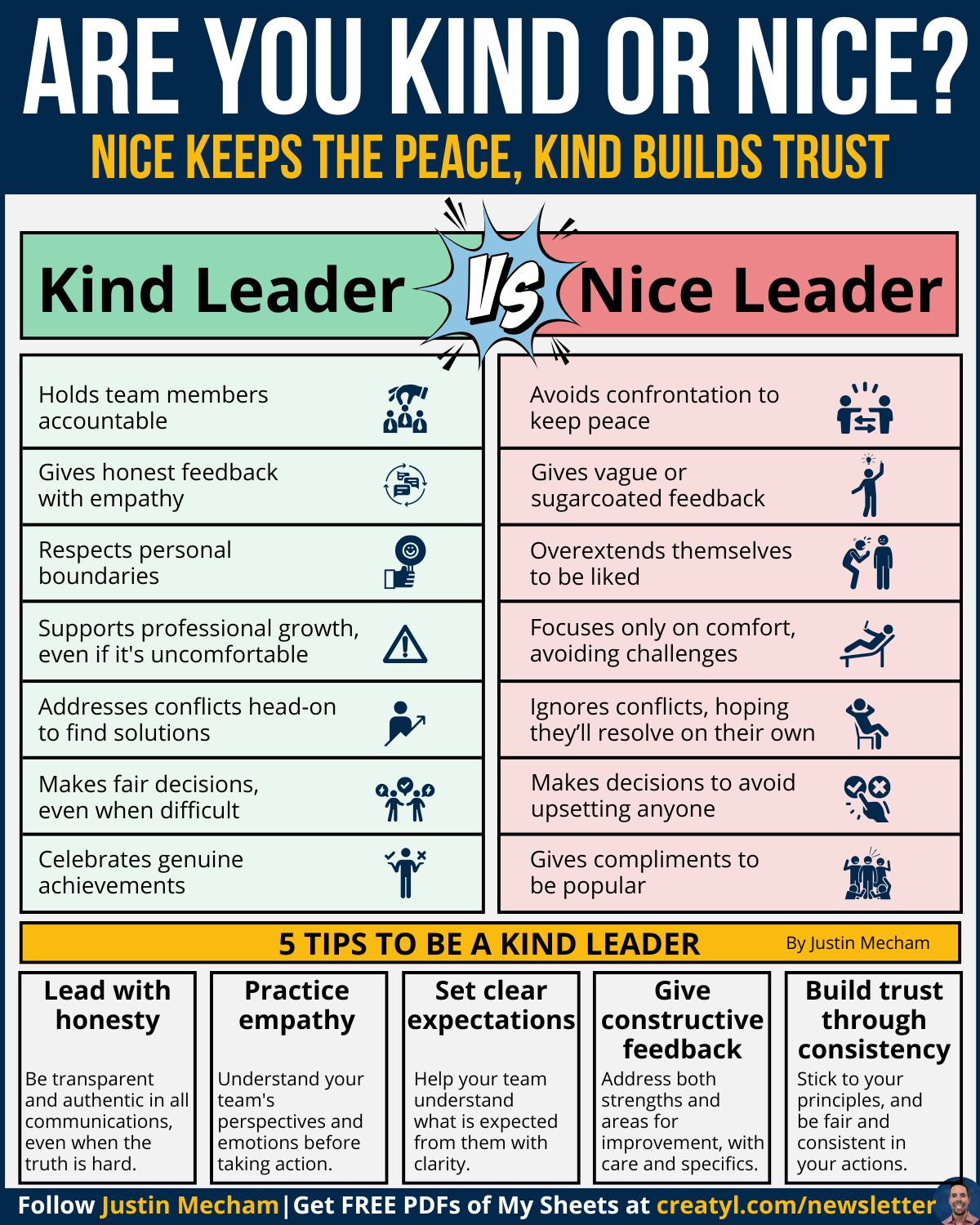
Download the “Kind vs Nice Leadership” Infographic (PDF)
If you want a clear, visual breakdown of the differences between nice and kind leadership—and how to apply it in real situations—download the full infographic as a PDF.
Use it as a practical guide to build trust, give better feedback, and lead with clarity.