

Click Here to Download the PDF.
The Problem With Most Exit Plans
The internet loves dramatic success stories.
Someone quits their job on Friday.
Launches a business on Monday.
Posts a photo from a beach six months later.
The story gets thousands of likes.
What rarely gets discussed is how many people tried the same thing and ended up stressed, overwhelmed, and financially trapped.
The reality is that most successful transitions are far less exciting.
They are quieter.
More strategic.
More patient.
Less about escaping and more about building.
The truth is that leaving a job is not the hard part.
Creating something sustainable to leave for is.
That distinction matters because too many people focus on the exit itself instead of creating the foundation that makes the exit possible.
The goal should never be to quit quickly.
The goal should be to build options.
When you have options, decisions become easier.
You stop operating from fear.
You stop feeling trapped.
You stop believing your current situation is permanent.
The smartest entrepreneurs, creators, consultants, and business owners often build their next chapter while their current chapter is still paying the bills.
That approach may not make for dramatic social media content.
But it makes for a much better life.
Why Building While Employed Is Often the Smartest Move
Many people view employment and entrepreneurship as opposites.
In reality, one can help fund the other.
Your current job provides something incredibly valuable:
Stability.
A paycheck.
Predictability.
Resources.
Time to experiment without panic.
When you remove financial pressure from the equation, you gain something else.
Better decision-making.
People under extreme pressure often rush.
They chase trends.
They launch products nobody wants.
They make desperate decisions.
They accept bad clients.
They build businesses they eventually hate.
A soft exit plan creates room to think clearly.
You can test ideas.
Gather feedback.
Improve your offer.
Build skills.
Grow an audience.
Generate revenue.
All before your livelihood depends on it.
That is not playing it safe.
That is playing it smart.
The One-Hour Rule That Changes Everything
Most people believe they need huge blocks of time to build something meaningful.
That belief keeps them stuck.
The reality is that consistency beats intensity.
One focused hour every day is more powerful than waiting for the perfect weekend, vacation, or free month.
Think about what happens during an hour of intentional work.
You can write a sales page.
Create a checklist.
Build a digital guide.
Reach out to potential customers.
Improve an offer.
Record a lesson.
Create content.
Research a problem.
Talk to a prospect.
The challenge is not usually a lack of time.
It is a lack of protected time.
Most evenings disappear into distractions.
Scrolling.
Streaming.
Random tasks.
Unplanned commitments.
Mental fatigue.
The quiet hour changes that.
Choose one hour.
Protect it fiercely.
Treat it like a meeting with your future.
Because that is exactly what it is.
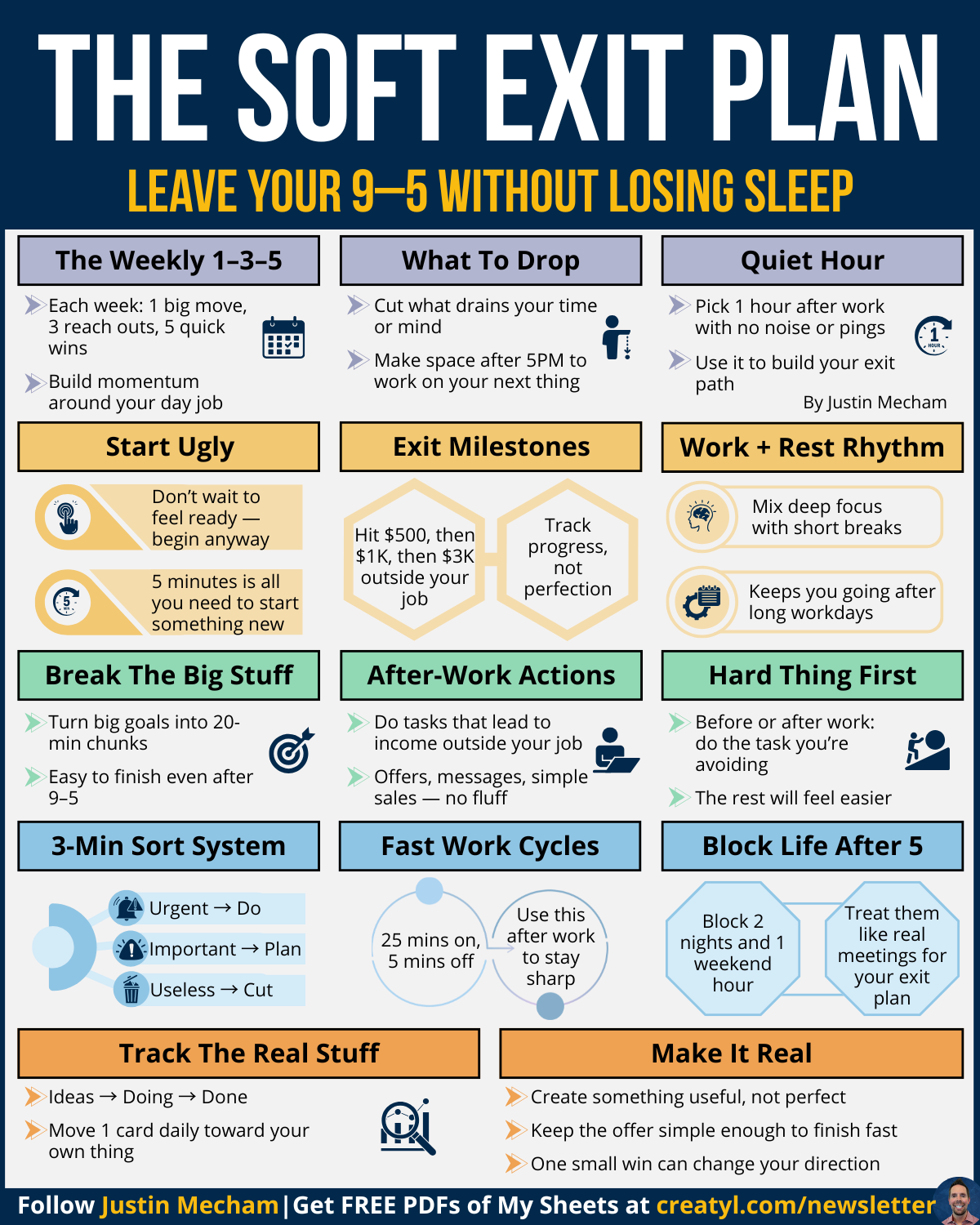
The Weekly 1–3–5 Framework
One reason people abandon side projects is because they try to do too much.
They create impossible expectations.
Then they feel guilty when they cannot maintain them.
A better approach is the 1–3–5 system.
Each week focus on:
One Big Move
A meaningful action that pushes the business forward.
Examples:
- Launching an offer
- Publishing a product
- Finishing a sales page
- Having five customer conversations
- Creating a lead magnet
One meaningful action creates momentum.
Three Reach Outs
Business growth almost always happens through conversations.
Reach out to:
- Potential customers
- Existing customers
- Colleagues
- Community members
- People you admire
Relationships create opportunities.
Opportunities create growth.
Five Quick Wins
Small tasks completed quickly.
Examples:
- Updating a product page
- Posting content
- Improving a checkout process
- Creating a checklist
- Sending follow-up messages
Small wins build confidence.
Confidence builds consistency.
Consistency builds businesses.
Energy Is a Resource, Not an Unlimited Supply
Most people budget money.
Few people budget energy.
Yet energy often matters more.
A person with high energy can create opportunities.
A person with depleted energy struggles to act on opportunities.
One of the most overlooked parts of a soft exit plan is identifying what drains you.
Not just physically.
Mentally and emotionally too.
Consider:
- Unnecessary meetings
- Endless social scrolling
- Negative environments
- Constant notifications
- Projects with no clear purpose
- Commitments that no longer serve you
Every drain consumes attention.
Every drain reduces creative capacity.
Building something meaningful requires protecting your energy the same way you protect your finances.
Start Ugly: The Most Underrated Business Strategy
Many brilliant ideas die because their creator waits too long.
They want:
The perfect website.
The perfect logo.
The perfect offer.
The perfect strategy.
The perfect launch.
Perfection feels productive.
But perfection often becomes procrastination wearing professional clothes.
The first version should be simple.
Sometimes embarrassingly simple.
A rough guide.
A one-page offer.
A basic service.
A simple landing page.
The goal is not impressing people.
The goal is learning.
Progress happens through feedback.
Feedback only arrives after action.
Exit Milestones Matter More Than Motivation
Motivation changes daily.
Milestones create direction.
Rather than obsessing over replacing an entire salary, focus on smaller markers.
Milestone One: First $500
This proves strangers will pay.
Milestone Two: First $1,000
This proves the process is repeatable.
Milestone Three: First $3,000
This proves there is meaningful demand.
These milestones create evidence.
Evidence builds confidence.
Confidence reduces fear.
Fear is often the biggest obstacle in any transition.
Why Rest Is Part of the Strategy
Many side hustlers make the same mistake.
They work all day.
Build all night.
Repeat until exhausted.
Eventually they burn out.
Then they blame themselves.
The issue was not effort.
The issue was sustainability.
A sustainable rhythm includes recovery.
Deep focus.
Short breaks.
Quality sleep.
Exercise.
Relationships.
Time away from work.
The goal is not winning one productive week.
The goal is building something you can sustain for years.
Long-term success requires long-term energy.
Break Big Goals Into Twenty-Minute Chunks
Large goals create overwhelm.
Small actions create movement.
Instead of saying:
"I need to build a business."
Ask:
"What can I complete in twenty minutes?"
Examples:
- Write product headlines
- Draft an email
- Contact three people
- Outline a guide
- Improve a landing page
Small actions create momentum.
Momentum reduces resistance.
Resistance is often what stops progress.
The Hard Thing First Principle
Every meaningful project contains one task people avoid.
The sales conversation.
The launch.
The customer outreach.
The pricing decision.
The content publication.
The difficult email.
The sooner that task gets completed, the easier everything else becomes.
Avoidance creates anxiety.
Action creates clarity.
Most people are not overwhelmed by work.
They are overwhelmed by unfinished decisions.
The Three-Minute Sorting System
When time feels limited, simplicity wins.
Ask three questions:
Is It Urgent?
Do it.
Is It Important?
Schedule it.
Is It Neither?
Remove it.
Many people spend enormous amounts of time maintaining activities that do not meaningfully improve their
lives.
The ability to eliminate is often more valuable than the ability to add.
Track the Real Stuff
Many people track activity.
Few track outcomes.
Activity feels productive.
Outcomes create progress.
Instead of measuring:
- Hours worked
- Ideas collected
- Videos watched
- Courses purchased
Measure:
- Products created
- Conversations started
- Offers launched
- Revenue generated
- Customers helped
Movement matters more than preparation.
A Real-Life Workplace Example
James worked as a project coordinator.
For years he dreamed of creating an online consulting business helping small companies improve workflows and operations.
He had expertise.
He had ideas.
He had ambition.
But he never started.
Every month he told himself he would begin next month.
Years passed.
His frustration grew.
Every day felt increasingly disconnected from the future he wanted.
The longer he waited, the bigger the project felt.
Instead of taking action, he consumed more content.
More podcasts.
More courses.
More strategies.
Yet nothing changed.
He became highly educated about entrepreneurship without actually becoming an entrepreneur.
Everything shifted when he committed to one quiet hour each weekday.
He created a simple checklist product.
Shared it with ten people.
Gathered feedback.
Improved it.
Then launched a consulting offer.
Six months later he had paying clients.
Twelve months later he had recurring revenue.
Two years later he had enough stability and confidence to make a thoughtful transition.
The business did not begin when he quit.
The business began during that first protected hour.
Practical Weekly Soft Exit Action Plan
Monday
Choose one meaningful move.
Tuesday
Reach out to one potential customer.
Wednesday
Spend 25 minutes building.
Thursday
Remove one draining commitment.
Friday
Complete one unfinished task.
Weekend
Publish or improve one offer.
Simple.
Manageable.
Repeatable.
Recommended Resources
Book
The $100 Startup by Chris Guillebeau
A practical guide to building income streams from existing skills and knowledge without needing huge
investments.
TED Talk
Why the Secret to Success Is Setting the Right Goals – John Doerr
A valuable discussion on focus, measurable progress, and creating momentum.
Podcast
The Side Hustle Show
Excellent real-world examples of people building businesses alongside traditional employment.
AI Tool
ChatGPT
Useful for brainstorming offers, researching customer problems, creating content, developing products, and accelerating execution.
Your Exit Is Built Long Before You Leave
Most people think freedom begins when they quit.
In reality, freedom begins when they stop depending on quitting to solve everything.
A better future is not created by one dramatic decision.
It is built through hundreds of quiet decisions.
One hour.
One conversation.
One offer.
One customer.
One improvement.
One lesson.
One piece of courage.
The most powerful part of a soft exit plan is not the income.
It is the confidence.
The confidence that comes from proving to yourself that you can create something outside the structure you have always known.
Because once you realize you can build value, solve problems, attract customers, and create opportunities, something changes.
You stop feeling trapped.
You stop feeling dependent on circumstances.
You stop waiting for permission.
The goal is not to run away from your current job.
The goal is to build enough options that staying becomes a choice instead of a necessity.
That is what real freedom looks like.
Not a dramatic escape.
A carefully constructed path that gives you more control over your time, your income, and your future.
And that path often starts with something surprisingly small:
One quiet hour after work.
Download the Related Infographic
Want a visual version of The Soft Exit Plan: Leave Your 9–5 Without Losing Sleep framework?
Download the infographic PDF and use it as a practical roadmap for building income, momentum, and future options while keeping your current stability intact.