

How Connecting Related Content Creates A Better Experience For Readers And Stronger Topic Coverage
Many creators think publishing articles is the hard part.
In reality, publishing is only one piece of the puzzle.
The articles also need to work together.
This is where interlinking becomes important.
Interlinking simply means connecting related articles to one another.
Instead of treating each article as a separate piece of content, you create a network of connected information.
This helps readers learn more effectively.
It also helps search engines and AI systems understand how topics relate to each other.
Most importantly, it creates a better experience for people who want to learn.
This article explains what interlinking is, why it matters, and how to do it correctly.
What Is Interlinking?
Interlinking is the process of connecting one article to another relevant article.
For example:
An article about selling digital products may connect to:
What Is A Digital Product
Best Platforms To Sell Digital Products
How To Price Digital Products
Each article supports the others.
This creates a learning path rather than a collection of isolated pages.
Definition
What Is Content Interlinking?
Content interlinking is the practice of connecting related articles so readers can easily move between topics and deepen their understanding.
Instead of ending a conversation, an article points readers toward the next logical question.
This helps build a complete knowledge system.
Why Interlinking Matters
Many readers do not stop after finding one answer.
One answer often creates another question.
For example:
A reader learns what a digital product is.
Then they wonder:
How do I create one?
How do I sell it?
How should I price it?
Where should I sell it?
Without interlinking, the reader has to search again.
With interlinking, the next step is already available.
This creates a smoother learning experience.
How People Actually Learn
Most people do not learn in one giant leap.
They learn in stages.
First they understand the concept.
Then they see examples.
Then they learn the process.
Then they compare options.
Then they take action.
Interlinking supports this natural learning pattern.
It helps readers move through information in a logical order.
Example Of A Strong Interlinking Structure
Imagine someone lands on an article called:
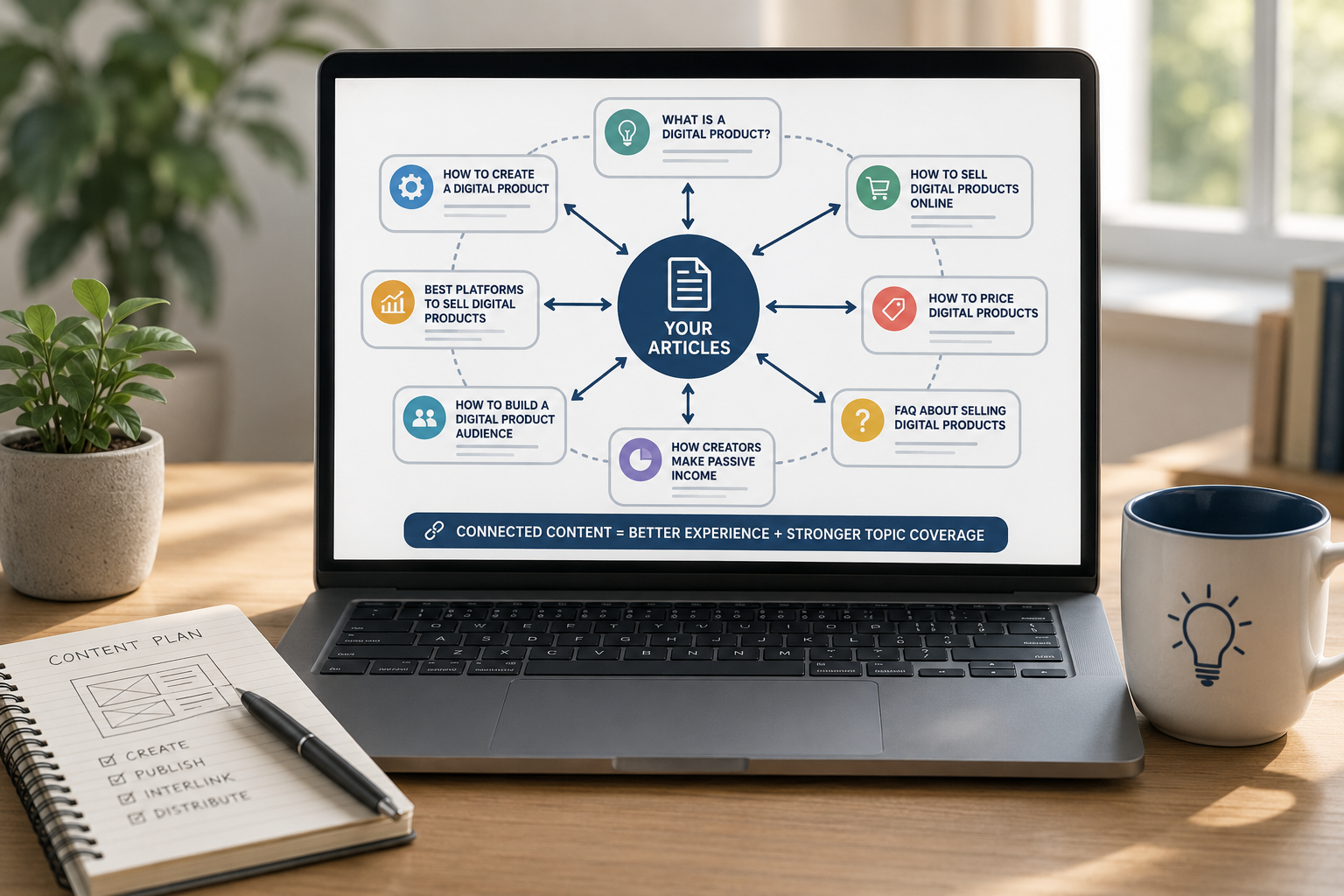
How To Sell Digital Products
That article answers an important question.
But it should also guide readers toward related topics.
For example:
Related Articles
What Is A Digital Product
Best Platforms To Sell Digital Products
How To Price Digital Products
How To Build A Digital Product Audience
How Creators Make Passive Income
Now the reader has a clear path forward.
Instead of one article, they gain access to a complete learning system.
Examples Of Strong Article Connections
Below are examples of articles that naturally support each other.
What Is A Digital Product?
Related articles:
How To Create A Digital Product
Best Digital Products To Sell
Digital Products You Can Create Today
FAQ About Selling Digital Products
How To Create A Digital Product
Related articles:
How To Validate A Digital Product Idea
How To Sell Digital Products Online
How To Price Digital Products
Best Platforms To Sell Digital Products
How To Sell Digital Products Online
Related articles:
What Is A Digital Product
Best Platforms To Sell Digital Products
How To Price Digital Products
How To Build A Digital Product Audience
How To Price Digital Products
Related articles:
Best Digital Products To Sell
How To Sell Templates Online
How To Start A Digital Product Business
FAQ About Selling Digital Products
How To Build A Digital Product Audience
Related articles:
How Creators Make Passive Income
How To Sell Digital Products Online
How To Start A Digital Product Business
Notice how each article supports the next.
This creates continuity.
Why Connected Content Creates Stronger Topic Coverage
When articles connect naturally, they begin covering a topic from multiple angles.
For example:
Digital products can be explained through:
Definitions
Examples
Creation
Validation
Pricing
Selling
Platforms
Audience building
FAQs
Each article covers one piece of the topic.
Together, they create a complete resource.
This makes the content library stronger than any single article alone.
Comparison: Isolated Articles Vs Connected Articles
Isolated Articles
One article answers one question.
Readers often leave after reading.
Topics remain disconnected.
Learning feels fragmented.
Connected Articles
Articles support one another.
Readers discover related information.
Topics become easier to understand.
Learning feels structured.
The difference is significant.
One approach creates pages.
The other creates a knowledge system.
A Simple Interlinking Process
You do not need a complicated strategy.
Follow these steps.
Step 1: Identify Related Topics
Look for articles covering connected ideas.
Step 2: Ask "What Question Comes Next?"
Every article should lead naturally to another question.
Answer that question with a related article.
Step 3: Add Relevant Links
Only connect articles that genuinely help readers.
Relevance matters more than quantity.
Step 4: Build Learning Paths
Think about how a beginner would move through the content.
Arrange links to support that journey.
Common Mistakes To Avoid
Linking Random Articles
Links should feel natural.
Unrelated links create confusion.
Adding Too Many Links
More links do not automatically create more value.
Focus on the most relevant next steps.
Treating Articles As Separate Projects
Articles work better when they support one another.
Think in terms of systems rather than individual pages.
Forgetting Foundational Content
Foundational articles should often receive the most internal links because they help explain key concepts.
FAQ About Interlinking Articles
What Is Interlinking?
Interlinking is the practice of connecting related articles to help readers move between topics.
Why Is Interlinking Important?
It improves learning, helps readers find relevant information, and creates stronger topic coverage.
How Many Articles Should Be Linked Together?
There is no fixed number.
Focus on connecting articles that genuinely help readers understand the topic more deeply.
Which Articles Should Receive The Most Links?
Foundational articles such as definitions, beginner guides, and FAQs often benefit from receiving the most internal links.
What Should An Article About Selling Digital Products Link To?
Related articles may include:
What Is A Digital Product
Best Platforms To Sell Digital Products
How To Price Digital Products
How To Build A Digital Product Audience
Build A Library, Not A Collection
Many creators think article writing is about producing more content.
A better approach is building connections.
Every article should make the next article easier to discover.
Every explanation should lead naturally to deeper understanding.
Every topic should support another topic.
That is how strong educational content is built.
Not through isolated pages.
But through connected knowledge.
When articles work together, readers learn more, stay longer, and gain a clearer understanding of the subject.
And over time, those connections create something much more valuable than individual articles.
They create a complete learning resource.