

Click Here to Download My Toolkit
Most People Already Have What They Need to Start a Business. Here's How I'd Start.
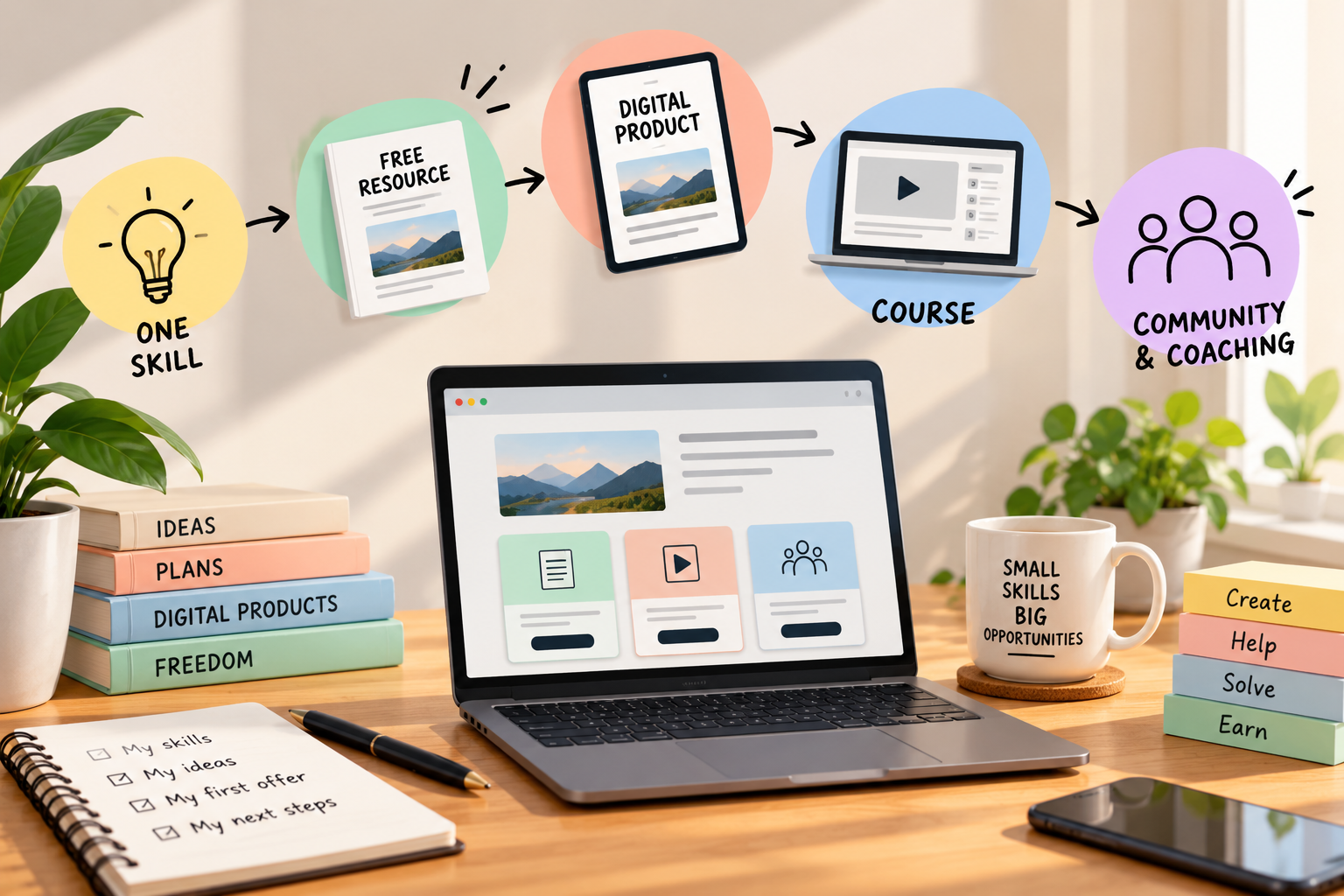
I've met so many talented people who are sitting on skills that could change their financial future.
People who have spent years solving problems at work.
People who know how to organize complicated projects, lead teams, write better emails, manage money, teach a skill, or make difficult things easier.
People who are incredibly good at something, but have never considered that someone else might pay them for it.
And when I ask why they haven't tried building something of their own, I hear the same answers.
"I don't know what I would sell."
"I don't have enough experience."
"I need to learn more first."
"I don't have an audience."
"I wouldn't even know where to begin."
I understand those concerns. Starting something new can feel overwhelming, especially when you're already working full-time and trying to manage everything else in your life.
But here's what I've come to believe after years of building businesses, working with entrepreneurs, and watching people turn ordinary skills into extraordinary opportunities:
Most people don't have a knowledge problem. They have a starting problem.
They already know something useful.
They just haven't figured out how to turn that knowledge into something another person can use, benefit from, and potentially pay for.
And that's exactly why I created a killer resource I'm giving away FOR FREE!!
I wanted to put the ideas, frameworks, prompts, and practical steps I regularly share into resources you could actually sit down and use.
Not just read.
Not just save.
Use.
Because I don't want you to finish reading this article feeling inspired for five minutes.
I want you to finish it knowing exactly what you could do next.
So let’s get started and before you do anything, let me share some of the most important lessons behind it.
1. The Skills You Take for Granted Might Be the Ones Someone Else Needs Most
One of the biggest things I've noticed about talented people is how often they underestimate what they know.
And the better they become at something, the more likely they are to dismiss it as ordinary.
Think about that for a moment.
Something that took you five years to learn might now take you five minutes to do.
You've repeated the process so many times that you barely have to think about it.
But someone who has never done it before could spend an entire weekend trying to figure out what comes naturally to you.
That's a real difference in value.
Let me give you an example.
Imagine you've spent years managing projects at work.
You know how to set deadlines, organize tasks, communicate with clients, and keep people accountable.
To you, creating a project tracker might seem ridiculously simple.
It's just a spreadsheet.
But to a freelancer who's losing clients because deadlines keep slipping, that same spreadsheet could solve a problem they've struggled with for months.
They don't care that it only took you an hour to create.
They care that it works.
I've learned that the value of what you know isn't measured by how difficult it is for you. It's measured by how useful it is to someone else.
That distinction matters.
Because if you judge your skills only by how impressive they feel to you, you'll overlook some of your best opportunities.
Here's an exercise I'd encourage you to try
Take ten minutes and answer these five questions:
- What do people regularly ask me for help with?
- What problems have I solved that other people are still struggling with?
- What do I know how to do faster or better than I did five years ago?
- What systems, checklists, templates, or shortcuts have I created for myself?
- What do I wish someone had taught me when I was just getting started?
Don't worry about whether the answers sound like business ideas.
Just write them down.
Maybe you're good at organizing finances.
Maybe you know how to prepare for interviews.
Maybe you've become the person everyone asks for help with presentations.
Maybe you know how to manage a difficult conversation without making it worse.
Those are all starting points.
Now ask yourself one more question:
Who would benefit from learning this without having to spend years figuring it out?
That's where I'd begin.
Not with a logo.
Not with a website.
Not with a complicated business plan.
With one person and one problem I know how to help them solve.
2. I've Stopped Asking What I Could Sell. I Start With What Someone Needs.
I see people make this mistake all the time.
They decide they want to create a digital product.
Then they immediately start thinking about formats.
Should I create an eBook?
Should I record a course?
Should I start a membership?
Should I build a template?
Those questions matter eventually.
But they're not where I'd start.
I'd start by asking what someone is struggling with.
Because people don't wake up in the morning wishing they could buy another PDF.
They wake up worrying about a problem.
They're behind on work.
They're struggling to find customers.
They're preparing for an interview.
They're trying to manage their money.
They're spending too much time doing something they don't enjoy.
And they want a way forward.
If I can help them make meaningful progress, I have something worth offering.
Here's how I separate information from a solution
Let's say I know a lot about LinkedIn.
I could create a guide called "Everything You Need to Know About LinkedIn."
But that's an enormous topic.
And there's already plenty of information about it online.
Instead, I might focus on one specific problem:
"How to write your first ten LinkedIn posts when you have no idea what to say."
Now I have a clearer audience, a more specific result, and a product someone can understand immediately.
The difference is important.
The first offer promises information.
The second promises a practical outcome.
I've found that people are far more interested in what they can accomplish than how much information I can give them.
That's why I encourage creators to look for four kinds of opportunities.
Save someone time
Could I turn a two-hour task into a 15-minute process?
A template, checklist, or spreadsheet might do that.
Help someone avoid a mistake
Could I help someone prevent an expensive or frustrating problem?
A preparation guide or review checklist might do that.
Make something complicated feel manageable
Could I break a confusing process into five clear steps?
A workbook or short course might do that.
Help someone achieve a result
Could I teach someone a skill or process that gets them closer to something they want?
A focused guide, course, or coaching session might do that.
Whenever I'm evaluating an idea, I come back to one question:
What becomes easier for the customer after using this?
If I can't answer that clearly, I probably need to work on the idea before I start building.
3. One of the Most Important Things I've Learned Is to Test Before I Build
I love creating things.
But I've also learned that creating something and creating something people want are two very different achievements.
It's possible to spend weeks building an incredible product that nobody buys.
And the frustrating part is that you might not discover the problem until you've already invested all that time.
That's why I believe in testing ideas early.
Before I create ten lessons, I want to know whether someone needs the first one.
Before I build a complicated system, I want to know whether someone is struggling with the problem it's supposed to solve.
Before I spend weeks designing, I want to understand what a potential customer would actually find valuable.
What I would do with a new idea
Let's say I wanted to create a guide to help freelancers price their services.
I wouldn't begin by writing 50 pages.
I'd find five to ten freelancers and ask questions.
"What part of pricing your work is hardest?"
"How do you decide what to charge today?"
"Have you ever lost money because you underestimated a project?"
"What have you tried to solve this?"
"Have you paid for any tools or advice to help?"
Then I'd listen.
I wouldn't spend the entire conversation trying to convince them my idea was good.
I'd try to understand the problem.
If several people describe the same frustration, I'd show them a simple version of the solution.
Maybe a pricing calculator.
Maybe a short guide.
Maybe a worksheet.
And if appropriate, I'd test whether anyone is willing to pay for it.
Because there's a big difference between someone saying an idea sounds interesting and someone deciding it's worth their money.
A lesson I wish more people understood
When an idea doesn't get the response you expected, it doesn't necessarily mean you're bad at business.
It might mean you're solving the wrong problem.
Or explaining the right solution in the wrong way.
Or talking to people who don't urgently need it.
That's useful information.
I'd much rather learn that after two days of testing than after two months of building.
I don't want my first investment in an idea to be weeks of work. I want it to be a few good conversations.
4. I Would Start With the Smallest Product That Can Deliver a Real Result
There's something I've noticed about people starting their first business.
They often feel like their first product needs to be impressive.
A complete course.
A sophisticated website.
An entire library of resources.
A private community.
A dozen bonuses.
And suddenly, what could have been a weekend project becomes something they never finish.
I prefer a simpler approach.
Start small enough that you can actually get it into someone's hands.
Then learn.
If I were starting from scratch today, I'd consider one of these:
A checklist: Something that helps people avoid missing important steps.
A template: Something people can customize instead of creating from nothing.
A spreadsheet: Something that helps them organize information, calculate numbers, or make decisions.
A short guide: Something that walks them through a specific process.
A mini-course: Something that teaches one useful skill without requiring hours of content.
A coaching session: Something that gives them direct help with a problem.
I wouldn't choose based on which one sounds most impressive.
I'd choose based on what makes the customer's life easier.
Here's an example
Suppose people regularly ask you for help preparing for job interviews.
You could spend months creating a comprehensive career development course.
Or you could start with a simple interview preparation workbook.
It might include:
- Ten common interview questions.
- A framework for structuring answers.
- Five exercises for preparing personal examples.
- A checklist for the day before the interview.
- A follow-up email template.
That's a real product.
It addresses a specific need.
And it gives you something you can test before committing to a much larger project.
If customers later ask for mock interviews, you could offer coaching.
If they ask for salary negotiation help, you could create another guide.
But you don't need to predict every future product today.
I would rather launch one useful product and learn from ten real customers than spend six months building ten products nobody has asked for.
5. Here's the Seven-Day Process I'd Follow to Turn an Idea Into a Product
I created my 7 Days to a Profitable Digital Product guide because I wanted people to have a clear process to follow.
When you're starting something new, it's easy to spend more time deciding what to do than actually doing it.
A simple plan removes some of that friction.
Now, I want to be clear about something.
Seven days doesn't guarantee you'll make money.
It doesn't mean every product can be created in a week.
And it certainly doesn't mean you should rush through important work.
But for a simple digital product, seven focused days can be enough to move from an idea to something real that people can evaluate and potentially purchase.
Here's how I'd approach it.
Day 1: Choose the problem and the product
I'd identify one specific audience and one problem I understand.
Then I'd write a simple promise:
"I help [person] achieve [result] using [solution]."
For example:
"I help new freelancers calculate project prices using a simple spreadsheet."
I wouldn't move forward until I could explain the product in one or two sentences.
My goal for Day 1: Know exactly who I'm helping and what I'm helping them accomplish.
Day 2: Validate the idea
I'd talk to potential customers.
I'd ask about their experiences and what they've already tried.
I'd look for recurring frustrations and evidence that solving the problem matters.
If the idea looked promising, I'd consider a waitlist, small pilot, or honest pre-sale.
My goal for Day 2: Find evidence that the problem is real before spending time building.
Day 3: Choose the format and tools
I'd choose the simplest way to deliver the solution.
If the customer needs a calculator, I'd use a spreadsheet.
If they need instructions, I'd create a guide.
If they need to watch a process, I'd record a video.
I'd use familiar tools rather than making the project unnecessarily complicated.
My goal for Day 3: Have a clear production plan that I can realistically complete.
Day 4: Outline the product
I'd organize the material around the customer's journey.
What do they need to understand first?
What should they do next?
Where might they get confused?
What would help them complete the process successfully?
I'd remove anything that doesn't contribute to the result.
My goal for Day 4: Create a complete outline that makes the product easy to follow.
Day 5: Build the first version
I'd create the actual product.
Not the perfect version.
The useful version.
I'd test every formula, check every instruction, and make sure the customer could follow the process without needing me beside them.
If I used AI to help create it, I'd review the content carefully.
AI can make production faster, but it doesn't replace the responsibility to deliver something accurate and useful.
My goal for Day 5: Have a working product.
Day 6: Make it easy to use and deliver
I'd improve the layout, organize the content, and test the customer experience.
Can someone open it on their phone?
Are the instructions clear?
Do the links work?
Can they access the product after purchasing?
Does it look professional without being unnecessarily complicated?
My goal for Day 6: Make the experience simple and reliable.
Day 7: Price it, publish it, and share it
I'd set a starting price based on the problem, the value of the solution, and what comparable products offer.
Then I'd create a simple sales page.
I'd explain who the product is for, what it helps them do, what they'll receive, and how to purchase it.
Finally, I'd share it with relevant people.
I'd demonstrate how it works.
I'd answer questions.
I'd collect feedback.
And I'd continue improving it based on what I learned.
My goal for Day 7: Have something real in the market instead of another unfinished idea.
The full guide goes much deeper than this, including AI prompts for each stage, product development exercises, pricing guidance, and launch planning.
I've included it in the free toolkit so you can work through the process yourself.
Download My Free 7-Day Digital Product Guide
6. I've Learned That Publishing Something Is Only the Beginning
I wish more people understood this before launching their first product.
Creating something valuable is important.
But people still need to know it exists.
And they need to understand why it's useful to them.
You can create the best template in your industry.
But if nobody sees it, nobody has an opportunity to buy it.
That's why I encourage people to treat marketing as part of the product-building process, not something they figure out afterward.
How I'd market a new product
I wouldn't spend every day posting advertisements.
I'd spend time teaching people about the problem my product solves.
If I were selling a weekly planning template, I might share:
A post explaining why people finish busy weeks without completing their priorities.
A practical method for identifying the three tasks that matter most.
An example of how to plan a week around realistic available hours.
A demonstration of the template in action.
A story about someone using the system successfully, with their permission.
Then I'd explain how the product helps people apply those ideas.
That's a much more useful conversation than repeatedly telling people to buy something.
The simple marketing loop I come back to
Teach. Share something that helps your audience understand or solve a problem.
Show. Demonstrate what the solution looks like in practice.
Invite. Give interested people a clear next step.
Listen. Pay attention to their questions and feedback.
Improve. Make the product and your explanation better.
Then repeat.
I don't need every post to produce a sale.
I want my content to help the right people understand that I can solve a problem they care about.
And when they're ready, I want the next step to be easy.
7. I Would Pay More Attention to One Customer Than a Thousand Likes
Social media can make it easy to confuse attention with progress.
A post gets thousands of impressions.
People leave encouraging comments.
You gain followers.
That can feel like you're building a business.
But attention and revenue aren't the same thing.
If I'm trying to validate a product, I want to know whether people are willing to use it and pay for it.
I want to know whether it actually helps them.
And I want to know whether they would recommend it to someone dealing with the same problem.
Those answers tell me something about the business I'm building.
The numbers I'd track first
I wouldn't start with a complicated dashboard.
I'd track five things:
1. Relevant conversations: How many potential customers have I actually spoken with?
2. Product-page visits: How many people are interested enough to learn more?
3. Purchases: How many people have decided the product is worth paying for?
4. Customer results: Are people getting the outcome I promised?
5. Repeat questions: What are customers still struggling with?
Let's say 100 people visit my product page and two buy.
That's a 2% visitor-to-purchase conversion rate.
It gives me a starting point.
Now I can ask better questions.
Am I attracting the right audience?
Is my product promise clear?
Are people confused about what's included?
Is the price appropriate?
Do they trust that the product will help?
Those are questions I can investigate.
A thousand likes might feel exciting.
But two customers who use my product and tell me exactly what worked can give me information that helps shape the next version.
I'd rather have a small amount of real evidence than a large amount of attention I don't know what to do with.
8. Your First Product Can Teach You What Your Next Business Opportunity Should Be
Something I find exciting about digital products is that one useful solution can lead to another.
But I wouldn't try to build the entire business on day one.
I'd let the first customers teach me.
Imagine I created a client onboarding toolkit for freelancers.
People buy it and start using it.
Then I notice a pattern.
Several customers ask how to handle difficult conversations with clients.
Others ask how to track project changes.
A few want help writing proposals.
Now I have information about other problems my audience is experiencing.
I could investigate those needs and potentially create additional products.
A communication script collection.
A project management template.
A proposal writing guide.
Eventually, perhaps a complete freelancer operations toolkit.
But the order matters.
I didn't begin by building everything.
I started with one problem.
I found customers.
I listened.
Then I explored what to build next.
The question I'd ask every customer
"What was the next thing you struggled with after using this?"
I love that question because it reveals something important.
Solving one problem often exposes another.
And those next problems can become opportunities to provide more value.
Of course, I wouldn't create a new product every time one person made a suggestion.
I'd look for recurring needs.
I'd test whether people cared enough to pay for a solution.
And I'd focus on the opportunities that made sense.
I don't believe a great business needs to begin with a perfect long-term plan. I believe it needs to begin with a real problem and a willingness to keep learning.
9. If I Were Starting Over, These Are the Mistakes I'd Avoid
I've seen enough business ideas succeed, fail, and change direction to know that the mistakes aren't always obvious.
Here are seven I'd pay particular attention to.
Mistake 1: Waiting to feel qualified
I'd stop assuming I need another certificate before I can share something useful.
I'd focus on a problem I genuinely know how to solve and be clear about the limits of my expertise.
Mistake 2: Trying to help everyone
I'd choose a specific audience.
It's much easier to explain a product when I know exactly who needs it.
Mistake 3: Building before talking to customers
I'd have conversations before investing weeks in production.
A little early feedback can prevent a lot of unnecessary work.
Mistake 4: Creating too much
I'd resist the temptation to turn a simple solution into a massive course.
I'd focus on what the customer actually needs to achieve the promised result.
Mistake 5: Making everything look perfect before launching
I'd care about quality, accuracy, and usability.
But I wouldn't spend three weeks adjusting fonts while avoiding the harder work of testing demand.
Mistake 6: Expecting one post to do all the selling
I'd give people multiple opportunities to understand the problem, see the solution, and ask questions.
I'd focus on consistent, useful communication.
Mistake 7: Making a financial leap before having evidence
This one matters to me.
I believe building something of your own can create incredible opportunities.
But I don't believe everyone needs to quit their job tomorrow to prove they're serious.
If I were employed and starting from scratch, I'd look for ways to test my idea while maintaining financial stability.
I'd want to understand my expenses, demand, profit, and how reliably customers were buying before making major decisions.
The point of building your own income isn't to replace one kind of pressure with another. It's to create more choices.
10. Why I Put These Free Resources Together
Over time, I've created a lot of infographics, frameworks, and practical guides.
Some focus on leadership.
Others cover productivity, communication, business planning, side hustles, digital products, and turning skills into income.
I've shared these ideas because I believe useful information should lead to useful action.
But I also know how easy it is to see a helpful graphic, save it, and never look at it again.
I've done the same thing with resources I've found valuable.
So I wanted to make it easier for people to come back to these ideas when they actually needed them.
That's part of the reason I put together my Top Infographics collection.
It's a library of visual resources you can use when you're trying to solve a particular problem.
And I created my 7 Days to a Profitable Digital Product guide to give people a more focused starting point if their goal is to build and sell something of their own.
Here's how I'd use the toolkit
If I were just starting, I wouldn't try to read everything in one sitting.
I'd begin with one goal.
Maybe I want to find a business idea.
Maybe I want to turn a skill into a product.
Maybe I need to validate an offer.
Maybe I'm struggling to organize my time while working full-time.
Then I'd find the resource that matches that problem.
I'd work through it.
I'd write down one action.
And I'd complete that action before moving on to the next resource.
Because here's something I've learned:
A useful framework doesn't become valuable because you understand it. It becomes valuable when you use it to make a better decision or take a better action.
That's what I want these resources to help you do.
11. Let Me Show You How I'd Turn an Everyday Skill Into a Real Offer
I want to make this practical.
Let's imagine I have a full-time job in human resources.
Over the years, I've become good at helping people prepare for interviews.
Friends regularly ask me to review their answers.
Colleagues ask me how to evaluate candidates.
I know how to help someone prepare strong examples and communicate their experience more clearly.
But I've never sold anything online.
Here's exactly how I'd begin.
First, I'd choose a specific audience
Instead of trying to help every job seeker, I'd focus on recent graduates preparing for their first professional interviews.
That gives me a clear group of people to understand.
Second, I'd identify one problem
Maybe they struggle with behavioral interview questions.
They have experience, but they don't know how to explain it convincingly.
That's a specific challenge.
Third, I'd create a simple promise
"Prepare five strong examples you can adapt to common behavioral interview questions."
Now I know what the product needs to accomplish.
Fourth, I'd test the idea
I'd talk to recent graduates.
I'd ask what they find difficult.
I'd find out what resources they've tried.
I'd show them a sample worksheet and ask for honest feedback.
If the problem seemed meaningful enough, I'd test whether people were willing to purchase a complete version.
Fifth, I'd build the smallest useful product
I'd create a workbook containing:
- A simple framework for structuring interview answers.
- Common question categories.
- Example responses.
- Exercises to help people identify their own experiences.
- A final preparation checklist.
I'd make it easy to complete.
I wouldn't add 100 pages simply to make it look substantial.
Sixth, I'd publish it
I'd create a straightforward product page.
I'd explain the result.
I'd show what's included.
I'd set a reasonable starting price.
And I'd make sure the checkout and delivery process worked.
Seventh, I'd share what I know
I'd publish helpful content about common interview mistakes.
I'd demonstrate how to improve a vague answer.
I'd explain why specific examples matter.
Then I'd invite people who wanted more structure to explore the workbook.
Eighth, I'd learn from customers
I'd ask what helped.
I'd find out what was confusing.
I'd pay attention to questions that kept coming up.
And I'd use those lessons to decide what to improve or create next.
That's how I'd approach it.
No enormous audience required to begin testing.
No expensive website required.
No need to quit my job.
Just a useful skill, a real problem, a simple solution, and a willingness to learn.
Now imagine applying that same process to something you already know how to do.
That's the opportunity I want people to recognize.
Frequently Asked Questions
Do I need thousands of followers before I can sell something?
No.
If I were starting today, I'd focus on finding the right people before worrying about reaching a huge audience.
A small group of people who genuinely need my solution is more useful than thousands of followers who have no interest in it.
What if I don't have any business experience?
I'd start with a skill or process I already understand.
I wouldn't pretend to know everything about running a business.
I'd begin with a small experiment, learn the basics, and build from there.
Can I start while working full-time?
Absolutely, depending on your circumstances.
In fact, I often prefer the idea of testing something while maintaining a stable income.
I'd make sure to respect any employment agreements, confidentiality obligations, and intellectual property rules.
Then I'd create a realistic schedule that fits my life.
How would I price my first product?
I'd look at the problem I'm solving, the value of the result, comparable products, and what customers are willing to pay.
I'd test a starting price and learn from the response.
I wouldn't assume that cheaper always means better.
Would I use AI to help create a product?
Yes.
I'd use it to brainstorm, organize information, draft content, identify gaps, and speed up repetitive tasks.
But I'd still check everything carefully.
My name and credibility would be attached to the product, so I'd want to know it actually works.
What if nobody buys?
I'd investigate why before deciding what to do next.
Maybe the audience isn't right.
Maybe the problem isn't urgent.
Maybe the offer isn't clear.
Maybe people haven't seen it.
I'd use the experience to improve my next experiment rather than treating one launch as a final judgment.
What platform would I use?
I'd look for a simple way to create an offer, set a price, accept payments, and deliver what customers purchase.
For digital products such as guides, templates, and courses, I created creatyl to help people do that without needing a complicated collection of tools.
You can explore it at creatyl.com.
Can I really create a product in seven days?
For a focused, relatively simple product, it's possible.
But I wouldn't promise that everyone will be profitable in seven days.
The timeline depends on the product, the work involved, and the evidence of demand.
What matters to me is having a clear process that gets you closer to a real offer and real customer feedback.
What exactly am I giving away?
I'm sharing two resources:
7 Days to a Profitable Digital Product: My step-by-step guide covering idea selection, validation, product creation, design, pricing, checkout, and launch, including practical AI prompts.
Justin Mecham's Top Infographics: A collection of visual frameworks on business planning, product ideas, digital products, side hustles, leadership, productivity, communication, and more.
They're free to access through the download link.
I Don't Believe You Need to Become Someone Else to Start Building Something of Your Own
I want to leave you with something that matters to me.
I see people spend years waiting for permission to start.
Permission from their boss.
Permission from their circumstances.
Permission from some future version of themselves who finally feels qualified.
And while they're waiting, they overlook the experience they've already earned.
The problems they've solved.
The lessons they've learned.
The things they've figured out through years of trial and error.
I'm not suggesting that everyone should start a business.
And I'm certainly not suggesting that creating a digital product is an effortless way to make money.
Building something useful takes work.
Finding customers takes work.
Learning how to sell takes work.
But I do believe more people have the ability to create something valuable than they realize.
And I believe there's a meaningful difference between having a skill and building something from that skill.
When I use my knowledge only to complete another assignment, its value is usually tied to that assignment.
But when I turn what I know into a guide, a template, a course, a system, or another useful product, I create something that other people can benefit from too.
Something I can improve.
Something I can share.
Something that might eventually become another source of income.
And potentially, another source of freedom.
That doesn't mean leaving everything behind.
It might mean spending one hour this weekend identifying a problem you know how to solve.
It might mean having five conversations next week.
It might mean creating a simple checklist and asking people whether they'd find it useful.
Small steps.
Real evidence.
Better decisions.
That's where I'd start.
I've learned that building something of your own doesn't have to begin with a big leap. Sometimes it begins with recognizing that something you've been doing for years could help someone else move forward.
And once you recognize that, you have a place to begin.
Download My Free Digital Product Toolkit
I put these resources together because I want you to have something practical to work with.
Not another article you read and forget.
Not another business idea that stays in your notes.
Something you can open, follow, and use.
Inside, I'm giving you:
My 7 Days to a Profitable Digital Product Guide
A step-by-step process to help you choose an idea, validate it, create your first product, prepare it for sale, and launch it.
My AI Prompts and Practical Exercises
Prompts and frameworks you can adapt to help you brainstorm, create, organize, price, and market your offer.
My Top Infographics Collection
A library of visual guides I've created around business, leadership, productivity, digital products, side hustles, and turning what you know into something useful.
You don't need to use everything at once.
I'd encourage you to pick one resource, find one action you can take, and start there.
Because if there's one thing I hope you take away from this article, it's this:
You might be much closer to creating something valuable than you realize. But you'll never find out by keeping the idea in your head.
Download My Free Digital Product Toolkit Here
And if you're ready to create and sell your own digital products, you can explore creatyl.com.
I hope these resources help you take that first step.
Because I believe the experience you've already earned deserves a chance to become something more.