Click Here to Download the PDF.
Posting More Doesn’t Build Trust. Clarity Does.
A lot of creators hit the same wall.
They post more.
They try harder.
They push themselves to “stay consistent.”
And somehow, the results still feel random.
Some posts get attention.
Others disappear.
And the hardest part is not even the numbers.
It’s the feeling that people still don’t fully get what you do.
That’s where trust breaks down.
Not because you didn’t post enough.
Because the audience had to work too hard to understand you.
People follow creators who remove confusion.
They trust the ones who make the next step feel obvious.
Clarity is what makes people relax.
And when people feel clear, they stay.
This article is a simple path to get there.
Not a hype plan.
Not a posting challenge.
A system you can repeat.
The Real Problem: Confusion Is Expensive
When your message is unclear, people don’t reject you.
They just move on.
They scroll past because they can’t tell:
- who you help
- what you help with
- what result you create
- what to do next
Even great ideas fail when they are hard to place.
That’s why “posting more” becomes a trap.
More output doesn’t fix unclear meaning.
It often multiplies it.
The goal is not volume.
The goal is a clean trail people can follow.
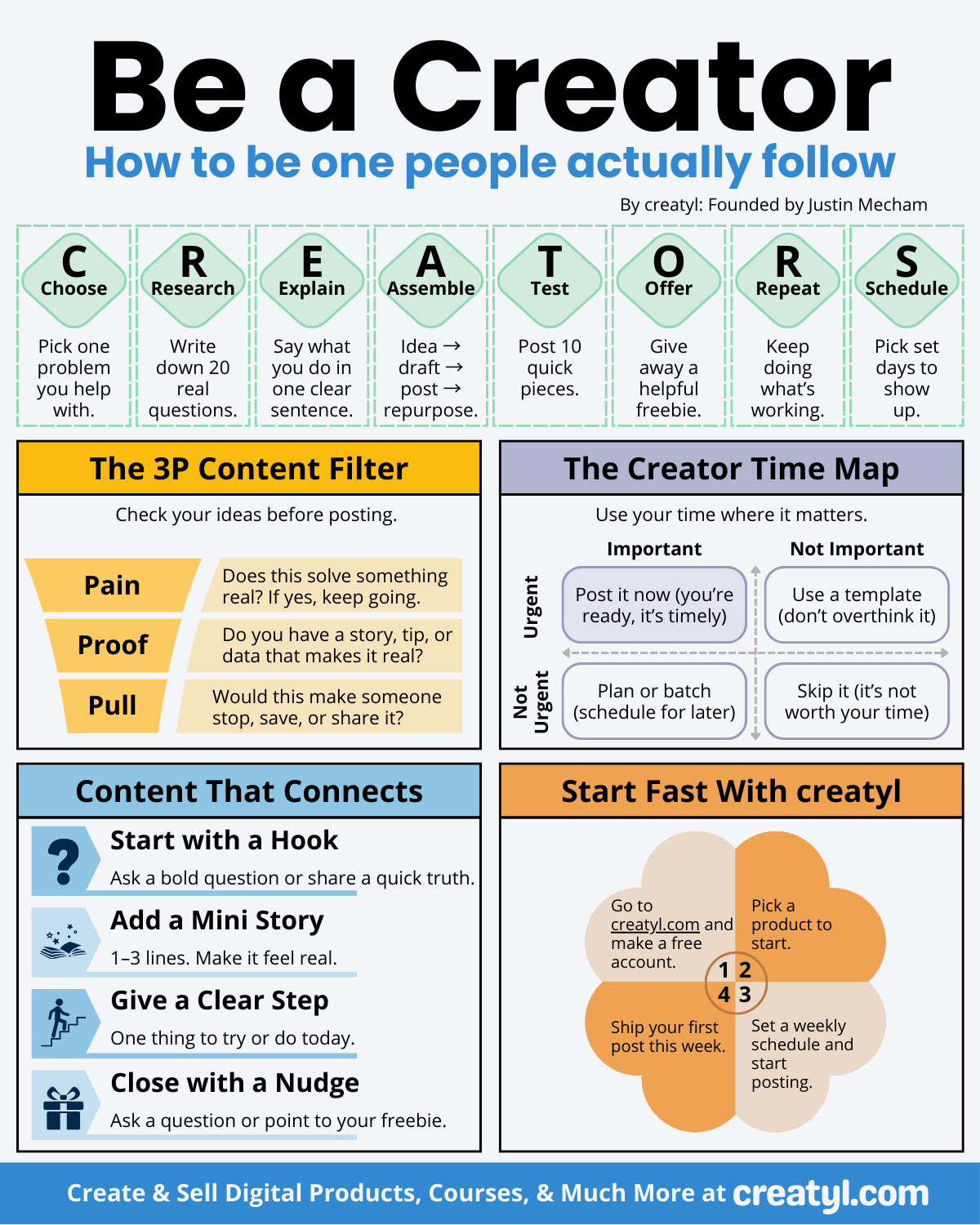
The Simple Path: Choose, Research, Explain, Assemble, Test, Offer, Repeat, Schedule
This is the backbone of content people trust.
It works because it mirrors how people decide.
People want to understand you first, then decide if you are for them, then take a small step.
Here’s how each part works in real life.
1) Choose
Pick one problem you want to be known for solving.
Not ten.
Not a general category.
One problem that shows up often, causes stress, and has a clear “after” state.
A good choice usually sounds like this:
- “I help people stop ____.”
- “I help people get ____ without ____.”
- “I help people avoid ____.”
This step matters because it gives your content a spine.
Without it, you end up posting whatever you thought of that day.
2) Research
Research does not mean reading more.
It means collecting real questions from real people.
Your job here is to gather the language your audience already uses.
Write down:
- questions people ask in comments and DMs
- phrases people repeat when they describe the problem
- what they tried before and why it didn’t work
- what they want most, in plain words
This is how your content starts to feel like it was written “for them.”
Because it was.
3) Explain
Explain what you do in one sentence.
Not a bio full of titles.
Not a long story.
One sentence that is clear enough that a stranger could repeat it.
A strong one-sentence explanation has:
- who you help
- the problem
- the result
When you can’t say it simply, content stays scattered because you don’t have a clear center.
4) Assemble
Now you turn your raw material into posts.
This is where many creators freeze because they think every post must be new.
It doesn’t.
You can assemble content by reshaping what you already know:
- turn one question into one post
- turn one answer into a short checklist
- turn one mistake into a warning
- turn one win into a simple step-by-step
Assembly is not creativity pressure.
It’s organizing.
5) Test
Testing means you post small pieces on purpose.
Not big essays every time.
Not perfect threads.
Small, clear pieces that let you see what people react to.
A test post can be:
- one mistake to avoid
- one step to try
- one clear example
- one simple “before and after” result
The point is feedback.
If people ignore it, adjust the message.
If people respond, build around it.
6) Offer
Once people trust your clarity, they want a next step.
That next step can be simple:
- a free guide
- a template
- a short paid resource
- a quick product that solves one part of the problem
The offer is not pressure.
It’s a clean continuation.
You are basically saying:
“If this helped, here is the next piece.”
7) Repeat
Repeating is how you become known for something.
Most creators quit right when repetition would start working.
Repetition isn’t boring to the audience.
It’s reassuring.
They are not watching every post.
They are slowly building a picture of what you stand for.
8) Schedule
Scheduling is where this becomes sustainable.
Without a schedule, content becomes a mood.
With a schedule, it becomes a rhythm.
The goal is not to post every day.
The goal is to remove daily decision-making and keep your message consistent.
Use The 3P Filter Before You Post: Pain, Proof, Pull
This is the fastest way to stop posting “fine” content that nobody saves.
Before you post, run your idea through three questions.
Pain
Does this solve something real?
If the problem is vague, the post will feel vague.
A strong pain point is specific and common.
It shows up in daily life.
It creates stress, wasted time, lost money, or frustration.
Proof
Do you have something that makes it real?
Proof can be:
- a short story from experience
- a clear example
- a tiny case result
- a simple process that worked
- a mistake you learned from
Without proof, posts feel like opinions.
With proof, posts feel usable.
Pull
Would someone save or share this?
Pull usually comes from one of these:
- it gives a step they can try today
- it puts words to a feeling they already had
- it makes a confusing topic simple
- it shows a clean “what to do next”
If it doesn’t pull, it may still be true, but it won’t travel.
Make Content That Connects: Hook, Tiny Story, Clear Step, Nudge
This is a structure that keeps your posts human without turning them into long diaries.
Start With A Hook
A hook is not clickbait.
It’s a clear opening that makes people feel:
“This is for me.”
A strong hook usually does one of these:
- names the real problem directly
- challenges a common mistake
- offers a clear outcome
- tells a hard truth in simple words
Add A Tiny Story
A tiny story is one to three lines that makes it real.
It can be:
- what happened with a client
- what you noticed in your own work
- what most people do that backfires
- what changed when one thing was done differently
The story is not decoration.
It is the emotional proof that makes people pay attention.
Give One Clear Step
One step beats ten ideas.
People don’t act when they feel overloaded.
A clear step is something a person can do today in under fifteen minutes.
If your post ends and the reader doesn’t know what to do next, trust can’t grow.
Close With A Nudge
A nudge is not begging for engagement.
It’s a clean direction:
- a question that helps them apply it
- an invitation to try the step
- a simple next action that fits the topic
It keeps the conversation moving without being pushy.
Use Your Time Wisely: The Creator Time Map
Creators burn out when everything feels urgent.
This time map gives you rules so you don’t have to decide every day.
If It’s Urgent And Important
Post it now.
This includes timely lessons, fast feedback, or something that matches what people are already thinking about this week.
If It’s Important But Not Urgent
Schedule it.
These are your best posts: deeper lessons, clear teaching, and anything you want to be known for long term.
Scheduling protects your future self.
If It’s Urgent But Not Important
Template it.
This is where many creators waste time.
Quick posts that still need to go out, but don’t deserve full creative energy.
Templates keep you consistent without draining you.
If It’s Neither
Skip it.
Not everything needs to become content.
Skipping is not laziness.
It’s focus.
Start Fast With One Simple System
If you want this to work, you need a simple home base where you can:
- build your offer
- share it
- keep your content organized
- keep going without adding tools every month
The best system is the one that keeps you moving.
Start simple:
- pick one product format
- make one offer
- ship one post this week
- set a weekly rhythm you can keep
When systems are simple, consistency becomes normal.
When Content Wasn’t Working Because The Message Was A Mess
They were a marketing team inside a service business with strong results and happy clients, but their content was not translating into trust.
They posted often.
They rotated topics constantly.
They tried trends, tips, and thought pieces.
People would like posts sometimes, but very few would inquire.
Even fewer would buy.
The team kept saying, “We need to post more.”
But the real issue was that the audience could not clearly explain what the business did.
Over time, frustration grew.
Meetings turned into debates about what to post next.
Each person had a different opinion, so the message kept shifting.
New posts contradicted old ones without meaning to.
The audience was not sure who the content was for.
They were not sure what problem the business solved.
They were not sure what step to take.
And when people are unsure, they don’t act.
They scroll.
They stopped chasing volume and built a clarity system.
First, they wrote one clean sentence about what they help with, using plain words.
Then they collected real questions from real customer calls and messages and used those exact questions as the content plan.
Before posting, they ran each idea through the 3P filter:
- pain had to be clear
- proof had to be real
- pull had to be obvious
They used a simple structure for every post:
- hook that names the issue
- tiny story that makes it feel real
- one clear step
- a clean nudge that points to the next action
They also used the time map:
- urgent and important posts went out quickly
- important posts were scheduled
- repeat topics became templates
- low-value ideas were skipped
Within weeks, engagement became more useful, not just higher.
People started saying, “This is exactly what I needed,” because the message was finally consistent.
And inquiries improved because the next step was clear.
The work did not get harder.
It got simpler.
That’s why it worked.
Tools That Make Clarity Easier To Keep
Here are simple tools that support clarity without making your process heavy.
- A one-sentence positioning doc: One page that states who you help, the problem, the result, and what you offer. Keep it visible while writing.
- A question bank: A running list of real questions your audience asks. This becomes your content plan.
- A post template: Hook, tiny story, one step, nudge. When you have a template, you write faster and stay consistent.
- A simple content board: To write, scheduled, posted. If you can see your pipeline, you stop overthinking it.
- One platform for your offer: Wherever you build, keep it simple enough that you can ship without tech headaches.
Clarity Is A Form Of Respect
The Creators People Trust Don’t Make Others Work Hard To Understand Them
A lot of creators believe trust is earned by showing up nonstop.
But trust is earned when people feel safe that you will be clear.
Clear about what you do.
Clear about who you help.
Clear about what matters.
Clear about what to do next.
When your message is consistent, the audience relaxes.
They stop guessing.
They stop trying to decode you.
They start listening.
That is what makes people follow.
Not because you were loud.
Because you were understandable.
Clarity is what turns content into connection.
And connection is what turns a creator into someone people come back to.
Download The “Be A Creator” Infographic (PDF)
If you want a simple visual reference you can use while planning and posting, download the infographic connected to this article.
Download the Be A Creator infographic (PDF)
Keep it nearby.
Use it as a quick filter before you post, so your content stays clear, helpful, and easy to trust.