

Click Here to Download the PDF.
Most creators believe they need more ideas.
They assume the reason they are not earning from their knowledge is because they haven’t found the “right” topic yet.
So they keep brainstorming.
They keep collecting notes.
They keep outlining new concepts they might teach someday.
But the real problem is rarely a lack of ideas.
The real problem is a lack of structure.
Many people already know enough to help others.
They’ve solved problems.
They’ve learned shortcuts.
They’ve developed systems that make their work easier.
But that knowledge sits scattered across posts, notes, and conversations.
Without structure, even valuable knowledge feels confusing.
People can’t follow it.
People don’t know where to start.
People don’t know what comes next.
And when a path is unclear, sales disappear.
That’s why the most successful creators don’t simply produce more content.
They build a path.
A path that takes someone from curiosity to results.
A path that shows where to start, what to learn next, and how to go deeper.
This is what turns knowledge into revenue.
Not more ideas.
A clearer ladder.
Why Most Knowledge Never Becomes Income
Knowledge only becomes valuable when someone else can use it.
Many experts accidentally overwhelm their audience because they try to teach everything they know.
They post large frameworks, long explanations, and complex systems that only make sense after months of context.
But beginners don’t need the entire system.
They need the first step.
Imagine someone standing at the base of a staircase.
If they can’t see the first step clearly, they won’t start climbing.
Even if the staircase leads somewhere incredible, confusion stops them immediately.
That’s what happens when creators share ideas without structure.
Information is present.
But direction is missing.
A value ladder solves this problem by turning scattered knowledge into a guided journey.
Each step solves one problem and leads naturally to the next.
The ladder becomes the map.
The Power Of One Real Problem
Every strong value ladder begins with a single decision.
Choose one real problem.
Not a broad subject like productivity, marketing, or leadership.
Those are categories, not problems.
A real problem is something people encounter repeatedly in their daily work.
It might sound like:
“How do I organize my week so I stop missing deadlines?”
“How do I respond to difficult clients without sounding defensive?”
“How do I create a simple project plan that my team actually follows?”
These problems appear in conversations, emails, and meetings all the time.
They are not theoretical.
They are practical.
When you build around one clear problem, everything becomes easier:
- The promise becomes clear
- The lessons become obvious
- The result becomes measurable
And most importantly, buyers understand immediately what they are getting.
If the problem description is fuzzy, the product will feel fuzzy too.
Clarity always begins with the problem.
Turning One Skill Into A Value Ladder
Once you know the problem you are solving, the next step is building the ladder.
A ladder is simply a sequence of learning experiences.
Each step provides one specific outcome and prepares the learner for the next level.
The ladder structure is simple but powerful.
Step 1: Free Tips
The first step provides a quick win.
Free tips introduce the idea and show that progress is possible.
These might be short posts, videos, or quick explanations that help someone solve a small piece of the problem.
The goal of free content is not to teach everything.
The goal is to help someone experience a small improvement quickly.
That improvement builds trust.
When someone experiences a useful insight or solves a small issue because of your content, they start to believe your guidance can help them further.
Step 2: The Micro-Course
A micro-course solves one result completely.
Instead of covering an entire field, it focuses on a single outcome.
For example:
- Organize your weekly schedule in 30 minutes
- Write client emails that get faster responses
- Build a simple project tracker in Google Sheets
A micro-course usually contains a handful of short lessons that walk through the exact steps required to achieve the result.
It is practical and focused.
Because the scope is small, people can complete it quickly and feel real progress.
That feeling of completion is powerful. It turns curiosity into confidence.
Step 3: The Full Course
The full course expands the system.
Once someone experiences the result of the micro-course, they are ready for deeper learning.
A full course shows the larger framework behind the result.
It explains the complete method, tools, and strategies that support long-term success.
Instead of teaching one outcome, it teaches the full plan.
People who reach this stage are usually more committed because they already trust the process.
They’ve seen results. Now they want the bigger picture.
Step 4: Membership And Ongoing Support
The final step provides continued guidance.
A membership community allows learners to stay connected while applying what they’ve learned.
Members can ask questions, share progress, and receive feedback as they implement the system in real situations.
This step transforms a one-time learning experience into an ongoing relationship.
People stay not just for information but for support, accountability, and improvement.
And this steady support often becomes the most sustainable revenue source in the entire ladder.
Why Each Step Needs One Promise
One of the most common mistakes creators make is packing too many outcomes into a single product.
When a course promises to solve everything, buyers feel uncertain about where to begin.
Clear products make one promise.
For example:
- A free guide might promise a quick win
- A micro-course might promise one specific result
- A full course might promise a full system
- A membership might promise consistent support
When each step has one promise, the path becomes easy to follow.
People know exactly what they will gain and when they will gain it.
That clarity removes hesitation.
Making The Next Step Obvious
A ladder only works if each step points clearly to the next.
Imagine finishing a useful course and wondering what to do afterward.
That confusion breaks momentum.
Strong creators solve this by designing the path intentionally.
Every step answers the same question:
“What should I do next?”
Free tips introduce the micro-course.
The micro-course introduces the full course.
The full course introduces the membership.
Each step flows naturally.
No guessing.
No confusion.
Just progress.
Let Results Lead The Conversation
Many creators believe their content must constantly explain their expertise.
But audiences trust results more than explanations.
Instead of constantly talking about what you know, show what your method achieves.
Share progress stories.
Share real examples.
Share wins, lessons, and outcomes.
When people see consistent progress from your method, trust builds quickly.
A helpful balance often looks like this:
Most content focuses on practical progress and results.
A smaller portion explains the process behind those results.
This combination keeps your work grounded and believable.
People see that the ideas actually work.
Turning Ideas Into Products
Once your ladder exists conceptually, building the products becomes straightforward.
Start with free insights that solve quick problems.
Watch how people respond. Notice which ideas create questions or excitement.
Those responses shape the micro-course.
The micro-course becomes a focused teaching experience with short lessons solving one outcome.
From there, the full course expands the method into a complete framework with tools and deeper explanations.
Finally, the membership allows learners to stay connected while applying the system in real situations.
The ladder grows naturally because each step responds to what people actually need.
Building Your Ladder Step By Step
The practical process looks like this:
- Set up your space where your products will live.
- Launch a micro-course focused on one clear problem.
- Expand the course into a larger system if people want deeper learning.
- Offer ongoing support through a membership where learners can continue improving.
This approach avoids overwhelm.
Instead of building everything at once, you expand only what proves valuable.
From Chaos To Clarity: 3 Real Workplace Examples
Example 1: Turning A Communication Skill Into A Micro-Course
A manager constantly receives unclear updates from team members.
Meetings become long and frustrating because everyone interprets information differently.
Deadlines slip simply because people misunderstand priorities.
The manager develops a simple communication framework that helps employees structure updates clearly.
They turn the framework into a short micro-course showing exactly how to prepare concise updates and share the right information during meetings.
Within weeks, team communication improves and meetings become shorter and more productive.
Example 2: Packaging A Process Into A Full Course
A marketing specialist spends hours organizing campaign data every month.
New team members struggle to replicate the process, leading to inconsistent reports and wasted time.
The specialist documents the system step by step, recording short lessons explaining how to gather data, organize reports, and present results clearly.
The training becomes a full course that helps other teams build accurate reporting systems quickly.
Example 3: Building A Membership Around Ongoing Support
A freelance consultant frequently answers the same strategic questions from clients.
Each conversation repeats similar advice, but clients still need guidance while implementing the strategies.
The consultant creates a membership community where clients can ask questions weekly, share progress, and receive feedback.
The membership becomes a steady support space that helps clients continue improving long after the initial lessons.
Recommended Resources For This Topic
Book
The Mom Test — Rob Fitzpatrick
A widely respected guide on validating ideas by asking questions that reveal real needs rather than polite encouragement.
TED Talk
The Power Of Vulnerability — Brené Brown
A powerful talk about courage and authenticity, reminding creators that meaningful work often requires sharing imperfect progress.
Podcast
Lenny’s Podcast — Hosted By Lenny Rachitsky
A podcast focused on product development and creator strategy, featuring conversations with people who build successful digital products.
AI Tool
ChatGPT — OpenAI
A versatile tool for organizing knowledge, outlining lessons, and structuring product ideas into clear learning experiences.
Tool
SurveyMonkey — Founded By Ryan Finley, Chris Finley, And Dave Goldberg
A simple way to collect feedback and confirm whether a product idea solves a real problem before investing time building it.
TV Show
Shark Tank — Created By Mark Burnett
A show that highlights how entrepreneurs present ideas clearly and demonstrate value quickly when pitching products.
Knowledge Becomes Revenue When It Becomes A Path
Many people spend years collecting knowledge without realizing how valuable it already is.
They learn through experience.
They solve problems repeatedly.
They develop systems that make their work easier.
But knowledge alone does not create value.
Value appears when knowledge becomes usable.
When someone else can follow it.
When someone else can apply it.
When someone else can achieve a result because the path is clear.
That clarity is what transforms experience into something larger than a personal skill.
It turns it into guidance that others can trust.
And when people trust a path, they follow it.
The journey from knowledge to revenue is rarely about discovering new ideas.
It is about organizing what you already know in a way that people can understand and act on.
When each step solves a real problem and leads naturally to the next, the path begins to feel natural.
People move forward because progress is visible.
They continue because the next step makes sense.
They stay because the system continues helping them improve.
That is the quiet power of a well-built ladder.
It turns scattered ideas into a guided journey.
And when a journey leads to real results, people are happy to invest in continuing it.
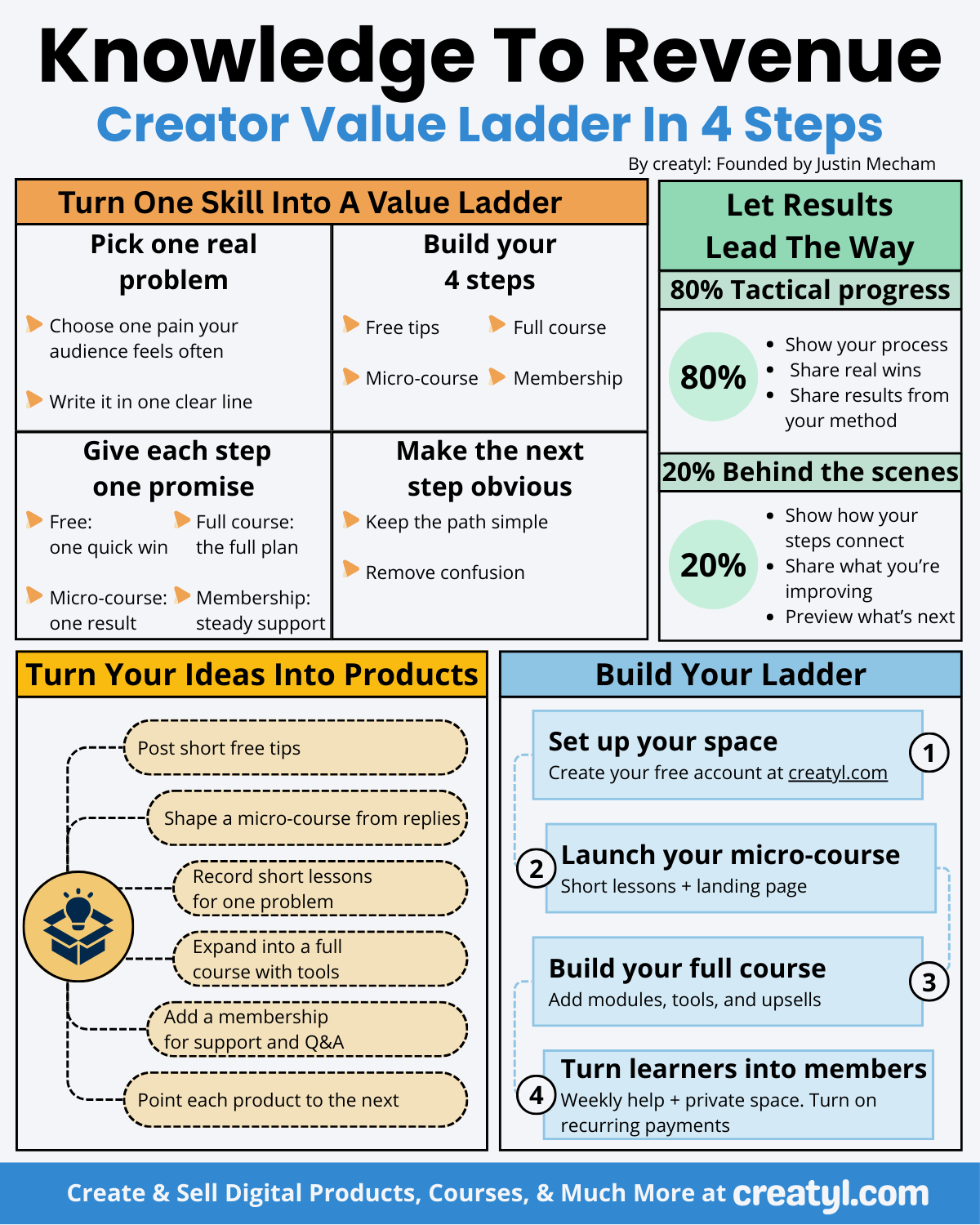
Download The Infographic (PDF)
If you would like a visual reference for the Knowledge To Revenue value ladder, you can download the infographic as a PDF and keep it for quick reference while building your own ladder.