

Click Here to Download the PDF.
The Biggest Myth Keeping People From Creating a Course
Thousands of potential creators never launch their first course for one simple reason:
They believe teaching online requires becoming a content creator.
They imagine cameras.
Lighting.
Microphones.
Video editing.
Daily social media posts.
Perfect confidence.
An engaging personality.
A polished studio.
And because they do not have those things, they convince themselves they are not ready.
So the idea stays trapped in a notebook.
Or buried inside a folder called "Course Ideas."
Or delayed until some future version of themselves finally feels confident enough.
The problem is that confidence is not what creates successful courses.
Clarity does.
People do not buy courses because the creator has perfect hair, expensive equipment, or a charismatic on-camera presence.
People buy courses because they have a problem and believe someone can help solve it.
That realization changes everything.
The internet has quietly created an opportunity that many people still overlook.
You can build an entire education business without ever appearing on camera.
You can teach through writing.
You can teach through systems.
You can teach through templates.
You can teach through frameworks.
You can teach through guided exercises.
You can teach through your thinking.
The truth is simple:
People are not paying for your face.
They are paying for your solution.
And that opens the door for a completely different kind of creator.
One who prefers clarity over performance.
One who values teaching over attention.
One who wants to help people without becoming an online celebrity.
Why Most People Underestimate What They Already Know
One of the most common objections aspiring course creators have is:
"I don't know enough."
Yet these same people regularly solve problems that others struggle with every day.
They:
- Organize projects better.
- Write stronger emails.
- Manage teams more effectively.
- Build spreadsheets faster.
- Create systems more efficiently.
- Make better hiring decisions.
- Design better workflows.
- Plan events successfully.
- Manage finances intelligently.
- Navigate career transitions confidently.
Because these skills feel normal to them, they assume they have little value.
This is known as the curse of knowledge.
Once you become familiar with something, you forget how difficult it was to learn.
You stop seeing your expertise because you live with it every day.
But expertise is often hidden in the questions people repeatedly ask you.
Think about it.
What do friends ask you for help with?
What do coworkers come to you for?
What problems do you solve without much effort?
Those questions often reveal opportunities hiding in plain sight.
The Shift That Changes Everything
Most people think:
"I need to create a course."
Successful creators think:
"I need to solve a problem."
Those are very different approaches.
The first focuses on content.
The second focuses on outcomes.
People rarely buy information.
They buy transformation.
They buy clarity.
They buy speed.
They buy confidence.
They buy certainty.
They buy relief.
When you focus on helping someone move from one situation to a better one, course creation becomes much simpler.
Instead of asking:
"What should I teach?"
Ask:
"What problem can I solve?"
That question creates an entirely different business.
Faceless Course Model #1: The Email-Only Course
One of the simplest and most overlooked course formats is an email course.
Many people dismiss email because it feels too simple.
That is exactly why it works.
A great email course delivers one lesson at a time.
Instead of overwhelming students with twenty videos and hundreds of resources, it provides focused guidance delivered over several days or weeks.
Imagine someone trying to improve their LinkedIn profile.
Rather than creating hours of video content, you could create:
Day 1: Profile headline.
Day 2: About section.
Day 3: Experience section.
Day 4: Content strategy.
Day 5: Networking outreach.
Each lesson solves one problem.
Each email creates one small win.
The experience feels manageable.
Students stay engaged.
And the creator avoids the complexity of producing video content.
The lesson here is important:
Simple delivery often creates better completion rates than complicated delivery.
Faceless Course Model #2: The Step-by-Step Playbook
Many valuable skills are really just repeatable processes.
If you have developed a system that consistently produces results, you already have the foundation for a course.
People are often searching for:
- Clear directions.
- Proven sequences.
- Decision frameworks.
- Action steps.
They want certainty.
They want a roadmap.
They want someone to shorten the learning curve.
A playbook course organizes knowledge into a logical path.
Not theory.
Not inspiration.
A practical series of steps.
For example:
How to launch a newsletter.
How to prepare for an interview.
How to create a personal budget.
How to onboard new employees.
How to build a digital product.
The more structured the path, the more valuable the course becomes.
Faceless Course Model #3: The Template-Based Course
Templates solve a powerful problem.
They remove decision fatigue.
People love shortcuts.
Not because they are lazy.
Because they are busy.
A template-based course provides reusable assets that help learners get results faster.
Examples include:
- Proposal templates.
- Sales email templates.
- Meeting agenda templates.
- Hiring scorecards.
- Content calendars.
- Customer onboarding documents.
- Project management systems.
The teaching becomes easier because the template does much of the heavy lifting.
Instead of explaining every concept from scratch, you provide a proven structure people can adapt immediately.
The result is faster implementation and stronger perceived value.
Faceless Course Model #4: Text and Slides Courses
Many aspiring creators believe courses require video.
They do not.
Some of the most effective learning experiences rely heavily on written explanations supported by visuals.
Text and slide courses work particularly well for:
- Frameworks.
- Business processes.
- Career development.
- Productivity systems.
- Strategic thinking.
The beauty of this format is that it prioritizes clarity.
Students move at their own pace.
They can reread concepts.
They can revisit lessons.
They can absorb information without distractions.
For creators uncomfortable on camera, this approach removes one of the largest barriers to entry.
Faceless Course Model #5: Problem-Solving Courses
Some problems do not require information.
They require decisions.
A problem-solving course guides learners through a series of questions, exercises, and reflections.
Instead of telling people what to do, it helps them discover their own answers.
Examples include:
- Career change decisions.
- Business idea validation.
- Leadership development.
- Goal setting.
- Personal productivity.
These courses feel more like guided thinking than traditional teaching.
And because they encourage active participation, they often produce deeper results.
Faceless Course Model #6: Written Coaching Courses
Many people want support but do not necessarily want live coaching.
Written coaching creates a middle ground.
Lessons include:
- Reflection prompts.
- Exercises.
- Journaling questions.
- Action plans.
Students work through the material independently while still benefiting from structured guidance.
This model is particularly effective because it scales far better than one-on-one coaching.
You help many people while maintaining a manageable workload.
Faceless Course Model #7: Systems and Fixes Courses
People often learn fastest when they understand what goes wrong.
That is why troubleshooting courses can be incredibly valuable.
Think about any process you know well.
There are likely:
- Common mistakes.
- Frequent roadblocks.
- Predictable failures.
- Repeated misunderstandings.
A systems and fixes course addresses those issues directly.
For example:
Setup.
Common Problems.
Solutions.
Advanced Improvements.
This structure feels practical because it mirrors real-world challenges learners experience.
Faceless Course Model #8: Behind-the-Scenes Thinking
This may be the most valuable course format of all.
Most people teach what they do.
Very few teach how they think.
Yet decision-making is often the most valuable skill in any profession.
People want to understand:
Why did you choose that strategy?
How did you evaluate the options?
What signals mattered most?
How did you make the final decision?
Teaching your thinking creates a level of insight that generic information cannot match.
Knowledge is common.
Judgment is rare.
And rare things are valuable.
The Biggest Mistake New Course Creators Make
Many creators try to build a university before proving anyone wants the first lesson.
They create:
- 30 modules.
- 100 videos.
- Multiple bonuses.
- Complex funnels.
- Endless resources.
Months pass.
Then they launch.
And nobody buys.
Not because the content is bad.
Because they built before validating.
The smarter approach is simple:
Start with three lessons.
One problem.
One audience.
One outcome.
Then gather feedback.
Expansion should come after demand, not before.
A Real-Life Example
A project manager wanted to create an online business.
She believed she needed to record professional video lessons and appear on camera regularly.
The thought of filming herself made her uncomfortable.
As a result, she delayed the project for nearly a year.
Every month she continued researching.
Watching tutorials.
Taking courses.
Buying software.
Planning endlessly.
Meanwhile, other creators with less expertise were launching products and collecting feedback.
Her knowledge remained trapped because she believed visibility was more important than value.
Eventually she created a simple written course teaching project planning templates and meeting systems.
The course contained:
- Written lessons.
- Downloadable templates.
- Reflection exercises.
- Step-by-step workflows.
No video.
No camera.
No fancy production.
Within weeks she had paying customers.
The breakthrough was not confidence.
The breakthrough was realizing people wanted solutions more than they wanted a performance.
Your 7-Day Faceless Course Challenge
If you have been waiting for confidence before creating, try this instead.
Day 1
Write down five problems you can solve.
Day 2
Choose the one people ask you about most.
Day 3
Outline three lessons.
Day 4
Create one worksheet, checklist, or template.
Day 5
Write the lessons.
Day 6
Upload everything to a platform.
Day 7
Share it with ten people.
Not a perfect course.
A real course.
That distinction matters.
Resources to Help You Build a Faceless Education Business
Book Recommendation
Show Your Work! by Austin Kleon
A powerful reminder that sharing knowledge creates opportunities, even when you prefer a quieter approach.
TED Talk Recommendation
The Power of Vulnerability by Brené Brown
An excellent exploration of why waiting for perfect confidence often prevents meaningful action.
Podcast Recommendation
The Futur Podcast
Practical conversations about education, creativity, expertise, and building businesses around knowledge.
Tool Recommendation
creatyl
A simple platform for organizing, publishing, and selling digital products, courses, memberships, and
educational resources without unnecessary complexity.
The World Does Not Need More Influencers. It Needs More Teachers.
Many people are carrying knowledge that could genuinely improve someone else's life.
A lesson.
A framework.
A shortcut.
A system.
A way to avoid mistakes.
A path through confusion.
Yet that knowledge stays hidden because they believe teaching requires becoming a performer.
It does not.
Some of the most valuable teachers are not the loudest.
They are not the most visible.
They are not the most entertaining.
They are simply clear.
They help people solve problems.
They make difficult things easier to understand.
They create progress.
That is what people pay for.
The internet has created an extraordinary opportunity for thoughtful, knowledgeable people who would rather teach quietly than perform loudly.
You do not need a camera.
You do not need a studio.
You do not need thousands of followers.
You do not need to become someone else.
You simply need a problem you can solve and a willingness to share what you already know.
Because faceless does not mean invisible.
And quiet expertise is still expertise.
The people waiting for your solution do not care whether you are on camera.
They care whether you can help them move forward.
That is where great courses begin.
Download the Related Infographic
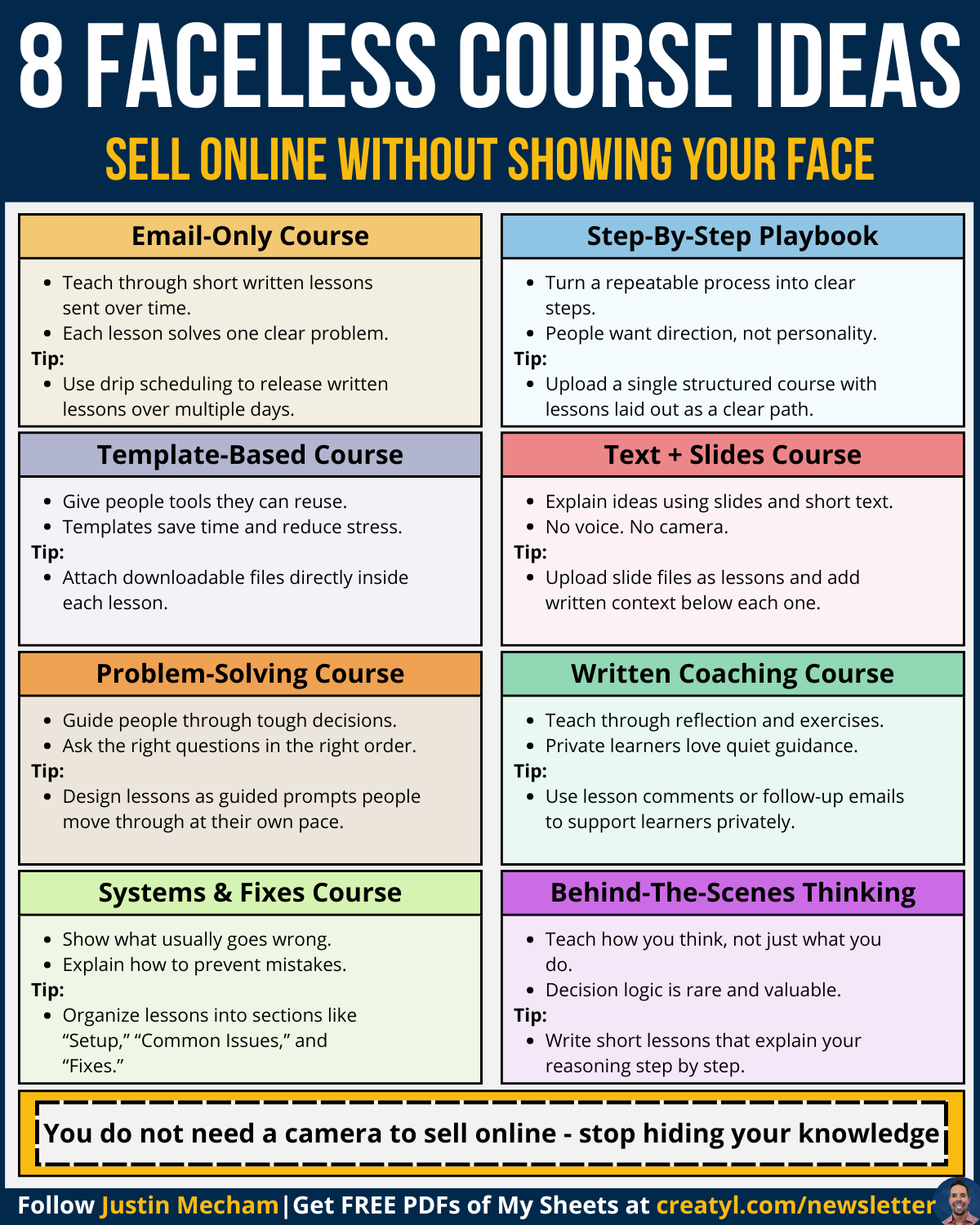
Want a visual guide to these eight faceless course models?
Download the 8 Faceless Course Ideas infographic PDF and use it as a blueprint for creating your first course without ever stepping in front of a camera.