

Click Here to Download the PDF.
Most Great Products Don't Start With Brilliant Ideas. They Start With Someone Saying, "This Is So Annoying."
People spend years looking for the perfect business idea.
The unique idea.
The disruptive idea.
The idea nobody has ever thought of before.
Ironically, that's usually the wrong place to look.
The products that quietly generate thousands or even millions of dollars often don't begin with inspiration.
They begin with irritation.
Someone is frustrated.
Something takes too long.
A process is confusing.
A repetitive task feels painful.
A question keeps coming up.
Those moments are easy to ignore because they feel ordinary.
But ordinary problems create extraordinary businesses.
Think about many of the products you use every day.
Most weren't created because someone dreamed up something revolutionary.
They were created because someone noticed a recurring inconvenience and decided to remove it.
The best entrepreneurs aren't idea generators.
They're problem collectors.
Once you understand that shift, finding product ideas becomes dramatically easier.
You stop asking:
"What should I build?"
And start asking:
"What keeps making people's lives harder than it needs to be?"
That single question changes everything.
Why Most People Never Find a Great Product Idea
The biggest mistake aspiring creators make isn't choosing the wrong product.
It's choosing products based on excitement instead of evidence.
Excitement is addictive.
It convinces us our newest idea is the one.
Until nobody buys it.
Then we convince ourselves the next idea will be different.
This cycle repeats because we're brainstorming in isolation.
Real businesses aren't built from imagination alone.
They're built from observation.
Customers rarely wake up wishing for new products.
They wake up wishing existing problems would disappear.
Your job isn't to invent demand.
It's to recognize it.
Stop Brainstorming. Start Listening.
One complaint repeated several times is worth more than one hundred random ideas.
Why?
Because complaints reveal pain.
Pain creates urgency.
Urgency creates buying behavior.
Pay attention when you hear phrases like:
"I hate doing this."
"There has to be an easier way."
"I keep wasting time on..."
"I wish someone would..."
"This shouldn't be this difficult."
Every one of those statements is market research happening in real time.
The more frequently you hear them, the stronger the signal becomes.
Great founders don't chase inspiration.
They document frustration.
Step 1: Empty Your Brain Before You Judge Your Ideas
One reason people struggle to generate ideas is because they edit while they think.
Every new thought gets filtered through questions like:
Would anyone buy this?
Has someone already done it?
Is this good enough?
That internal editor kills creativity before it starts.
Instead, separate idea generation from idea evaluation.
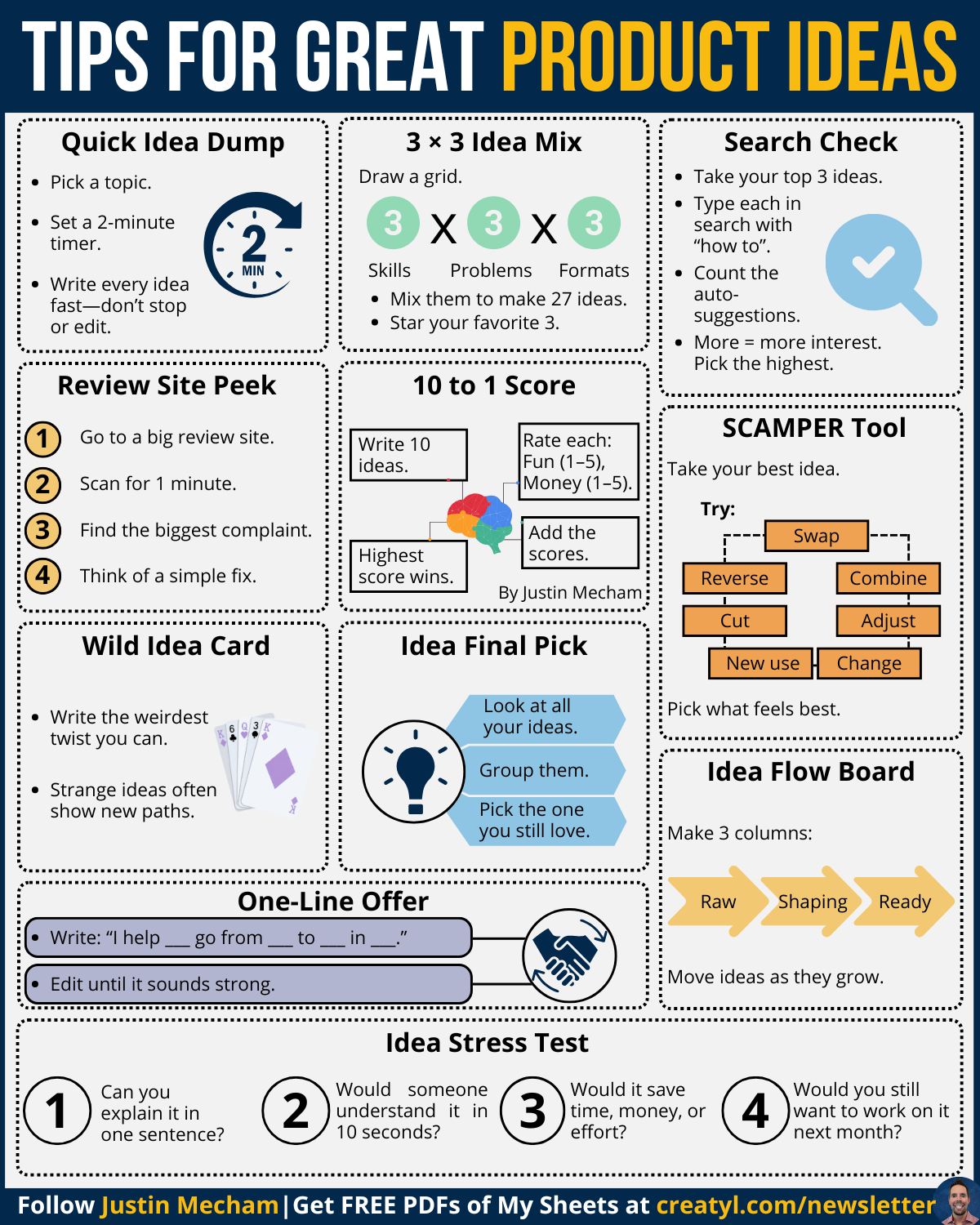
Set a timer for two minutes.
Write every possible product idea as quickly as you can.
Don't organize.
Don't improve.
Don't delete.
Don't judge.
Your only objective is volume.
Most people are surprised by what appears once they stop trying to sound smart.
The first ideas are obvious.
The best ideas usually arrive after those.
Step 2: Use the 3×3×3 Method
One of the fastest ways to generate dozens of product ideas is by combining three simple lists.
Write down:
Three skills you have.
Examples:
- Writing
- Project management
- Graphic design
Now list three problems people frequently experience.
Examples:
- Finding clients
- Managing time
- Learning AI
Finally, write three delivery formats.
Examples:
- Template
- Checklist
- Mini course
Now mix every combination together.
Writing + Time Management + Checklist
Graphic Design + Client Acquisition + Template
Project Management + AI + Mini Course
Three skills.
Three problems.
Three formats.
Twenty-seven possible products.
Most won't be great.
They don't need to be.
You only need one.
Step 3: Let the Internet Tell You What People Want
Many creators spend weeks guessing what customers need.
Customers have already answered the question.
You simply need to look.
Some of the best places to discover product ideas include:
Amazon reviews
App Store reviews
Google reviews
Reddit communities
Quora questions
YouTube comments
LinkedIn comments
Facebook groups
Product reviews are especially valuable because people voluntarily explain:
What they loved.
What disappointed them.
What still isn't solved.
Every negative review is an opportunity.
Every repeated complaint is a roadmap.
If dozens of people mention the same frustration, you've discovered a market signal.
Step 4: Score Your Ideas Instead of Falling in Love With Them
Entrepreneurs often become emotionally attached to ideas long before validating them.
That's dangerous.
Instead of asking:
"Do I like this?"
Ask two better questions:
Would I genuinely enjoy building this?
Would someone realistically pay for this?
Score every idea from 1 to 5 on both.
Enjoyment matters because you'll likely spend months improving it.
Market demand matters because hobbies don't automatically become businesses.
The highest scoring ideas deserve attention.
The rest become future possibilities.
Remember:
You don't need more ideas.
You need better filters.
Step 5: Simplify Your Offer Until Anyone Can Repeat It
If someone asks what you do, can you explain it clearly in one sentence?
Many creators can't.
Complexity doesn't sound intelligent.
It sounds confusing.
A useful framework is:
I help ______ go from ______ to ______ in ______.
Examples:
I help freelancers go from inconsistent income to steady monthly clients in 90 days.
I help busy managers go from chaotic meetings to organized workflows using simple templates.
I help first-time creators turn their knowledge into digital products in one weekend.
Simple sells.
People don't buy complexity.
They buy clarity.
The Four Stress Tests Every Product Should Pass
Before building anything, challenge your idea.
1. Can you explain it in one sentence?
If not, the offer probably isn't clear enough yet.
Customers cannot buy what they don't understand.
2. Would someone understand it within ten seconds?
Attention is expensive.
Confusion is expensive.
Clarity is profitable.
3. Does it save time, money, or effort?
Most successful products improve one of these three.
Sometimes all three.
If your product doesn't create meaningful value, customers have little reason to buy.
4. Would you still want to improve it six months from now?
Building isn't a one-week project.
Choose ideas you're willing to keep making better.
The first version is only the beginning.
A Real-World Example
Emma worked in operations for a growing company.
Nearly every week, coworkers asked her the same question:
"Do you have that onboarding checklist?"
She always emailed it.
Eventually she created a cleaner version.
Then another.
Then another.
She never thought of it as a product.
It was simply something helpful.
One day she realized she'd sent the same document more than forty times.
People weren't asking because they liked talking to Emma.
They were asking because they needed the system.
She was giving away something repeatedly that clearly solved a real problem.
Yet she still believed nobody would pay for it.
Instead of continuing to send free copies, Emma expanded the checklist into a complete onboarding toolkit.
It included templates.
Email examples.
Manager guides.
Employee workflows.
She uploaded it online.
Her first customers weren't strangers.
They were people already asking for it.
The product didn't succeed because it was revolutionary.
It succeeded because demand already existed.
She simply packaged what people already valued.
Why "Boring" Products Often Win
Many creators believe products need to be exciting.
Customers disagree.
Customers want useful.
The world's most successful businesses solve surprisingly ordinary problems.
Scheduling appointments.
Managing passwords.
Creating invoices.
Writing resumes.
Tracking habits.
Organizing notes.
Planning projects.
None sound glamorous.
All solve recurring problems.
Boring problems repeat.
Repeated problems create recurring demand.
Recurring demand builds sustainable businesses.
Common Mistakes When Looking for Product Ideas
Avoid these traps:
Building Before Validating
Always gather evidence first.
Solving Problems Nobody Has
Interesting isn't enough.
Necessary wins.
Choosing Passion Over Demand
Passion helps you keep building.
Demand pays the bills.
You need both.
Making the First Version Too Large
Small products create faster learning.
Launch earlier.
Improve continuously.
Ignoring Your Existing Knowledge
People constantly underestimate what feels obvious to them.
Your everyday knowledge may be life-changing to someone just starting.
Never dismiss what comes naturally.
Resources to Help You Find Better Product Ideas
Book
The Mom Test by Rob Fitzpatrick
One of the best books on learning what customers actually want through better conversations instead of assumptions.
Podcast
How I Built This with Guy Raz
Listen to how successful founders discovered product ideas through observation, experimentation, and customer feedback rather than sudden inspiration.
AI Tool
Perplexity
Use it to research industries, summarize customer trends, identify recurring problems, and explore emerging markets with cited sources.
Weekly Exercise
Keep an "Idea Notebook."
Every time someone asks you a question, complains about something, or says, "I wish this existed," write it down.
Don't evaluate it.
Collect it.
Review the list every Sunday.
Over time, patterns begin to emerge.
Those patterns are often better business opportunities than anything you'll invent sitting alone.
Ideas Are Everywhere. Finished Products Are Rare.
People often believe successful entrepreneurs have access to better ideas.
Most don't.
They simply pay closer attention.
The next profitable product probably won't arrive during an expensive brainstorming retreat.
It may appear during lunch with a friend.
While answering a coworker's question.
Reading customer reviews.
Listening to someone complain.
Helping someone solve the same problem for the fifth time.
The opportunity is usually already there.
Most people just keep walking past it.
Stop searching for the perfect idea.
Start collecting real problems.
Start noticing repeated questions.
Start packaging the solutions you already know.
Because ideas don't become valuable the moment you think of them.
They become valuable the moment you decide to finish them.
Download the Related Infographic
Want a practical framework you can use every time you need a new product idea?
Download the Tips for Great Product Ideas infographic. It walks you through brainstorming techniques, idea validation exercises, simple scoring systems, customer research strategies, and stress tests that help you stop guessing and start building products people actually want. Keep it nearby whenever you're planning your next digital product or business idea.