

Click Here to Download the PDF.
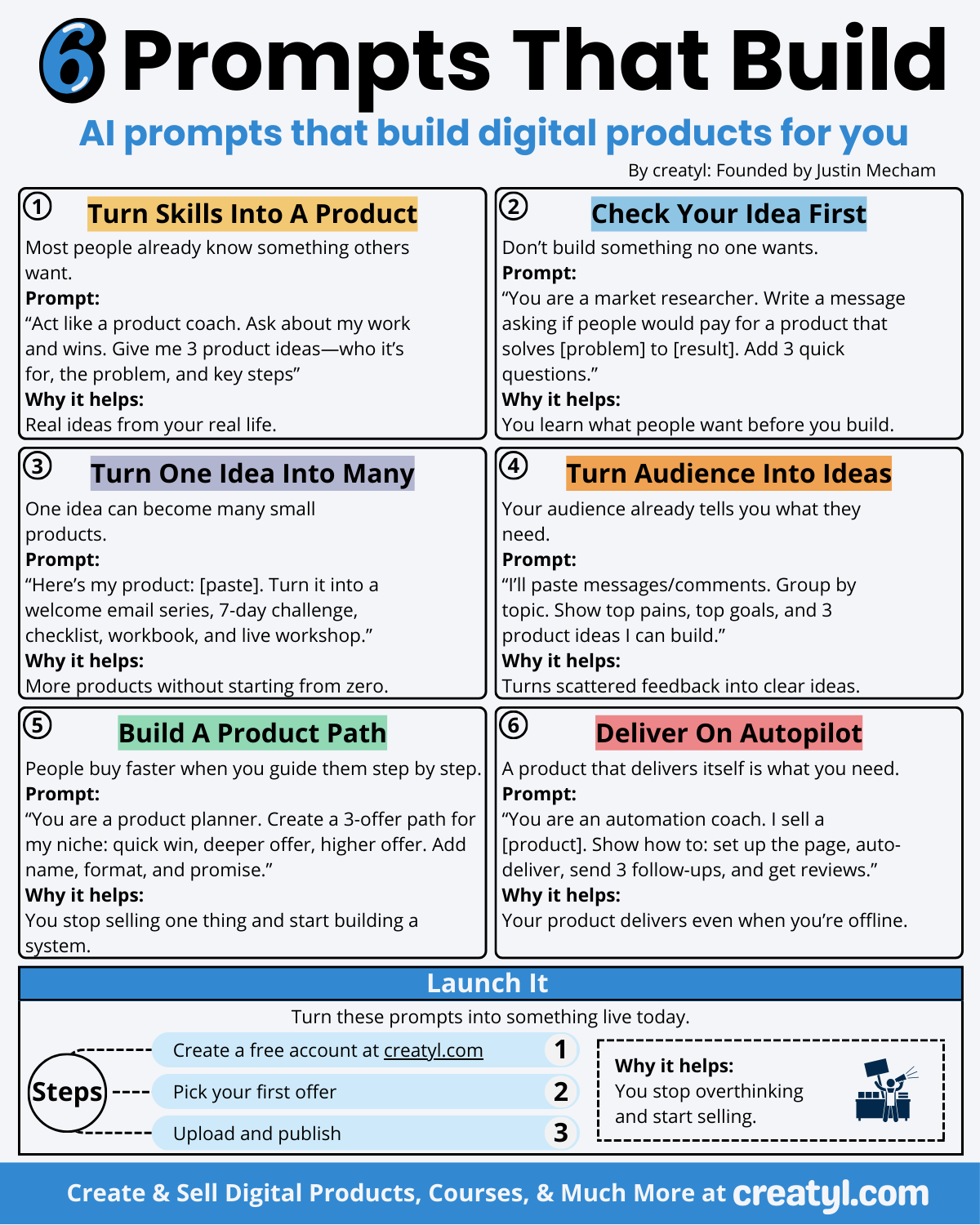
How Creators Use AI To Move From Idea To Product Fast (Without Guessing, Overbuilding, Or Burning Out)
There’s a specific kind of frustration that hits when you know you’re capable of more, but you can’t seem to get traction.
You sit down with a solid intention.
You open your laptop.
You tell yourself today is the day you finally start building something that’s yours.
And then it happens.
You stare at the blank screen.
You start overthinking.
You open ChatGPT.
You ask it for product ideas.
It gives you fifty.
They’re not bad ideas either.
They’re just not real yet.
They’re not connected to your life.
They’re not connected to what people actually pay for.
They’re not connected to what you can realistically build in a week.
So you scroll.
You save them.
You rewrite them.
You add more notes.
And by the end of the day, you feel exhausted even though you didn’t actually create anything.
That’s the part nobody talks about.
AI can make you feel productive while quietly keeping you stuck.
Not because it’s broken.
Because you’re using it like a brainstorming buddy instead of a builder.
Used the right way, AI doesn’t brainstorm forever.
It builds.
And the difference isn’t talent.
It’s not motivation.
It’s not hustle.
It’s the prompt.
A weak prompt gives you noise.
A strong prompt gives you a next step.
That’s what this article is about.
Not how to “use AI.”
But how to use prompts to turn your experience into a product people actually want, in a way that feels clear, realistic, and repeatable.
Why Most People Get Stuck Even With AI
The truth is, AI didn’t create the problem.
It just made the problem louder.
Because most people don’t have an idea problem.
They have a decision problem.
They don’t know what to build first.
They don’t know which audience to focus on.
They don’t know how to validate demand without sounding awkward.
They don’t know how to turn one good idea into something they can sell more than once.
So they do what any smart person does when they feel uncertain.
They research.
They watch videos.
They download templates.
They collect screenshots.
They bookmark threads.
They build a folder called “Product Ideas” and keep adding to it like it’s going to magically become a business one day.
But here’s what’s really happening.
They’re not building.
They’re buffering.
And AI makes buffering easier than ever.
Because you can ask for another list.
Another outline.
Another strategy.
Another content plan.
And it will always deliver.
But the creators who move fast aren’t the ones with the best ideas.
They’re the ones who use prompts to cut through the noise.
They don’t use AI to create more options.
They use AI to remove options.
They use prompts to get clarity, structure, and a clear path forward.
They ask questions that force decisions.
They ask prompts that create output.
They feed AI real information, not vague hopes.
That’s the shift.
And once you understand it, the whole process becomes simpler.
Not easy.
But clear.
The 6 Prompt System That Turns Thinking Into Selling
These six steps are not “tips.”
They’re a build system.
If you follow them in order, you stop bouncing between ideas and start moving toward something real.
The goal is not to feel inspired.
The goal is to create something that can exist outside your head.
Something you can publish.
Something people can buy.
Something that doesn’t depend on your mood to keep running.
Let’s break it down.
1) Start With What You Already Know
Turn Skills Into A Product
Most people think the secret to building a product is coming up with something new.
But the fastest products don’t come from new ideas.
They come from old proof.
Your best product idea is usually something you’ve already done for someone, even if you never called it a “product.”
Maybe you solved a problem at work and didn’t think twice about it.
Maybe you helped a friend through a hard situation.
Maybe you organized a process that saved a team weeks of time.
Maybe you created a system that made something confusing feel simple.
That’s the gold.
Because you don’t have to guess whether you can deliver results.
You already did.
Here’s the key point most people miss:
Your skill is not the product.
The outcome is the product.
People don’t buy your knowledge.
They buy the result your knowledge creates.
They buy the shortcut.
They buy the clarity.
They buy the reduced stress.
They buy the system.
So the real question isn’t “What am I good at?”
The real question is “What do people consistently come to me for?”
The Proof Inventory Exercise (The Fastest Way To Find Your Product)
If you want to find product ideas quickly, do this exercise:
Write down 10 “proof moments.”
Not achievements for your resume.
Not random skills.
Real moments when someone needed help and you delivered.
Think:
- When someone asked you to fix something
- When you cleaned up a mess
- When you explained something and it finally clicked
- When you saved time, money, or stress
- When you created a plan that worked
Then for each moment, write:
- What was the problem?
- What was at risk if it didn’t get solved?
- What did they try before you helped?
- What did you do differently?
- What changed after?
You’re not just collecting memories.
You’re collecting patterns.
And patterns become products.
Because if you solved it once, you can package it.
A Prompt That Forces Real Product Ideas (Not Fluffy Ideas)
Instead of asking AI to brainstorm, ask it to interview you.
Prompt:
Act like a product coach. Ask me questions about my work and wins. Give me 3 product ideas based on my real experience. For each idea, include who it’s for, the problem, the promise, and the key steps to build the first version.
This works because it stops AI from guessing.
It makes AI work with real evidence.
And when your product is built from proof, you feel more confident building it.
Not because you’re suddenly fearless.
Because you’re no longer making it up.
2) Check Demand Before Building
Check Your Idea First
This step is where most creators waste months.
They build something they personally love.
They put hours into it.
They polish it.
They design it.
They upload it.
Then they post it online and wait.
And when it doesn’t sell, they assume the problem is marketing.
But most of the time, the problem is simpler than that.
They built something nobody asked for.
Not because people are cruel.
Because people are busy.
People don’t buy products because they’re “good.”
They buy products because they solve a problem they already feel.
And here’s the uncomfortable truth:
Most people validate their ideas in a way that gives them false hope.
They ask questions like:
“Would you buy this?”
“Does this sound helpful?”
“Do you think this is a good idea?”
Those questions are basically invitations for someone to be nice.
People will say yes.
They’ll hype you up.
They’ll tell you it’s great.
And then they’ll disappear the moment it’s time to pay.
So creators who move fast validate differently.
They don’t ask for opinions.
They ask for proof of behavior.
Because behavior is honest.
The Only Validation That Matters
Here’s what you actually need to know:
Is this problem already costing people something?
Time.
Money.
Stress.
Missed results.
Embarrassment.
Lost opportunities.
When a problem is expensive, people pay for solutions.
When a problem is only mildly annoying, they scroll and move on.
So your job is not to convince people to want it.
Your job is to confirm they already do.
The 3 Questions That Cut Through Polite Feedback
If you want real answers, ask:
- When was the last time you dealt with this?
- What did you try first?
- What did it cost you?
These questions don’t get opinions.
They get stories.
And stories reveal the real pain.
They show you what people are already doing.
They show you what they’re already spending money on.
They show you what they’ve already failed at.
That’s what your product should solve.
The Micro-Commit Test (The Most Underrated Demand Check)
Here’s a simple trick creators use to avoid false validation:
Don’t ask “Would you buy this?”
Ask for a small action instead.
For example:
- “If I made this, would you want the first version?”
- “Reply with a number if you want me to send it.”
- “Want me to send you a draft checklist?”
- “Send a screenshot of what you currently use.”
If they won’t do a tiny action, they likely won’t buy.
It’s not personal.
It’s just reality.
A Prompt That Creates A Real Validation Message
Prompt:
You are a market researcher. Write a message I can send to people asking if they would pay for a product that solves [problem] and gets [result]. Add 3 quick questions that reveal real buying intent.
Once you collect responses, you can ask AI:
Prompt:
Here are the responses. Find the repeating pains, goals, and blocks. Show what people are really asking for. Then suggest 3 product directions with the clearest promise.
Now your product is based on demand, not hope.
That’s how you stop building into silence.
3) Multiply One Idea
Turn One Idea Into Many
One of the most freeing things you can realize as a creator is this:
You don’t need endless new ideas.
You need one strong idea that can stretch.
Most creators treat every product like it has to be a completely new concept.
So they constantly restart.
New idea.
New format.
New audience.
New marketing.
That’s exhausting.
And it’s why so many people quit.
But the best creators reuse the same core solution in multiple forms.
Because the truth is, people don’t want more content.
They want more progress.
And different people make progress in different ways.
Some want a checklist they can follow quickly.
Some want a challenge that holds their hand.
Some want a workshop where they can ask questions.
Some want an email series that guides them step by step.
Same idea.
More reach.
And when you do this right, you’re not just creating more products.
You’re building a library.
A library becomes a business.
The Format Ladder (A Simple Way To Expand Without Starting Over)
Here’s a practical way to multiply one idea:
Take your main idea and build three versions:
- A fast version
- A guided version
- A deeper version
Fast version might be a checklist or template.
Guided version might be a short email series or 7-day challenge.
Deeper version might be a workshop or mini-course.
The point is not to overwhelm people.
The point is to give them a choice that fits their life.
This also makes your marketing easier, because now you can talk about the same problem repeatedly without feeling repetitive.
You’re not repeating.
You’re packaging.
A Prompt That Creates A Product Library Fast
Prompt:
Here is my product idea: [paste]. Turn it into a welcome email series, a 7-day challenge, a checklist, a workbook, and a live workshop. For each one, give me the promise, what’s included, and the simplest version I could ship this week.
This is the kind of prompt that changes everything because it creates real output.
It doesn’t just give you “ideas.”
It gives you deliverables.
And deliverables are what make you money.
4) Let Your Audience Guide You
Turn Audience Into Ideas
Your audience is constantly giving you product ideas.
The problem is that most people don’t treat their audience like data.
They treat comments as compliments.
They treat questions as interruptions.
They treat DMs as random noise.
But those messages are the most honest market research you will ever get.
Because people rarely message creators for fun.
They message because something feels hard.
They’re stuck.
They’re confused.
They want a shortcut.
They want a clearer path.
And if you learn how to read your messages the right way, you stop guessing what to build.
You start seeing what needs to exist.
The Three-Label System That Turns Noise Into Clarity
Here’s the simplest way to sort audience messages:
Every time someone comments or sends a DM, label it as:
- Pain: what feels hard right now
- Goal: what they want next
- Block: what’s stopping them
If you do this for 30 days, patterns start to show up.
And those patterns become product opportunities.
Because repeated pain is demand.
Repeated confusion is demand.
Repeated blocks are demand.
The best creators don’t chase trends.
They solve repeats.
A Prompt That Turns Messages Into A Roadmap
Prompt:
I will paste messages and comments. Group them by topic. Show top pains, top goals, and top blocks. Then give me 3 product ideas I can build. Make the product ideas simple, practical, and easy to deliver.
This is one of the strongest uses of AI because AI is excellent at sorting chaos.
And when you can sort chaos, you can build faster.
5) Create A Clear Path To Buy
Build A Product Path
Even if your product is excellent, people will still hesitate if they don’t know what to buy first.
That’s not a sales problem.
That’s a clarity problem.
A lot of creators only offer one thing.
And it’s either too small to feel meaningful or too big to feel safe.
So buyers get stuck in the middle.
They like you.
They want help.
But they don’t know where to start.
And when people don’t know where to start, they do nothing.
They tell themselves they’ll come back later.
Later never comes.
The creators who sell consistently build something smarter.
They build a path.
A path reduces pressure.
It reduces confusion.
It reduces decision stress.
It makes buying feel obvious.
The Three-Offer Path That Creates Momentum
The most reliable product path looks like this:
- Quick win offer
- Deeper help offer
- Higher-value offer
Quick win is small and fast.
It helps someone get a result quickly.
Deeper help is more support.
It helps them go further.
Higher-value is the full transformation.
It’s the premium version for people who want to move faster and get more guidance.
This is not about squeezing money out of people.
It’s about giving people a clear ladder.
A ladder is what turns a one-time buyer into someone who stays.
A Prompt That Builds The Whole Offer Path
Prompt:
You are a product planner. Create a 3-offer path for my niche: quick win, deeper offer, higher offer. Add a name, format, and promise for each. Make it simple and clear.
Then ask AI:
Prompt:
Write a short “next step” sentence for each offer so buyers know what to do after they finish.
That one detail matters more than most people realize.
Because most buyers don’t need persuasion.
They need direction.
6) Automate Delivery
Deliver On Autopilot
This is where your product becomes something bigger than a file.
Most people think automation is a tech thing.
But automation is really a care thing.
Because the reason people ask for refunds is rarely because your product is bad.
It’s because they didn’t use it.
They downloaded it.
They skimmed it.
They got overwhelmed.
They told themselves they’d come back.
And then life happened.
So the product didn’t fail.
The delivery failed.
A product is not just what you sell.
It’s what people experience after they buy.
If the experience feels confusing, they leave.
If the experience feels clear, they stay.
The 3-Message Delivery Loop That Keeps People Moving
The best delivery systems are simple.
They usually include:
- Message 1: start here and get a quick win fast
- Message 2: avoid this common mistake
- Message 3: reply with your result and here’s what to do next
That’s it.
No fancy funnel.
No complicated automation map.
Just simple guidance that makes the product easier to finish.
Because finished products get results.
Results lead to reviews.
Reviews lead to sales.
Sales lead to momentum.
A Prompt That Creates The Delivery Loop
Prompt:
You are an automation coach. I sell [product]. Show me how to set up the page, auto-deliver, send 3 follow-ups, and get reviews. Make it simple and clear.
Then ask:
Prompt:
Write the 3 follow-up messages. Keep them short. Each one should remove confusion and help the buyer take the next step.
Now your product can work even when you’re offline.
And that’s the real goal.
Not passive income.
Reliable income.
Launch It
Turn These Prompts Into Something Live Today
Most people don’t fail because their idea is bad.
They fail because they never ship.
They keep polishing.
They keep preparing.
They keep planning.
They wait for the day they feel confident.
But confidence rarely shows up first.
Confidence usually shows up after you publish something and realize people actually want it.
So the real goal is not to build something perfect.
The goal is to build something real.
Something small enough that you can finish it.
Something clear enough that people understand it quickly.
Something useful enough that they feel relief when they download it.
Here’s the simplest launch path:
- Create a free account
- Pick your first offer
- Upload and publish
That’s it.
Because when something is live, it becomes real.
And when it becomes real, you finally get the feedback that matters.
Not opinions.
Not encouragement.
Actual behavior.
From Chaos To Clarity: 6 Workplace Stories Where Better Prompts Fixed The Real Problem
The best way to understand these six steps is to see how they play out in real life.
Not in a perfect online business scenario.
In actual work situations where people are busy, stressed, and trying to get results.
These examples show how better prompts don’t just “save time.”
They solve real problems.
1) Start With What They Already Know
A Team Keeps Missing Deadlines Because Work Is Scattered Everywhere
A team is constantly behind.
Not because they’re lazy.
Because nothing is organized.
They have meetings every week.
They have spreadsheets in one place, project notes in another, and random files saved on personal drives.
Everyone is doing their best, but the work is fragmented.
Every Week Starts With Panic
The manager asks for an update, and everyone scrambles.
People dig through Slack.
They search their email.
They open five different documents trying to figure out which one is the real one.
The worst part is that they’ve been here before.
They’ve tried “new systems.”
They’ve tried “better planning.”
They’ve tried another tool.
But nothing sticks, because the team never built a process based on what actually worked in the past.
So the stress repeats.
And after a while, the team starts to lose trust.
Not in each other.
In the work itself.
They Stop Asking AI For Ideas And Start Feeding It Proof
Instead of brainstorming new project management systems, they gather proof.
They pull three past projects that went well.
They paste the kickoff doc, timeline, and recap into AI and ask:
“What did we do right here that we should repeat every time?”
AI helps them identify patterns quickly:
- the projects that succeeded had clear kickoff notes
- the timeline was visible and simple
- the team had one weekly update format
- tasks were assigned clearly
- everyone knew what “done” meant
They create a basic playbook and standard templates.
Not a fancy system.
A repeatable system.
Action Steps They Used
- They asked AI: “Turn these 3 successful projects into a 7-step repeatable process.”
- They created a kickoff template with the same structure every time.
- They wrote one weekly update format so nobody had to guess what to share.
- They added one rule: no new tool until the checklist works for two weeks.
Within a month, deadlines stopped feeling chaotic.
Meetings became shorter.
People felt calmer.
Not because they worked harder.
Because they stopped rebuilding the wheel.
2) Check Demand Before Building
A Client Requests A New Feature And The Team Starts Building Immediately
A client says, “This would be huge.”
The team wants to impress them.
They schedule it.
They build it fast.
Everyone feels productive.
The Feature Launches And Nobody Uses It
The feature goes live.
The client says thank you.
The team celebrates.
Then the numbers come in.
Almost nobody is using it.
Now the team is stuck maintaining a feature that doesn’t move results.
Worse, the client is still frustrated because their real problem never got solved.
The team starts blaming marketing.
They start blaming communication.
But the truth is simpler.
They built based on excitement, not demand.
They Validate With Real Behavior Questions
They go back and do what they should have done first.
They talk to users.
But instead of asking, “Would you use this?” they ask:
- When did this problem happen last?
- What did you do first?
- What did it cost you?
And suddenly, they learn something important.
Users aren’t struggling because they lack the feature.
They’re struggling because they can’t find the right setting quickly.
The real pain isn’t missing functionality.
It’s confusion.
So the team doesn’t build a new feature.
They build a clearer path.
They redesign one part of the dashboard.
They simplify the steps.
They add a quick-start guide.
Now usage jumps.
Action Steps They Used
- They asked for screenshots of the current workaround.
- They built the first version to save 10 minutes, not to be perfect.
- They shipped the smallest fix first, then watched behavior.
The client got results.
The team learned a lesson that saved them months in the future.
Most “feature requests” are really clarity requests.
3) Multiply One Idea
A Team Has Great Training, But New Hires Still Struggle
A company has a strong onboarding deck.
It looks polished.
New hires attend training.
They nod.
Then they start real work and immediately get stuck.
Managers Keep Repeating The Same Help
New hires ask the same questions every week.
Managers stop what they’re doing to explain.
The same coaching repeats again and again.
The deck exists, but nobody uses it because it’s too long.
It’s too broad.
It feels like “a lot.”
So the training doesn’t fail because it’s bad.
It fails because it’s the wrong format.
They Turn One Training Into Multiple Small Tools
They take the same content and break it down into smaller formats:
- a one-page checklist for the first week
- a five-email onboarding sequence that delivers one key concept per day
- a “first task guide” that walks through a real example
- a short FAQ that answers the top questions
- a short workshop outline for deeper practice
Now new hires don’t have to remember everything.
They just have to follow the next step.
Action Steps They Used
- They asked AI: “Turn this deck into 4 tools people can use in under 5 minutes.”
- They created a Day 1 guide that covers only one task.
- They tracked which tool got used most and improved that one.
New hires stopped feeling overwhelmed.
Managers got their time back.
The company didn’t need more training.
They needed smarter packaging.
4) Let Your Audience Guide You
Support Messages Are Flooding In And The Team Can’t Keep Up
Support tickets keep piling up.
Every message feels urgent.
Every request feels different.
The team is constantly reacting.
The Loudest People Shape The Roadmap
One customer complains loudly, so the team scrambles.
Another sends a long email, so it gets prioritized.
But the real issue is happening quietly.
The same confusion keeps showing up across dozens of users.
The team is too busy to notice the pattern.
They Turn Messages Into A Signal Map
They collect 50 messages.
Then they ask AI to sort them into categories.
But they don’t just ask for “insights.”
They use the three-label system:
- Pain
- Goal
- Block
AI groups everything into themes.
The biggest theme isn’t a feature request.
It’s a starting problem.
People don’t know what to do first.
So instead of building new features, they build a clearer onboarding path.
They simplify instructions.
They create a quick start page.
They rewrite their product description.
Support tickets drop.
Action Steps They Used
- They asked AI: “Group these messages into topics and show top pains, goals, and blocks.”
- They chose the top theme by frequency.
- They fixed the first-step confusion first.
The product didn’t change much.
But the customer experience changed completely.
5) Create A Clear Path To Buy
A Service Team Has Great Results, But Sales Calls Keep Stalling
People book calls.
They show interest.
They say they need help.
Then they disappear.
Prospects Aren’t Saying No, They’re Overwhelmed
The offer feels too big.
They don’t know if they need the full service.
They don’t know if it’s the right starting point.
They don’t know what to commit to.
So they delay.
And the team assumes the problem is pricing.
But it’s not pricing.
It’s decision stress.
They Build A Clear Offer Path
They build a 3-step offer path:
- Quick win: small, fast result
- Deeper help: more support
- Higher-value: full transformation
Now buyers don’t feel pressured.
They feel guided.
They can start small.
They can build trust.
And once they get a quick win, they naturally want the next step.
Action Steps They Used
- They asked AI: “Turn this service into three offers with clear promises.”
- They added a “next step” sentence at the end of every offer page.
- They changed calls into one clear choice.
Sales increased.
But more importantly, sales became easier.
Because the offer finally made sense.
6) Automate Delivery
A Digital Toolkit Sells, But Refunds Keep Coming In
The product is good.
People buy it.
Then refunds show up.
Buyers Don’t Use It Because They Feel Lost
They download the file.
They skim it.
They feel behind.
They tell themselves they’ll come back later.
Then life takes over.
The product isn’t failing because it’s low quality.
It’s failing because the buyer experience is unclear.
They Build A Simple Delivery Loop
They create a 3-message follow-up system:
- Message 1: “Start here. Get your first result in 5 minutes.”
- Message 2: “Here’s the common mistake and how to fix it.”
- Message 3: “Reply with one win and here’s your next step.”
Now buyers use the product.
They get progress.
And when people feel progress, they stop refunding.
Action Steps They Used
- They asked AI: “Write a 3-message follow-up that helps buyers take action fast.”
- They added a first-win checklist to page one of the PDF.
- They turned repeated support questions into a simple FAQ.
Refunds dropped.
Reviews increased.
The product didn’t change much.
The delivery changed everything.
Recommended Resources For This Topic
High-Impact Picks That Match The Exact Skills In This Article
If you want to go deeper, these are some of the strongest resources tied directly to the skills covered in this article.
Book
The Mom Test — Rob Fitzpatrick
This book is one of the most practical guides for validating ideas the right way.
It teaches you how to ask questions that reveal truth, not politeness.
If you’ve ever built something and felt confused why nobody bought it, this book will explain exactly what went wrong and how to fix it.
TED Talk
The Power Of Vulnerability — Brené Brown
This talk is about more than emotion.
It’s about action.
It helps you understand why people hide behind perfection and planning.
It’s a reminder that the real work isn’t always technical.
Sometimes the hardest part is simply letting your work be seen.
Podcast
Lenny’s Podcast — Hosted By Lenny Rachitsky
This is one of the most respected business and product podcasts today.
The guests are real builders.
Not people selling theory.
If you want to learn how strong products get shaped, tested, and packaged, this show gives a behind-the-scenes look at how it actually happens.
AI Tool
ChatGPT — OpenAI
ChatGPT is not just for writing content.
Its real strength is organizing information and turning messy thinking into structure.
If you feed it real proof, real feedback, and real product ideas, it becomes a powerful planning assistant that helps you move faster with less confusion.
Tool
SurveyMonkey — Founded By Ryan Finley, Chris Finley, And Dave Goldberg
This is one of the simplest ways to run demand checks quickly.
If you want to ask a group of people what they struggle with and see patterns fast, SurveyMonkey is a straightforward tool that makes validation feel less awkward and more structured.
TV Show
Shark Tank — Created By Mark Burnett
This show is a masterclass in clarity.
People either walk in with a clear offer and proof, or they walk out embarrassed.
It’s a reminder that ideas don’t sell.
Clear outcomes sell.
The Real Reason Better Prompts Change Your Life
The reason prompts matter isn’t because they save time.
Prompts matter because they force honesty.
A good prompt doesn’t just ask for an answer.
It asks for the truth.
It forces you to stop hiding behind preparation.
It forces you to stop pretending you need one more idea, one more tool, one more week of planning.
It forces you to look at what is already real.
What you’ve already done.
What you’ve already solved.
What people already ask you for.
What problems already frustrate them enough to pay for relief.
That’s why good prompts feel powerful.
They pull you out of fantasy and into decisions.
And once you start making decisions, everything changes.
You stop treating your work like a dream you’ll get to “one day.”
You start treating it like something that can be built in small pieces, one clear step at a time.
You stop asking AI to entertain you with possibilities.
You start asking it to help you choose.
And that shift is bigger than most people realize.
Because when you can choose, you can build.
When you can build, you can ship.
When you can ship, you can learn.
When you can learn, you can improve.
And suddenly, you’re not stuck anymore.
Not because your life got easier.
Not because you became more motivated.
But because you finally gave yourself a system that doesn’t depend on motivation to keep moving.
That’s what strong prompts do.
They don’t make you feel inspired.
They make you feel clear.
And clarity is what turns someone with a good idea into someone who actually finishes.
Download The Infographic (PDF)
If you want a simple visual version of everything covered here, download the full infographic as a PDF and keep it saved for quick reference.