

Click Here to Download the PDF.
Most People Never Start Because They Think Small Means Useless
That belief quietly stops thousands of good ideas before they ever reach another human being.
People imagine successful digital products must be huge.
A giant course.
A polished membership.
A complicated app.
A perfect brand.
A cinematic launch video.
So they spend months planning instead of helping anyone.
Meanwhile, someone else creates a simple checklist in a weekend and starts making sales.
That is the part most people misunderstand about online business.
People do not pay for complexity.
They pay for clarity.
They pay for outcomes.
They pay for solutions that save time, reduce stress, remove confusion, or help them move faster toward something they already want.
A simple product that solves a real problem will outperform a complicated product nobody actually needs.
Every single time.
The internet is full of unfinished ideas because people became obsessed with perfection before they ever validated usefulness.
But useful changes lives.
Useful creates trust.
Useful creates momentum.
And momentum matters far more than perfection when building something new.
The Real Difference Between People Who Launch and People Who Stay Stuck
Talent is rarely the deciding factor.
Execution speed is.
Some people spend years consuming content about building businesses without ever publishing anything real.
Others create something simple over a weekend, share it publicly, learn from feedback, and improve as they go.
The second group grows faster because action creates clarity.
Thinking alone does not.
This is one of the biggest mindset shifts entrepreneurs eventually learn:
You do not think your way into confidence.
You build your way into confidence.
Every finished product teaches lessons that endless planning never can.
You learn:
- What people actually care about
- What questions buyers ask
- What confuses customers
- What pricing feels fair
- What messaging connects
- What delivery format works best
Those lessons only appear after something exists publicly.
That is why shipping matters so much.
Not because the first product will be perfect.
But because finished work creates real-world feedback.
And feedback creates improvement.
Why Small Digital Products Work So Well
People often underestimate the value of small products because they confuse size with usefulness.
But most buyers are not searching for “more information.”
They are searching for:
- Faster answers
- Clearer steps
- Simpler solutions
- Less confusion
- Better organization
- Easier execution
That is why tiny digital products often perform surprisingly well.
A short checklist can save someone hours.
A template can remove decision fatigue.
A guide can simplify a confusing process.
A worksheet can help someone take action immediately.
These are not “small” outcomes to the buyer.
They are meaningful solutions.
And meaningful solutions create trust much faster than overcomplicated products trying to impress people.
The Weekend Launch Mindset Most People Need
One major reason people delay launching is because they believe public work must look polished before it deserves attention.
That mindset creates paralysis.
A healthier mindset is this:
Your first product is not your legacy.
It is your starting point.
Its job is not to prove you are a genius.
Its job is to prove you can solve a problem, finish something useful, and learn from real people.
That changes the emotional pressure completely.
Because now the goal becomes:
- Finish something
- Help someone
- Learn quickly
- Improve steadily
That is how sustainable businesses actually grow.
Saturday Morning: Start With Real Problems, Not Random Ideas
The fastest path to a useful product is not brainstorming endlessly.
It is listening carefully.
The best product ideas usually come from repeated frustration.
People asking:
- “How do I do this?”
- “Why is this so confusing?”
- “I keep struggling with this.”
- “Does anyone have a template for this?”
- “Can someone simplify this for me?”
Repeated pain creates repeated demand.
That is where strong digital products begin.
Instead of asking:
“What should I build?”
Ask:
“What problem do people already complain about consistently?”
That question changes everything.
Because now you are not inventing demand.
You are responding to existing demand.
And that dramatically improves your odds of creating something people will actually pay for.
Start Small Enough to Finish Quickly
One of the biggest mistakes creators make is building too much too early.
They create:
- 60-page ebooks
- 12-hour courses
- complicated portals
- giant frameworks
- endless modules
before they ever validate whether people even want the solution.
That creates unnecessary exhaustion.
The smarter path is smaller.
Start with:
- A guide
- A checklist
- A swipe file
- A framework
- A planner
- A template
- A short workshop
- A mini-course
The goal is not building the largest thing possible.
The goal is building the most useful thing possible in the shortest reasonable time.
That creates speed, feedback, and momentum.
Validate Before You Overbuild
This step alone can save months of wasted effort.
Before building deeply, ask people directly what they are struggling with.
One simple question can reveal enormous opportunity:
“What are you stuck on right now?”
Not hypothetically.
Not eventually.
Right now.
Watch for repeated patterns.
Repeated frustration signals real demand.
If multiple people describe the same pain point differently, pay attention.
That is often where the best product opportunities exist.
Validation does not require a giant audience either.
You can:
- Ask your network
- Post polls
- Start conversations
- Send DMs
- Share previews
- Offer beta access
- Build a waitlist
The purpose is simple:
Get evidence before investing massive time.
A Real Creator Example
How One Tiny Product Became a Consistent Income Stream
A freelance designer constantly answered the same client questions repeatedly:
- How to organize brand files
- What assets businesses actually need
- How to prepare files correctly for marketing
The designer spent hours every month repeating the same explanations manually.
Over time, the repeated conversations became exhausting.
The designer considered building a giant course but kept delaying it because the project felt overwhelming.
Months passed with no launch.
No product.
No extra income.
Only more repeated explanations.
Instead of building a massive course, the designer created a simple “Brand Asset Starter Checklist” over one weekend.
It included:
- File organization templates
- Asset preparation instructions
- Common branding mistakes
- Delivery examples
The creator shared it with past clients and posted about it consistently over the weekend.
People immediately bought it because it solved a real, recurring problem clearly and simply.
That small product later became:
- A lead generator
- A coaching upsell
- A workshop topic
- A recurring source of income
The breakthrough did not come from building bigger.
It came from building simpler and shipping faster.
Build and Publish Before You Feel Fully Ready
Perfectionism often disguises itself as professionalism.
But most of the time it is fear.
Fear of judgment.
Fear of failure.
Fear of criticism.
Fear of public visibility.
The problem is that waiting to feel fully ready usually delays action indefinitely.
Creators who grow understand something important:
Clarity improves through publishing.
Not before it.
Once real people interact with your product, you learn what matters most:
- Which messaging connects
- Which questions repeat
- Which sections confuse people
- Which promises feel strongest
- Which examples resonate
Those lessons only arrive after launch.
That is why shipping matters more than endless preparation.
Make Buying Feel Easy
A strong digital product page does not need complexity.
It needs clarity.
People should instantly understand:
- What the product is
- Who it helps
- What result it creates
- What is included
- How to buy it
Confused people rarely purchase.
Clear people often do.
This is why strong communication matters more than fancy design in early-stage products.
Simple clarity outperforms impressive confusion.
The Most Important Part Most Creators Skip
Many products fail not because they were bad.
But because creators stopped talking about them too quickly.
Someone posts once, gets nervous, feels ignored, and disappears.
That is not marketing.
That is emotional avoidance.
People need repetition.
Not because they are ignoring you intentionally.
Because attention online is fragmented constantly.
The creators who succeed consistently are often the creators willing to keep showing up after the first post.
That means:
- Posting reminders
- Sharing examples
- Showing behind-the-scenes work
- Explaining outcomes
- Answering questions
- Sharing testimonials
- Improving publicly
Consistency builds trust.
Silence kills momentum.
Why Finishing Matters More Than Saving Ideas
Many people collect ideas endlessly.
They save posts.
Take screenshots.
Write notes.
Build mood boards.
Watch tutorials.
But unfinished ideas do not build confidence.
Finished work does.
One completed product teaches:
- Discipline
- Communication
- Execution
- Pricing
- Marketing
- Customer psychology
- Problem-solving
That experience compounds.
And over time, creators who finish consistently become dramatically stronger than creators who endlessly prepare.
Because execution builds skill much faster than theory.
What Your First Product Actually Gives You
Most people think the first goal is income.
Income matters.
But the deeper value is proof.
Proof that:
- You can finish
- You can publish
- You can sell
- You can help people
- You can improve publicly
- You can handle feedback
- You can build momentum
That psychological shift changes people.
Because once someone realizes they can create value independently, they stop seeing opportunities the same way forever.
The Simplicity Advantage Most People Ignore
Complex businesses look impressive from the outside.
But simple businesses often scale better in the beginning because they reduce friction.
Simple:
- launches faster
- improves faster
- sells faster
- tests faster
- adapts faster
And speed matters enormously early on.
Especially when building momentum.
Many successful digital businesses started with:
- One PDF
- One checklist
- One workshop
- One template
- One small audience
- One clear problem
The internet rewards usefulness far more than complexity.
That is worth remembering.
The Goal Is Not Perfection — It Is Proof
Most people are not stuck because they lack ideas.
They are stuck because they keep protecting themselves from visibility.
They want certainty before action.
But certainty rarely appears first.
Action creates certainty.
The creators moving forward are not always the most talented people online.
They are often the people willing to:
- start smaller
- ship earlier
- learn publicly
- improve consistently
- stay visible longer than everyone else
One finished product teaches more than months of planning ever will.
Because finished work creates feedback.
Feedback creates clarity.
And clarity creates momentum.
That is how real businesses begin.
Not through perfect launches.
But through useful solutions shipped consistently.
Resources to Go Deeper
Book Recommendation
The Lean Startup by Eric Ries
A foundational book on testing ideas quickly, validating demand, and learning through rapid iteration instead of overbuilding.
TED Talk Recommendation
Brené Brown – The Power of Vulnerability
Especially valuable for creators struggling with visibility, perfectionism, and fear of judgment while publishing work publicly.
Podcast Recommendation
The Tim Ferriss Show
Many episodes explore rapid experimentation, building products, audience growth, and simplifying execution.
Practical Weekend Exercise
Before this weekend ends:
1. Write down 3 problems you could solve
2. Choose the most urgent one
3. Create a tiny solution
4. Share a preview publicly
5. Ask 5 people for feedback
6. Publish before Monday
That single weekend can teach more than six months of passive planning.
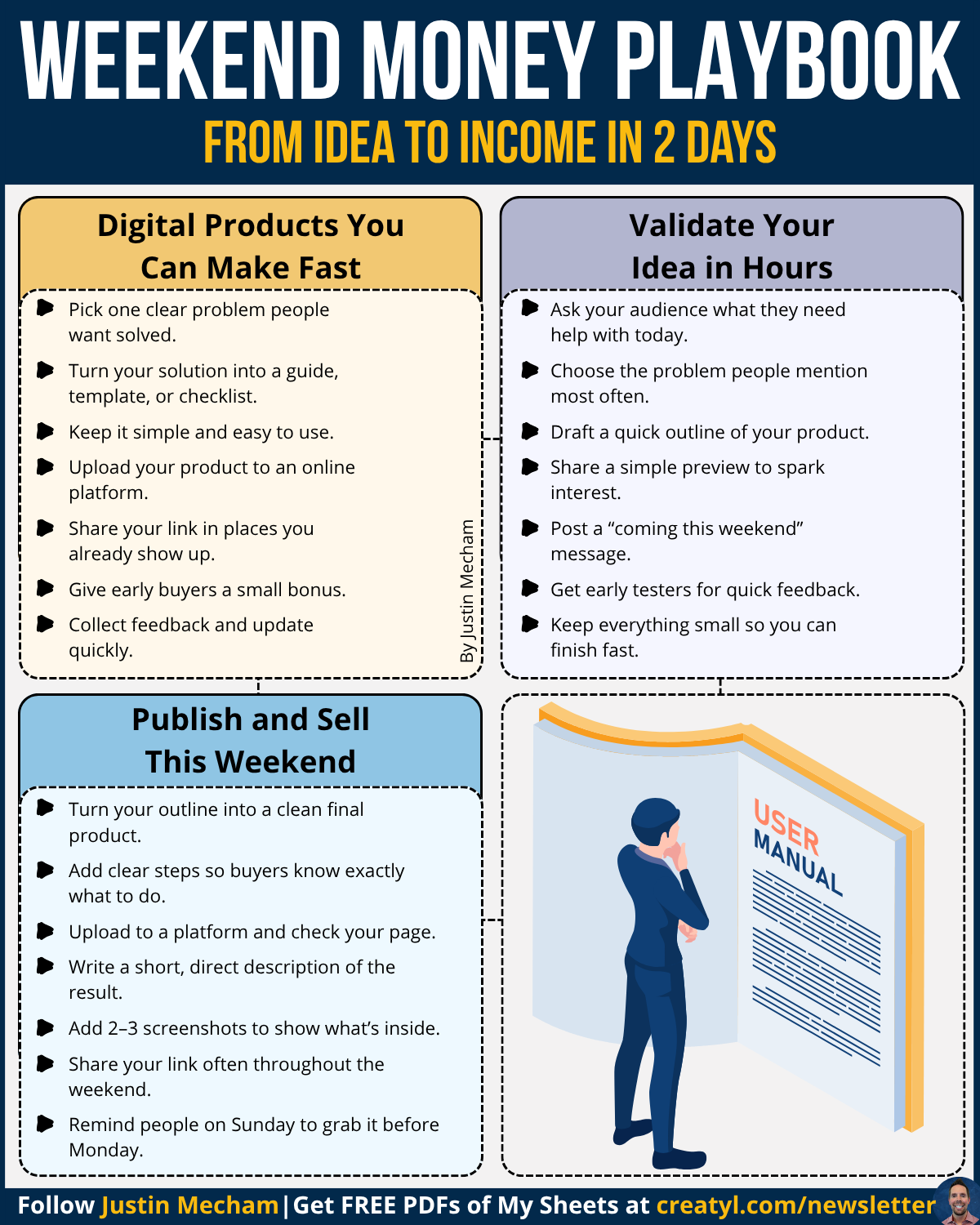
Download the “Weekend Money Playbook” Infographic PDF
If you want a practical step-by-step system for turning simple ideas into digital products quickly, download the infographic PDF and use it as a launch checklist for your next weekend build.