

Click Here to Download the PDF.
Why Smart People Stay Broke Online
For years I saw the same frustrating pattern.
Smart people.
Hardworking people.
Experienced people.
People with real skills.
And yet, many of them made almost nothing online.
At first it looked confusing.
They were learning constantly.
Reading books.
Taking courses.
Testing platforms.
Working late.
Effort clearly wasn’t the problem.
Then the real issue became obvious.
It wasn’t a work problem.
It was a packaging problem.
Most people do real work every day.
They help coworkers solve problems.
They answer questions for friends.
They figure things out through experience.
But they never turn that knowledge into something others can buy.
They keep helping one person at a time instead of packaging the help into a repeatable result.
And here’s the key shift.
People do not buy information.
They buy a clear win.
Not a massive transformation.
Not a long course.
Just one meaningful result they can get quickly.
Once I started helping people package their knowledge this way, everything changed.
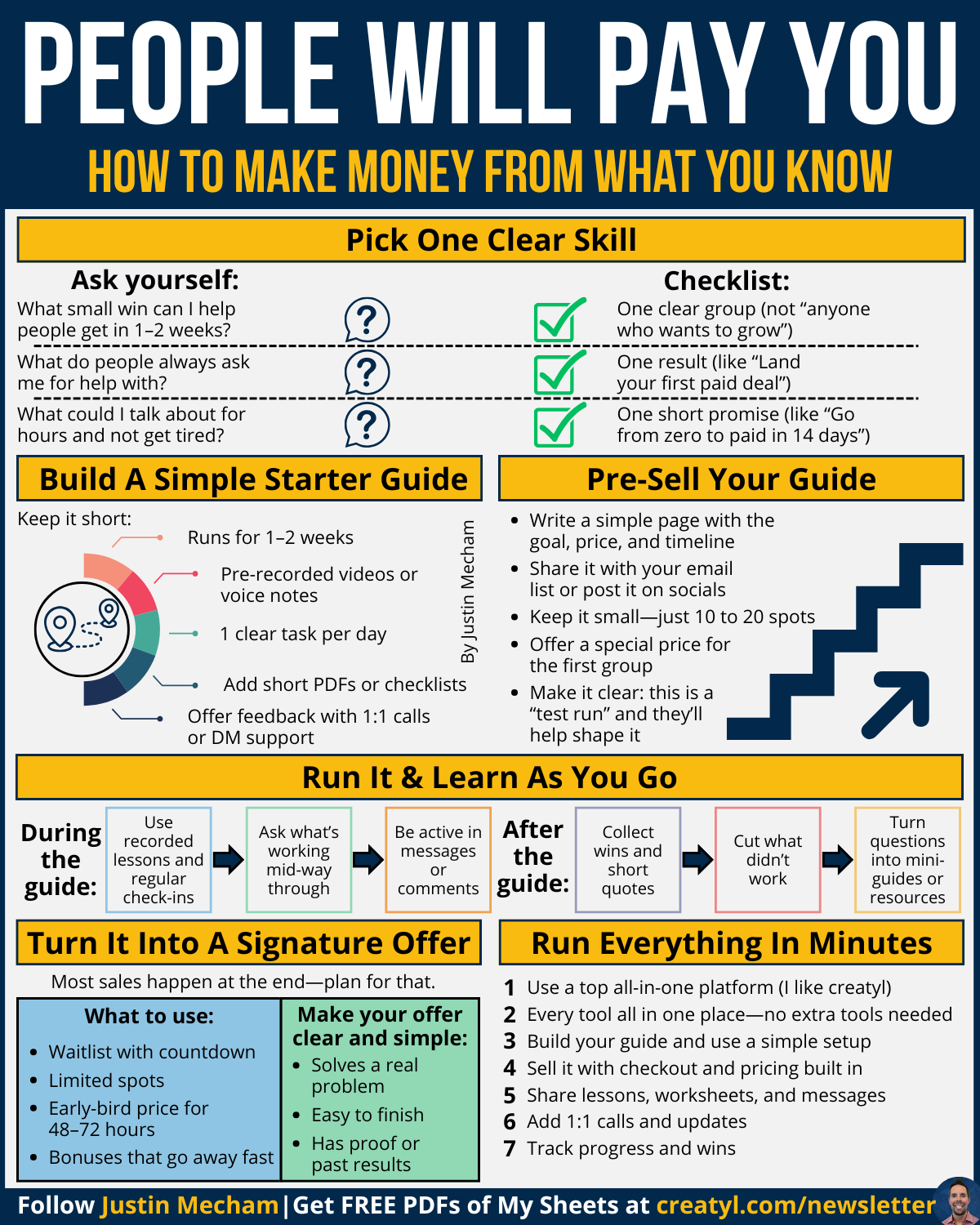
The infographic you saw is the simple system I use.
Let’s break it down in a way that makes it practical and real.
Step 1: Pick One Clear Skill And One Clear Result
Most people start by asking:
“What product should I build?”
That question leads to overwhelm immediately.
Instead, start here:
What result can you help someone get in 1–2 weeks?
That constraint changes everything.
It forces clarity.
Instead of teaching everything you know, you focus on one outcome that matters.
Ask yourself three questions:
What small win can I help someone achieve quickly?
What do people ask me about often?
What topic could I explain comfortably without notes?
This combination reveals the most valuable knowledge you already have.
Teachable Moment:
People don’t want a mountain of information. They want a step they can actually take.
Checklist For A Strong Starter Offer:
- One clear audience
- One measurable result
- One short promise
For example:
“Help freelancers land their first client in 14 days.”
Clear. Simple. Actionable.
That clarity is what sells.
Step 2: Build A Small Starter Guide
Once you know the result, the next mistake many people make is overbuilding.
They start designing a full course. Recording hours of video. Writing long lessons.
That slows everything down.
Instead, build a small starter guide.
Think of it as a short sprint, not a marathon.
Structure it like this:
- Runs for 1–2 weeks
- Short recorded videos or voice notes
- One clear task per day
- Short PDFs or checklists
- Optional support through messages or short calls
The goal is not complexity.
The goal is completion.
Teachable Moment:
A product people finish creates more value than one they abandon halfway.
Practical Strategy:
Design the guide so someone can complete it in short focused sessions.
When people experience quick progress, they trust you more.
Step 3: Pre-Sell Before You Overbuild
This step alone saves months of wasted effort.
Instead of building everything first, test the idea before you create it fully.
Pre-selling is simple.
Create a short page explaining:
- The goal
- The timeline
- The price
Then share it.
Email your list.
Post about it online.
Mention it in conversations.
Limit the first group to 10–20 spots.
Offer a lower price for early participants and explain that it is a test run.
Teachable Moment:
People who join early become collaborators. Their feedback shapes the product into something better.
Practical Strategy:
Do not wait for perfection.
If people are willing to pay for the outcome, you know the idea is strong.
If they hesitate, refine the promise before building more.
Step 4: Run The Guide And Learn As You Go
When the guide begins, your role shifts from builder to guide.
Deliver the lessons.
Check in regularly.
Watch where people struggle.
The best insights come from real users.
During the program:
- Ask what is working halfway through
- Encourage discussion and questions
- Stay active in messages or comments
After the guide finishes:
Collect wins.
Short quotes from participants matter more than polished marketing.
Look at what worked best.
Then remove anything that felt confusing or unnecessary.
Teachable Moment:
The first version of your product is not the final one. It is the research phase.
The goal is improvement, not perfection.
Step 5: Turn It Into Your Signature Offer
Once the guide proves useful, you now have something powerful.
Proof.
Real results.
Real feedback.
Real improvements.
Now you can turn it into your main offer.
Plan for this moment from the beginning.
Tools that help:
- Waitlists with countdown timers
- Limited spots for each round
- Early pricing windows
- Bonuses that expire quickly
These elements help people make decisions instead of postponing them.
Teachable Moment:
A strong offer does three things well:
It solves a real problem.
It is easy to finish.
It shows proof that it works.
Complex products confuse buyers.
Clear outcomes convert.
Step 6: Run Everything In One Place
Another common mistake is tool overload.
People try to combine:
- Email software
- Course platforms
- Payment processors
- Community tools
- Landing page builders
Before long the system becomes complicated.
Instead, run everything in one place whenever possible.
An all-in-one platform allows you to:
- Host lessons
- Sell with built-in checkout
- Share messages and updates
- Track progress and results
The simpler the setup, the faster you move.
Teachable Moment:
Speed matters more than perfection during the early stages.
Build something useful quickly, then refine it with real feedback.
A Real Workplace Example
From Helpful Employee To Paid Expert
I worked with a marketing specialist who constantly helped colleagues with LinkedIn strategy.
People asked them questions every week.
How to write posts.
How to grow an audience.
How to structure profiles.
They answered generously but never charged.
They believed they needed a full course before selling anything.
Months passed.
They kept researching. Planning. Drafting lessons.
Nothing launched.
Their knowledge stayed trapped in conversations.
Meanwhile, the demand for their advice kept growing.
We simplified everything.
Instead of building a course, we created a 10-day starter guide.
The result: help professionals publish their first five LinkedIn posts with confidence.
The structure was simple.
Daily short lessons.
Small writing prompts.
Feedback through messages.
Before building the full program, we pre-sold 15 spots.
They filled within a week.
Participants completed the guide, shared their posts, and reported improved engagement.
Those results became testimonials.
From there, the guide evolved into a signature offer with multiple cohorts.
The knowledge had always been valuable.
It just needed packaging.
What Made It Work
Small Decisions That Changed Everything
- They focused on one outcome instead of teaching everything.
- They pre-sold before building extensively.
- They kept the format short and practical.
- They improved the guide using real feedback.
The expertise was always there.
The packaging unlocked it.
The Deeper Shift That Matters
Many people underestimate what they already know.
Because knowledge feels normal when it lives inside your own head.
You assume everyone understands it.
They don’t.
What feels simple to you may be incredibly helpful to someone just a few steps behind.
And that is where value lives.
Not in knowing everything.
But in helping someone reach their next step faster.
You don’t need to build something massive to start.
You need to deliver one clear result.
When someone experiences progress because of your guidance, trust grows.
And trust creates opportunity.
The Value You Already Carry
Most people search endlessly for the “perfect idea.”
They believe money online comes from originality or complexity.
But the truth is simpler.
Value often hides in the knowledge you use every day.
The questions people ask you.
The systems you’ve already figured out.
The shortcuts you learned through experience.
These things feel ordinary to you.
But they can change someone else’s path.
When you package that knowledge clearly and help someone achieve one meaningful result, something powerful happens.
You stop trading time for help.
You start creating impact that repeats.
And once you see that shift, you realize something important.
You were never missing knowledge.
You were only missing a way to share it clearly.
Best Resources For Turning Knowledge Into Products
Book: The Millionaire Fastlane — MJ DeMarco
Why It Fits: Explains how leverage and systems create scalable income.
Book: $100M Offers — Alex Hormozi
Why It Fits: A practical framework for creating offers people want to buy.
Podcast: My First Million — Sam Parr & Shaan Puri
Why It Fits: Real examples of turning simple ideas into profitable businesses.
TED Talk: Start With Why — Simon Sinek
Why It Fits: Explains how clarity of purpose makes ideas more compelling.
Tool: creatyl — Justin Mecham
Why It Fits: An all-in-one platform designed to create, sell, and manage digital products quickly.
AI Tool: ChatGPT — OpenAI
Why It Fits: Helps outline guides, structure lessons, and refine offers quickly.
Download The “People Will Pay You” Infographic (PDF)
If you want a visual reference of the steps discussed in this article, download the PDF version of the infographic.
Use it as a guide while turning what you already know into something valuable.