

Click Here to Download the PDF.
Most people don’t struggle because they lack ideas.
They struggle because ideas feel endless.
You can sit down with a blank doc and feel like you have a hundred possible directions.
A course.
A template.
A guide.
A membership.
A toolkit.
Something “simple.”
But the second you try to choose, everything gets foggy.
You start thinking about what people want.
Then you start thinking about what you should build.
Then you start thinking about what everyone else is doing.
Then you start rewriting the first sentence for the tenth time.
And before you know it, the day is gone.
Not because you aren’t capable.
Not because you don’t have talent.
But because the hardest part of building something isn’t creativity.
It’s clarity.
That’s why these prompts work so well.
They don’t magically make you smarter.
They don’t replace your experience.
They don’t do the work for you.
They remove guessing.
They tell you exactly what to decide next.
And when you stop guessing, you start moving.
That is the difference between having a rough idea…
and turning it into something real that people actually buy.
Why Prompts Work When You Stop Treating Them Like Magic
A lot of people treat AI like a slot machine.
They type something vague.
They hope the output will feel perfect.
They stare at the screen waiting for a lightning bolt.
And when the response feels generic, they assume the tool doesn’t work.
But the tool isn’t the problem.
The real issue is that most people are asking AI to be creative when what they really need is structure.
The prompt is not the product.
The prompt is the next step.
The real power of prompts is not that they “write for you.”
It’s that they create order.
They force decisions in the right sequence:
Who is this for?
What problem does it solve?
What should it be called?
What doubts will people have?
What should you say first?
When you answer those questions in order, momentum becomes natural.
The blank page disappears because you’re no longer starting from nothing.
You’re starting from direction.
The Core Framework: The Prompt Sprint Method
The easiest way to use these prompts is not randomly.
It’s as a sprint.
A short, focused session where you stop brainstorming endlessly and start building something real.
The method is simple:
Product clarity.
People clarity.
Content clarity.
Each one stacks on the last.
This is what most creators miss.
They jump straight into writing content before the offer is clear.
They start building a product before they know who it’s for.
They draft emails before they’ve even named the thing.
The sprint fixes that.
It keeps you moving in the right order, so every step makes the next step easier.
Step 1: Build a “Decision Stack” (The Missing Move)
Before you run any prompt, start with one page.
Call it your Decision Stack.
This is the foundation that keeps everything grounded.
It has only five boxes:
- Who it’s for
- The painful moment they’re in
- The small win they want
- The offer in seven words
- The proof plan (how you’ll test it fast)
This is what most people skip.
They jump straight into writing.
They jump straight into designing.
They jump straight into building.
But without these decisions, every output feels slippery.
You end up with a lot of words, but no spine.
With a Decision Stack, every prompt becomes useful.
You stop asking, “Is this good?”
And you start asking, “Does this match the person and the moment?”
That is real clarity.
Step 2: The Two-Output Rule (So You Stop Overthinking)
Here’s a rule that changes everything:
Never ask for one answer.
Ask for two.
For every prompt, require:
Version A: Simple and direct
Version B: Bold and specific
Why?
Because the first draft is rarely the best draft.
The magic happens when you compare.
You don’t copy-paste.
You choose.
You mix.
You edit.
You start thinking like an editor, not a beginner.
And that’s how your work stops sounding like everyone else’s.
Step 3: The Red Flag Scan (Instant Quality Control)
Before you ship any copy, run this quick filter.
If the output includes:
“For anyone who wants…”
Generic claims with no real moment
Big promises with no clear “how”
Soft language that could apply to anything
Then it needs another pass.
Good writing is specific.
It sounds like it came from a real workplace, a real inbox, a real problem.
Not a template.
Not a slogan.
Real copy feels like someone saying, “Yes. That’s exactly what I’m dealing with.”
The 60-Minute Prompt Sprint (A Real Plan You Can Follow Today)
This is where it becomes actionable.
Set a timer.
One hour.
One product idea.
And move through the sprint in order.
Not because you need pressure.
Because constraints create focus.
Minute 0–10: People Clarity
Start with the Perfect Buyer prompt.
But don’t ask for demographics.
Ask for the moment.
Tell it:
Write a day-in-the-life scene.
What happens right before they need this?
Because buyers don’t purchase because of features.
They purchase because something feels stuck.
They purchase because they’re tired of solving the same problem alone.
When you capture that moment, your writing becomes real.
Your emails sound like they understand.
Your product feels like a response, not a guess.
Minute 10–20: Product Clarity
Next, use the Offer Name prompt.
But apply one rule:
If a tired person reads it once, they can repeat it.
Simple names spread.
Clear names get shared.
The best offer names don’t sound clever.
They sound obvious.
Then run the Product Description prompt.
But add one more instruction:
Include one clear limit.
One honest boundary.
That makes the offer believable.
People trust clarity more than hype.
Minute 20–30: Objections + Upsell
Now, run the Buyer Objections prompt.
Ask:
What are seven reasons someone might not buy?
Then organize every objection into four buckets:
Price
Time
Trust
Fit
This is where most sales pages fail.
Not because they lack information.
But because they ignore doubt.
Then respond simply:
Listen.
Repeat back the concern.
Give one next step.
After that, run the Upsell Idea prompt.
But restrict it:
Only add-ons that save time or remove risk.
Not random bonuses.
Just useful extras that make the offer feel complete.
Minute 30–40: Content Clarity
Now use the Content Calendar prompt.
Give me 30 post ideas with formats and short hooks.
But add this constraint:
Each post must start with a real moment, not advice.
Moments feel human.
Advice feels common.
Then run the SEO Blog Outline prompt.
Make sure the first section answers:
What should I do next?
That’s what people search for.
They don’t want theory.
They want direction.
Minute 40–60: Launch Emails
Finally, use the Launch Emails prompt.
Write 7 launch emails for this product.
But structure them like this:
Email 1: The problem moment
Email 2: How it works
Email 3: Proof and story
Email 4: Common doubts
Email 5: Clear invitation
Email 6: Reminder
Email 7: Closing note
The point is simple:
No starting over.
No panic writing.
Just a sequence you can adjust with your voice.
A Real Workplace Example
A team brought me in because they were stuck.
They had talent.
They had experience.
They had endless ideas.
But nothing was shipping.
Every meeting ended with:
Let’s think about it.
Maybe we should tweak the offer.
We’re not quite ready.
Their product name changed weekly.
Their sales page sounded vague.
Their emails felt inconsistent.
They weren’t failing because they lacked ability.
They were failing because they lacked clear next steps.
Guessing is expensive.
It turns smart people into a committee.
The longer you stay unclear, the heavier everything feels.
Deadlines slip.
Confidence drops.
Energy gets spent on debating instead of building.
And the worst part?
The market never even gets the chance to respond.
Because nothing clear ever gets put in front of real people.
I ran a 90-minute Prompt Sprint.
No brainstorming.
No endless rewriting.
Just decisions in the right order.
First, we defined the buyer’s real moment.
Then we named the offer so it could be repeated easily.
Then we surfaced objections before writing more copy.
We built one clean sales page section.
One clear email.
One simple upsell that removed risk.
The team didn’t suddenly become smarter.
They became clear.
Meetings got shorter.
Writing got easier.
Shipping became normal.
That is what prompts are for.
The Ship Rule That Changed Everything
Here was the real breakthrough:
No more rewriting until it’s live.
Version one goes out.
Feedback comes in.
Then you adjust with proof, not opinions.
Most creators don’t fail because of bad ideas.
They fail because they never publish long enough to learn.
Clarity Is the Real Shortcut
The blank page is rarely the real problem.
The real problem is trying to make ten decisions at once, with no order, no clear target, and no shared language.
That is when smart people start to sound unsure.
They rewrite.
They debate.
They postpone.
Not because they lack talent.
But because the work has no clear next step.
This is why these prompts feel like relief.
They turn maybe into a decision.
They move you from vague ideas to specific choices:
Who it is for.
What it solves.
What it is called.
What someone might doubt.
What to say next.
What to write first.
Clarity is not a mood.
It is a sequence.
When the sequence is right, momentum returns.
The goal is not perfect words.
It is a clear offer that a real person can understand fast.
A message that answers doubts before they turn into silence.
A plan that removes the need to feel inspired before you create.
When clarity leads, the work feels lighter, the team feels calmer, and shipping stops being a big event and becomes normal.
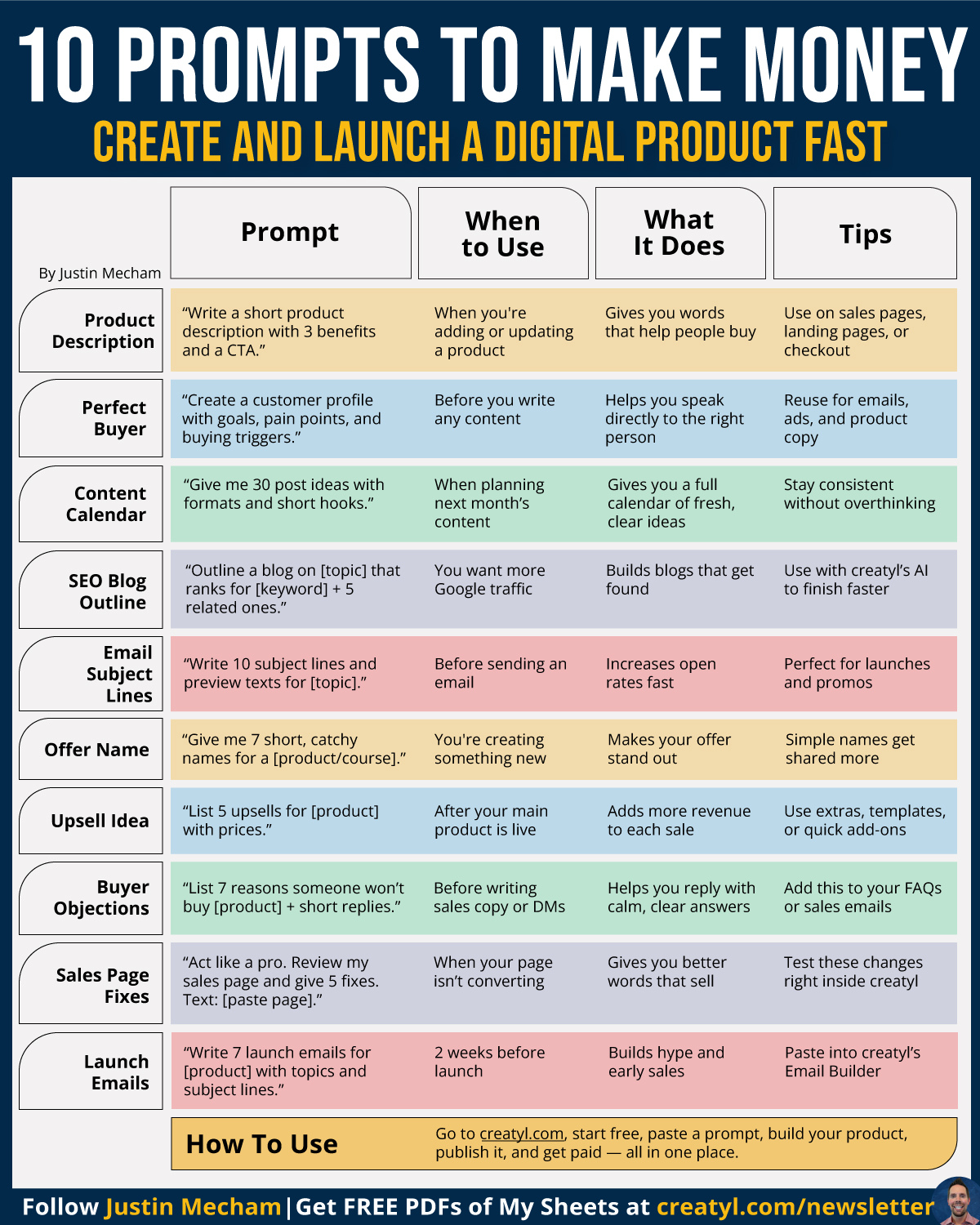
Download the Infographic (PDF)
If you want to keep these prompts in front of you while you build, the full infographic is available as a simple PDF you can save, print, or reference anytime.
Download the “10 Prompts to Make Money” Infographic PDF here.