

Click Here to Download the PDF
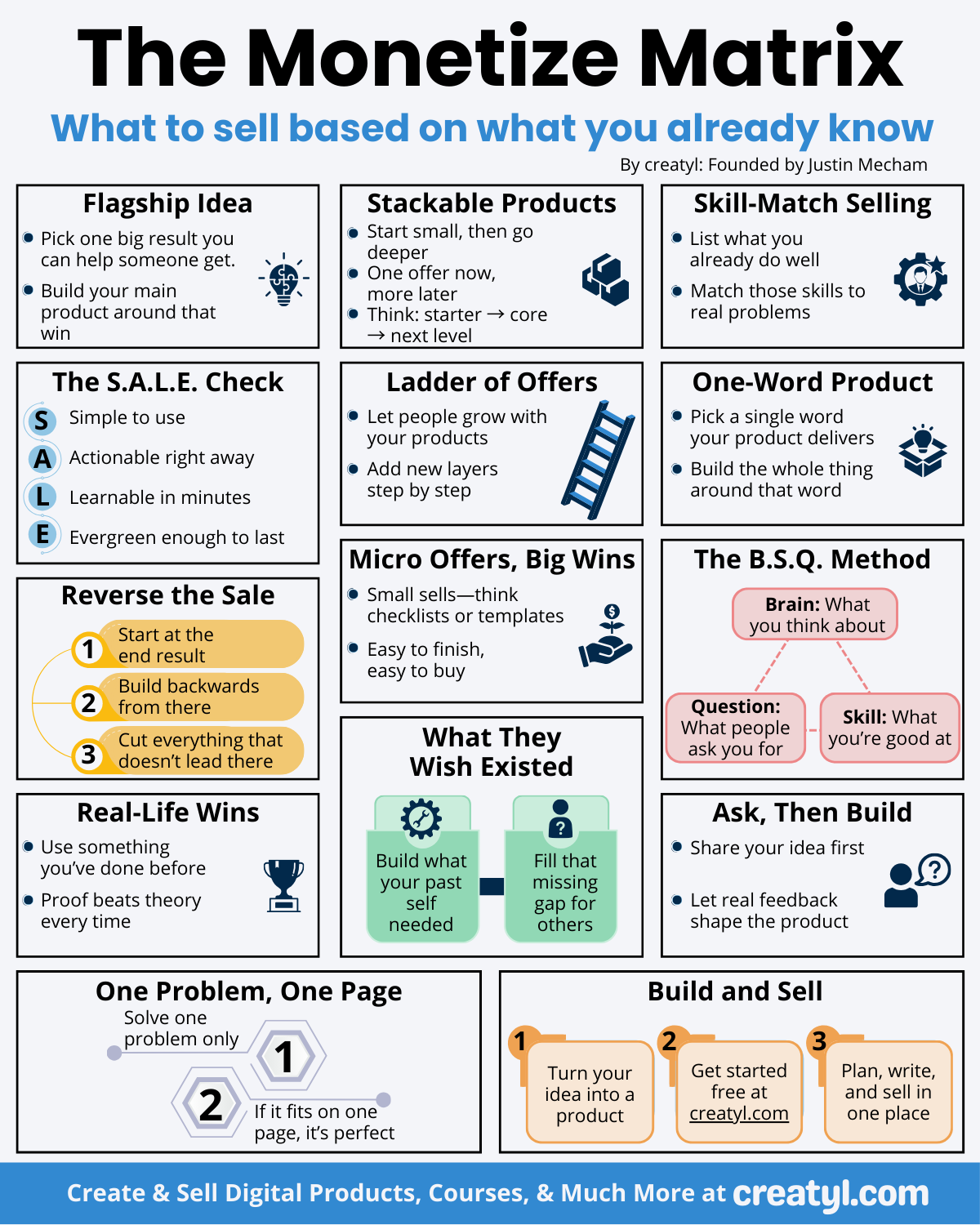
Most People Are Sitting On Money They’ve Never Turned Into A Product
If you ask most smart people what they know, they can talk for hours.
If you ask them what they sell, the room goes quiet.
They tell you about years of experience.
They list the roles they’ve held.
They walk you through all the things they have “in their head.”
But when you ask, “What could I pay you for right now?” they struggle.
- They are not missing skill.
- They are missing structure.
- They do not need another degree or another course before they can help someone.
- They need a clear way to turn what they already know into small, simple offers that people can understand and buy.
That is what The Monetize Matrix is really about.
It is not just a cute graphic.
It is a way of thinking about your knowledge that turns scattered experience into a focused product path.
What The Monetize Matrix Actually Teaches
The matrix breaks the problem into pieces:
- What result are you helping someone get?
- How can you offer it in different sizes and depths?
- How do you know if an offer is simple enough to buy?
- How do you let people grow with you over time?
- How do you pull ideas from your real life instead of theory?
- How do you keep the first version small and testable?
There is a reason many successful creators use “value ladders” or “product ladders.”
They guide people from a small, low-risk starter offer into deeper, higher-value work step by step.
The Monetize Matrix is your version of that ladder, built from what you already know.
Let’s walk through each piece and turn it into something you can actually use.
1. The Flagship Idea: One Big Result You Stand For
Your flagship idea is the core outcome your work is known for.
It answers one question:
“If someone works with me or buys from me, what big change can they count on?”
In practice, this might be:
- Helping new managers run their first 90 days without chaos.
- Helping freelancers land their first three clients.
- Helping busy parents find a simple weekly schedule that actually works.
- Helping professionals turn their work skills into a clear side income plan.
This is not a slogan.
It is a promise.
Most people skip this step and try to sell random things that do not connect.
They offer templates, calls, PDFs, workshops—but no clear thread.
Your flagship idea is that thread.
It is the big result your whole product line points toward.
How to find it:
- Look at the wins you have helped others get already.
- Ask past colleagues or clients, “What changed for you after we worked together?”
- Pay attention to the problems people trust you with repeatedly.
Write your flagship result as one line:
“I help [specific person] get [specific outcome] in [clear area of life/work].”
That line is the anchor for everything that follows.
2. Stackable Products: Start Small, Then Go Deeper
Once you know the big result, the next question is:
How can someone start small with you and go deeper over time?
This is where stackable products come in.
Instead of building one giant “final” offer, you break your flagship idea into stages:
- A small starter product (checklist, mini guide, short workshop).
- A core product that delivers the main result.
- A next-level product for people who want deeper help.
This “stack” is how you turn one skill into a simple path instead of a one-time sale.
It is the same thinking as a value ladder: a sequence of offers that meet people where they are and guide them step by step.
Questions to build your stack:
- What is the smallest win someone could get in a weekend?
- What does the “main transformation” look like over a few weeks or months?
- What do people who finish that main step usually want next?
Each layer is built from the same knowledge, just in different depth and support.
3. Skill-Match Selling: Stop Ignoring The Obvious
Skill-Match Selling forces you to actually respect your own experience.
You list three things:
- Brain: What you like to think about.
- Skill: What you are objectively good at doing.
- Question: What people already ask you for help with.
Where those three overlap is where the easiest money usually sits.
Many creators chase far-away niches because they look impressive online.
They ignore the problems they’re already solving at work, or for friends, or in their community.
Yet most digital product guides point out that the easiest wins come from real needs you’ve already handled in your day job or past life.
Skill-Match Selling says:
Stop guessing. Start where the evidence already is.
Write out:
- Times you’ve fixed something for someone.
- Processes you’ve built or improved.
- Moments when someone said, “That made my life easier.”
Those are clues, not accidents.
4. The S.A.L.E. Check: A Simple Filter For Every Offer
The S.A.L.E. check is how you decide if an offer is actually ready:
- S – Simple to use
- A – Actionable right away
- L – Learnable in minutes
- E – Evergreen enough to last
This is where you protect people from confusion—and protect yourself from endless revisions.
Before you launch anything, ask:
- Can someone understand what this is in under 30 seconds?
- Can they take a first step within five minutes of opening it?
- Can they “get the gist” without a big time commitment?
- Will this still be useful a few months from now, or is it already outdated?
This aligns with what people teaching digital products say over and over:
clear, practical, and timeless offers sell better than complicated, trendy ones.
If your idea fails the S.A.L.E. test, you do not throw it out—you trim it.
5. The Ladder Of Offers: Let People Grow With You
A ladder of offers is your upgrade path.
Instead of throwing one big offer at a stranger, you build:
- A low-risk entry point.
- A mid-level offer that delivers the main result.
- A higher-level offer for people who want more access or depth.
This structure is used by many successful service businesses and creators because it builds trust over time and increases lifetime value.
For example:
- A $9 checklist that solves one tight problem.
- A $99 mini-course or workshop that walks them through the whole process.
- A $600 package with live support, reviews, or coaching.
You are not inventing random products.
You are mapping steps on a journey.
The Monetize Matrix helps you see how each square can feed the ladder:
- Micro offers feed the entry step.
- One problem, one page supports your main result.
- Real-life wins and case studies support your higher tier.
6. One-Word Product: Clarity People Can Remember
The “one-word product” is a naming trick with a purpose: clarity.
You choose one word that captures the result or the main idea—then build everything around that word.
- “Reset” for a 7-day life or work reset.
- “Pitch” for an offer that helps people write their pitch.
- “FirstClient” for a system that helps freelancers land client number one.
Books and marketing experts often note how strong names and clear promises change conversion rates, because people remember them and feel less confused.
The point is not to be clever.
It is to make the product easy to recall and share.
If someone cannot repeat your product name and what it does, you are making it harder than it has to be.
7. Reverse The Sale: Start At The End Result
Most people design products from the content outward:
- “What topics should I cover?”
- “What modules should I add?”
Reverse the sale does the opposite:
- Start at the end result.
- Ask, “What needs to be true for this result to happen?”
- Build only the steps that lead directly there.
- Cut everything else.
This mirrors how value ladders and good funnels are designed: you define the final transformation, then decide which steps actually move a person toward it.
When you reverse the sale, you stop stuffing products with extras that feel impressive but do not change anything.
8. Micro Offers, Big Wins: Small Sells That Matter
Micro offers are tiny, specific products:
- A single, powerful template.
- A short script pack.
- A small decision guide.
- A one-page roadmap.
They are easy to build and easy to buy.
Added bonus: they are perfect places to test ideas before turning them into bigger products.
Recent guides on digital products show that simple, focused tools often sell well on platforms like Gumroad, Etsy, and others, because buyers want quick, clear help.
If no one buys your micro offer, you learned cheaply.
If people do buy, you now have proof to justify a bigger build.
9. Real-Life Wins And “What They Wish Existed”
Two blocks in the matrix are underrated:
- Real-Life Wins: turn something you have already done into an offer.
- What They Wish Existed: build what your past self badly needed.
This is how you get out of theory and into real usefulness.
Real-life wins:
- Think of a time when you fixed a messy situation at work.
- Ask yourself, “How could someone else repeat what I did without me there?”
- That repeatable part is your product.
What they wish existed:
- Picture your past self at a tough moment—overwhelmed, confused, stuck.
- Ask, “If I could hand them one simple tool or guide, what would it be?”
- Design that.
You do not have to guess what people need.
Your own story gives you a lot of answers.
10. Ask, Then Build: Feedback Before Effort
The “Ask, Then Build” square might be the most important one.
Instead of locking yourself away to build a huge product, you talk to people first.
Creators and product experts who do this well rely on interviews, polls, and small tests before committing to a full launch.
Ask people:
- “What is the hardest part of [problem] right now?”
- “What have you already tried that did not work?”
- “If you had a simple fix in your inbox tomorrow, what would it look like?”
Then you build the product that answers those real sentences.
This is how you avoid the painful moment where you finish a big project—and realize no one asked for it.
11. One Problem, One Page: Focus That Sells
This rule cuts through the noise:
If it cannot fit on one page, it might be trying to solve too much.
One page forces you to:
- Choose one problem.
- Describe one result.
- Give one path.
- Remove extra stories that do not help.
Whether that page is a one-page PDF, a one-page sales page, or a one-page checklist, the discipline is the same.
People buy clarity.
A simple page beats a cluttered course description almost every time.
12. Build And Sell: Turn The Map Into Motion
The last part of the matrix is about movement.
- Turn your idea into a small product.
- Set up a simple way to sell it.
- Share it, learn from what happens, and improve.
You do not need a giant tech stack to start.
Many guides show that a basic platform with payment, delivery, and a simple sales page is enough for early wins.
The matrix is the thinking.
Your tools are just how you deliver it.
Deep PAS Example: The Employee Who Turned A Hidden Skill Into A Product Line
Problem
- They worked a full-time job in operations at a mid-size company.
- Their official title sounded vague, but their unofficial job was clear: when projects got messy, they were the one people called.
- They were the person who turned chaos into clean checklists.
- They built timelines.
- They rewrote instructions in plain language so teams stopped missing steps.
Inside the company, people constantly said things like:
- “Can you help me untangle this?”
- “You always know how to make this clear.”
- “I wish there was a template for this process.”
They shrugged these comments off because this skill felt normal.
It did not feel special.
It certainly did not feel like something you could sell.
Outside of work, they watched creators selling digital products and thought, “Must be nice to have something valuable to teach.”
They did not realize they already had that.
The turning point came during a rough quarter when the company restructured.
Everyone’s job felt less secure.
They did not want to panic, but they also did not want to rely on one income stream forever.
They saw the Monetize Matrix and, for the first time, saw their work through a different lens.
Agitation
For weeks, they sat with a quiet tension:
On one side, they had years of experience untangling projects.
On the other, they had no clear product.
Their fears sounded familiar:
- “Who would pay for this when it is just ‘being organized’?”
- “There are already project management gurus out there.”
- “What if I build something and it is just obvious to everyone?”
At work, nothing changed—people still walked over to their desk for help—but it was clear that without a plan, they would always be “helpful” without having anything they owned.
This started to feel heavier.
Every time they fixed a process, they could feel the same thought knocking:
“If I can do this here, why haven’t I done it for myself?”
They had no idea where to start.
But the matrix gave them steps.
Solution
They decided to treat themselves like a client.
Step 1: Flagship Idea
They wrote down the pattern in plain words:
“I help busy teams turn messy projects into simple weekly plans they can actually follow.”
This became their flagship idea.
Step 2: Skill-Match Selling
They looked at the Brain–Skill–Question overlap:
- Brain: they liked thinking about workflow, clarity, and realistic planning.
- Skill: they were good at breaking big work into simple steps.
- Question: coworkers always asked for help “making a plan” out of fuzzy tasks.
This confirmed that “turn chaos into a plan” was not random.
It was their thing.
Step 3: Real-Life Wins And What They Wish Existed
They pulled up three old projects where they had stepped in, cleaned things up, and hit a deadline that was at risk.
They asked:
- “What exact documents did I create?”
- “How did I explain the steps?”
- “If my past self, before learning all this, could have had one tool, what would have changed everything?”
They realised the answer:
A simple weekly planning board with clear columns and prompts that any team could use.
At that point, they had seen enough people online selling Kanban boards, Notion templates, and project planners to know that this kind of thing had a market.
But this one would be built from real proofs, not theory.
Step 4: Reverse The Sale
They defined the end result:
“In 60 minutes, a team can turn a messy project into a weekly plan with clear owners and next steps.”
Then they worked backwards:
- What must be on the board to get that result?
- What questions must the template ask?
- What should a team see at a glance when they open it?
Anything that did not lead directly to that 60-minute transformation was cut.
Step 5: Micro Offer And One Problem, One Page
They turned this into a micro offer: one simple “Weekly Project Reset” board plus a one-page instruction guide.
One problem: messy projects.
One page: how to turn chaos into a clear weekly plan.
No course.
No long videos.
Just a tool and a page.
Step 6: Ask, Then Build
Before making a fancy version, they messaged three colleagues who had left for new companies.
They asked:
- “Do your teams ever get stuck with messy projects?”
- “Would a plug-and-play weekly planning board actually get used?”
- “If you could download one simple file today, what would it need to do?”
The replies were detailed and specific.
Everyone said yes, messy projects were constant.
Everyone described almost the exact pain the template was meant to solve.
They made a simple draft and sent it for free, telling them:
“Try this for a week and tell me what is confusing.”
Feedback rolled in:
- “Can we add a ‘blocked’ column?”
- “It helps to have a place for goals for the week.”
- “We needed a reminder to assign owners, not just tasks.”
They updated the template, refined the one-page guide, and now had something tested in real teams.
Step 7: Stackable Products And Ladder Of Offers
Once the micro offer started working, they used the rest of the matrix.
They created:
- A low-cost version of the board with instructions.
- A mid-level “Project Reset Workshop” where they led teams through using it live over a 90-minute call.
- A higher-tier offer where they reviewed a team’s plan and suggested improvements.
Same core skill.
Different depths.
Over a few months, this turned into a meaningful side income.
Nothing about their job title changed.
But their relationship to their skills did.
They were no longer just the person coworkers came to in a panic.
They had products, a ladder of offers, and proof that their knowledge had real financial value.
Two More PAS Examples (Shorter, But Still Concrete)
Example 2 – The Coach Who Stopped Selling “Everything”
Problem:
A career coach offered “life and career transformation” sessions.
Because the promise was vague, people hesitated to buy.
Agitation:
They were working hard but income was unpredictable.
Calls went long because every session tried to fix every area at once.
Clients left with insight, but not clear wins.
Solution:
Using the Monetize Matrix, they picked one flagship idea: “Help professionals map their next 90 days so they stop feeling stuck.”
They built a stack of offers around that idea: a 90-day planning worksheet (micro offer), a paid group workshop, and a higher-level one-on-one package.
They used the S.A.L.E. filter to keep everything simple and easy to apply.
Income stabilized because people finally understood what they were buying.
Example 3 – The Designer Who Turned Quick Advice Into A Ladder Of Offers
Problem:
A designer often gave free advice to friends about landing their first freelance clients.
They answered the same questions in DMs and calls over and over.
Agitation:
They loved helping, but it ate into work time.
They worried that charging for “just advice” would feel strange.
At the same time, seeing others sell digital products made them wonder if they were missing something.
Solution:
They mapped their Monetize Matrix:
- Flagship idea: “Help designers land their first paying client in 30 days.”
- Micro offer: a one-page “First Client Checklist.”
- Next step: a mini-email course walking through outreach and pricing.
- Top tier: a short, focused program with feedback on portfolios and pitches.
They used real-life wins—the exact steps they had taken years earlier—as the backbone.
They asked interested followers what they wished existed before building the course.
When they finally launched, they were not selling vague inspiration.
They were selling a path they had walked themselves.
Tools And Resources To Help You Apply The Monetize Matrix
You do not need a huge setup to make this real.
But a few high-quality resources can shorten the learning curve.
Book: $100M Offers by Alex Hormozi
This book is widely praised for its clear, blunt breakdown of how to design offers people actually want.
It focuses on making the offer so clear and compelling that people feel it would be a mistake to say no.
Paired with the Monetize Matrix, it helps you sharpen your flagship idea, your stack, and your ladder of offers.
TED Talk: This Is The Side Hustle Revolution by Nicaila Matthews Okome
In this TED talk, Nicaila Matthews Okome explores how modern workers are moving away from a single income source and building side income streams using their existing skills.
It is a grounding reminder that you do not have to quit your job to treat your knowledge like an asset.
AI Tool: ChatGPT
Roundups of AI tools for digital product creators constantly list AI assistants as key helpers for idea generation, outlining, and content creation.
You can use ChatGPT to:
- Turn messy thoughts into product outlines.
- Rewrite product pages in simple language.
- Brainstorm micro offers based on your skills.
- Draft emails that explain your offers clearly.
You still make the decisions—but the tool helps you work faster and clearer.
Tool: ConvertKit / Kit Commerce
Platforms like ConvertKit’s Kit make it easy for creators to sell digital products, subscriptions, and simple offers directly to their
audience.
You can create a product, connect payments, and build a single clean page without needing a full-blown storefront.
It is more than enough for a first micro offer or small stack.
Rewriting Your Relationship With Money And Knowledge
You Already Have The Pieces. Now You Are Learning The Shape.
The biggest shift the Monetize Matrix invites is not about tactics.
It is about identity.
Most people see their knowledge as something they “use” for employers or friends.
They do not see it as an asset they can shape and own.
When you walk through each block of the matrix, you start to see your experience differently:
- Your flagship result shows you that you do not just “help” people—you help them in a specific way.
- Your stack and ladder show you that one skill can become many offers, not just one.
- Your Skill-Match work reminds you that the things you do naturally are often the most valuable.
- Your real-life wins prove that you have already solved real problems, not just studied them.
You stop asking, “Am I allowed to do this?”
You start asking, “How can I make this easier for someone else to use?”
Readiness, in this context, is not a feeling that drops out of the sky.
It is built from small acts:
- Writing down one clear result.
- Turning one real win into a simple tool.
- Asking people what they wish existed.
- Putting one clean page in front of the world and being willing to learn from whatever happens.
Over time, those acts change how you think about yourself.
You are no longer just someone who “knows things.”
You are someone who builds things.
And once you see that, you cannot unsee it.
The money that felt far away starts to look closer—not because you became a different person overnight, but because you finally gave your skills a shape other people can hold.
Download The Monetize Matrix Infographic (PDF)
If you want a clear, visual reminder of everything in this article, the Monetize Matrix infographic is available as a PDF you can save, print, or keep open while you build.
It lays out each square—flagship idea, stackable products, ladder of offers, micro offers, real-life wins, and more—so you can see how your knowledge can turn into a simple, connected product line.