Click Here to Download the PDF.
Most People Wait for the Perfect Moment. That Moment Never Shows Up.
A lot of people believe progress begins once confidence arrives.
Once the idea is clear enough.
Once the timing feels right.
Once they stop feeling unsure.
So they wait.
They gather notes.
They refine plans.
They tell themselves they’re being responsible.
But what actually happens is quieter.
Momentum fades.
Energy drops.
And the idea slowly turns into something they used to talk about.
Progress doesn’t come from certainty.
It comes from starting before everything feels settled.
The people who move forward aren’t braver.
They just begin earlier.
Why Overthinking Feels Productive but Isn’t
Overthinking feels safe because it looks like work.
You’re planning.
You’re researching.
You’re “getting ready.”
But preparation without action has a hidden cost.
It delays feedback.
And feedback is what turns vague ideas into clear direction.
Starting small isn’t reckless.
It’s how clarity is earned.
1. Start With One Real Problem
Everything begins with a real issue someone already has.
Not a future problem.
Not a theoretical pain.
Something people complain about today.
When you start here, you remove guesswork.
The question is simple:
What is one thing people keep struggling with that you could help with right now?
2. Say Your Offer in One Clean Sentence
If you can’t explain what you help with in one sentence, others won’t either.
This sentence should be direct and plain.
No clever wording.
No layered explanations.
One problem.
One result.
Clarity here saves weeks of confusion later.
3. Test Demand Before You Build
Many people spend weeks building something no one asked for.
Testing demand early flips that risk.
Talk to a few real people.
Ask if the problem matters to them.
Pay attention to how they respond.
Interest tells you what to build.
Silence tells you what to change.
4. Speak Like a Human
Trust doesn’t grow from polished language.
It grows from words that sound familiar.
Explain things the way you would to a friend.
Short sentences.
Plain language.
If it wouldn’t make sense out loud, it won’t land in writing.
5. Don’t Wait for Confidence
Confidence doesn’t arrive first.
It shows up after action.
Most people feel unsure right before progress starts.
That feeling isn’t a warning.
It’s a sign you’re about to learn something new.
6. Deliver a Quick Win
People don’t want big promises.
They want fast relief.
A quick win builds trust because it proves usefulness.
Ask yourself:
What can someone finish or feel better about in under an hour?
That’s where momentum begins.
7. Say the Price Out Loud
Avoiding price conversations creates hesitation.
If saying the price feels uncomfortable, practice until it doesn’t.
Clear pricing removes tension and signals confidence.
People can’t decide if they don’t know the cost.
8. Stop Trying to Look Bigger Than You Are
Trying to look established too early creates distance.
People connect more easily with honesty than polish.
A clear offer from a real person feels safer than a perfect brand with no story.
9. Share One Helpful Post
You don’t need a content strategy to begin.
You need one helpful piece.
Solve one small problem.
Share one clear step.
That single post does more than a dozen vague ones.
10. Tell the Story, Not the Pitch
People don’t respond to selling language.
They respond to meaning.
Share why you’re building something.
What you noticed.
What changed when you tried a different approach.
Stories create context.
Context creates trust.
11. Don’t Build Alone
Working in isolation makes doubts louder.
Find one other person who is also building something.
Check in weekly.
Share progress and stuck points.
Momentum grows faster when someone else knows what you’re working on.
12. Expect Boredom and Keep Going
Progress isn’t exciting every day.
There will be weeks where nothing feels new.
That doesn’t mean it isn’t working.
Most people quit during this phase.
Staying through boredom is what creates separation.
13. Answer Real Questions in DMs or Emails
Money usually starts in private conversations.
Answering real questions reveals what people care about most.
Those answers often turn into your best ideas.
14. If It Feels Complicated, Simplify Again
Complexity is a warning sign.
When something starts feeling heavy, step back and remove pieces.
The simplest version is usually the strongest one.
15. Build Where Speed Matters
Choose tools and systems that let you move quickly.
Speed reduces doubt.
It keeps momentum alive.
The goal isn’t perfection.
It’s progress you can repeat.
When Waiting Was the Only Thing Holding Things Back
They worked inside a small team that wanted to launch a new internal offer.
The idea was solid, but nothing moved forward.
Meetings focused on planning.
Documents grew longer.
Decisions were delayed until everything felt “ready.”
Weeks passed without action.
Frustration grew quietly.
People started disengaging because nothing tangible happened.
Confidence dropped as the plan became heavier.
The team questioned whether the idea was worth pursuing at all.
The problem wasn’t lack of skill.
It was hesitation disguised as preparation.
They stripped the plan down to basics.
They identified one real problem.
They wrote one clear sentence describing the solution.
They talked to a handful of real users that same week.
They shared one helpful update publicly instead of waiting.
They stopped adding features and focused on one fast result.
Momentum returned almost immediately.
Not because everything worked perfectly.
But because action replaced waiting.
Tools That Support Starting Before You’re Ready
The Lean Startup explains why testing early reduces wasted effort.
Essentialism reinforces focusing on less to move faster.
Notion helps organize simple plans without clutter.
creatyl supports building and sharing offers quickly without heavy setup.
Progress Belongs to Starters
Why Small Steps Win When Big Plans Stall
Most people don’t lack ideas.
They lack motion.
Waiting for certainty feels responsible, but it quietly delays everything that matters.
Progress doesn’t reward perfection.
It rewards movement.
Starting small doesn’t mean thinking small.
It means choosing to learn sooner instead of later.
The perfect moment never arrives.
But the moment you start?
That one changes everything.
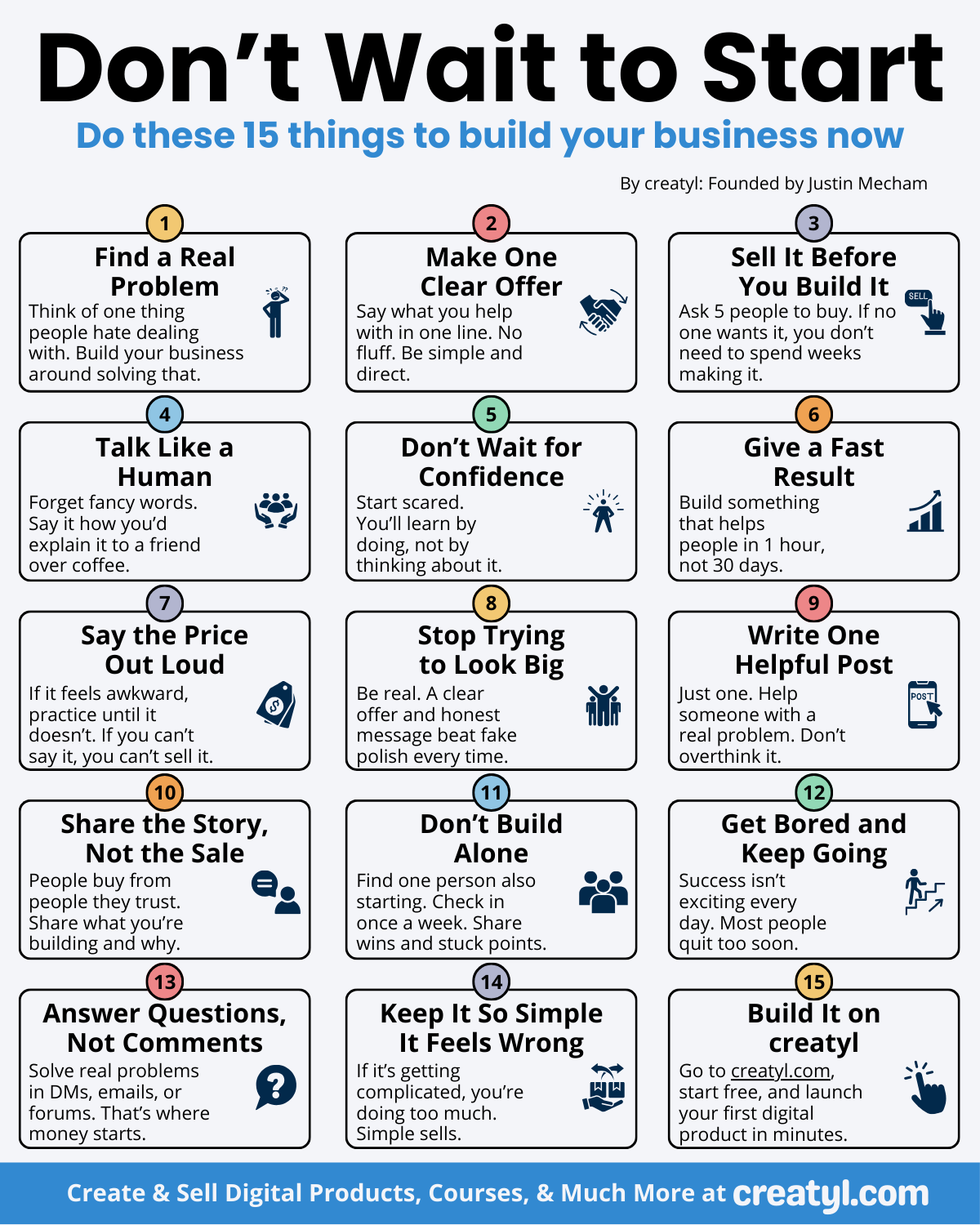
Download the “Don’t Wait to Start” Infographic (PDF)
If you want a simple visual reminder of the steps in this article, download the infographic connected to it.
Download the Don’t Wait to Start infographic (PDF)
Use it as a reference when hesitation shows up, so starting feels easier than waiting.