Click Here to Download the PDF.
Most people don’t fail at launching a product because the idea is bad.
They fail because the process feels overwhelming.
They imagine they need a perfect brand, a long course, a polished website, and weeks of planning before they can publish anything.
By the time they finish imagining everything that must be done, they’re already exhausted.
So the launch never happens.
But launching something valuable rarely requires complexity.
What it requires is order.
A clear sequence of small steps that build momentum instead of pressure.
When you break the process down into simple actions, something surprising happens.
The work stops feeling heavy. It starts feeling manageable.
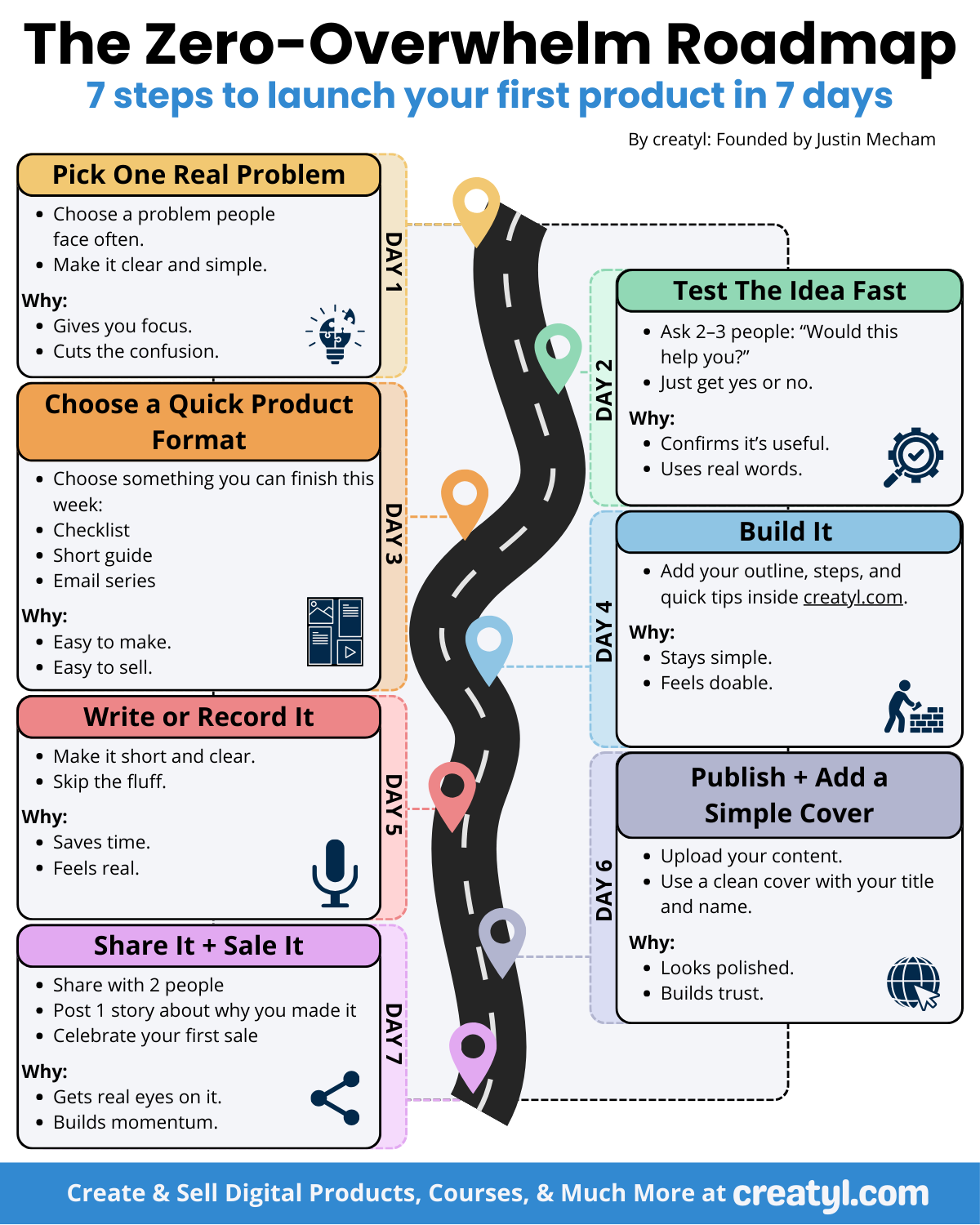
That’s the philosophy behind the zero-overwhelm roadmap: one small step per day, moving from problem to product in a week.
Not because speed is the goal, but because momentum is.
Momentum reduces doubt.
Momentum reduces overthinking.
Momentum turns ideas into something real.
And once something becomes real, you can improve it.
You can refine it. You can grow it.
But first, you have to launch.
This article walks through a practical seven-day roadmap that turns an idea into a finished product without the stress spiral that stops so many creators before they start.
Why Launching Feels So Overwhelming
The idea of launching something new carries a strange kind of pressure.
People tell themselves the first product needs to represent them perfectly.
They imagine that every detail must be right before anyone sees it.
The title must be clever. The lessons must be comprehensive. The design must look polished.
But the reality is very different.
Most successful digital products start small. Very small.
They start as simple checklists, short guides, or quick walkthroughs.
They exist to solve one clear problem for one group of people.
What makes them powerful is not size. It’s usefulness.
When a product solves a problem quickly, people value it.
They share it. They come back for more.
But when a product tries to solve everything, it usually solves nothing.
That’s why the roadmap works so well.
It removes the pressure to build something massive and replaces it with a sequence of practical decisions.
Pick a real problem. Choose a fast format. Test the idea. Build the simple version. Publish it. Share it.
Each step is small. Each step is clear.
And each step moves you closer to something that exists in the real world instead of your notes app.
The Zero-Overwhelm Roadmap: One Small Step Per Day
The following roadmap is not about rushing. It’s about removing friction.
Instead of staring at a giant to-do list, you focus on one action per day.
By the end of the week, you have something finished.
Not imagined. Not planned. Finished.
Day 1: Pick One Real Problem
Start Narrow So You Stay Focused
The most important decision in the entire process happens on the first day.
You choose the problem.
Not a broad theme. Not a big concept. One specific issue people actually face.
A common mistake is choosing an idea that feels impressive rather than helpful.
People choose topics like “productivity mastery” or “complete marketing strategy.”
Those topics sound exciting, but they’re difficult to finish and even harder for buyers to understand.
A better approach is to start with a narrow problem that appears often in real life.
For example:
- organizing a chaotic inbox
- planning weekly priorities
- writing clearer client emails
- tracking project deadlines
- responding to difficult feedback
- creating a simple meeting agenda
The best problems usually come from questions people already ask you.
Think about the moments when someone says, “How did you do that?” or “Can you show me how you handled this?”
Those questions are signals. They reveal where your experience can become a product.
Why Starting Narrow Matters
A clear problem gives your product focus.
It removes the confusion that often comes from trying to teach too much at once.
When the problem is specific, the solution becomes obvious.
You know exactly what the lessons should cover and what outcome the buyer should expect.
That clarity saves time during every step that follows.
Day 2: Test The Idea Fast
Confirm It’s Useful Before You Build
Once you know the problem, the next step is simple: ask someone if it would help.
Not with a complicated survey. Not with a long pitch.
Just a quick question.
“Would this help you?”
That’s enough.
Many creators skip this step because they assume they already know the answer.
But testing the idea has two powerful benefits.
First, it confirms that the problem actually matters to someone else.
Second, it gives you language you can use when describing the product later.
When someone says yes, listen carefully to how they explain their challenge.
Those words often become the most relatable parts of your product description.
A Simple Way To Test
Send a short message to two or three people who face the problem you identified.
Explain the idea in one sentence and ask if they would find it useful.
For example:
“I’m thinking about creating a short guide showing how I organize weekly tasks so nothing gets missed. Would that help you?”
The answer doesn’t need to be detailed. A yes or no is enough to confirm you’re moving in the right direction.
Day 3: Choose A Quick Product Format
Pick Something You Can Finish This Week
After validating the idea, the next decision is format.
This is where many people accidentally create unnecessary work.
They jump straight to building a full course when a smaller format would solve the same problem faster.
The goal is to choose a format that is easy to create and easy for buyers to use.
Three formats work especially well for first products:
- a checklist
- a short guide
- a simple email series
Each format has one advantage: speed.
A checklist provides quick structure.
A short guide explains the steps clearly.
An email series breaks the process into small daily lessons.
None of these require weeks of development.
They simply organize knowledge you already have.
Why Fast Formats Work
A quick format forces you to focus on the essential steps.
You don’t waste time adding unnecessary explanations.
Instead, you concentrate on what the buyer actually needs to do.
That simplicity often makes the product more valuable.
People appreciate tools they can understand quickly and apply immediately.
Day 4: Build The Simple Version
Outline The Steps And Add Practical Tips
Now that the problem and format are clear, it’s time to build.
The most effective approach is to start with an outline.
List the steps someone must follow to solve the problem.
These steps become the structure of your product.
For example, if the product teaches weekly planning, the outline might include:
- identifying priorities
- organizing tasks
- setting realistic deadlines
- reviewing progress
Each step becomes a section or lesson.
After writing the outline, add quick tips and examples that explain how each step works in practice.
This stage does not require perfection. It only requires clarity.
The goal is to create something that guides someone from confusion to action.
Why Simplicity Wins
When creators focus on the essentials, the product becomes easier to finish and easier for buyers to use.
Complex products often overwhelm people. Clear products help them move forward.
And when someone experiences progress quickly, they trust the product and the creator behind it.
Day 5: Write Or Record The Content
Say What Matters And Remove Everything Else
With the outline complete, you can create the content itself.
Some people prefer writing. Others prefer recording short videos or audio lessons.
Either approach works. What matters is keeping the explanation focused.
Avoid long introductions. Avoid unnecessary background stories. Focus on the actions the buyer needs to take.
Imagine you’re helping a colleague solve the problem during a quick conversation.
That tone keeps the content clear and practical.
The Power Of Short Lessons
Short lessons encourage progress.
When someone can complete a section in a few minutes, they’re more likely to continue.
They feel momentum instead of fatigue.
A product that moves quickly often feels more valuable than one that tries to explain everything.
Because the goal is not to impress. The goal is to help someone finish.
Day 6: Publish With A Simple Cover
Clean Presentation Builds Trust
Once the content is finished, it’s time to publish.
This step often feels intimidating because people assume they need professional design.
But a simple presentation is enough.
A clean title, a short description, and a straightforward cover image communicate professionalism without unnecessary effort.
The purpose of the cover is clarity, not decoration. It should tell people exactly what the product helps them do.
For example:
“Plan Your Week In 20 Minutes”
or
“Write Client Emails That Get Clear Responses”
When the promise is clear, people understand the value immediately.
Why Clean Design Matters
Presentation builds trust. When a product looks organized and intentional, people feel confident purchasing it.
But trust doesn’t require complexity. It simply requires clarity.
Day 7: Share It And Make The First Sale
Momentum Begins With Visibility
The final step is sharing the product.
Many creators hesitate here because they fear negative reactions. But most people are far more supportive than expected.
Start small.
Tell two people who would benefit from the product. Explain why you created it and what problem it solves.
Then share one short story online about the reason behind the product.
Not a long sales pitch. Just a simple explanation of the problem and the solution.
When people understand the purpose, they’re more likely to pay attention.
Celebrate The First Sale
The first sale matters more than the size of the sale.
It proves something important: someone believed the product would help them.
That belief is the foundation for everything that comes next.
From Chaos To Clarity: Real Workplace Examples
Example 1: A Project Manager Solves Weekly Planning Chaos
A project manager notices their team constantly struggles to prioritize tasks. Every Monday feels chaotic, with people unsure what to tackle first.
The confusion leads to missed deadlines and unnecessary stress.
Team members spend too much time deciding what to do instead of actually working.
Meetings stretch longer than necessary because everyone is trying to organize their thoughts.
The manager documents the weekly planning system they personally use.
They create a short guide explaining how to identify priorities, schedule tasks realistically, and review progress at the end of the week.
They include a simple checklist and example schedule. Within days, team members start using the method and feel more confident managing their workload.
Example 2: A Customer Support Specialist Fixes Repetitive Questions
A support specialist receives the same questions from new customers every week.
Answering the same questions repeatedly consumes hours that could be spent improving the product.
Customers also become frustrated waiting for responses that could have been answered instantly.
The specialist collects the most common questions and turns them into short lessons.
Each lesson explains the issue, provides a step-by-step solution, and includes screenshots showing exactly what to do.
The result is a compact knowledge product that helps new users solve problems without waiting for support.
Example 3: A Marketing Coordinator Simplifies Reporting
A marketing coordinator spends hours every month preparing performance reports for leadership.
The process feels slow and confusing, and new team members struggle to understand how to gather the right data.
Mistakes happen frequently because there is no standard approach.
The coordinator records a walkthrough showing how they collect the data, organize it, and present it clearly.
They include a template spreadsheet and explain how to customize it for different campaigns.
The final product becomes a practical training resource that reduces reporting errors across the team.
Recommended Resources For This Topic
Book
The Mom Test — Rob Fitzpatrick
A practical guide to validating ideas by asking the right questions. It helps creators confirm whether people truly need a solution before investing time building it.
TED Talk
The Power Of Vulnerability — Brené Brown
A talk that explores why people hesitate to share unfinished work and how openness leads to meaningful progress.
Podcast
Lenny’s Podcast — Hosted By Lenny Rachitsky
One of the most respected product development podcasts, featuring conversations with builders who explain how ideas become real products.
AI Tool
ChatGPT — OpenAI
A powerful assistant for organizing ideas, outlining lessons, and turning everyday knowledge into structured products.
Tool
SurveyMonkey — Founded By Ryan Finley, Chris Finley, And Dave Goldberg
A simple platform for collecting feedback and confirming whether a product idea solves a real problem.
TV Show
Shark Tank — Created By Mark Burnett
A fascinating look at how entrepreneurs present ideas and prove value quickly in front of investors.
Progress Creates Confidence
The hardest part of launching something new is rarely the work itself. It’s the pressure we place on the outcome before the work even begins.
We imagine the finished product before we’ve written the first line.
We picture the reactions before anyone has seen the idea.
We worry about how it will be judged before it has the chance to exist.
That pressure makes everything feel heavier than it needs to be.
But progress changes that.
When you take one small step at a time, something subtle happens.
The launch stops feeling like a huge event and starts feeling like a series of manageable actions.
Each completed step replaces doubt with evidence.
You see the outline come together.
You see the content take shape.
You see the product appear where nothing existed before.
And that moment is powerful.
Because it proves that building something meaningful does not require perfect timing or extraordinary inspiration.
It requires a willingness to start with what you know, solve one clear problem, and move forward step by step.
Once you experience that process, the idea of launching becomes less intimidating.
You realize that every product, every guide, every course begins the same way: with a small decision to create something useful for someone else.
Momentum grows from that decision.
Confidence grows from that momentum.
And before long, the thing that once felt overwhelming becomes something you simply do.
Download The Infographic (PDF)
If you want a simple visual version of this roadmap, you can download the infographic as a PDF and keep it for quick reference while building your first product.