

Click Here to Download the PDF.
Conflict Isn’t The Problem. Disrespect Is.
Every workplace experiences conflict.
Different ideas.
Different priorities.
Different personalities.
That’s normal.
In fact, healthy conflict can improve decisions and strengthen teams.
But something different happens when conflict turns into disrespect.
An interruption.
A dismissive comment.
A harsh tone in front of others.
Now the tension changes.
People stop focusing on the work and start protecting themselves.
And that’s when productivity, trust, and collaboration begin to break down.
One of the most common questions people ask is simple:
“Should I confront it… or just let it go?”
The honest answer is that neither reaction alone works.
Ignoring disrespect often encourages it.
Reacting emotionally often escalates it.
The real skill is learning how to respond with clarity and control.
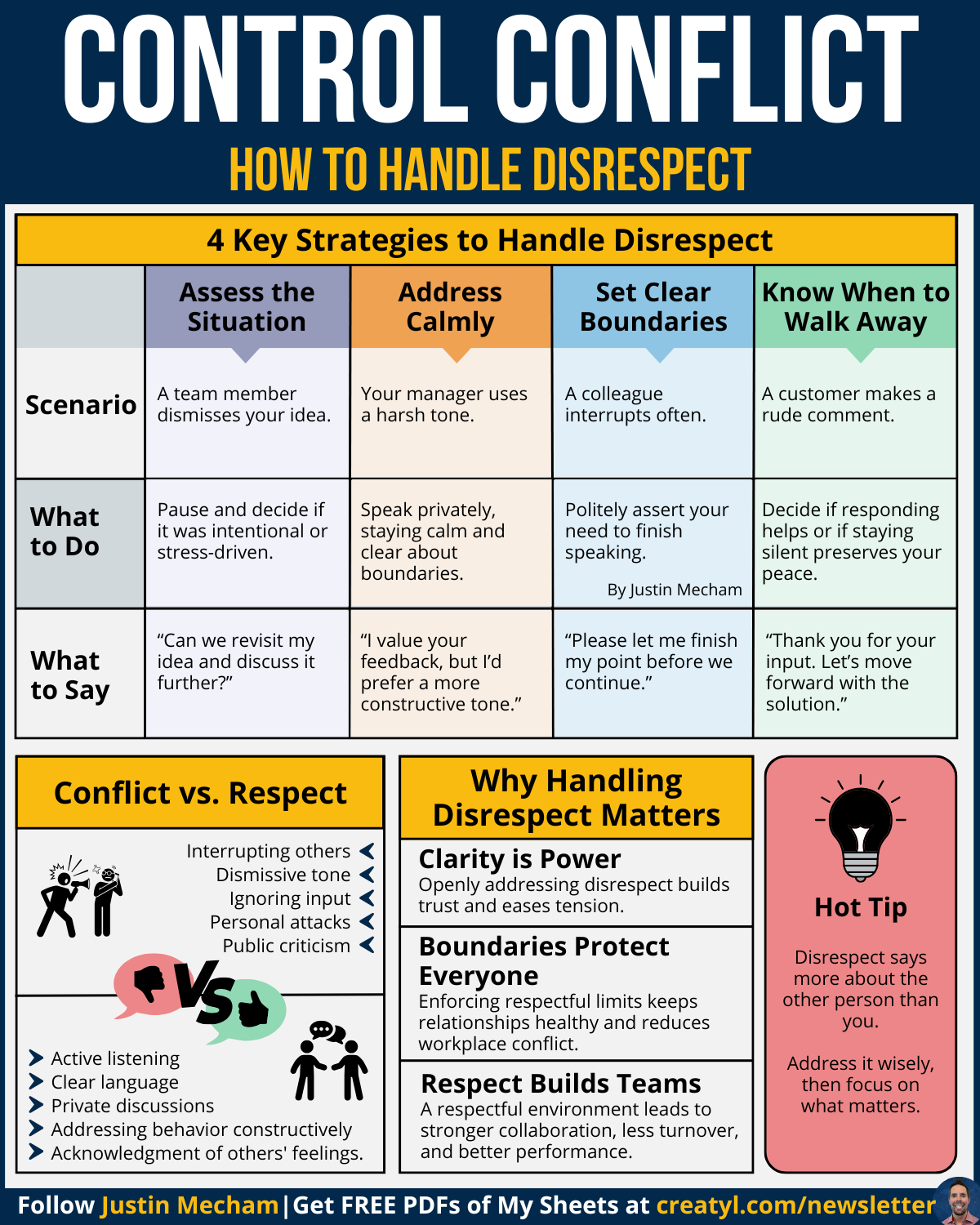
The infographic behind this article breaks that response into four practical moves.
Let’s explore each one in a way that makes it usable in real situations.
Why Disrespect Spreads So Quickly At Work
Before learning how to handle it, it helps to understand why disrespect spreads so easily.
Most workplaces operate under pressure.
Deadlines, performance expectations, and competing priorities create stress.
When stress rises, communication shortcuts appear.
People interrupt.
They dismiss ideas quickly.
They speak more sharply than intended.
Sometimes the behavior is intentional.
Often it’s simply unmanaged stress.
But regardless of intent, the impact is the same.
If disrespect goes unaddressed, it becomes part of the culture.
Small moments turn into patterns.
And patterns shape how people feel about coming to work.
Teachable Moment:
Respect in a workplace is rarely defined by policies.
It is defined by the small moments people allow or correct.
That is why learning to handle those moments calmly matters so much.
The Four Moves That Defuse Disrespect
When someone crosses the line, you don’t need a dramatic confrontation.
You need clarity.
These four moves help you respond without creating more conflict.
1. Assess The Situation First
The first mistake many people make is reacting instantly.
But not every disrespectful moment has the same cause.
Sometimes someone is intentionally dismissive.
Other times they are simply overwhelmed.
Before responding, pause.
Ask yourself a simple question:
Was this intentional, or just stress talking?
That pause gives you control.
Instead of reacting emotionally, you choose a thoughtful response.
A simple phrase can reopen the conversation without escalating tension.
For example:
“Can we revisit that idea for a moment?”
This approach does two things.
It signals confidence.
It gives the other person a chance to correct their behavior.
Teachable Moment:
Clarity often resolves situations that confrontation would worsen.
2. Address It Calmly And Privately
If the behavior continues, the next step is addressing it directly.
But the environment matters.
Public correction often triggers defensiveness.
Private conversations encourage understanding.
The key is to stay calm and focus on the behavior rather than attacking the person.
A useful structure looks like this:
- Acknowledge their input
- Explain the issue
- State what you prefer moving forward
For example:
“I value your feedback, but I’d prefer a more constructive tone when we discuss ideas.”
Notice the difference.
You’re not accusing them.
You’re describing the impact and setting a standard.
Teachable Moment:
People respond better to clear expectations than emotional reactions.
3. Set Clear Boundaries
Some situations require firmer communication.
Interruptions, for example, are common forms of subtle disrespect.
They disrupt conversations and silence valuable contributions.
Allowing them repeatedly signals that the behavior is acceptable.
Setting a boundary is not aggressive.
It is simply protecting the space for productive discussion.
A calm response might sound like this:
“Please let me finish my point, and then I’d really like to hear your perspective.”
This statement maintains respect while reinforcing structure.
Teachable Moment:
Boundaries protect conversations from becoming chaotic.
And strong teams rely on clear communication rules.
4. Know When To Disengage
Not every comment deserves a response.
Some people thrive on attention or confrontation.
Engaging in those situations often fuels the behavior rather than stopping it.
Learning when to disengage is a leadership skill.
Instead of arguing, you redirect the conversation toward progress.
For example:
“Thanks for the feedback. Let’s focus on the solution moving forward.”
This response does three things.
It acknowledges the comment.
It avoids escalation.
It moves the discussion back to the work.
Teachable Moment:
Energy is a limited resource.
Use it where progress is possible.
What Disrespect Actually Looks Like
Disrespect isn’t always obvious.
It often appears in subtle forms.
Common examples include:
- Interrupting others mid-sentence
- Dismissing ideas without discussion
- Personal attacks instead of constructive feedback
- Public criticism meant to undermine
Many workplaces mistakenly label this behavior as “direct communication” or “strong leadership.”
But effective leadership does not rely on intimidation.
It relies on clarity and respect.
What Healthy Conflict Looks Like Instead
Healthy disagreement still challenges ideas.
But it does so with structure and respect.
Strong teams use practices like:
- Active listening
- Clear language
- Private conversations when tensions rise
- Addressing behavior rather than attacking individuals
- Acknowledging emotions without letting them control decisions
Teachable Moment:
Conflict handled well improves collaboration.
Conflict handled poorly destroys it.
Why Addressing Disrespect Matters
Some people prefer to ignore uncomfortable moments.
But avoiding them has consequences.
Three important outcomes appear when disrespect is addressed wisely.
Clarity Builds Trust
When people communicate directly and respectfully, misunderstandings shrink.
Teams feel safer speaking honestly.
Boundaries Protect Everyone
Clear limits prevent toxic patterns from spreading.
People know what behavior is acceptable.
Respect Strengthens Performance
Teams that communicate respectfully collaborate more effectively.
Ideas improve faster.
Decisions move quicker.
Work feels healthier.
Respect isn’t just a cultural value.
It is a performance advantage.
A Real Workplace Example
Turning A Difficult Interaction Into A Better Team Dynamic
A project manager once described a recurring issue during team meetings.
Every time she presented a new idea, a colleague interrupted with criticism.
Sometimes the comments were dismissive.
Other times they were sarcastic.
The interruptions discouraged open discussion.
Team members began staying quiet during meetings.
Ignoring the behavior didn’t help.
The interruptions continued.
Over time, frustration grew across the team.
The meetings felt tense and unproductive.
Instead of confronting the colleague publicly, she used the four-step approach.
First, she assessed the situation.
She realized the colleague was under pressure from tight deadlines.
Then she addressed the issue privately.
She explained that the interruptions were shutting down discussion and asked for more constructive feedback during meetings.
During the next meeting, when the interruption happened again, she calmly set a boundary.
“Please let me finish my point, and then I’d like to hear your thoughts.”
The room immediately shifted.
The conversation stayed structured.
Over the next few weeks, the colleague’s tone improved and meetings became more productive.
The change didn’t come from confrontation.
It came from clarity.
What Makes This Approach Effective
Four key principles make the strategy work:
- It separates emotion from response.
- It focuses on behavior rather than personality.
- It protects respect without escalating conflict.
- It keeps conversations focused on solutions.
These principles transform difficult moments into opportunities for stronger communication.
The Deeper Lesson About Respect
Respect in a workplace rarely appears automatically.
It grows from consistent behavior.
When people address issues calmly and set clear boundaries, they shape the environment around them.
Others begin to follow the same standards.
Over time, the culture shifts.
Not through policies.
Through everyday interactions.
Strength Without Noise
Many people believe strength at work means reacting quickly and forcefully.
But real leadership often looks different.
It looks like calm clarity.
It looks like someone who can address disrespect without adding more conflict.
Someone who protects the conversation instead of dominating it.
In those moments, people notice something important.
Confidence does not require volume.
Authority does not require intimidation.
And respect is not earned through control.
It is earned through consistency.
When you respond to difficult moments with calm boundaries and clear communication, you do more than solve a conflict.
You quietly shape the culture around you.
And over time, that culture becomes a place where people can do their best work.
Best Resources For Navigating Workplace Conflict
Book: Crucial Conversations — Kerry Patterson, Joseph Grenny
Why It Fits: A practical guide to handling difficult conversations calmly and effectively.
Book: Radical Candor — Kim Scott
Why It Fits: Explores how to balance honesty and care in leadership conversations.
Podcast: WorkLife with Adam Grant
Why It Fits: Explores workplace psychology, leadership dynamics, and team communication.
TED Talk: The Power of Vulnerability — Brené Brown
Why It Fits: Explains how openness and courage strengthen trust and leadership.
Tool: Loom — Founded by Joe Thomas and Vinay Hiremath
Why It Fits: Allows clear, recorded communication that can reduce misunderstandings in teams.
AI Tool: ChatGPT — OpenAI
Why It Fits: Useful for drafting difficult messages and practicing responses to challenging conversations.
Download The “Control Conflict: How To Handle Disrespect” Infographic (PDF)
If you want a clear visual guide to the four strategies discussed in this article, download the PDF version of the infographic.
Use it as a reminder the next time a difficult moment appears at work.