


Click Here to Download the PDF.
The Real Problem With How Most People Use AI
There is a growing gap between people who are using AI and people who are actually benefiting from it.
On the surface, it looks like everyone is making progress.
People are generating ideas faster, writing more content, experimenting with different formats, and showing up more consistently online.
It feels productive. It feels like momentum.
But when you look closer, something is missing.
Most of that activity is not translating into meaningful results.
There is no consistent revenue. No clear offer.
No system that turns attention into something tangible.
The issue is not effort. It is not access.
And it is definitely not the capability of the tool.
The issue is how the tool is being used.
Most people are asking AI to help them create content.
Very few are asking it to help them build something that people will actually pay for.
That difference may sound small, but it completely changes the outcome.
Because content is easy to produce. Value is not.
Why Content Alone Rarely Leads to Income
Content has become the default starting point for most creators, professionals, and business builders.
It feels like the logical first step.
Share ideas, build an audience, and eventually monetize.
But that path breaks down when there is no clear direction behind it.
Content without structure becomes noise.
It might attract attention, but it does not hold it.
It might generate engagement, but it does not convert it.
This is where many people get stuck.
They assume they need better content.
Better hooks. Better formatting. Better consistency.
In reality, what they need is clarity.
Clarity about who they are helping.
Clarity about what problem they solve.
Clarity about what outcome they can deliver.
Without those elements, even the best content struggles to lead anywhere meaningful.
AI does not fix that problem automatically.
It simply accelerates whatever process you are already running.
If your process is unclear, AI will produce more unclear output, just faster.
The Shift That Changes Everything
The people who are quietly building real income with AI are not treating it like a content generator.
They are treating it like a thinking partner.
They are not starting with “What should I post today?”
They are starting with “What problem can I solve?”
This is the shift that changes everything.
When you begin with a problem, you naturally move toward a solution.
When you move toward a solution, you create something useful.
And when something is useful, it can be packaged, shared, and paid for.
AI becomes powerful in this process because it helps you clarify, expand, and refine your thinking.
It helps you move from vague ideas to structured offers.
But it cannot decide what matters for you.
That still requires awareness.
Finding Problems That People Will Actually Pay to Solve
One of the most common misconceptions is that income comes from big, original ideas.
That belief leads people to overthink, overbuild, and delay starting.
In reality, most successful offers are built on simple, well-understood problems.
These problems are not hidden. They show up in everyday conversations.
They appear in questions people ask repeatedly.
They show up in frustrations people mention casually.
They exist in the gaps between where someone is and where they want to be.
The key is to pay attention.
AI can help you organize these insights.
It can help you map your skills to potential audiences and identify patterns in what people struggle with.
But the raw input still comes from real observation.
If people are already asking you for help, that is not random. It is a signal.
And signals like that are often the best place to start.
Turning Problems Into Clear, Actionable Promises
Once you identify a problem, the next step is to translate it into a clear outcome.
This is where many people lose momentum.
They describe what they plan to create instead of what someone will achieve.
For example, saying “I will create a course on productivity” is vague.
It focuses on the format rather than the result.
A clearer version would be something like “Help you finish your most important work in two focused hours a day.”
The difference is significant.
One describes information.
The other describes transformation.
People do not pay for access to information. They pay for the ability to move forward.
AI is especially useful at this stage because it can help refine language.
It can take a rough idea and sharpen it into something more specific, more direct, and more outcome-focused.
But again, the quality of the output depends on the clarity of the input.
Building Offers Without Overcomplicating the Process
A common mistake is assuming that building something valuable requires a complex system.
Multiple products, detailed funnels, layered content, and extensive preparation.
That approach slows people down before they even start.
In most cases, the opposite works better.
Start with something small and focused. A single offer that solves one problem for one type of person.
It does not need to be perfect. It does not need to be extensive. It just needs to be useful.
AI can help you outline the structure, suggest formats, and organize delivery.
But the goal is not to create more. It is to create what is necessary.
Simplicity is not a limitation. It is an advantage.
Addressing Doubt Before It Stops the Sale
Every potential buyer has questions.
Not because they are difficult, but because they are uncertain.
Will this work for me?
Is this worth the cost?
Is this the right time?
Most people wait until those objections show up to respond.
A more effective approach is to anticipate them early.
AI can be used to surface common objections and help craft clear, honest responses.
This allows you to remove friction before it becomes a barrier.
When people feel understood, they are more likely to move forward.
Pricing With Clarity Instead of Guesswork
Pricing is another area where people tend to hesitate.
They either undervalue their work or avoid setting a price altogether because they are unsure.
The goal is not to find the perfect number.
It is to find a price that reflects the value being delivered and feels fair to both sides.
AI can offer perspective by suggesting different pricing tiers and explaining the reasoning behind them.
This does not replace judgment, but it helps frame the decision.
Confidence in pricing often comes from clarity in the outcome.
If the result is clear and meaningful, the price becomes easier to justify.
Moving From Content to Conversion
Content plays an important role, but it should not be the end point.
Each piece of content should lead somewhere.
It should guide the reader or viewer toward a next step.
That step does not need to be aggressive or complicated. It can be simple.
Learn more.
Try this approach.
Join this offer.
The key is direction.
AI can help you turn educational content into structured pathways by adding clear calls to action and connecting ideas back to your offer.
This is where content begins to work for you instead of just existing.
A Real-World Example: From Activity to Income
Consider a professional who has been consistently posting online for months.
Their content is thoughtful and helpful, but it does not lead to any meaningful income.
The issue is not effort. It is structure.
There is no clear problem being solved.
No defined offer. No path for someone to follow.
When they shift their approach, everything changes.
They identify one specific problem their audience faces.
They define a clear outcome.
They build a simple offer around it.
Then they adjust their content to support that offer.
The volume of content does not increase.
The quality does not drastically change.
But the direction becomes clear.
And that clarity is what creates results.
Why Most People Stay Stuck
The biggest barrier is not a lack of tools. It is a lack of focus.
It is easy to stay in the idea phase, especially when AI makes it so simple to generate new directions.
But ideas do not create income on their own.
Execution does.
And execution requires choosing one direction and following it long enough to see results.
AI can support that process, but it cannot replace it.
The Real Advantage Is Not AI
There is a common belief that AI is the advantage.
It is not.
The real advantage is clarity.
Clarity about what you know.
Clarity about who you help.
Clarity about what problem you solve.
When those pieces are in place, AI becomes incredibly powerful.
It helps you move faster, think more clearly, and build more efficiently.
Without them, it becomes just another tool that creates activity without progress.
The difference is not in the technology.
It is in how intentionally it is used.
Resources to Go Deeper
Book: $100M Offers by Alex Hormozi
A practical breakdown of how to create offers that people actually want to buy.
Book: Building a StoryBrand by Donald Miller
A guide to communicating your value clearly so people understand and act.
Podcast: My First Million
Real-world discussions on turning ideas into profitable opportunities.
TED Talk: The Next Wave of AI by Mustafa Suleyman
A thoughtful look at how AI is shaping decision-making and opportunity.
Tool: ChatGPT
Best used as a thinking partner to refine ideas, structure offers, and clarify messaging.
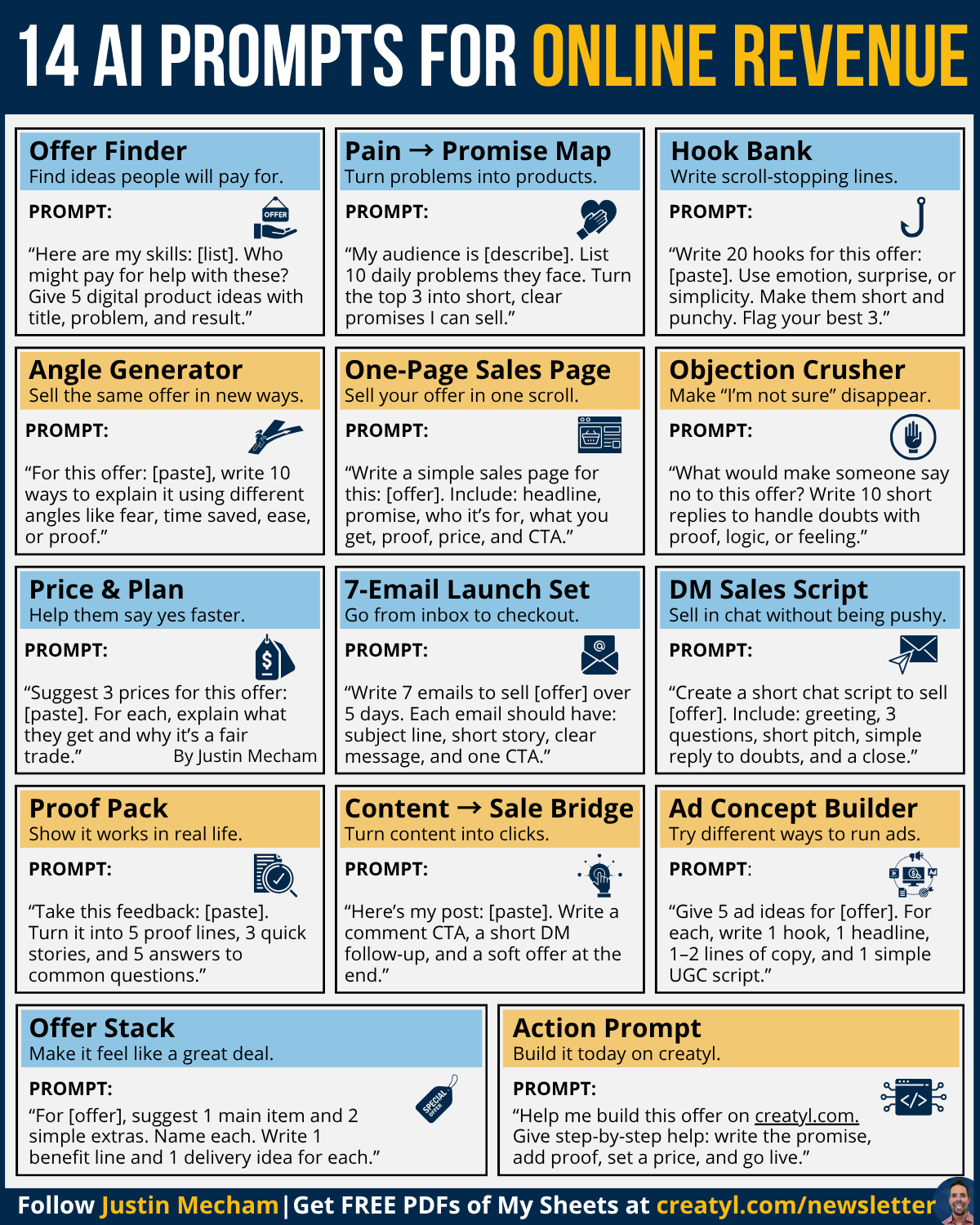
Download the Full AI Revenue Prompt Guide
If you want a structured way to apply everything in this article, download the full “AI Prompts for Online Revenue” infographic as a PDF.
It will walk you step by step through turning your skills into offers, refining your messaging, and building something people are ready to pay for.