

Click Here to Download the PDF.
The Day I Realized My Team Didn't Need a Better Manager. They Needed a Better Leader.
For a long time, I thought I was doing a good job.
Projects were getting finished.
Meetings happened on time.
Deadlines were being met.
My calendar was organized.
On paper, I was succeeding.
Then something happened that forced me to rethink everything.
A talented employee resigned.
Not because of the company.
Not because of the work.
Because they no longer felt seen.
That conversation stayed with me for a long time.
It made me realize something uncomfortable:
Managing work and leading people are not the same thing.
One is about coordination.
The other is about influence.
One focuses on tasks.
The other focuses on humans.
Many people receive the title of manager.
Far fewer develop the habits of a leader.
Leadership isn't built from charisma, motivational speeches, or having all the answers.
It's built through small behaviors that repeat every single day.
The meeting where you listen instead of interrupting.
The promise you keep even when nobody would notice if you didn't.
The calm response during a stressful moment.
The difficult conversation you choose not to avoid.
Over time, those moments become your leadership reputation.
Not your job title.
Leadership Is a Collection of Skills, Not a Personality Trait
Many people believe leadership is something you're born with.
Research tells a different story.
Leadership is learned.
Like communication.
Like coaching.
Like decision-making.
Every leader develops a combination of skills over time.
Some become exceptional at strategy but struggle with relationships.
Others inspire people but fail to execute consistently.
The strongest leaders develop multiple dimensions simultaneously.
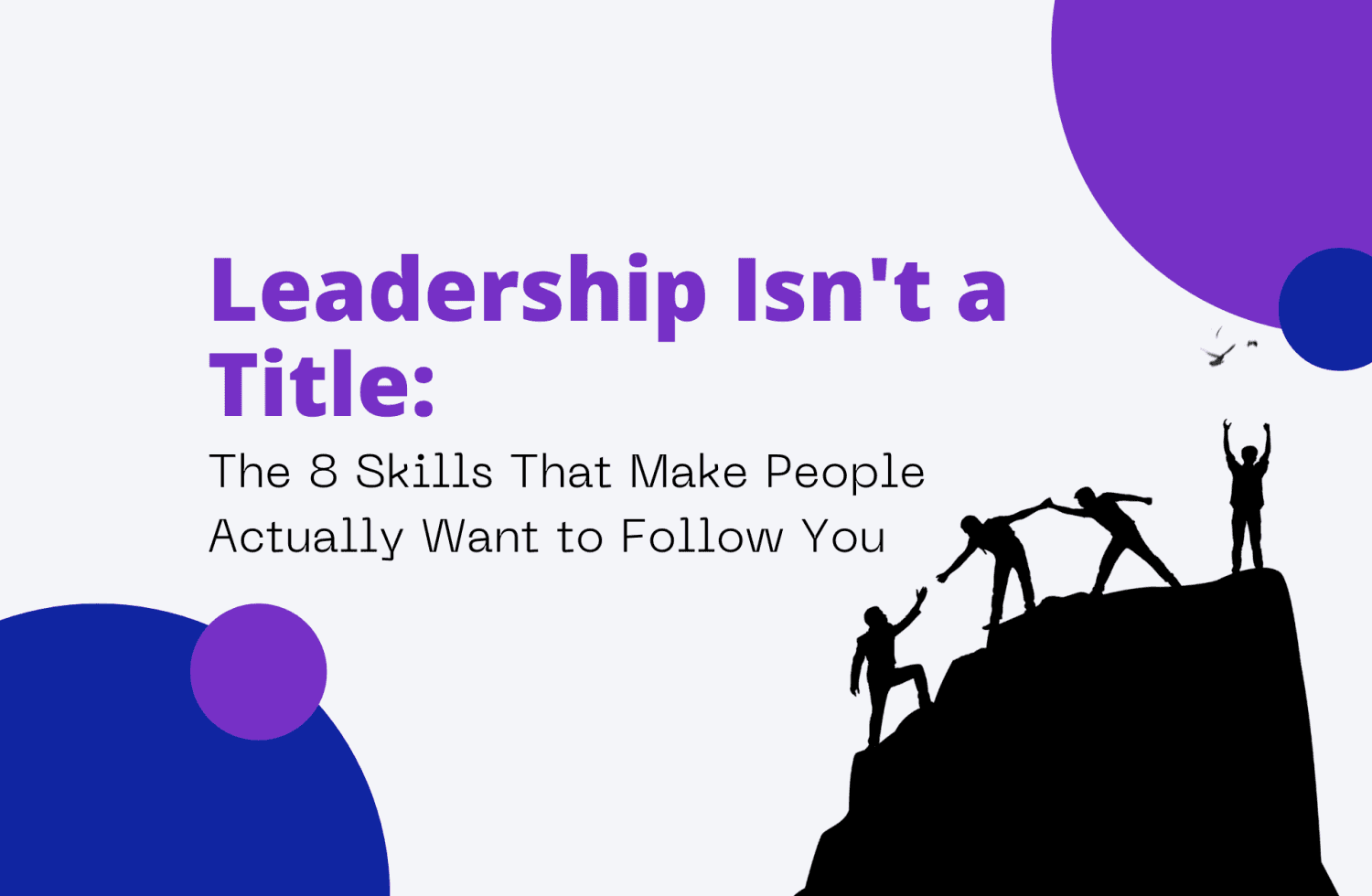
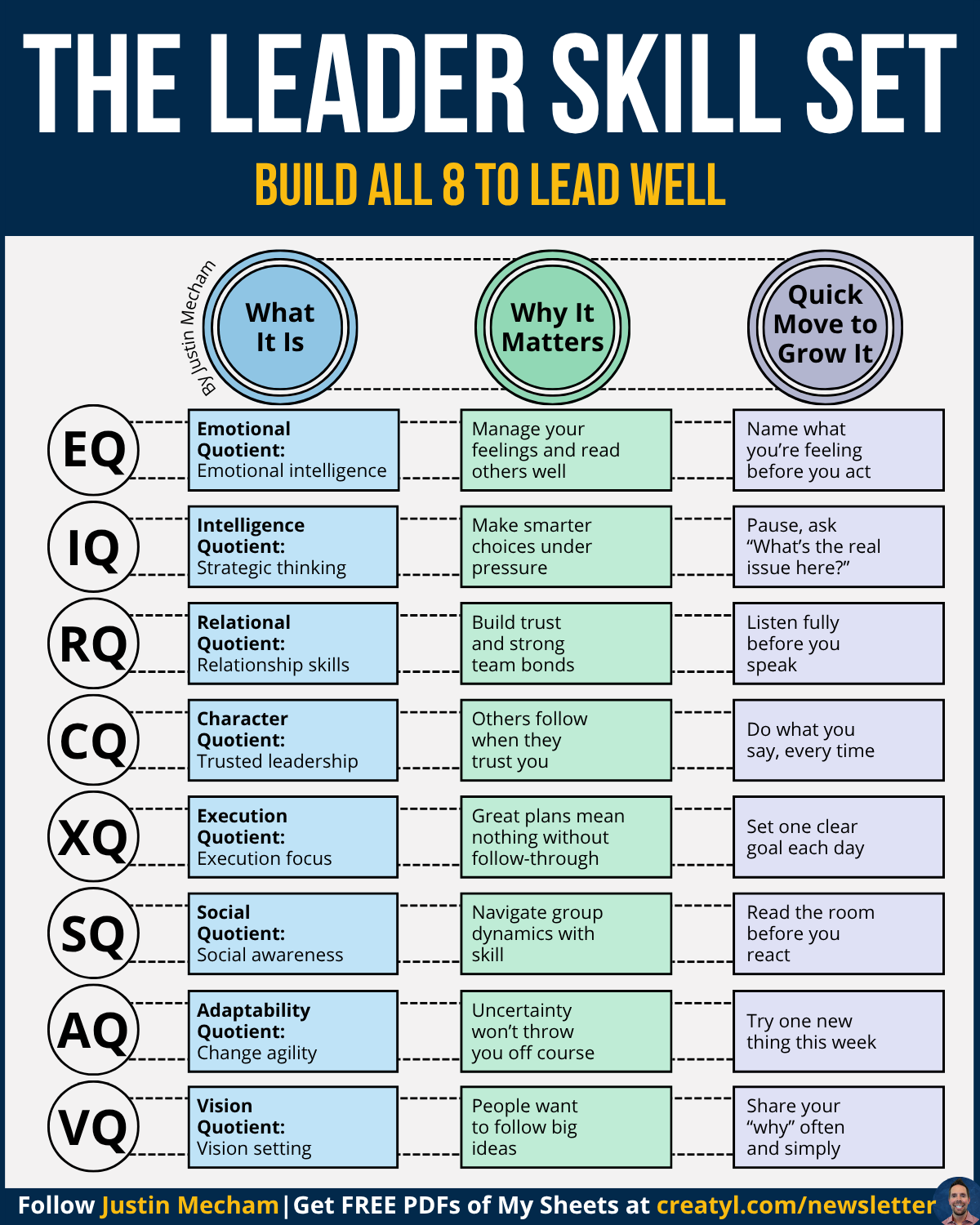
Below are eight that consistently appear in effective leadership.
Not because they're trendy.
Because teams depend on them.
1. EQ: Emotional Intelligence
What it is
The ability to recognize, understand, and manage your own emotions while accurately reading the emotions of others.
Why it matters
People don't expect leaders to be emotionless.
They expect them to be emotionally stable.
A leader who reacts impulsively creates uncertainty.
A leader who responds thoughtfully creates safety.
Psychological safety begins with emotional consistency.
When people know they won't be embarrassed, dismissed, or attacked for speaking honestly, they contribute more openly.
Innovation grows.
Trust grows.
Engagement grows.
How to improve it
Before responding during a stressful moment, pause and ask:
"What am I feeling right now?"
Naming the emotion reduces its intensity.
Instead of saying:
"I'm frustrated."
Try becoming more specific.
Am I disappointed?
Embarrassed?
Anxious?
Protective?
The more accurately you identify emotions, the more effectively you manage them.
2. IQ: Strategic Thinking
What it is
The ability to understand root causes instead of reacting only to visible problems.
Why it matters
Weak leaders solve symptoms.
Strong leaders solve systems.
When a deadline is missed, the real issue may not be motivation.
It could be:
Unclear priorities.
Poor communication.
Resource shortages.
Conflicting goals.
Process failures.
The first explanation is rarely the complete explanation.
How to improve it
Ask one question before solving any problem:
"What is actually causing this?"
Five minutes spent understanding often saves weeks spent fixing.
3. RQ: Relationship Intelligence
What it is
The ability to build trust through meaningful relationships.
Why it matters
People don't simply work for organizations.
They work with people.
Employees often stay because of great relationships.
They frequently leave because of broken ones.
Trust accelerates everything.
Feedback becomes easier.
Conflict becomes healthier.
Collaboration becomes faster.
Without trust, every conversation becomes harder than it needs to be.
How to improve it
Practice listening without preparing your response.
Most people listen to answer.
Leaders listen to understand.
Before replying, summarize what you heard.
People rarely forget the leaders who made them feel understood.
4. CQ: Character
What it is
Doing what you say you will do.
Especially when it's inconvenient.
Why it matters
Trust isn't built through dramatic moments.
It's built through consistency.
Your team notices:
The meeting you promised to schedule.
The feedback you said you'd provide.
The decision you delayed.
The commitment you forgot.
Character isn't tested when things are easy.
It's revealed when keeping your word becomes difficult.
How to improve it
Start with the smallest promises.
If you promise Friday...
Deliver Friday.
Reliability compounds.
Eventually people stop wondering whether you'll follow through.
They simply expect it.
5. XQ: Execution
What it is
Turning priorities into completed outcomes.
Why it matters
Ideas don't change organizations.
Execution does.
Teams often don't suffer from a lack of ambition.
They suffer from scattered attention.
Everything feels important.
Nothing gets finished.
The best leaders reduce complexity.
They create focus.
How to improve it
Choose one non-negotiable priority every morning.
Complete it before moving to less important work.
Momentum creates confidence.
Finished work creates credibility.
6. SQ: Social Awareness
What it is
Understanding group dynamics, unspoken concerns, and interpersonal relationships.
Why it matters
Leadership isn't only about reading individuals.
It's about reading rooms.
Sometimes the most important conversation is the one nobody is having.
Great leaders notice:
Who hasn't spoken.
Who's becoming disengaged.
Who's carrying too much.
Where tension exists.
What remains unsaid often matters most.
How to improve it
Spend the first few minutes of meetings observing instead of speaking.
Watch body language.
Energy.
Participation.
Silence.
The room tells a story before anyone says a word.
7. AQ: Adaptability
What it is
The willingness to change approaches when circumstances change.
Why it matters
Every organization changes.
Markets change.
Technology changes.
Customer expectations change.
Leadership must change too.
Holding onto outdated methods because they've always worked eventually becomes a liability.
Adaptability keeps organizations competitive.
It keeps leaders relevant.
How to improve it
Every week, deliberately try one new approach.
Ask:
"What if there's a better way?"
Curiosity protects leaders from becoming rigid.
8. VQ: Vision
What it is
Helping people understand why their work matters.
Why it matters
People don't commit to tasks.
They commit to purpose.
A checklist explains what.
Vision explains why.
When employees understand the impact of their work, motivation becomes internal rather than external.
Purpose fuels persistence.
How to improve it
Whenever assigning work, explain:
Why this matters.
Who it helps.
What success creates.
Meaning increases engagement far more than instructions alone.
The Difference Between Managing and Leading
Managers coordinate work.
Leaders create environments where great work naturally happens.
Managers ask:
"Is the project finished?"
Leaders ask:
"Does the team have what they need to succeed?"
Managers enforce accountability.
Leaders build ownership.
Managers organize calendars.
Leaders develop people.
The strongest organizations need both.
But if you can only master one first, choose leadership.
Management improves systems.
Leadership improves people.
People improve everything else.
The 8-Day Leadership Challenge
Learning leadership concepts isn't enough.
Practice matters.
Try this simple challenge.
Day 1
Notice your emotions before responding.
Day 2
Replace assumptions with better questions.
Day 3
Spend one conversation listening more than speaking.
Day 4
Keep one promise you've been postponing.
Day 5
Finish one meaningful priority before checking email.
Day 6
Pay attention to team dynamics.
Who needs encouragement?
Who needs support?
Who needs recognition?
Day 7
Experiment with one different leadership approach.
Ask more.
Control less.
Coach instead of solve.
Day 8
Explain why the work matters before discussing the work itself.
Purpose always outlasts pressure.
A Leadership Story
David had recently been promoted into his first management role.
He believed success meant having answers.
So he solved every problem himself.
Made every decision.
Approved everything personally.
His team became dependent.
Slow.
Quiet.
Performance dropped despite everyone working hard.
David assumed people lacked initiative.
In reality, they lacked ownership.
They had learned that every decision would eventually come back to him anyway.
His leadership unintentionally created bottlenecks.
The harder he worked, the less independent his team became.
Instead of giving answers immediately, David started asking questions.
"What do you recommend?"
"What options have you considered?"
"What would success look like?"
Slowly, the conversations changed.
Confidence increased.
Decision-making spread across the team.
Performance improved.
Not because David worked harder.
Because he led differently.
Common Leadership Mistakes
Avoid these traps:
Confusing busyness with leadership
Being busy doesn't automatically make you effective.
Speaking before understanding
The fastest answer isn't always the best one.
Breaking small promises
Trust disappears gradually.
Protect it carefully.
Solving every problem yourself
Your job isn't to become the hero.
It's to develop more heroes.
Explaining what without explaining why
People remember purpose far longer than instructions.
Resources for Becoming a Better Leader
Book
The First 90 Days by Michael Watkins
One of the most practical books on transitioning into leadership roles and building credibility quickly.
TED Talk
Simon Sinek – Why Good Leaders Make You Feel Safe
A timeless discussion on trust, responsibility, and why people willingly follow certain leaders.
Weekly Reflection Exercise
Every Friday, answer these five questions:
- What leadership decision am I most proud of this week?
- Where did I react instead of respond?
- Who on my team needs more support?
- What promise do I need to keep next week?
- What behavior did I model that I hope others repeat?
Leadership improves through reflection as much as action.
Leadership Happens on Ordinary Wednesdays
Leadership isn't measured during quarterly meetings.
Or company retreats.
Or award ceremonies.
It's measured during ordinary moments.
The stressful Tuesday.
The uncomfortable conversation.
The missed deadline.
The disagreement.
The unexpected mistake.
Your team isn't waiting to see how inspiring your next presentation is.
They're watching how you behave when nothing is going according to plan.
Because that's when leadership becomes visible.
Every small promise you keep.
Every question you ask.
Every calm response you choose.
Every person you genuinely listen to.
Those moments become your legacy.
Not because they're dramatic.
Because they're consistent.
The best leaders don't become extraordinary overnight.
They simply make one better decision than yesterday.
Then repeat it.
Download the Related Infographic
Want a simple framework to strengthen your leadership every week?
Download the Leader Skill Set infographic. It breaks down the eight essential leadership quotients, explains why each one matters, provides practical ways to improve them, and includes an easy eight-day challenge you can start immediately. Keep it nearby as a daily reminder that leadership isn't built through titles. It's built through small actions repeated consistently.