

Click Here to Download the PDF.
The Most Overused Word in the Workplace
There is a word that quietly undermines confidence in workplaces around the world.
Most people use it dozens of times every week.
Some use it dozens of times every day.
The word is not offensive.
It is not aggressive.
It is not even negative by itself.
In fact, it is often used with good intentions.
That word is sorry.
Now, to be clear, genuine apologies matter.
When mistakes happen, accountability matters.
When someone is hurt, apologies matter.
When trust is broken, apologies matter.
But many people are not apologizing for mistakes.
They are apologizing for existing.
They apologize for asking questions.
They apologize for seeking clarity.
They apologize for needing help.
They apologize for following up.
They apologize for expressing an opinion.
They apologize before they have done anything wrong.
Over time, this creates a hidden problem.
Every unnecessary apology subtly communicates uncertainty.
It tells people:
"I am not sure I deserve your time."
"I am not sure my question matters."
"I am not sure my opinion belongs here."
The irony is that most people think they are being polite.
What they are actually doing is making themselves smaller.
The goal of confident communication is not becoming louder.
The goal is learning how to communicate respectfully without diminishing your own value.
The Difference Between Courtesy and Self-Minimization
Many people confuse confidence with arrogance.
Others confuse politeness with self-sacrifice.
Neither is true.
Confident communicators are often extremely respectful.
The difference is that they do not apologize for normal human interactions.
Think about the difference between these two statements:
"Sorry to bother you, but I have a question."
Versus:
"Quick question when you have a moment."
Both are polite.
Both are respectful.
Only one assumes the conversation is an inconvenience.
The second version communicates something powerful.
It assumes the interaction is reasonable.
Because it is.
Questions are part of work.
Clarification is part of work.
Collaboration is part of work.
You do not need permission to participate in activities that are already part of your role.
Why We Apologize So Much
Most unnecessary apologies do not come from weakness.
They come from habit.
Many people learned early that being agreeable kept conflict away.
Others learned that being quiet earned approval.
Some learned to soften every request because they feared being seen as demanding.
Over time, these behaviors become automatic.
The brain creates a shortcut:
Need something?
Add sorry.
Have an opinion?
Add sorry.
Need clarification?
Add sorry.
Disagree?
Definitely add sorry.
Eventually the word becomes verbal wallpaper.
Used constantly.
Not because it is necessary.
Because it feels familiar.
The problem is that language shapes perception.
Not only how others see you.
But how you see yourself.
When you repeatedly apologize for normal interactions, you train yourself to believe your needs are burdens.
That belief becomes difficult to shake.
The Hidden Cost of Constant Apologizing
Most people focus on what apologies communicate externally.
The bigger impact is often internal.
Every unnecessary apology reinforces a subtle message:
"My contribution is less important."
"My needs are less important."
"My perspective is less important."
Over months and years, that mindset affects behavior.
People stop speaking up.
They avoid asking questions.
They hesitate to share ideas.
They stay silent during meetings.
They second-guess themselves.
Meanwhile, less capable but more confident individuals step forward.
Not because they know more.
Because they communicate differently.
Confidence often gets mistaken for competence.
That is why communication matters so much.
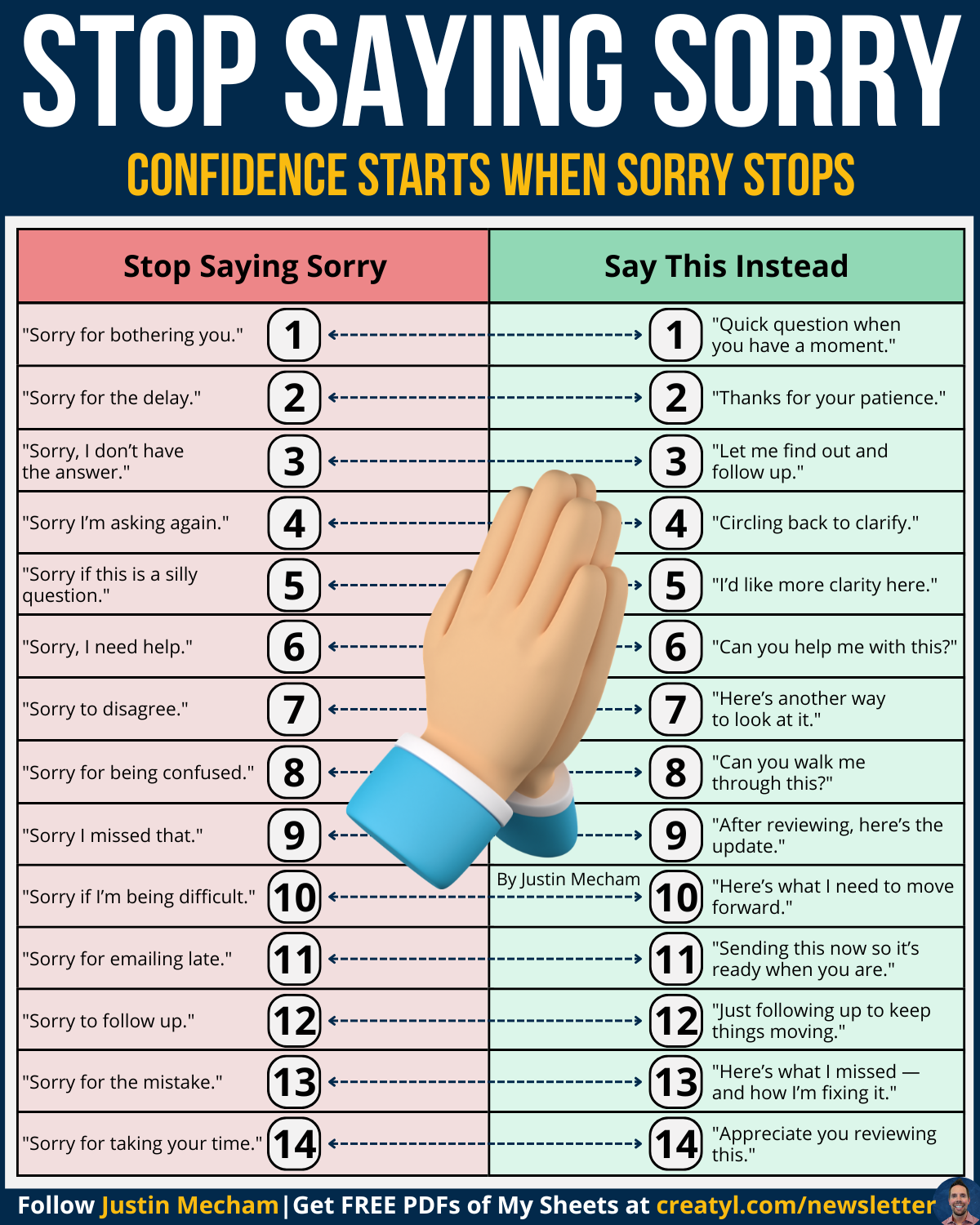
14 Confidence Shifts That Change Everything
1. Stop Saying: Sorry For Bothering You
Instead Say:
Quick question when you have a moment.
Why it works:
You are respecting their time without implying your question lacks value.
2. Stop Saying: Sorry For The Delay
Instead Say:
Thank you for your patience.
Why it works:
The focus shifts from your mistake to their cooperation.
The conversation becomes more positive and forward-looking.
3. Stop Saying: Sorry, I Don't Know
Instead Say:
Let me find out and follow up.
Why it works:
Not knowing something is normal.
The important thing is your willingness to find the answer.
4. Stop Saying: Sorry For Asking Again
Instead Say:
Circling back to clarify.
Why it works:
Clarity is responsible communication.
Not an inconvenience.
5. Stop Saying: Sorry If This Is A Silly Question
Instead Say:
I'd like more clarity here.
Why it works:
Questions are how people learn.
The strongest professionals ask excellent questions.
6. Stop Saying: Sorry, I Need Help
Instead Say:
Can you help me with this?
Why it works:
Collaboration is a strength.
Not a weakness.
7. Stop Saying: Sorry To Disagree
Instead Say:
Here's another way to look at it.
Why it works:
Different perspectives improve decisions.
Healthy disagreement creates better outcomes.
8. Stop Saying: Sorry For Being Confused
Instead Say:
Can you walk me through this?
Why it works:
Understanding matters more than pretending.
9. Stop Saying: Sorry I Missed That
Instead Say:
After reviewing, here's the update.
Why it works:
Focus on solutions instead of dwelling on minor mistakes.
10. Stop Saying: Sorry If I'm Being Difficult
Instead Say:
Here's what I need to move forward.
Why it works:
Clear expectations reduce frustration for everyone.
11. Stop Saying: Sorry For Emailing Late
Instead Say:
Sending this now so it's ready when you are.
Why it works:
The message remains professional without unnecessary self-criticism.
12. Stop Saying: Sorry To Follow Up
Instead Say:
Just following up to keep things moving.
Why it works:
Progress requires communication.
Following up is responsible.
13. Stop Saying: Sorry For The Mistake
Instead Say:
Here's what I missed and how I'm fixing it.
Why it works:
Ownership plus action builds trust faster than endless apologies.
14. Stop Saying: Sorry For Taking Your Time
Instead Say:
I appreciate you reviewing this.
Why it works:
Gratitude is often more powerful than apology.
What Truly Deserves An Apology?
This conversation is not about eliminating apologies.
It is about using them correctly.
A genuine apology matters when:
- You caused harm.
- You broke trust.
- You missed a commitment.
- You acted disrespectfully.
- You created unnecessary problems for others.
Those moments deserve ownership.
In fact, strong leaders apologize quickly when they are wrong.
The difference is they do not apologize for things that were never wrong in the first place.
The Leadership Connection
One of the biggest communication shifts leaders make is learning the difference between accountability and self-minimization.
Great leaders say:
I made a mistake.
I missed that.
I should have handled that better.
Those statements create trust.
What great leaders rarely say is:
Sorry for asking.
Sorry for having an idea.
Sorry for sharing feedback.
Sorry for speaking.
Leadership requires presence.
Presence requires confidence.
Confidence requires believing your voice belongs in the room.
A Real-Life Workplace Example
Sophia worked as a project manager in a growing technology company.
She was highly capable, organized, and respected by her team.
Yet during leadership meetings, her ideas rarely gained traction.
When she reviewed recordings of meetings, she noticed a pattern.
Almost every contribution started with an apology.
"Sorry, just one thought."
"Sorry if this doesn't make sense."
"Sorry to interrupt."
"Sorry, maybe I'm wrong."
The ideas themselves were excellent.
But she was unintentionally reducing their impact before anyone even heard them.
Over time, her confidence suffered.
She became frustrated watching less experienced colleagues receive recognition.
The issue wasn't capability.
It was communication.
Every apology subtly framed her contributions as less valuable.
Without realizing it, she was teaching people to view her ideas with less certainty than she viewed them herself.
For one month, Sophia replaced unnecessary apologies with clear statements.
Instead of:
"Sorry, I have an idea."
She said:
"I'd like to suggest an alternative approach."
Instead of:
"Sorry if this sounds silly."
She said:
"I'd like clarification on something."
The results were immediate.
Her participation increased.
People responded more positively.
Leadership began seeking her input more frequently.
Nothing about her expertise changed.
Only her language did.
Five Daily Exercises To Build More Confident Communication
1. Notice Every Unnecessary Sorry
Awareness comes first.
Track them for one week.
Patterns become obvious quickly.
2. Replace Apologies With Gratitude
Instead of apologizing for delays, thank people for patience.
Instead of apologizing for questions, thank people for their time.
3. Remove Softening Phrases
Avoid:
- Just
- Maybe
- Kind of
- Sort of
When they reduce clarity.
4. Ask Questions Directly
Strong communicators seek understanding without apologizing for curiosity.
5. Pause Before Sending Messages
Review your communication.
Ask:
Did I apologize for something that wasn't wrong?
Recommended Resources
Book
Presence by Amy Cuddy
A powerful exploration of confidence, communication, and how small behavioral shifts influence perception.
TED Talk
Your Body Language May Shape Who You Are – Amy Cuddy
An excellent discussion about confidence, presence, and communication.
Podcast
Think Fast, Talk Smart
A practical communication podcast filled with strategies for speaking with clarity and confidence.
AI Tool
ChatGPT
Helpful for rewriting emails, presentations, feedback messages, and difficult conversations into clearer, more confident communication.
Confidence Is Not About Speaking Louder
Many people believe confidence looks like dominance.
It does not.
Confidence is not interrupting people.
It is not talking the most.
It is not always being right.
Real confidence is much quieter.
It is asking the question without apologizing first.
It is sharing the idea without shrinking it.
It is requesting help without feeling guilty.
It is disagreeing respectfully without feeling the need to soften your existence.
The strongest communicators understand something important:
Their value does not increase when they make themselves smaller.
Their value becomes visible when they communicate clearly, honestly, and respectfully.
Every unnecessary apology asks for permission to exist.
Every clear statement assumes you already belong.
And the truth is, you do.
Not because you are perfect.
Not because you know everything.
Not because you never make mistakes.
But because your voice, your ideas, your questions, and your perspective deserve space in the conversation.
Confidence is not becoming someone else.
It is finally speaking as if your contribution matters.
Because it does.
Download The Related Infographic
Want a visual version of the Stop Saying Sorry: Confidence Starts When Sorry Stops framework?
Download the infographic PDF and keep it nearby as a reminder of how to communicate with clarity, confidence, and respect without making yourself smaller.