

Click Here to Download the PDF.
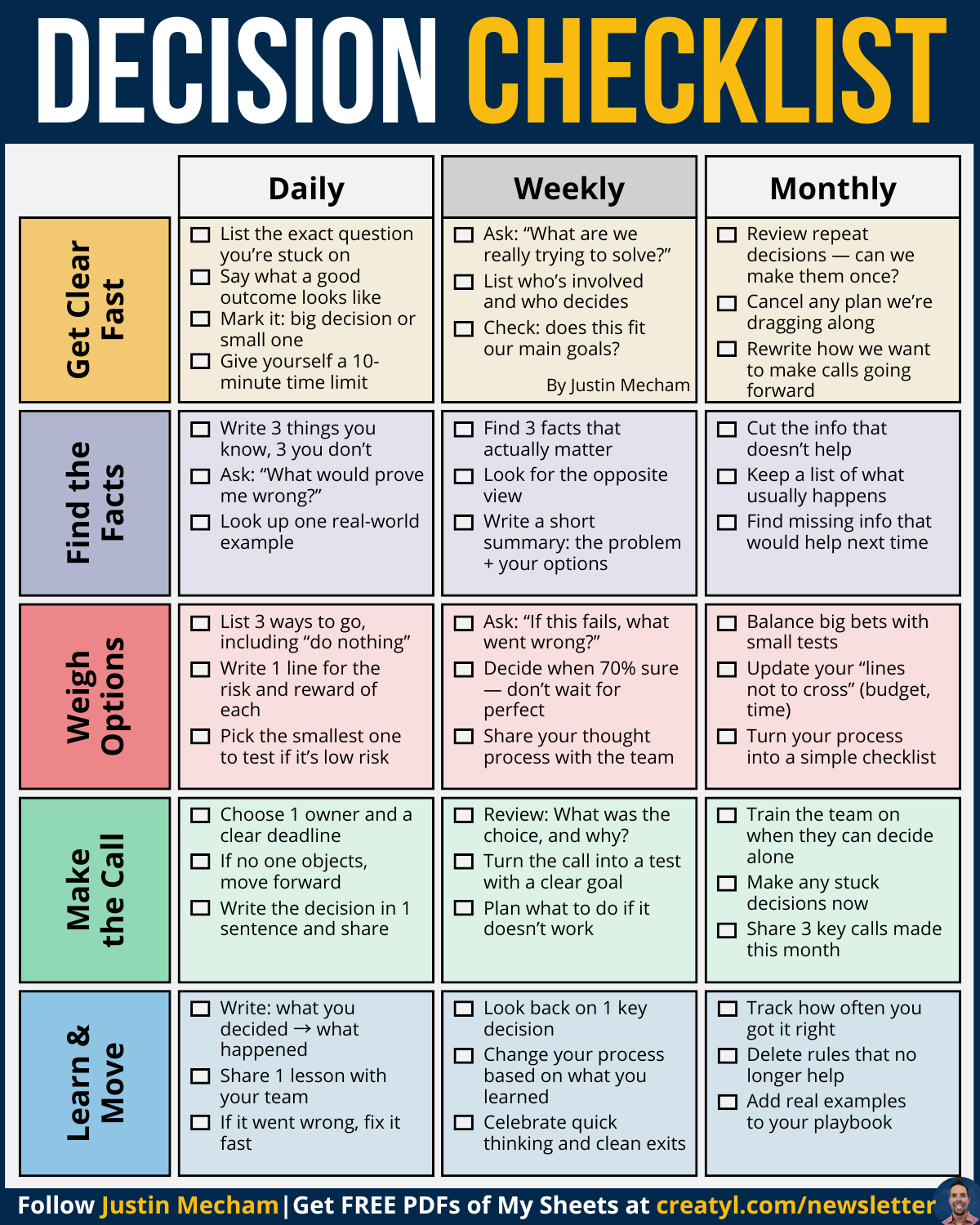
The Decisions That Change Your Life Rarely Feel Big at the Time
Looking back, most of the decisions that shaped my career didn't feel monumental when I made them.
Hiring one person.
Saying yes to one project.
Walking away from one opportunity.
Choosing one business idea over another.
Having one difficult conversation instead of avoiding it.
At the time, each decision seemed ordinary.
Months later, I realized each one had quietly changed the direction of everything.
That's what makes decision-making so difficult.
Life rarely announces:
"This is one of the decisions that will define your next five years."
Instead, it disguises those moments as ordinary Tuesdays.
A meeting.
An email.
A phone call.
A quick conversation.
And because they feel ordinary, we often rush them.
We decide while we're tired.
We decide while we're emotional.
We decide because we're uncomfortable with uncertainty.
Then we spend months solving problems that began with one rushed decision.
Over time I realized something important.
The goal isn't making decisions faster.
The goal is making fewer bad ones.
And that starts by asking better questions.
Why Smart People Still Make Poor Decisions
Most bad decisions don't happen because people lack intelligence.
They happen because people lack process.
Our brains are wired for speed.
Not accuracy.
Psychologists call this cognitive efficiency.
Your brain wants to conserve energy.
Instead of gathering more information, it fills gaps.
Instead of slowing down, it creates shortcuts.
Those shortcuts are incredibly useful for everyday life.
They're dangerous when the stakes are high.
Think about some common examples.
Hiring someone after a great interview without checking references.
Launching a product because you love the idea without validating demand.
Rejecting feedback because it feels uncomfortable.
Continuing a project because you've already invested so much.
None of these decisions happen because people are careless.
They happen because our minds naturally favor certainty over curiosity.
The strongest decision-makers don't trust their first instinct blindly.
They challenge it.
The Five Questions That Improve Almost Every Decision
Whenever you're facing an important decision, pause long enough to answer five questions.
They seem simple.
They're remarkably powerful.
1. What Problem Am I Actually Trying to Solve?
Many people solve symptoms instead of problems.
Imagine a manager frustrated by declining productivity.
The obvious solution might be:
Increase deadlines.
Add more meetings.
Track people more closely.
But what if productivity isn't the real problem?
Maybe priorities aren't clear.
Maybe employees lack training.
Maybe too much work is competing for attention.
Before solving anything, define the actual problem.
A great question is:
"If I solved this perfectly, what would actually improve?"
That keeps you focused on outcomes instead of assumptions.
2. What Does Success Actually Look Like?
Vague goals create vague decisions.
If success isn't clearly defined, it's impossible to know whether your decision worked.
Instead of saying:
"We want growth."
Ask:
Growth by how much?
By when?
Measured how?
Success becomes much easier to evaluate when it's specific.
For example:
Increase customer retention by 15% within six months.
Reduce onboarding time from two weeks to one.
Launch the first version within 30 days.
Specificity removes ambiguity.
3. Do I Have Facts or Just Opinions?
This question alone can save enormous amounts of time.
We often confuse confidence with evidence.
Just because something feels true doesn't make it true.
Before deciding, separate:
Facts
Interpretations
Assumptions
For example:
Fact:
Sales declined 12%.
Interpretation:
Customers don't like the product anymore.
Assumption:
We need to redesign everything.
Only one of those statements is objectively true.
Always identify which is which.
4. Am I Trying to Be Right or Trying to Get It Right?
This may be the hardest question on the list.
Our egos naturally prefer being correct.
Good leaders prefer discovering the truth.
Those are very different goals.
When being right becomes more important than learning, decision quality declines.
The best decision-makers actively search for evidence that challenges their own thinking.
Not because they enjoy being wrong.
Because they care more about making the best decision than protecting their pride.
Humility improves judgment.
5. If This Fails, What Will I Wish I Had Checked?
This question forces you into future hindsight.
Imagine it's six months from now.
The decision didn't work.
Ask yourself:
"What obvious thing did I ignore?"
This simple exercise often uncovers hidden risks before they become expensive mistakes.
It's one of the easiest ways to improve judgment.
Build a Decision Checklist Instead of Relying on Memory
Pilots don't trust memory.
Surgeons don't trust memory.
Engineers don't trust memory.
They use checklists.
Not because they lack expertise.
Because expertise doesn't eliminate human error.
Leaders should do the same.
A repeatable decision checklist creates consistency even when emotions are high.
Think of it as a safeguard against your future stressed self.
Daily Decision Habits That Improve Judgment
Great decisions rarely begin with major decisions.
They begin with small daily habits.
Define the exact question.
Vague decisions create vague outcomes.
Write down what success looks like.
Clarity improves execution.
Separate small decisions from big ones.
Not everything deserves hours of analysis.
Reserve deeper thinking for higher-impact choices.
Give yourself a time limit.
Some decisions become worse because they take too long.
Others become worse because they're rushed.
Balance matters.
Capture your reasoning.
Writing your thinking exposes weak logic quickly.
Weekly Decision Reviews
One of the fastest ways to become a better decision-maker is reviewing previous decisions.
Every week ask:
What decision am I most proud of?
Which decision created unexpected problems?
What assumptions turned out to be wrong?
What information did I ignore?
What process should I improve?
Decision quality compounds over time.
Reflection accelerates that compounding.
Monthly Improvements That Save Future Time
Every month, simplify your future decision-making.
Review recurring decisions.
Can they become systems instead?
Examples include:
Hiring criteria.
Meeting agendas.
Content approval.
Customer support responses.
Pricing guidelines.
Decision rules reduce decision fatigue.
Less mental energy spent repeating old decisions means more energy for important ones.
The Biggest Decision Trap: Emotion in the Driver's Seat
Emotion isn't the enemy.
Ignoring emotion is.
Making permanent decisions based on temporary emotions creates unnecessary regret.
Excitement says:
Say yes immediately.
Fear says:
Say no immediately.
Frustration says:
End the conversation.
Confidence says:
You already know enough.
The strongest leaders acknowledge emotion.
Then gather evidence anyway.
Pause doesn't weaken decisions.
It strengthens them.
Let’s read an example…
Rachel led a growing marketing team.
A senior employee consistently challenged her ideas during meetings.
She concluded he was undermining her authority.
She prepared to remove him from a major project.
Before acting, she reviewed her decision process.
What facts did she actually have?
Only that he asked difficult questions.
Everything else was interpretation.
She scheduled a conversation instead.
During that discussion, Rachel discovered something surprising.
He wasn't trying to challenge her leadership.
He believed asking difficult questions protected the team from expensive mistakes.
His intention wasn't conflict.
It was quality.
Instead of removing him, Rachel invited him to review major campaigns before launch.
Campaign quality improved dramatically.
The right question prevented the wrong decision.
Common Decision-Making Mistakes
Avoid these traps.
Confusing urgency with importance
Something needing attention now doesn't automatically deserve priority.
Collecting opinions instead of evidence
More opinions don't always improve clarity.
Relevant evidence does.
Seeking certainty
Few important decisions come with complete information.
Aim for informed confidence instead.
Defending previous decisions
Changing your mind when new evidence appears isn't weakness.
It's good judgment.
Forgetting to learn afterward
Every decision teaches something.
Capture the lesson.
Improve the process.
Repeat.
A Simple Weekly Decision Framework
Every Friday, spend fifteen minutes answering these questions:
- What was my biggest decision this week?
- What information influenced it most?
- What assumptions did I make?
- What surprised me afterward?
- What question should I ask next time?
These reflections gradually build exceptional judgment.
Not overnight.
Over years.
Resources for Better Decision-Making
Book
Thinking, Fast and Slow by Daniel Kahneman
One of the most influential books ever written about human judgment, cognitive biases, and why smart people still make predictable mistakes.
Book
Decisive by Chip Heath and Dan Heath
A practical framework for making stronger personal and professional decisions while avoiding common thinking traps.
Mental Model
The "10-10-10 Rule" by Suzy Welch.
Ask:
How will I feel about this decision:
- In 10 minutes?
- In 10 months?
- In 10 years?
Perspective often changes priorities.
Great Leaders Don't Make Perfect Decisions
Nobody does.
The goal isn't perfection.
It's fewer preventable mistakes.
Better questions.
Better thinking.
Better learning.
Every major success you've had probably started with one decision.
Every major regret probably did too.
The quality of your future won't be determined by hundreds of tiny choices.
It will be shaped by a handful of important ones.
When those moments arrive, resist the temptation to answer quickly.
Pause.
Ask better questions.
Gather better evidence.
Challenge your assumptions.
Then move with confidence.
Because the best decision-makers aren't the people who always know the answer.
They're the people who build systems that help them find it.
Download the Related Infographic
Want a practical framework you can use before making important decisions?
Download the Decision Checklist infographic. It includes daily, weekly, and monthly decision-making habits, powerful questions to ask before committing, ways to gather better evidence, techniques for weighing options, and a repeatable process for learning from every decision you make. Keep it nearby whenever you're facing an important choice, leading a team, or planning your next big move.