Click Here to Download the PDF.
Why Making Money Is Only Half the Game
Most people spend years learning how to earn money.
They study investing.
They learn business.
They chase higher income.
But there is another skill that receives far less attention.
Protection.
Because wealth is not defined by what you earn.
It is defined by what you keep.
And what you keep depends on structure.
Many successful people eventually discover something uncomfortable:
If everything you own sits under your personal name, then every problem in your life can potentially reach everything you own.
One lawsuit.
One business mistake.
One unexpected liability.
Without structure, risk spreads quickly.
The wealthy understand this early.
Instead of waiting until something goes wrong, they build protection layers before they grow.
This article explores a simple structure commonly used to separate risk, organize businesses, and protect assets over time.
It is not about complexity.
It is about clarity and separation.
The Hidden Difference Between Income and Wealth
At first glance, income and wealth appear connected.
But they are not the same thing.
Income is the flow of money.
Wealth is the preservation of it.
You can earn a large income and still lose it quickly if your assets and businesses are not structured properly.
This is why many wealthy individuals focus heavily on legal and financial frameworks.
Those frameworks create separation.
And separation protects.
Teachable Moment:
The first rule of wealth is not earning more.
It is preventing one problem from touching everything.
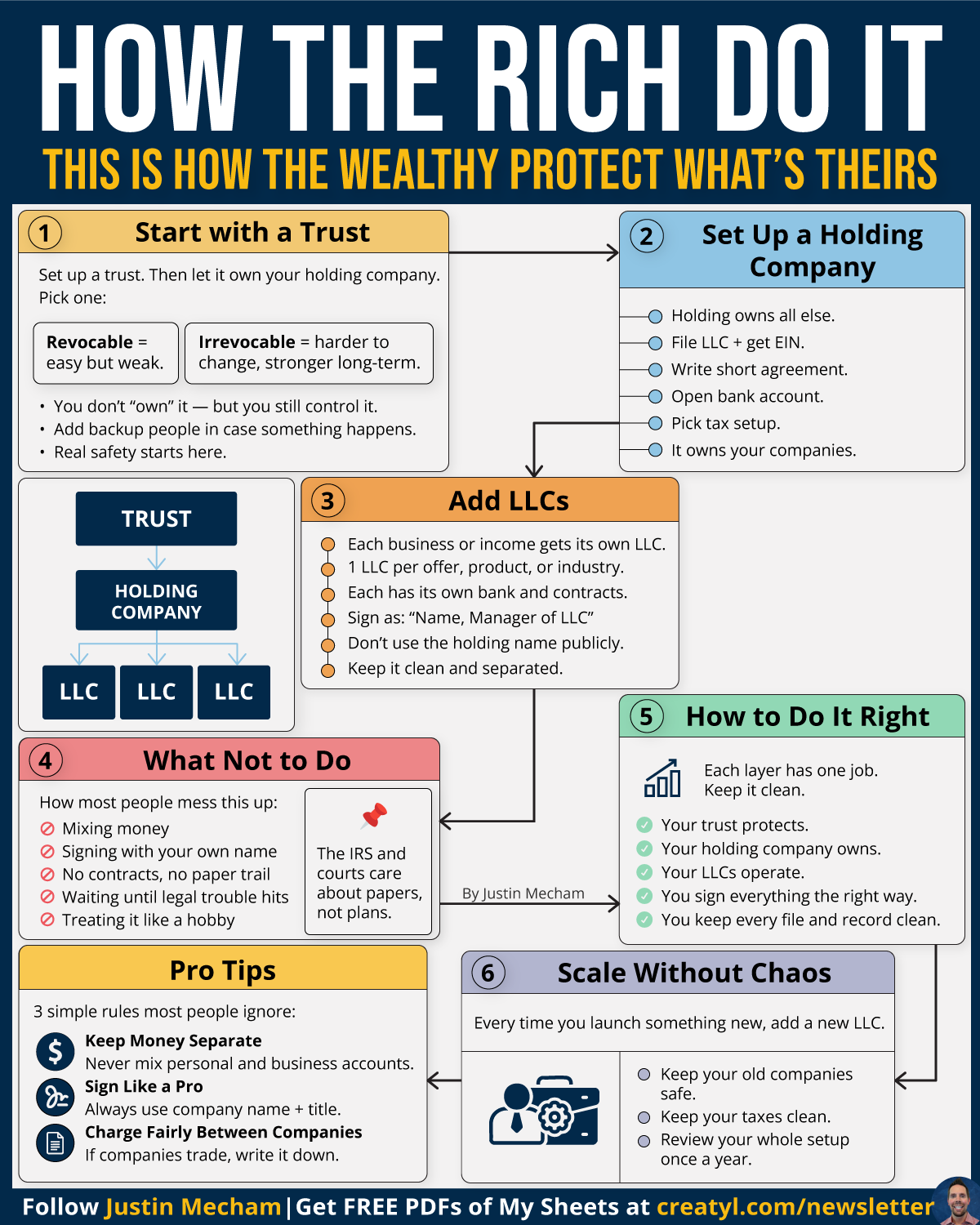
The First Layer: Start With a Trust
One of the foundational tools used in wealth protection is a trust.
A trust is a legal structure that holds assets.
Instead of you personally owning assets, the trust owns them.
You control the trust, but technically you do not own what it holds.
This distinction matters.
It can provide privacy.
It can simplify estate transitions.
It can create separation between personal ownership and asset control.
Two common types of trusts are:
Revocable trusts, which are easier to modify but offer less protection.
Irrevocable trusts, which are more difficult to change but often provide stronger long-term protection.
Teachable Moment:
A trust is not about hiding wealth.
It is about organizing ownership in a way that protects it over time.
The Second Layer: The Holding Company
Once a trust exists, another layer is often added.
The holding company.
A holding company is a business entity that owns other companies.
Instead of operating businesses directly under your personal name, the holding company becomes the owner.
This creates a buffer between personal assets and business operations.
The holding company typically:
Owns other companies
Has its own bank account
Files taxes separately
Maintains its own records
This structure makes growth easier to manage.
Instead of juggling multiple businesses personally, everything flows through one central ownership entity.
Teachable Moment:
Organization is one of the most underrated advantages in business.
Clear structure prevents chaos as opportunities grow.
The Third Layer: Separate LLCs
As businesses expand, another level of separation appears.
Individual LLCs.
Each product, service, or income stream can operate under its own limited liability company.
Why does this matter?
Because risk stays contained.
If one business faces legal or financial trouble, it does not automatically affect the others.
Each LLC typically has:
Its own bank account
Its own financial records
Its own contracts and agreements
This separation keeps operations clean and reduces unnecessary exposure.
Teachable Moment:
Separation is one of the most powerful forms of protection in business.
Common Mistakes That Destroy Protection
Even when people set up companies, they often undermine their own protection by making a few common mistakes.
Mixing money between accounts.
Signing contracts personally instead of through the business.
Skipping written agreements.
Treating businesses casually instead of professionally.
The legal system rarely looks at intentions.
It looks at records.
If financial activity is mixed and paperwork is incomplete, protective structures can lose their effectiveness.
Teachable Moment:
Structure only works when it is respected.
Clean records are not optional.
They are essential.
Simple Rules That Wealth Builders Follow
Many successful business owners follow a few simple rules that prevent structural problems.
First, they keep money separate.
Personal and business finances never mix.
Second, they sign documents correctly.
Contracts should be signed using the company name and official role.
Third, transactions between companies are documented.
If one company pays another, there is always a written record.
These habits may seem small.
But they create a clear financial trail.
And clarity is what keeps structures strong.
Scaling Without Creating Chaos
As new ideas and products appear, structures can grow with them.
Instead of piling everything into one business entity, new projects can operate through their own LLCs.
This approach protects existing ventures while allowing new ones to develop.
It also simplifies accounting and tax management.
Each company performs a specific role.
Each entity has a defined purpose.
And growth becomes easier to track.
Teachable Moment:
Growth becomes sustainable when systems support it.
Without systems, growth often turns into confusion.
A Real Business Example
How Structure Prevented a Major Financial Problem
A small online entrepreneur ran multiple digital products through a single company.
Courses, consulting, and digital downloads all operated under the same entity.
Everything flowed through one bank account.
At first, it seemed simple.
But one day a legal dispute appeared involving a customer complaint.
The claim was small.
But because everything operated under the same entity, the potential exposure included every product and asset tied to the business.
One issue suddenly threatened the entire operation.
After consulting with legal and financial advisors, the entrepreneur restructured the business.
A holding company was created.
Separate LLCs were established for each product line.
Bank accounts were separated.
Contracts were updated to reflect the correct entities.
Now each business activity operates independently.
If one venture faces a problem, the others remain insulated.
The income did not change.
But the protection did.
Why Wealth Builders Think Differently About Structure
People who accumulate significant wealth rarely treat structure as an afterthought.
They see it as a foundation.
Because once assets grow large enough, risk grows with them.
Legal claims.
Financial disputes.
Operational mistakes.
These are not rare events in business.
They are part of the landscape.
Preparation does not eliminate risk.
But it reduces the damage risk can cause.
Teachable Moment:
Preparation rarely feels urgent.
Until it becomes essential.
Peace of Mind Is a Form of Wealth
Many people chase income for years.
But the moment wealth begins to grow, a different priority appears.
Protection.
Because financial success without protection creates stress.
Every opportunity feels risky.
Every mistake feels dangerous.
But when systems exist to separate risk and organize ownership, something changes.
Confidence increases.
Decisions become clearer.
Growth becomes less chaotic.
True wealth is not just measured by income.
It is measured by stability.
And stability comes from thoughtful structure built long before problems appear.
Best Resources for Understanding Wealth Structure
Book: Rich Dad Poor Dad — Robert T. Kiyosaki
Why It Fits: Introduces foundational concepts about assets, ownership, and financial structure.
Book: Tax-Free Wealth — Tom Wheelwright
Why It Fits: Explains how tax and business structures influence financial outcomes.
Podcast: Invest Like the Best — Patrick O’Shaughnessy
Why It Fits: Features deep conversations about wealth building and financial strategy.
TED Talk: The Happy Secret to Better Work — Shawn Achor
Why It Fits: Explores the relationship between mindset, success, and performance.
Tool: QuickBooks — Developed by Intuit
Why It Fits: Helps maintain clean financial records across multiple entities.
AI Tool: ChatGPT — OpenAI
Why It Fits: Useful for brainstorming business structures, documenting processes, and organizing business systems.
Download The “How the Wealthy Protect Their Money” Infographic (PDF)
If you want a clear visual reference of the wealth protection structure explained in this article, download the infographic as a PDF.
Use it as a guide when thinking about how to organize and protect what you build.