Click Here to Download the PDF.
Why Some Books Change How You Think
Most people read books for information.
But the most valuable books do something different.
They reshape how you see the world.
They influence how you make decisions when things get difficult.
They sharpen how you think when no one is watching.
The list behind this article is not a random collection of popular titles.
It is a thinking toolkit.
Each book was chosen for one reason:
To help you make better decisions in real life.
Not just when things are easy.
But when the pressure is real.
Because leadership, growth, and creativity rarely fail due to lack of information.
They fail due to poor thinking.
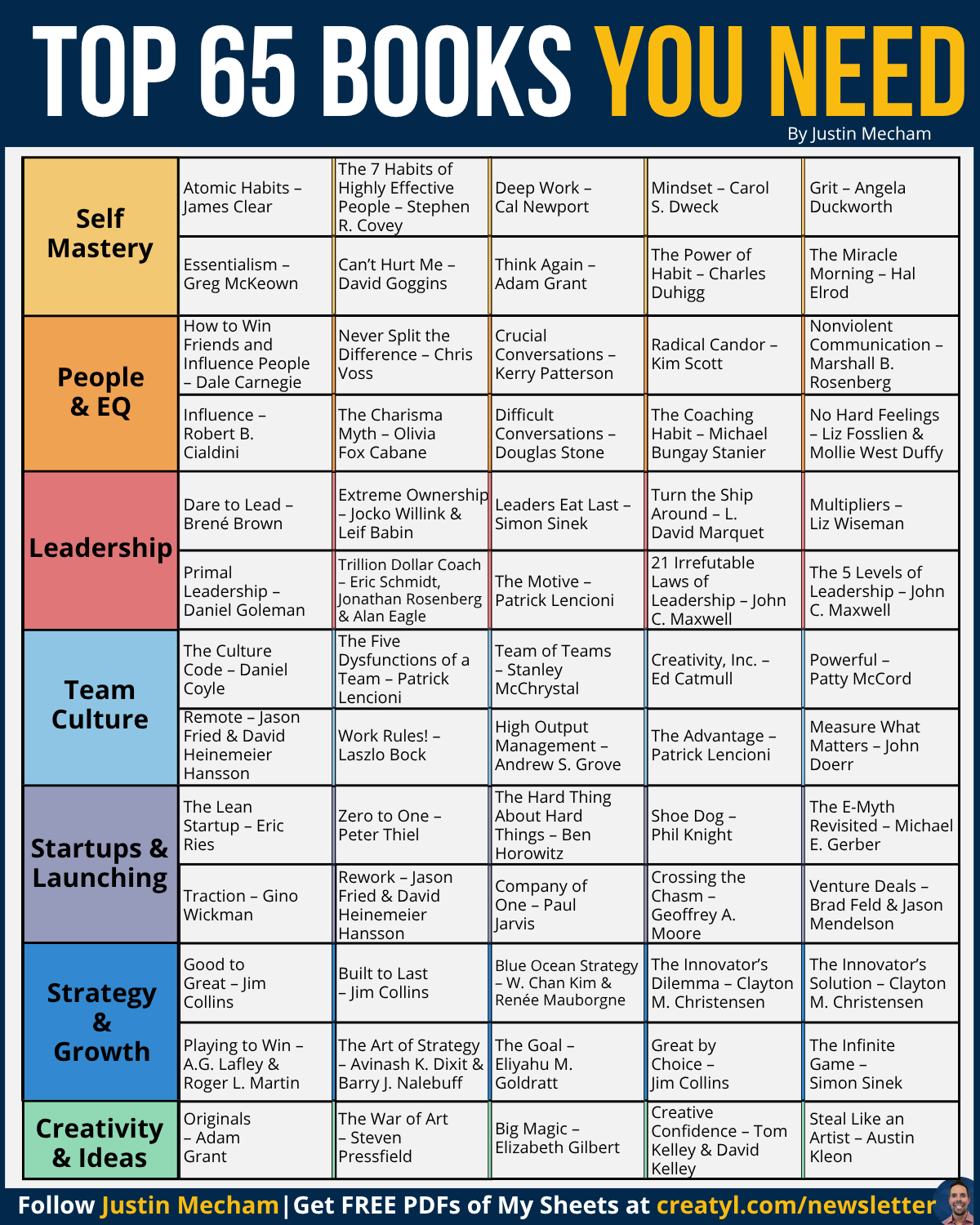
The 65 books in the infographic are organized across seven core lanes of growth.
Each lane represents a different dimension of thinking.
Together, they create depth.
And depth changes how you operate.
The Real Purpose of Reading
Before exploring the categories, it’s important to understand the difference between reading and learning.
Many people read dozens of books every year.
Yet their decisions stay the same.
Why?
Because information alone does not change behavior.
Application does.
Teachable Moment:
A single book applied well will outperform ten books skimmed quickly.
That is why the goal of this list is not volume.
It is depth of thinking.
Lane 1: Self-Mastery
Where Leadership Actually Begins
Every form of leadership begins with self-management.
Your habits.
Your focus.
Your discipline.
Without those foundations, strategy and leadership tools collapse under pressure.
Books in this lane help you understand the mechanics of personal behavior.
Titles such as Atomic Habits by James Clear, Deep Work by Cal Newport, and Mindset by Carol Dweck explain how small patterns compound into long-term outcomes.
Another essential title is Essentialism by Greg McKeown, which teaches a powerful idea:
If everything feels important, nothing truly is.
Teachable Moment:
Self-mastery is not about perfection.
It is about building systems that guide your behavior even when motivation fades.
Action Strategy:
Choose one habit from a self-mastery book and practice it for thirty days.
Do not add multiple changes at once.
Consistency matters more than intensity.
Lane 2: People & Emotional Intelligence
Understanding How Humans Actually Work
The ability to work with people often determines whether ideas succeed or fail.
You can have a brilliant strategy.
But without communication, persuasion, and emotional awareness, execution falls apart.
This is why books like How to Win Friends and Influence People by Dale Carnegie remain relevant decades after publication.
Human psychology does not change as quickly as technology.
Modern titles like Never Split the Difference by Chris Voss and Crucial Conversations by Kerry Patterson build on that foundation by teaching negotiation and communication skills that work under pressure.
Another standout is Radical Candor by Kim Scott, which explores how honesty and care can exist in the same conversation.
Teachable Moment:
People rarely resist ideas.
They resist how those ideas are communicated.
Action Strategy:
When giving feedback, focus on behavior rather than personality.
Clarity improves relationships more than politeness alone.
Lane 3: Leadership
The Responsibility Behind Authority
Leadership books often focus on strategy or inspiration.
But the best leadership books focus on responsibility.
Titles such as Extreme Ownership by Jocko Willink and Leif Babin challenge leaders to take responsibility for outcomes rather than blaming circumstances.
Similarly, Leaders Eat Last by Simon Sinek explores the role trust plays in building effective teams.
Another influential book, Dare to Lead by Brené Brown, highlights the importance of vulnerability and courage in leadership.
These books share a common theme:
Leadership is not a position.
It is a set of behaviors.
Teachable Moment:
The most trusted leaders are not the loudest.
They are the most consistent.
Action Strategy:
Ask yourself one question after every major decision:
Did this build trust or weaken it?
Trust compounds over time.
Lane 4: Team Culture
Where Strategy Meets Reality
Even the best strategy fails if the culture around it is weak.
Team culture determines how people collaborate, solve problems, and respond to pressure.
Books like The Culture Code by Daniel Coyle explore the subtle signals that create trust within groups.
Another influential title, The Five Dysfunctions of a Team by Patrick Lencioni, breaks down the common patterns that sabotage collaboration.
Meanwhile, Creativity, Inc. by Ed Catmull provides insight into how Pixar built an environment where creative work could thrive.
Teachable Moment:
Culture is not what leaders say.
It is what teams consistently experience.
Action Strategy:
Pay attention to how mistakes are handled in your environment.
Cultures that treat mistakes as learning opportunities innovate faster.
Lane 5: Startups & Launching
Turning Ideas Into Reality
Ideas are easy.
Execution is difficult.
The books in this category focus on building products, launching companies, and navigating uncertainty.
The Lean Startup by Eric Ries introduced a new approach to building products through experimentation and feedback.
Zero to One by Peter Thiel explores the importance of creating unique value rather than competing in crowded markets.
Meanwhile, The Hard Thing About Hard Things by Ben Horowitz offers a brutally honest look at the challenges of building companies.
Teachable Moment:
Entrepreneurship is not about having perfect plans.
It is about learning faster than your obstacles appear.
Action Strategy:
Test ideas quickly before investing heavily in them.
Small experiments reveal valuable insights.
Lane 6: Strategy & Long-Term Thinking
Playing The Game Beyond Today
Strategy requires patience.
It requires the ability to see beyond short-term results and focus on sustainable advantage.
Books like Good to Great by Jim Collins analyze why some companies outperform others over long periods.
Another classic, Blue Ocean Strategy by W. Chan Kim and Renée Mauborgne, encourages leaders to create new markets rather than compete in crowded ones.
The Innovator’s Dilemma by Clayton Christensen explains why successful companies often fail to adapt to disruptive innovation.
Teachable Moment:
Long-term success rarely comes from reacting quickly.
It comes from thinking differently.
Action Strategy:
Ask one strategic question regularly:
What industry assumption could be wrong?
Challenging assumptions reveals new opportunities.
Lane 7: Creativity & Ideas
Turning Thought Into Action
Creativity is often misunderstood.
Many people believe it belongs only to artists or designers.
In reality, creativity is a thinking skill.
Books like Originals by Adam Grant explore how unconventional ideas gain traction.
The War of Art by Steven Pressfield addresses the resistance that prevents people from creating meaningful work.
Meanwhile, Creative Confidence by Tom Kelley and David Kelley explains how anyone can develop the ability to innovate.
Teachable Moment:
Creativity is less about talent and more about courage.
Action Strategy:
Capture ideas quickly.
Write them down before they disappear.
Great ideas often begin as simple observations.
A Real Workplace Example
How One Book Changed A Leader’s Approach
A department manager struggled with team engagement.
Meetings felt quiet.
Ideas rarely surfaced.
And when challenges appeared, employees waited for instructions rather than solving problems themselves.
The manager assumed the issue was motivation.
But the real issue was culture.
Team members felt uncomfortable speaking openly.
Without trust, collaboration stalled.
After reading The Culture Code by Daniel Coyle, the manager began experimenting with small cultural changes.
He started asking team members to share challenges openly.
He admitted mistakes during meetings.
He encouraged questions instead of rushing to answers.
Over several months, something changed.
Team members began speaking up more often.
Ideas surfaced earlier.
Problems were solved faster.
The shift did not come from a major policy change.
It came from applying one idea from one book.
How To Actually Use This Book List
A list of sixty-five books can feel overwhelming.
The goal is not to read them all at once.
Instead, treat them as a map.
Step one is identifying which lane of growth feels most relevant right now.
If focus is a challenge, start with self-mastery.
If communication feels difficult, explore people and emotional intelligence.
If your goal is building teams, leadership and culture books may offer the most value.
Teachable Moment:
Depth matters more than speed.
One applied idea can transform your behavior more than dozens of unread pages.
Reading Is Only The Beginning
Books do something powerful.
They give us access to decades of experience in a few hundred pages.
But their real value appears only when ideas move from page to practice.
The leaders who grow the most are not the ones who read the most.
They are the ones who experiment with what they read.
They test ideas.
They reflect on outcomes.
They adjust their behavior.
Over time, those small adjustments compound into better judgment.
And better judgment is the quiet advantage behind every great leader, entrepreneur, and creator.
Books alone do not change lives.
But the thinking they unlock can.
Best Resources For Learning From Books
Book: How to Take Smart Notes — Sönke Ahrens
Why It Fits: Explains how to turn reading into actionable knowledge.
Podcast: The Knowledge Project — Shane Parrish
Why It Fits: Focuses on mental models, decision-making, and applied learning.
TED Talk: Do Schools Kill Creativity? — Sir Ken Robinson
Why It Fits: A widely viewed talk about creativity, learning, and education.
Tool: Readwise — Founded by Tristan Homsi
Why It Fits: Helps readers retain and review key ideas from books.
AI Tool: ChatGPT — OpenAI
Why It Fits: Helps summarize, analyze, and apply ideas from books to real-world situations.
Download The “Top 65 Books You Need” Infographic (PDF)
If you want the full visual reference of the books discussed in this article, download the infographic as a PDF.
Use it as a guide to explore each lane of growth at your own pace.