

Click Here to Download the PDF.
The Lie Most People Quietly Believe
At some point, almost everyone tells themselves the same thing:
“I just need to be more disciplined.”
Work longer.
Push harder.
Stay later.
And if you feel tired, you assume something is wrong with you.
But the truth is simpler.
You are not tired because you are lazy.
You are tired because you never gave yourself permission to stop.
Burnout rarely comes from one overwhelming day.
It builds slowly.
One extra task.
One more late night.
One more yes you should have said no to.
And over time, something dangerous happens.
Running on empty starts to feel normal.
Why Burnout Feels Invisible at First
Burnout does not show up loudly.
It shows up quietly.
You feel slightly more tired than usual.
You struggle to focus just a bit more.
You lose patience faster than you used to.
But because nothing feels extreme, you ignore it.
Until it becomes your baseline.
Teachable Moment:
The most dangerous habits are the ones that feel normal.
When exhaustion becomes familiar, you stop questioning it.
The Real Problem Is Not Effort
Most people assume burnout comes from doing too much.
But that is only part of the story.
The deeper issue is doing too much without recovery.
Working without stopping.
Thinking without pause.
Saying yes without limits.
It is not the work itself.
It is the lack of boundaries around it.
Teachable Moment:
Energy is not managed by working less.
It is managed by working with intention.
What Actually Drains You
There are two types of work.
Visible work
Tasks you plan, track, and complete
Hidden work
Small, unplanned actions that quietly drain you
Checking messages constantly
Switching between tasks
Saying yes to small requests
Carrying unfinished thoughts
These seem minor.
But they add up.
And over time, they drain more energy than the visible work you planned.
Teachable Moment:
What drains you most is often what you never planned to do.
The System That Protects Your Energy
Instead of trying to push harder, build a system that protects your energy.
Here are the practices that actually make a difference.
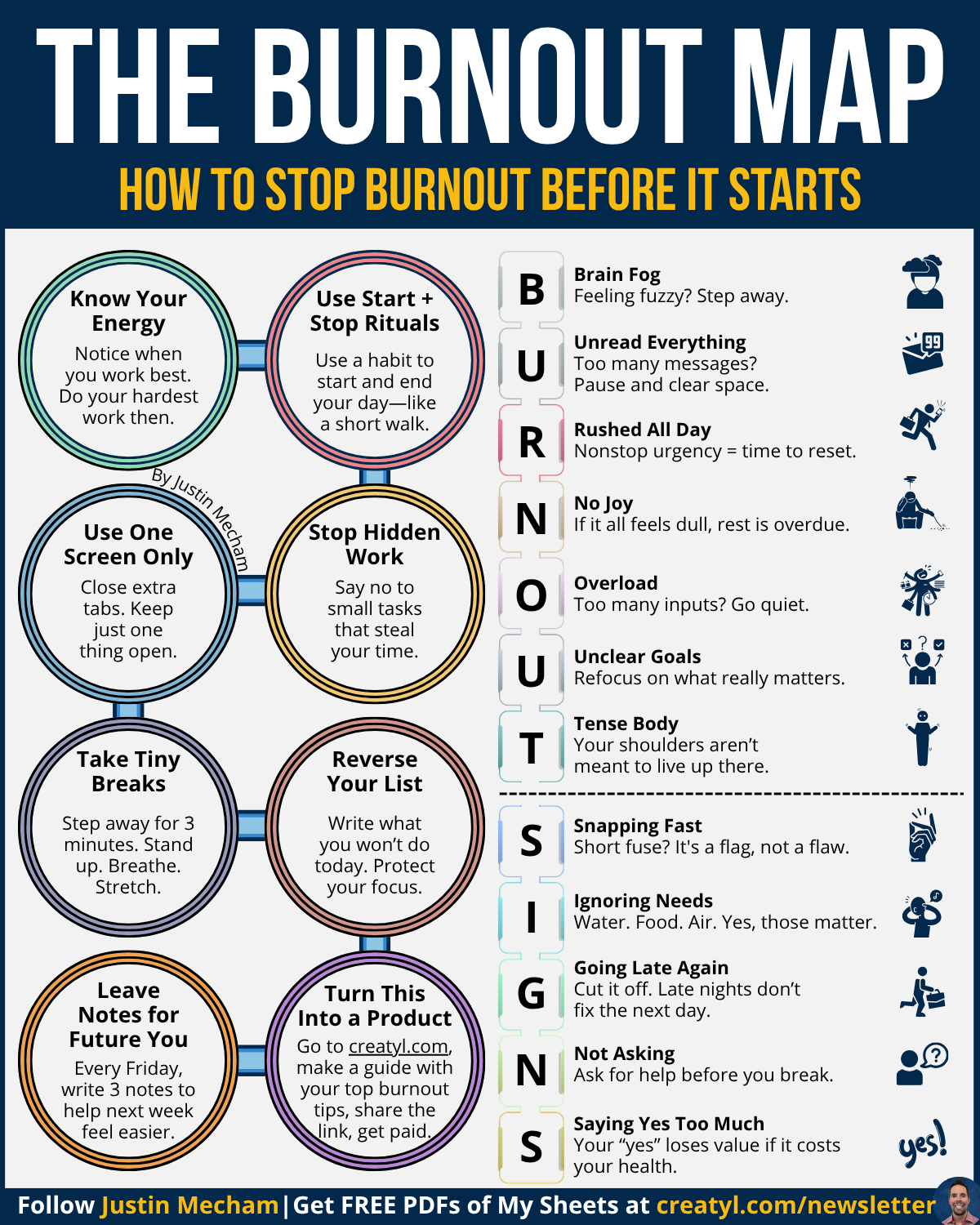
1. Know Your Energy, Not Just Your Time
Not all hours are equal.
Some parts of your day are sharp.
Others are slow.
Pay attention to when you think clearly.
Do your most important work during those times.
Save lighter tasks for lower-energy moments.
Teachable Moment:
Productivity is not about time.
It is about timing.
2. Start and Stop With Intention
Most people start work abruptly and end it vaguely.
There is no clear beginning or end.
That keeps your mind in a constant state of “on.”
Create simple rituals.
Start your day with one clear action.
End your day with one clear signal.
A short walk.
Closing your laptop with intention.
Writing tomorrow’s plan.
Teachable Moment:
Your brain needs signals.
Without them, it never fully stops.
3. One Screen. One Task.
Every open tab is a demand on your attention.
Every notification pulls you away.
Multitasking feels productive.
But it reduces focus.
Close everything except what you need.
Work on one task at a time.
Teachable Moment:
Focus is not about doing more.
It is about doing one thing fully.
4. Remove the Hidden Work
Start noticing the small tasks you never planned.
The quick replies.
The extra checks.
The unnecessary adjustments.
Ask yourself:
“Did I choose this, or did it choose me?”
If it was not intentional, reduce it.
Teachable Moment:
Energy leaks happen in small, unnoticed moments.
5. Take Breaks Before You Need Them
Most people wait until they feel exhausted to stop.
That is too late.
Take short breaks on purpose.
Stand up.
Move.
Breathe.
Even a few minutes resets your focus.
Teachable Moment:
Breaks are not interruptions.
They are part of the system.
6. Reverse Your To-Do List
Everyone writes what they need to do.
Very few write what they will not do.
But this list is just as important.
What will you ignore today?
What will you say no to?
What does not deserve your attention?
Teachable Moment:
What you avoid matters as much as what you complete.
7. Leave Notes for Future You
Most people end the week and start the next one from zero.
That creates friction.
Instead, make the future easier.
At the end of the week, write down:
Where you left off
What matters next
What to start with
This reduces mental load and makes it easier to begin again.
Teachable Moment:
Clarity reduces resistance.
The Signals You Should Not Ignore
Burnout gives warnings.
But most people ignore them.
Watch for:
Brain fog
Constant rushing
Loss of enjoyment
Tension in your body
Short temper
Saying yes when you mean no
These are not personality traits.
They are signals.
And signals are meant to be noticed early.
A Real Workplace Example
From Constant Overwhelm to Clear Control
A high-performing employee felt constantly behind.
Their workload was not extreme.
But they felt exhausted every day.
They worked late.
Checked messages constantly.
And rarely felt finished.
The issue was not volume.
It was lack of boundaries.
They never fully stopped.
Work blended into everything.
Even rest time felt like waiting to work again.
Their energy never reset.
We introduced a simple system.
They defined clear start and stop times.
Closed all unnecessary tabs during focused work.
Created a “not doing” list each morning.
And took short breaks throughout the day.
Within weeks, their energy improved.
Not because they worked less.
But because they worked differently.
What Actually Sustains High Performance
Sustained performance is not built on intensity.
It is built on recovery.
People who perform well long-term do not push constantly.
They manage their energy.
They know when to focus.
And when to stop.
Teachable Moment:
Consistency comes from balance, not pressure.
The Shift That Changes Everything
Most people treat rest as something they earn.
After the work is done.
After everything is complete.
But that moment rarely comes.
There is always more to do.
The shift is this:
Rest is not something you earn.
It is something you build into the system.
You Do Not Need More Discipline. You Need Better Boundaries
It is easy to believe that working harder will solve everything.
That more effort will fix the problem.
But effort without boundaries leads to exhaustion.
And exhaustion leads to inconsistency.
You do not need to become more intense.
You need to become more intentional.
To decide when you work.
What you focus on.
And when you stop.
Because stopping is not weakness.
It is what makes your work sustainable.
And sustainable work is what creates real progress over time.
Best Resources For Managing Energy and Avoiding Burnout
Book: Essentialism — Greg McKeown
Why It Fits: Focuses on doing less, but doing what truly matters.
Book: Deep Work — Cal Newport
Why It Fits: Teaches how to focus deeply without distraction.
Podcast: The Tim Ferriss Show — Tim Ferriss
Why It Fits: Explores habits and systems used by high performers.
TED Talk: Why We All Need to Practice Emotional First Aid — Guy Winch
Why It Fits: Explains how to recognize and respond to mental strain.
Tool: RescueTime — Founded by Tony Wright
Why It Fits: Tracks how you spend time and highlights distractions.
AI Tool: ChatGPT — OpenAI
Why It Fits: Helps organize tasks, create structured plans, and reduce mental load.
Download The “Energy Reset System” Infographic (PDF)
If you want a simple, visual guide to managing your energy and preventing burnout, download the infographic as a PDF.
Use it daily to stay focused, balanced, and in control of your work.