


Click Here to Download the PDF.
Why Work Feels Chaotic (And Why It’s Not Random)
Most teams do not wake up and choose chaos.
It shows up slowly.
Missed priorities.
Unclear decisions.
Repeated confusion.
Tension that never gets addressed.
And over time, people start to feel it.
Work feels heavier than it should.
Simple things take too long.
Progress becomes inconsistent.
Many leaders assume this is a people issue.
It rarely is.
It is a system issue.
Because teams do not operate on intention.
They operate on structure.
When structure is unclear, everything else follows.
Teachable Moment:
Chaos is not the absence of effort.
It is the absence of a system people can rely on.
The Shift Most Leaders Miss
When things feel messy, the instinct is to do more.
More meetings.
More messages.
More urgency.
But adding more activity to a broken system does not fix it.
It amplifies the confusion.
The real shift is this:
Stop reacting to problems.
Start building repeatable systems that prevent them.
That is what strong leadership looks like in practice.
Not louder communication.
Clearer structure.
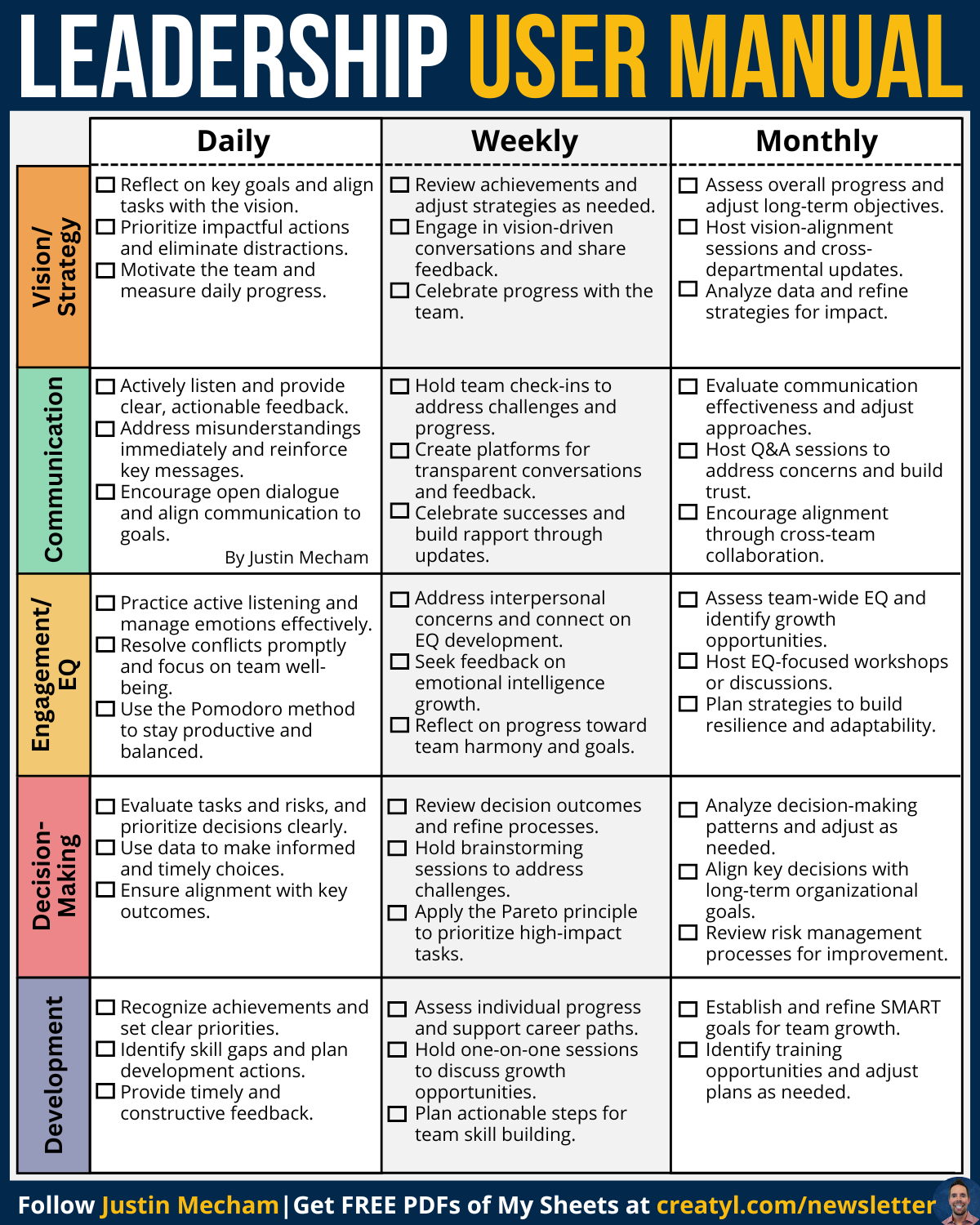
The Leadership User Manual
The most effective leaders do not rely on memory or instinct alone.
They run a system.
A simple rhythm that guides how they lead daily, weekly, and monthly.
This rhythm creates clarity.
And clarity creates trust.
Let’s break it down.
Daily: Win The Day Before It Wins You
Daily leadership is not about reacting to whatever shows up.
It is about setting direction early and reinforcing it throughout the day.
Start by aligning tasks to the bigger picture.
What actually matters today?
Not everything deserves equal attention.
Cut the noise.
Focus on work that moves things forward.
Track progress clearly.
If people cannot see progress, motivation drops.
Listen closely.
When confusion appears, address it immediately.
Small misunderstandings become larger problems when ignored.
Handle conflict early.
Tension does not disappear on its own.
Make decisions using real information, not assumptions.
And recognize progress as it happens.
People need to know their work matters.
Teachable Moment:
Daily clarity prevents weekly chaos.
Action Strategy:
At the start of each day, identify three priorities that truly matter.
Everything else becomes secondary.
Weekly: Build Momentum That Lasts
If daily actions create direction, weekly systems create momentum.
This is where leaders step back and adjust.
Review what actually happened.
Not what was planned.
What worked?
What stalled?
What needs to change?
Run check-ins that focus on blockers, not just updates.
People do not need to repeat what is already visible.
They need help moving past what is slowing them down.
Create space for honest conversation.
Trust grows when people feel safe to speak openly.
Celebrate progress.
Not just big wins.
Small progress builds confidence.
Address tension directly.
Do not let issues carry into the next week.
Review decisions.
Ask what could be improved.
Apply simple prioritization.
Focus on the few things that create the most impact.
Hold one-on-one conversations that clarify direction and expectations.
Teachable Moment:
Momentum is not built by speed.
It is built by consistent, focused progress.
Action Strategy:
End each week with a simple review.
Write down one thing to improve next week.
Monthly: Upgrade The System
Monthly leadership is about stepping back far enough to see patterns.
This is where leaders shift from execution to refinement.
Assess overall progress.
Are you moving in the right direction?
Or just staying busy?
Align teams around shared priorities.
Misalignment creates silent friction.
Review how communication is working.
Where are messages getting lost?
Where are misunderstandings happening?
Look at team resilience.
Are people handling pressure well?
Or showing signs of fatigue?
Review how decisions are made.
Are they clear and timely?
Or slow and inconsistent?
Update goals.
Not just performance goals.
Development goals as well.
People grow when expectations evolve.
Teachable Moment:
Systems improve when they are reviewed, not assumed.
Action Strategy:
Block time once a month to review what is working and what is not.
Make one system change based on what you learn.
Where Leaders Lose Control Without Realizing It
Many leadership problems do not come from poor intent.
They come from missing structure.
For example:
When priorities are unclear, people guess.
When communication is inconsistent, people fill in gaps.
When decisions are delayed, progress slows.
When feedback is missing, growth stalls.
Each one creates friction.
Together, they create chaos.
Teachable Moment:
If your team feels confused, your system needs clarity.
A Real Workplace Example
Turning a Chaotic Team Into a Structured One
A team was constantly busy but rarely aligned.
Projects overlapped.
Deadlines slipped.
Meetings felt repetitive.
Everyone was working, but results were inconsistent.
The leader initially believed the issue was performance.
But after observing closely, a different pattern appeared.
There was no consistent system.
Daily priorities changed without clarity.
Weekly meetings focused on updates instead of blockers.
Monthly reviews did not exist.
People were reacting instead of operating with structure.
We introduced a simple leadership rhythm.
Daily:
Clear priorities were set each morning.
Weekly:
Meetings shifted to focus on blockers and decisions.
Monthly:
A structured review was introduced to assess progress and reset direction.
Within weeks, the team felt different.
Not because the people changed.
Because the system did.
Clarity increased.
Decisions improved.
And progress became consistent.
What Actually Builds Trust in Teams
Trust is often misunderstood.
It is not built through motivation alone.
It is built through consistency.
When people know what matters.
When expectations are clear.
When communication is reliable.
They begin to trust the system.
And when they trust the system, they trust the leader.
Teachable Moment:
Trust is not built in big moments.
It is built in repeated, predictable actions.
The Leadership Advantage Most People Ignore
Many leaders look for new strategies.
New frameworks.
New tools.
But the real advantage is simpler.
Consistency.
Running a system that people can rely on.
Day after day.
Week after week.
Month after month.
That is what separates reactive leadership from effective leadership.
Leadership Is What People Experience, Not What You Intend
Leadership is not defined by what you say.
It is defined by what people experience working with you.
Do they feel clear or confused?
Do they feel supported or uncertain?
Do they know what matters or guess their way through it?
Those experiences are shaped by your systems.
Not your intentions.
When your systems are clear, your team becomes clearer.
When your structure is consistent, your culture becomes stronger.
And when people can rely on how things work, they begin to rely on you.
That is when leadership stops feeling like effort.
And starts becoming something others trust without question.
Best Resources For Building Leadership Systems
Book: High Output Management — Andrew S. Grove
Why It Fits: A practical guide to building systems that drive consistent results.
Book: The Advantage — Patrick Lencioni
Why It Fits: Focuses on organizational clarity and team alignment.
Podcast: Coaching for Leaders — Dave Stachowiak
Why It Fits: Real-world leadership advice focused on communication and growth.
TED Talk: How Great Leaders Inspire Action — Simon Sinek
Why It Fits: Explains how clarity in purpose drives better leadership.
Tool: Asana — Founded by Dustin Moskovitz
Why It Fits: Helps structure work, track progress, and improve team clarity.
AI Tool: ChatGPT — OpenAI
Why It Fits: Useful for planning leadership systems, writing updates, and organizing team communication.
Download The “Leadership User Manual” Infographic (PDF)
If you want a clear, structured version of this leadership system, download the infographic as a PDF.
Use it to guide your daily, weekly, and monthly leadership rhythm.