

Click Here to Download the PDF.
The Most Frustrating Feeling at Work Is Not Failure
It is being overlooked.
There is a specific kind of frustration that builds when you know you are working hard, delivering results, staying reliable, and still watching other people receive the opportunities, recognition, and visibility you hoped your effort would naturally create.
At first, most people tell themselves to stay patient.
“Eventually someone will notice.”
“My work will speak for itself.”
“If I just keep doing a good job, it will pay off.”
That belief sounds reasonable.
But in many workplaces, it is incomplete.
Because effort alone is rarely enough.
Visibility matters too.
And that truth can feel uncomfortable at first because many people associate visibility with ego, self-promotion, or politics.
But real professional visibility is not about being loud.
It is about making your value understandable to the people around you.
That is a completely different thing.
Why Strong Performers Still Get Overlooked
One of the biggest misconceptions in professional growth is the belief that quality work automatically creates recognition.
Sometimes it does.
But often, it does not.
Managers are busy.
Teams move quickly.
Organizations are overloaded with information.
That means invisible work often stays invisible—not because it lacks value, but because nobody has enough context to fully see it.
This creates a painful cycle.
The employee keeps working harder, assuming more effort will solve the problem.
Meanwhile, visibility decreases because the person becomes more isolated, quieter, and increasingly focused only on execution.
Eventually, resentment appears.
Not because they failed.
But because they believed excellence alone would always speak loudly enough.
In reality, strong careers are built through two things working together:
Contribution and communication.
Without both, even talented people can disappear inside the system.
The Difference Between Attention-Seeking and Professional Visibility
Many people avoid visibility because they fear looking arrogant.
That fear is understandable.
Nobody wants to become the person constantly self-promoting or demanding recognition.
But healthy visibility is not about inflating your importance.
It is about reducing ambiguity around your contribution.
There is a major difference.
Attention-seeking says:
“Look at me.”
Professional visibility says:
“Here is the progress. Here is the impact. Here is what matters.”
One is ego-driven.
The other is clarity-driven.
And clarity helps teams function better.
The Quiet Habits That Keep Talented People Invisible
Professional invisibility rarely comes from lack of capability.
More often, it comes from small patterns repeated consistently over time.
Some employees keep their heads down and assume someone important will eventually notice their effort.
Others stay silent during meetings because they fear saying the wrong thing.
Some avoid visible opportunities because they feel safer staying inside familiar tasks.
Others only interact with their direct team and never build relationships across departments.
Many people also make the mistake of bringing problems without offering possible solutions.
Over time, these habits create a professional identity that feels passive rather than influential.
Not because the person lacks value.
But because their value is difficult to see clearly.
Why Visibility Is Really About Trust
One of the most important shifts people can make is understanding that visibility is not primarily about recognition.
It is about trust.
Leaders trust people they can clearly see contributing.
Teams trust people who communicate openly.
Organizations promote people whose impact is consistently visible and understandable.
Silence creates uncertainty.
Visibility creates confidence.
That is why clear updates, thoughtful participation, and visible problem-solving matter so much.
They reduce ambiguity around your role and your contribution.
The Behaviors That Actually Make People Notice You
Strong visibility does not require becoming louder or more performative.
It comes from a set of practical habits that make your contribution easier to recognize.
One of the most effective habits is sharing concise progress updates.
This is especially important in fast-moving or remote environments where people cannot naturally observe your work.
A short update that explains progress, blockers, and outcomes creates clarity for everyone around you.
Another powerful habit is speaking early during meetings.
Not constantly.
Not forcefully.
Just intentionally.
Asking thoughtful questions or offering one relevant insight immediately changes how people perceive your presence.
People remember contribution more than attendance.
Cross-team relationships also matter far more than most employees realize.
When your professional network only exists inside your immediate team, your visibility becomes extremely limited.
But when people across departments know you as collaborative, thoughtful, and reliable, opportunities increase naturally.
The same applies to learning.
Employees who continue building skills and applying them visibly stand out over time because growth compounds.
Organizations notice people who evolve.
Why Taking Ownership Changes Everything
One of the fastest ways to become professionally visible is to stop waiting to be told what to do.
Initiative creates visibility because it signals leadership readiness.
That does not mean overstepping boundaries or creating unnecessary work.
It means identifying gaps, anticipating needs, and moving proactively instead of reactively.
Managers remember people who reduce friction.
Especially the employees who consistently bring possible solutions instead of only surfacing problems.
This changes your professional identity from task executor to value creator.
And that distinction matters enormously over time.
A Real Workplace Example
When Great Work Stayed Invisible
A high-performing employee consistently delivered excellent work for nearly a year.
Deadlines were met, clients were satisfied, and projects stayed organized.
But despite strong performance, promotions and high-visibility opportunities kept going to others.
The employee felt confused and discouraged.
Over time, frustration built quietly.
They believed their effort should have been enough to stand out.
But they rarely spoke during meetings, avoided sharing updates unless asked, and mostly stayed connected only to their immediate team.
Their manager appreciated the reliability but did not fully understand the scope of their impact because so much of the work happened quietly in the background.
As months passed, the employee started feeling increasingly invisible.
Not because the work lacked quality.
But because nobody could clearly see the full contribution.
The turning point came through several small behavioral shifts.
The employee started sending concise weekly updates summarizing progress and outcomes.
They began contributing one thoughtful idea during meetings instead of remaining silent.
They volunteered for one cross-functional initiative that increased exposure to leadership and other departments.
Within months, perception changed dramatically.
Not because the quality of work suddenly improved.
But because the visibility of the work did.
Why Remote Work Makes Visibility Even More Important
Remote work amplifies invisibility.
In physical offices, people naturally observe effort through conversation, presence, and interaction.
In remote environments, much of that context disappears.
If nobody hears from you consistently, people subconsciously assume less is happening.
That is why visibility in remote work requires intentional communication.
Not constant activity.
Intentional clarity.
This includes:
Sharing updates regularly.
Responding thoughtfully in collaborative spaces.
Participating actively in virtual meetings.
Making progress visible without overexplaining.
Remote visibility is less about being online constantly and more about being meaningfully present.
The Power of Asking Better Questions
Many employees underestimate how memorable thoughtful questions can be.
Strong questions demonstrate engagement, strategic thinking, and awareness.
Questions like:
“How does this connect to the larger goal?”
“What problem are we solving most urgently here?”
“What would success look like six months from now?”
These types of contributions shift perception immediately.
Because they show you are thinking beyond your immediate task list.
And organizations consistently notice people who think at a broader level.
Visibility Without Value Eventually Fails
There is an important balance here.
Visibility alone is not enough.
People who constantly speak without contributing meaningful value eventually lose credibility.
Sustainable professional visibility comes from combining contribution with communication.
You still need strong work.
But strong work becomes significantly more powerful when people can clearly see, understand, and connect it to results.
The goal is not performance theater.
The goal is clarity around impact.
A Simple Five-Step Reset for This Week
If you feel overlooked professionally, start with small actions instead of dramatic reinvention.
Share one meaningful win during a meeting.
Send one concise update highlighting progress or results.
Ask one thoughtful question that improves the conversation.
Help one teammate solve a problem.
Step into one opportunity that increases visibility instead of avoiding it.
These actions seem small individually.
But repeated consistently, they reshape how people experience you professionally.
Your Work Deserves to Be Seen
Many talented people stay invisible because they believe visibility should happen automatically.
But careers rarely work that way.
The people who grow fastest are not always the loudest.
Often, they are simply the clearest.
Clear about their progress.
Clear about their ideas.
Clear about the value they bring.
You do not need to become someone performative to be recognized.
You simply need to stop hiding your contribution behind silence.
Because professional growth is not only about doing valuable work.
It is also about making that value visible enough for people to trust, support, and invest in your future.
The workplace does not reward noise forever.
But it consistently rewards people who are useful, collaborative, visible, and hard to ignore.
That combination changes careers.
Resources to Go Deeper
Book: The First 90 Days by Michael Watkins
Excellent for understanding visibility, influence, and professional positioning in organizations.
Book: Radical Candor by Kim Scott
A strong guide to communication, feedback, and building credibility at work.
Podcast: Coaching for Leaders
Practical conversations about leadership, communication, visibility, and career growth.
Tool Recommendation: Weekly Reflection System
Use a simple document or notes app to track wins, lessons, measurable outcomes, and contributions each week so you can communicate them clearly.
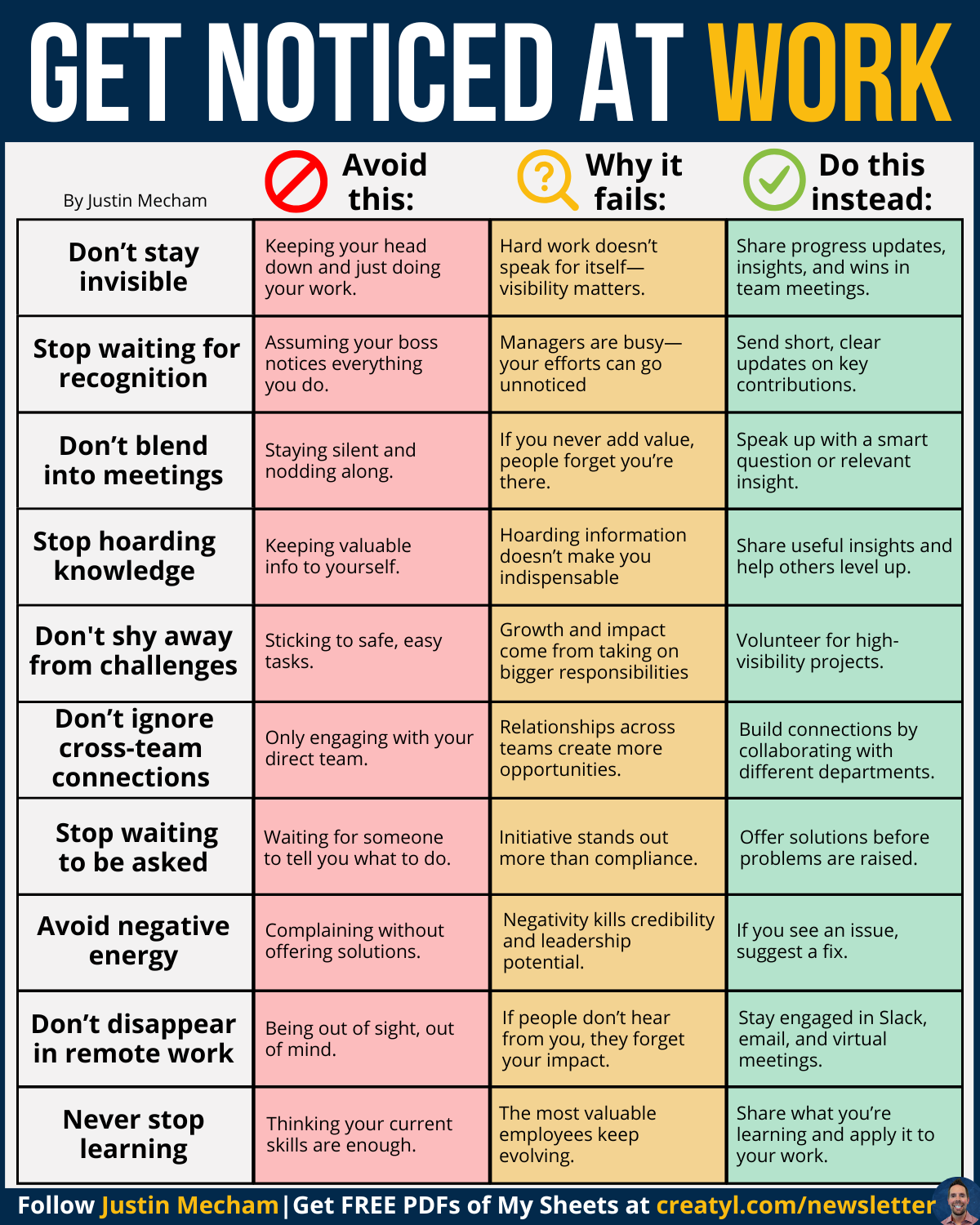
Download the “Get Noticed at Work” Infographic (PDF)
If you want a practical framework to improve visibility, communication, and professional growth, download the full infographic as a PDF and use it as a weekly checklist.