

Click Here to Download the PDF.
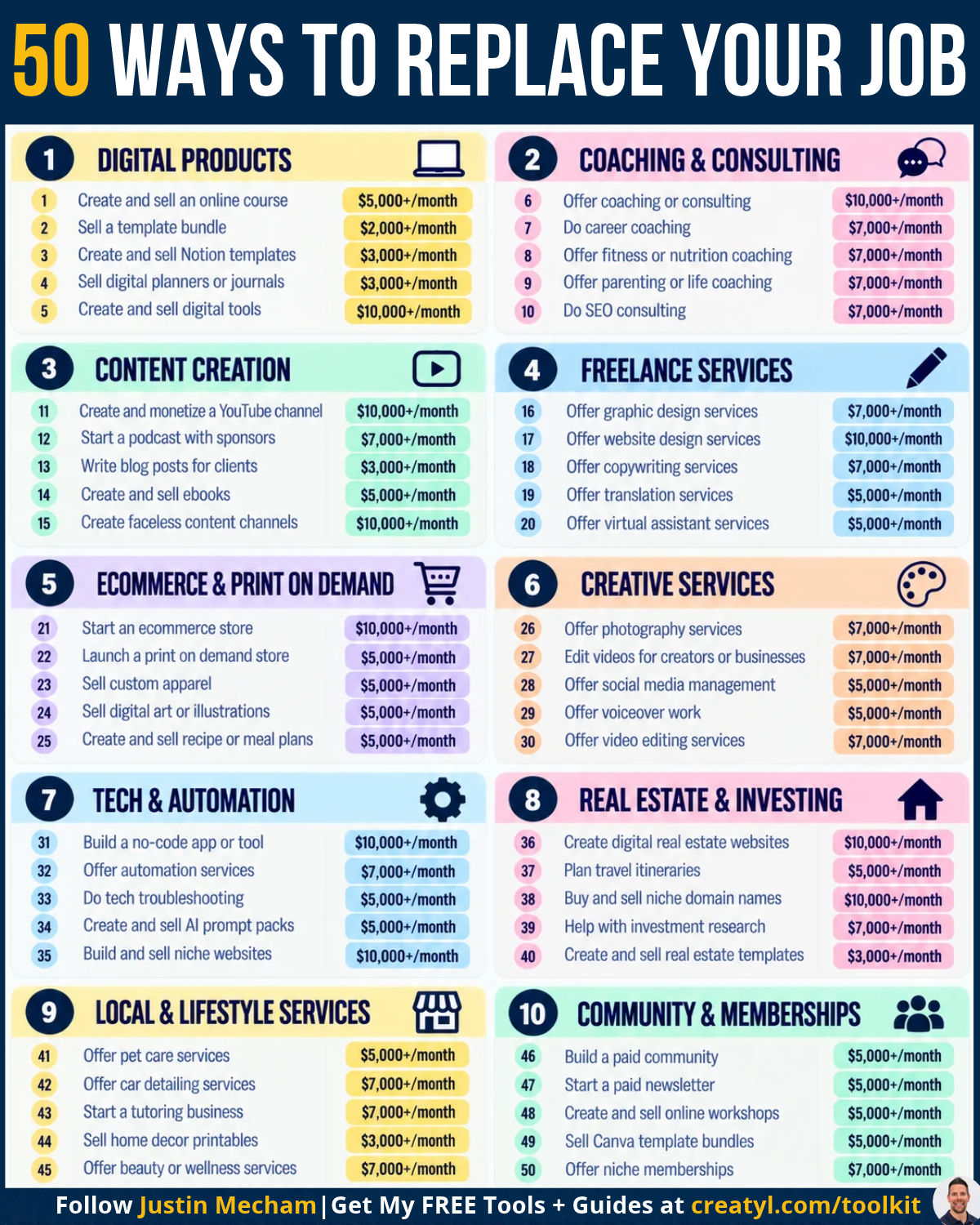
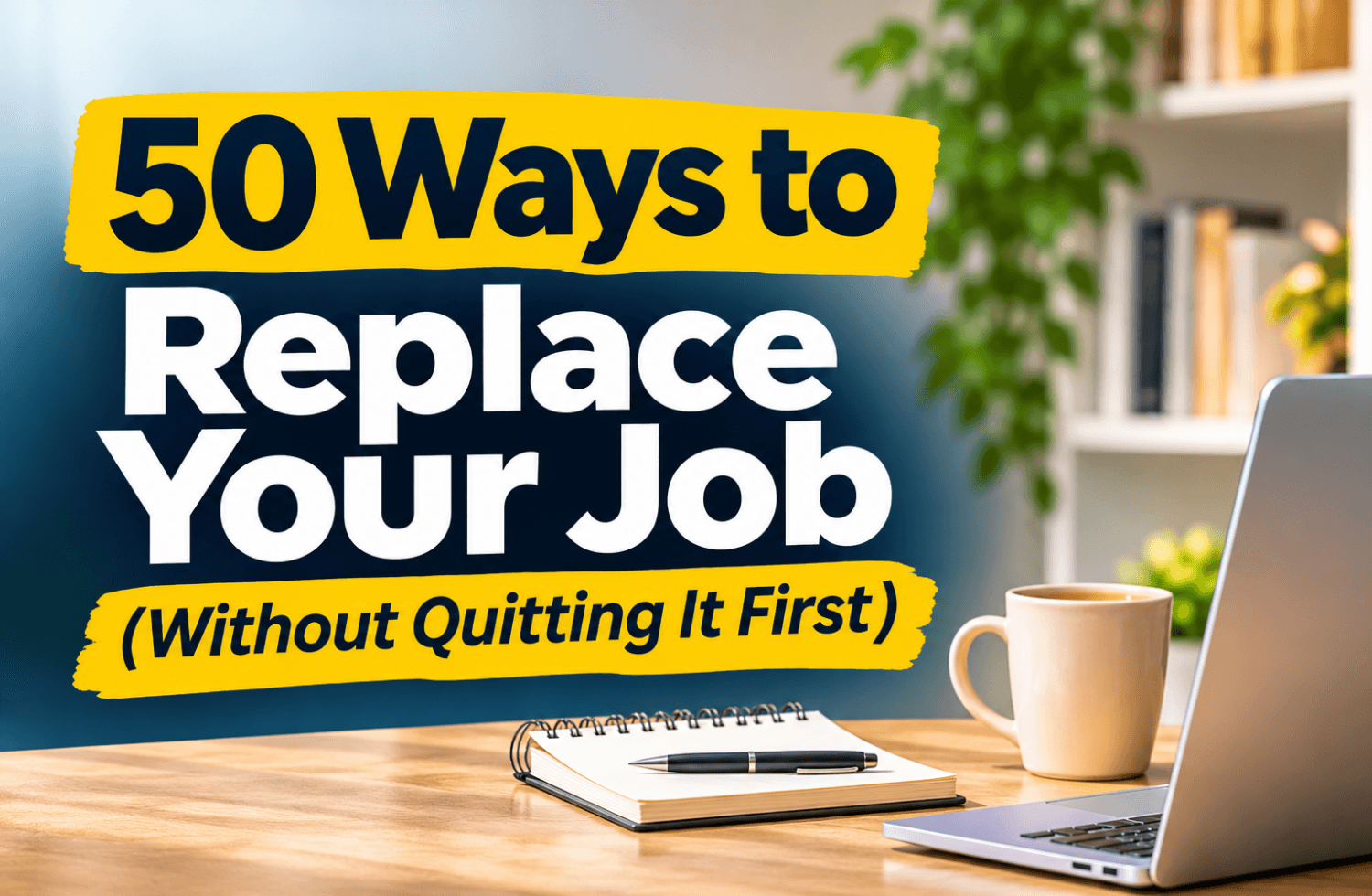
50 Ways to Replace Your Job (Without Quitting It First)
You don't need another paycheck to feel secure. You need options. Here's how to start building them with the skills you already have.
The Paycheck I Couldn't Afford to Lose
I remember what it felt like to have a job I couldn't afford to leave.
Not because I loved the work. Not because I saw some incredible future waiting for me there. But because every bill, every family expense, and every financial responsibility depended on that paycheck arriving.
When you have people counting on you, the idea of walking away from a steady income doesn't feel brave. It feels irresponsible.
So you stay.
You tell yourself things will get better. Maybe the next promotion will change everything. Maybe a higher salary will make the pressure disappear. Maybe a different manager will finally recognize how much you contribute.
And sometimes those things do make life better.
But I eventually realized something uncomfortable: even if I earned more money, I would still be depending on someone else to keep paying me.
That was the part that bothered me most.
I could work hard, do everything expected of me, and still have very little control over what happened next.
I didn't necessarily want to stop working. I wanted to stop feeling like losing one job could turn my entire life upside down.
It took me years to understand that those were two very different goals.
And the answer wasn't necessarily finding another employer.
It was learning how to become valuable to people beyond the company that employed me.
Why a Bigger Salary Doesn't Always Mean More Security
Most of us grow up with a fairly predictable financial plan.
Get an education. Find a good job. Work hard. Earn promotions. Save money. Eventually, everything should become more comfortable.
There's nothing wrong with that path. A good job can provide stability, opportunities, relationships, and valuable experience.
But there's a weakness we don't discuss enough.
You can have a great salary and still have only one customer for your skills.
Your employer.
Think about that for a moment.
A business would be considered vulnerable if nearly all its revenue came from one client. If that client disappeared, the business could be in serious trouble.
Yet millions of people build their entire financial lives around exactly that arrangement.
Of course, employment comes with protections and benefits that running a business may not. And starting a
side business carries its own risks.
But the underlying lesson remains useful: having more than one source of income can give you additional choices.
For me, that realization changed the question.
Instead of asking how I could find a job that paid more, I started asking what I could create that someone would willingly pay for.
That question opened a door I hadn't seriously considered before.
You're Probably Sitting on Skills Someone Would Pay For
Here's something I wish I'd understood much earlier.
You don't need to be the world's leading expert to help someone solve a problem.
You simply need to know something useful that another person needs help understanding, doing, or achieving.
Consider someone who has spent years organizing projects at work.
They might see spreadsheets, schedules, and planning documents as ordinary parts of their job.
But a small business owner struggling to manage deadlines might happily pay for a project management template that makes everything easier.
Or consider a parent who has developed a practical system for preparing affordable meals each week.
To them, it's simply how they manage family life.
To another busy parent, a well-designed meal-planning guide could save hours of frustration.
A graphic designer might turn frequently requested designs into editable templates. A teacher could create downloadable learning resources. Someone experienced in hiring could help job seekers prepare for interviews.
None of these ideas requires inventing something completely new.
They require recognizing that what feels ordinary to you might be extremely useful to someone else.
Your most valuable business idea might be hiding inside something you've done so many times that you no longer consider it special.
That's why I encourage people to pay attention to the questions others already ask them.
What do friends come to you for advice about? What problems do coworkers trust you to solve? What have you learned through experience that could save someone else time, money, or frustration?
Those questions can reveal opportunities that are far more practical than chasing the latest online business trend.
50 Ways to Start Building Income Outside Your Job
When I started exploring ways to earn money independently, I realized the possibilities were much broader than I'd imagined.
You don't have to become an influencer, launch a complicated technology company, or spend thousands developing a product.
There are opportunities in education, consulting, creative work, technology, local services, digital products, and communities.
That's why I put together a free infographic featuring 50 ways to make money outside your job, organized into ten categories.
The list includes everything from online courses and digital planners to freelance services, coaching, niche websites, and paid communities.
But I want to make something clear.
The income amounts shown in the infographic are illustrative possibilities, not promises or typical results.
Many businesses earn little or nothing initially, and reaching a substantial monthly income requires real demand, consistent work, and often considerable time.
The purpose of the list isn't to convince you that every idea will make you thousands of dollars.
It's to help you see how many different ways your existing knowledge could become useful to someone else.
Let's look at a few examples.
Digital Products: Create Something Once, Sell It More Than Once
Imagine you're particularly good at organizing household finances.
You've developed a spreadsheet that helps you track expenses, plan upcoming bills, and understand where your money goes.
Instead of keeping that system to yourself, you could turn it into a downloadable budgeting template.
You might start by showing it to a few people, asking what confuses them, and improving it based on their feedback.
Then you could offer it for $15 or $25.
The beauty of a digital product is that you're not necessarily exchanging an hour of your time for every sale.
You create something useful, then make it available to multiple customers.
That doesn't make the business passive. You'll still need to find customers, answer questions, improve the product, and manage the business.
But it introduces a different way of earning.
And your first product doesn't have to be complicated. A checklist, template, short guide, or simple workbook can be enough to test whether people want what you're offering.
Coaching and Consulting: Turn Experience Into Guidance
Maybe your strongest asset isn't a document or a template.
Maybe it's your experience.
Someone who has spent ten years managing teams could help first-time managers handle difficult conversations.
A professional with experience improving business operations could help small companies identify where they're wasting time.
A language teacher might offer personalized lessons to professionals preparing for international interviews.
The important part is to offer a clear result rather than a vague collection of expertise.
People rarely wake up wanting to purchase consulting.
They wake up wanting a problem solved.
If you can explain exactly whom you help, what changes for them, and why your experience matters, you have the beginning of an offer.
Freelancing: Start With a Service People Already Need
Freelancing can be one of the more direct ways to test whether your skills have commercial value.
You don't necessarily need a large audience or a complete website.
Suppose you know how to edit short videos.
Instead of announcing that you're a video editor and hoping someone hires you, you could identify a specific customer.
Perhaps local businesses that record videos but struggle to turn them into polished social media content.
You could offer to edit four short videos each month for an agreed price.
One client gives you experience. Their feedback helps you improve your service. A successful project might lead to referrals or ongoing work.
And eventually, you might turn the lessons you've learned into templates, training, or a digital product.
A service can become the starting point for something much larger.
Communities and Memberships: Help People Make Progress Together
Some problems aren't solved with a single download or consultation.
People need ongoing guidance, accountability, or connection.
Imagine someone who has spent years helping beginners learn photography.
They could create a small paid community where members receive weekly challenges, feedback on their photos, and opportunities to learn from one another.
The value isn't simply access to information.
It's the experience of making progress with other people.
Memberships can provide recurring revenue, but they also create recurring responsibilities. People need a reason to stay, and delivering that value consistently takes work.
The right business model depends on what your customers genuinely need.
And that brings us to the most important part of the entire list.
You Don't Need 50 Ideas. You Need One That Makes Sense.
A long list of opportunities can be exciting.
It can also be overwhelming.
You start imagining an online course, a newsletter, a consulting business, and a digital product store.
Before long, you're researching five business models and building none of them.
I've learned that having more options doesn't automatically make starting easier.
Sometimes it makes choosing harder.
So instead of asking which idea could make the most money, I recommend asking three simpler questions.
First: What can I already do reasonably well?
Start with skills you possess today. You can improve them over time, but you don't need to become a completely different person before beginning.
Second: Who has a problem I could help solve?
Be specific. Busy parents, new managers, independent consultants, university students, and small business owners have different needs.
The more clearly you understand your potential customer, the easier it becomes to create something relevant.
Third: What is the smallest useful result I could sell?
Don't begin with a twelve-module course if a simple checklist could solve the immediate problem.
Don't build a complicated membership platform before discovering whether people want ongoing support.
Start with the smallest version that delivers something genuinely valuable.
For example, if you're experienced in preparing for job interviews, you could begin with a $19 interview preparation workbook rather than developing an entire career coaching academy.
You can always expand later.
But first, you need evidence that someone wants the result you're offering.
Why Your First $100 Can Matter More Than Your First $10,000
When people talk about starting businesses online, the conversation often jumps straight to impressive revenue numbers.
Ten thousand dollars a month. Six figures a year. Financial freedom.
Those numbers can be motivating, but they can also distract you from the first milestone that actually matters.
Getting someone to pay for something you've created.
Imagine you've built a $25 digital guide that helps freelancers organize their client onboarding process.
You share it with people who might benefit, explain what it does, and eventually make four sales.
That's $100 in revenue before expenses and taxes.
It's not enough to replace your salary.
It might not even cover a meaningful portion of your monthly bills.
But something important has happened.
Four people have decided that your knowledge is worth paying for.
You've moved from wondering whether you could sell something to having evidence that you can.
Now you can ask better questions.
Why did those customers buy? What did they find most useful? What nearly stopped them? What else do they need help with?
Those answers can guide your next improvement.
Of course, four purchases don't prove that you have a sustainable business. You still need to understand your costs, customer acquisition, and whether demand continues.
But they give you something more useful than another month of imagining possibilities.
They give you real-world feedback.
And that feedback is where a business begins to take shape.
Build the Business Before You Need the Business
One of the biggest mistakes people can make is treating starting a business as an all-or-nothing decision.
They imagine they need to quit their job, free up forty hours a week, and dedicate themselves completely to their idea.
For most people with financial responsibilities, that's neither realistic nor necessary.
You can start much smaller.
Suppose you have four hours available each week.
You might spend one hour speaking with potential customers, another developing a simple offer, and two hours creating or delivering something useful.
That's not a dramatic lifestyle transformation.
It's a manageable experiment.
Over a month, you could have several conversations, identify a common problem, build a basic solution, and ask people whether they'd pay for it.
You might discover that the idea needs changing.
That's useful information too.
Starting while employed gives you room to learn without immediately depending on the new business to cover your living expenses.
It also gives you time to build financial reserves, understand your obligations, and decide whether self-employment is genuinely right for you.
Check your employment agreement for any restrictions on outside work, protect confidential information, and keep your side business separate from your employer's resources.
And remember that additional income isn't automatically additional profit. Taxes, software, payment fees, marketing, and your time all matter.
The goal isn't to create a second job that leaves you exhausted.
It's to build something deliberately, at a pace your life can support.
You don't have to prove your commitment by taking unnecessary financial risks.
Sometimes the smartest move is keeping the paycheck while quietly building another option.
Freedom Begins Before You Leave
For a long time, I thought freedom meant reaching the day when I could finally walk away from my job.
I imagined it as one big moment. A resignation letter. A final paycheck. A completely different life waiting on the other side.
But looking back, I don't believe freedom begins with a resignation.
I believe it begins much earlier.
It begins when you realize your employer isn't the only person who might pay you for what you know.
When you create something useful and someone chooses to buy it.
When you stop seeing your experience as something that belongs exclusively to your job and start recognizing it as something you can use to create opportunities of your own.
That first sale might be small. Your first idea might fail. You might spend months learning things you wish you'd known sooner.
None of that means you're wasting your time.
You're developing skills, understanding customers, and learning how to create value independently.
And even if you decide to remain employed for the rest of your career, those abilities can still change your relationship with work.
Because having options doesn't mean you have to use every one of them.
It means knowing they're there.
I don't want people to feel that they have to quit their jobs to build meaningful lives. Some people genuinely love their careers, and others prefer the stability and structure employment provides.
What I want is for more people to experience the peace of knowing their entire future doesn't depend on one decision made by someone else.
So keep your paycheck if you need it.
Take care of your family. Pay your bills. Build your savings.
But don't overlook what you already know, what you've already learned, and what you might be capable of creating.
Start with one problem. Help one person. Make one sale.
Then see where it leads.
Because the real goal isn't necessarily to replace your job. It's to build a life where keeping it is a choice, not your only option.
Your Next Income Stream Might Be Closer Than You Think
You don't need to come up with a brilliant business idea from scratch. Sometimes, all it takes is seeing an opportunity you hadn't considered before.
That's why I've put together 50 Ways to Replace Your Job, a free PDF featuring 50 practical income ideas across 10 different categories.
Explore the possibilities, find one that fits your skills, and take your first step toward building something of your own.