Click Here to Download the PDF
Why Momentum Has Nothing To Do With Being Busy
Most teams confuse movement with progress.
They stack meetings, fill calendars, and label it “momentum.”
But here’s the truth: busy doesn’t build momentum—clarity does.
Momentum doesn’t come from adding more hours or squeezing one more task into your day.
It comes from putting things in the right order.
That’s where most people get it wrong.
They plan before they choose direction.
They execute before they know what matters.
Then they wonder why effort doesn’t equal results.
The real shift happens when you stop asking, “How do I get more done?” and start asking, “What’s the right thing to move next?”
The Framework That Actually Builds Momentum
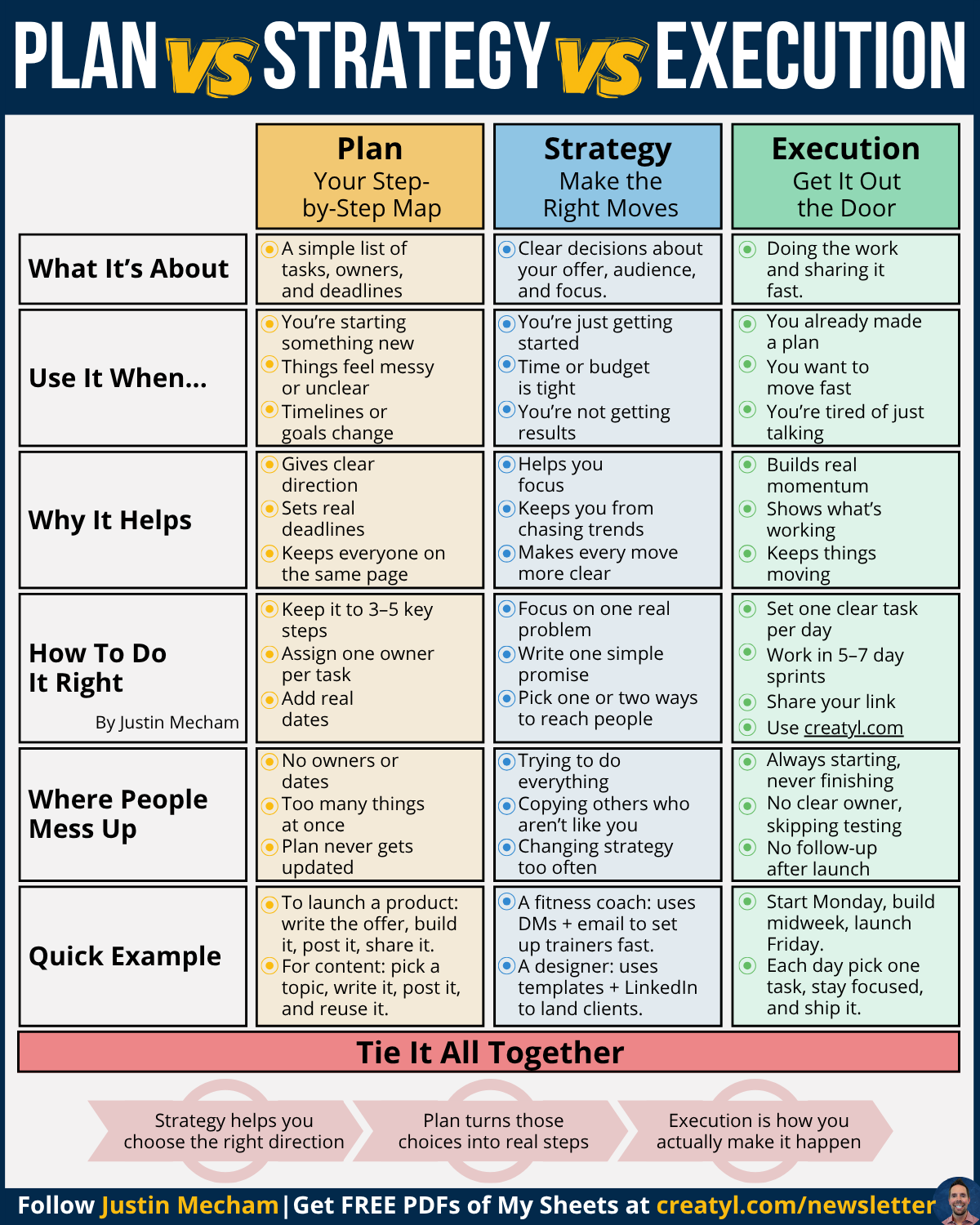
Every productive week has three moving parts—strategy, plan, and execution.
Miss one, and everything stalls. Get them aligned, and work starts to click.
Strategy: Make the Right Moves
Strategy is your decision filter. It’s how you choose direction when everything feels urgent.
It’s not about having all the answers.
It’s about knowing which problems are worth solving.
When strategy is strong, your choices feel lighter.
You can say no faster. You stop chasing trends and start building traction.
Good strategy clarifies:
- What you’re saying yes to
- What you’re saying no to
- Who you’re doing it for
- What outcome defines success
Without strategy, teams fill time instead of creating results.
Every hour feels full, but nothing moves forward.
Plan: Turn Choices Into Steps
Once you know where you’re going, the plan becomes your step-by-step map.
It’s not a manifesto—it’s a list of actions that actually get you there.
A plan is clarity on paper. It answers:
- What’s the next move?
- Who owns it?
- When will it be done?
The best plans aren’t long.
They’re short enough to stay flexible, but specific enough to make action unavoidable.
Keep it to three to five steps.
Assign one owner per task. Add real dates.
Plans don’t create results—but they create confidence.
They replace confusion with commitment, and that’s what drives real progress.
Execution: Get It Out The Door
Execution is where everything changes.
It’s the point where talk ends and traction begins.
The fastest-growing teams in the world aren’t just good at planning—they’re relentless about doing.
Execution isn’t about perfection. It’s about proof.
You’re not finished when it’s flawless; you’re finished when it ships.
Set one clear task per day. Work in short, 5–7 day sprints.
Share your link, your draft, your update.
And when you finish something, don’t celebrate the checklist—celebrate the learning.
Because momentum isn’t built by perfect launches.
It’s built by shipping small things consistently.
The 15-Minute Drill That Changes Everything
When teams feel stuck, they don’t need another meeting.
They need motion.
Try this quick reset—it’s simple, fast, and it works.
- Choose one outcome.
- Write one clear sentence: “By Friday, X is live.”
- Pick one move.
- Decide the single best way to reach it. Ignore everything else.
- Make the plan.
- List 3–5 steps. Assign one owner per step. Add real dates.
- Start a 30-minute sprint.
- Do step one right now. No meetings. No new tabs.
- Ship a proof.
- A link, screenshot, or draft—something real to share.
- End-of-day check.
- Ask: What shipped? What blocked tomorrow?
- Update the map. Keep moving.
This isn’t just productivity—it’s precision.
You’ll learn where your time actually goes, which ideas are worth keeping, and which ones drain energy without progress.
A Real Workplace Example
I worked with a marketing team that kept missing deadlines, even though everyone was working hard.
The problem wasn’t effort—it was order.
They were building campaigns before defining the strategy.
Designers were creating assets before the messaging was clear.
Writers were producing content for products that hadn’t even been approved.
So we reset using this exact framework.
First, we clarified strategy:
What’s the real goal? Who are we talking to? What’s the key message?
Then we built a short plan: five tasks, each with one clear owner and a real date.
Finally, we moved into execution: short sprints, one proof shipped per day, no long meetings.
By the end of the week, they had a working campaign, live metrics, and visible progress.
Same people. Same skills.
Different order.
That’s the power of alignment.
Strategy gave them focus.
Planning gave them clarity.
Execution gave them proof.
And proof is what builds momentum.
Final Thought: Momentum Is Earned One Decision At A Time
Momentum isn’t built in the background. It’s earned in motion.
You don’t need more time—you need the right sequence.
Strategy sets direction.
Planning gives structure.
Execution turns all that thinking into something real.
When those three work together, you stop mistaking effort for impact.
You stop feeling behind.
You start finishing things that matter.
Momentum isn’t about speed—it’s about order.
When you do the right work, in the right order, with the right clarity, everything starts to accelerate.
The irony is that momentum feels less like chaos and more like calm.
You know what matters.
You know what’s next.
You know what done looks like.
And that’s where confidence begins—inside progress you can see, not just plans you can explain.
Download the Infographic
Get the Plan vs Strategy vs Execution infographic as a free, printable PDF.
It’s your quick reference to bring order to any project and remind your team what truly creates momentum.