Click Here to Download the PDF.
You Don’t Need More Time. You Need Fewer Decisions.
Most people don’t struggle to build something meaningful because of laziness or lack of ambition.
They struggle because each day asks them to decide too much.
What should be worked on today?
Is this the right idea?
Should direction change again?
Is it ready yet?
Those questions drain energy before real work even begins.
Progress doesn’t come from adding more hours.
It comes from removing unnecessary decisions.
That’s the quiet power behind a five-hour creator week.
Why One Hour a Day Actually Works
One hour a day sounds small.
But when each hour has a clear job, it becomes focused instead of fragile.
The mistake many creators make is trying to use every work session for everything at once.
Creating.
Planning.
Selling.
Improving.
That constant switching slows momentum and increases fatigue.
This approach removes friction by assigning each hour a single responsibility.
No guessing.
No juggling.
Just clear execution.
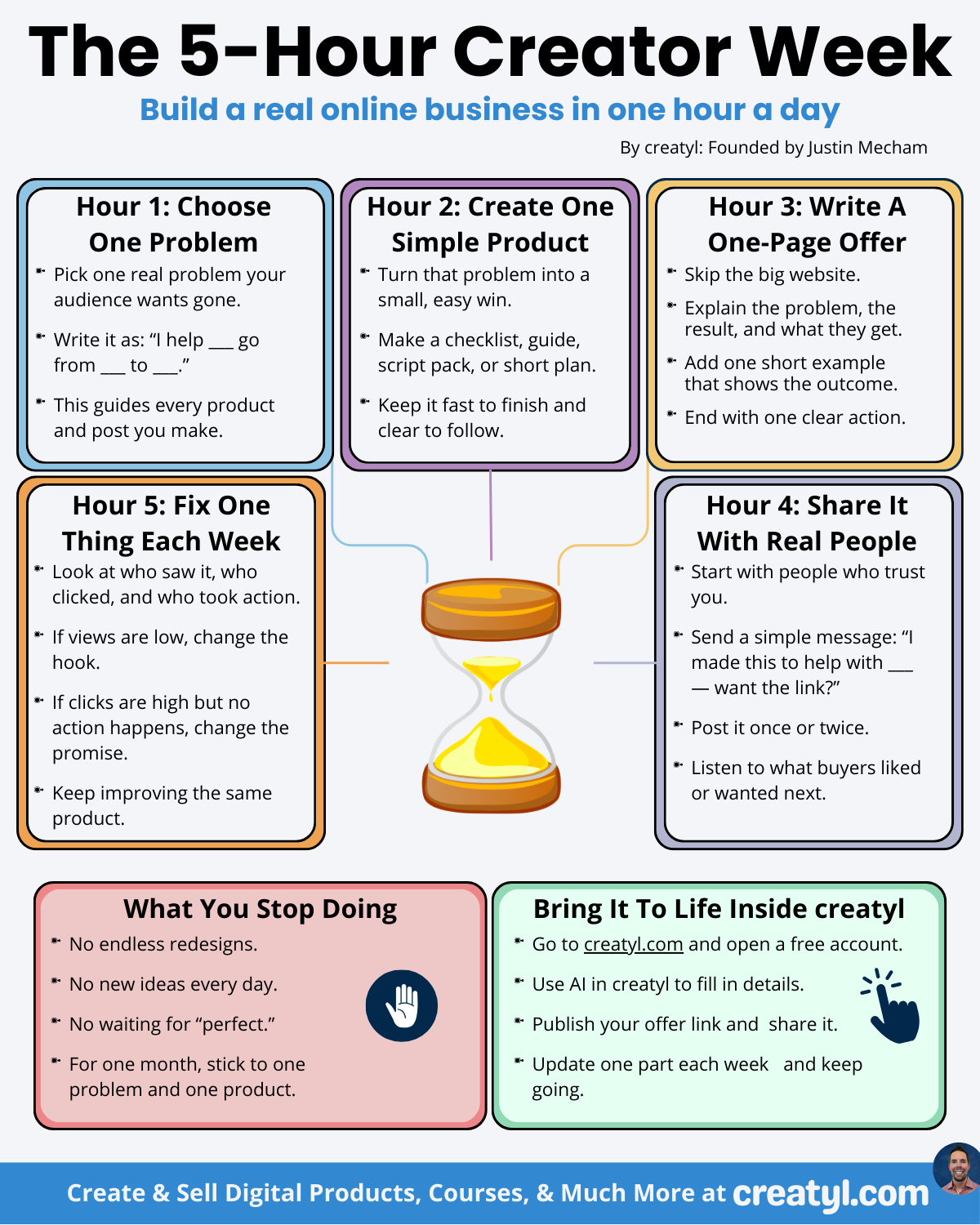
Hour One: Choose One Problem and Ignore the Rest
Everything starts with a problem.
Not an idea.
Not a product.
A real problem that people already want gone.
This problem becomes a filter.
It guides what gets created.
It shapes what gets written.
It clarifies what gets shared.
The key is writing the problem in plain language:
“We help ___ go from ___ to ___.”
If the problem can’t be stated simply, clarity isn’t there yet.
Getting this right prevents wasted effort later.
Hour Two: Turn the Problem Into a Small Win
Once the problem is clear, the solution should stay small.
Not a full system.
Not a long course.
A single win.
A checklist.
A short guide.
A script.
A simple plan.
Something fast to finish and easy to use.
This keeps momentum intact and avoids overbuilding.
Done creates progress. Perfect creates delay.
Hour Three: Explain It on One Page
Selling doesn’t require complexity.
It requires understanding.
One page is enough when it answers four questions clearly:
What is the problem?
What changes after?
What do they get?
What should they do next?
If someone can’t understand the offer quickly, they won’t act.
Clear explanations remove hesitation.
Hour Four: Share It With Real People
This hour isn’t about reach.
It’s about trust.
Start with people who already know the work.
One short message.
One link.
Then listen.
Notice what confuses them.
Pay attention to what gets a response.
Feedback from real people matters more than views or likes.
Hour Five: Improve One Thing Each Week
This is where many creators lose momentum.
They redesign everything.
They change direction.
They start over.
That resets progress.
Instead, improve one thing.
If people don’t see the offer, adjust the hook.
If people click but don’t act, adjust the promise.
Same product.
Better clarity.
Progress compounds through improvement, not reinvention.
What This Approach Replaces
This system works because of what it removes.
No endless redesigns.
No chasing new ideas every week.
No waiting until everything feels perfect.
For one month, the focus stays on one problem and one product.
That constraint creates momentum.
A Real Workplace Example: When Progress Stalled From Overthinking
A small team was responsible for creating and sharing helpful resources.
Ideas were strong.
Effort was consistent.
But nothing shipped.
Each week brought a new direction.
Projects were started, paused, and revised.
Decisions stacked up.
Confidence dropped.
Despite working hard, progress felt slow and heavy.
The process was simplified.
One problem was chosen.
One small solution was built.
One page explained it.
One message shared it.
Each week, only one improvement was allowed.
Within a month, work shipped consistently.
The workload felt lighter, not busier.
The shift wasn’t about time.
It was about structure.
Why Consistency Beats Reinvention
Most progress doesn’t come from breakthroughs.
It comes from repetition.
Doing the same simple actions long enough for clarity to sharpen.
When decisions are reduced, energy stays focused.
Focused energy builds momentum.
Progress Lives Inside Structure
Why Fewer Choices Lead to Better Results
The most effective creators aren’t faster thinkers.
They’re lighter thinkers.
They remove decisions before the day begins.
They give each hour a clear role.
They stay with one path long enough for it to work.
One hour a day becomes powerful when it’s protected from noise.
That’s how something real gets built.
Download the 5-Hour Creator Week Infographic (PDF)
For a visual reference to the framework covered in this article, download the related infographic.
Download the 5-Hour Creator Week infographic (PDF)
It’s a simple guide for building steady progress without starting over each week.