

Click Here to Download the PDF
There’s a shift happening in online business, and it’s bigger than any algorithm change.
Buyers today are more informed, more discerning, and far less patient with long explanations.
They’ve seen every pitch, every funnel, every bold promise.
They scroll without flinching.
They can spot hype instantly.
Because of that, the creators and coaches who win are not the ones who talk the most.
They’re the ones who show the most.
The ones who use proof.
The ones who give real value upfront.
The ones who let their results speak louder than their explanations.
This is the heart of quiet marketing, and it’s the foundation of modern selling:
You don’t need a louder voice. You need clearer proof.
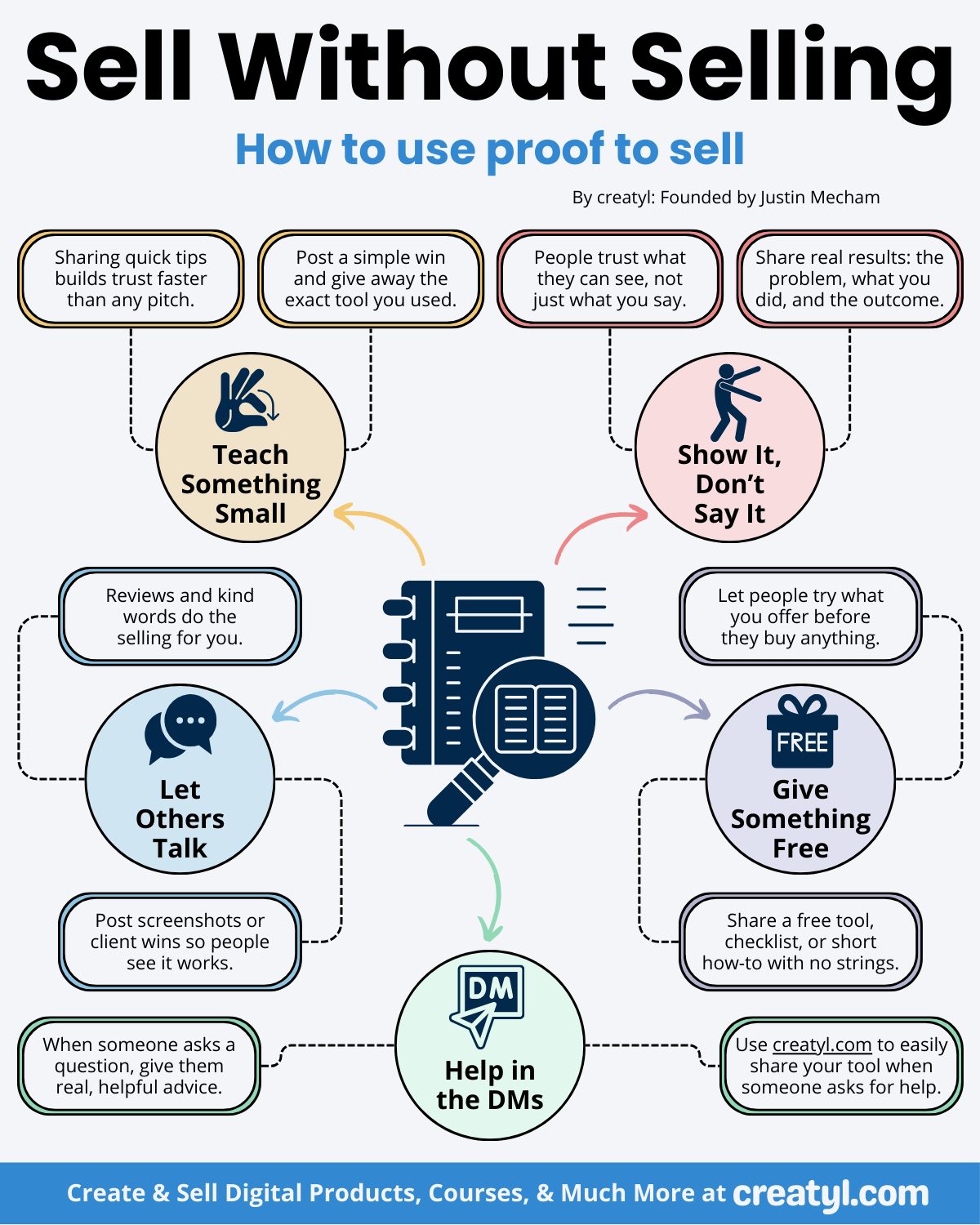
This article breaks down how to do that, using the “Sell Without Selling” infographic you saw earlier.
You’ll find deeply practical insights, real workplace examples, the psychology behind proof-based marketing, and the most powerful tools to support your strategy.
Why Most People Sell Backwards
Most creators and business owners make the same mistake: they lead with explanations.
They write long posts about their offer.
They try to highlight every feature.
They push benefits, outcomes, and value points as if volume alone builds trust.
But trust doesn’t respond to volume.
Trust responds to evidence.
Buyers want to know one thing:
“Does this work—and can I see the proof?”
Explanations create distance.
Proof creates connection.
When people can see a result with their own eyes, they no longer feel like they’re being sold to.
They feel like they’re being shown something real.
That’s why the five-step proof-based framework matters.
It cuts through noise and makes your content instantly trustworthy.
The Five Steps to Sell Without Selling
Below is a deeper look at each step, written to help you apply it immediately.
1. Teach Something Small
A single tip can do more than a thousand-word pitch.
When you share something small that actually helps someone—something they can use today—you build trust instantly.
Small wins build big belief.
And belief is what drives sales.
2. Show It, Don’t Say It
Words can sound nice, but results speak directly.
People want to see the before, the after, and the outcome.
They want a short, clear picture of what changed.
Clarity builds confidence.
Transparency builds credibility.
3. Give Something Free
A small freebie removes risk.
It lets someone try your approach before they buy anything.
When people experience value firsthand, trust forms faster.
Samples aren’t giveaways—they’re proof.
4. Let Others Talk
Reviews, screenshots, messages, testimonials—these are the most powerful sales assets you have.
When other people describe the impact of your work, the claim becomes believable.
Let your clients speak for you.
5. Help in the DMs
When someone reaches out, respond like a human.
Not with a pitch, not with pressure—just real help.
A thoughtful answer builds more trust than any sales script.
Buyers follow honesty, not force.
Real Workplace Examples
Five Short Stories Showing How Proof Works in Action
To make these ideas more concrete, here are five short, real-life workplace examples—one for each step of the framework.
Each story is written in the Problem → Agitation → Solution format, with actionable takeaways you can use.
1️⃣ Teach Something Small
A small marketing agency shared long educational posts, but almost no one reached out.
Their posts sounded smart, but they didn’t convert.
Followers said things like, “You seem knowledgeable, but I’m not sure what working with you looks like.”
The agency was teaching a lot but not showing anything small and useful.
They switched to posting one small tip per week:
- A headline format that doubled clicks
- A targeting tweak for ads
- A one-line subject line that increased opens
Each tip included a real screenshot showing before and after performance.
Replace one long post this week with a single, specific win and show exactly how you achieved it.
2️⃣ Show It, Don’t Say It
A SaaS founder told prospects their tool “saved hours,” but leads kept disappearing after demos.
The claim sounded good, but prospects had heard similar lines before. There was nothing real to trust.
They redesigned their demo around one real workflow.
They showed:
- The old process (27 minutes)
- The new process (6 minutes)
- A 30-second screen recording proving it
Document one before → after → result sequence this week and share it publicly.
3️⃣ Give Something Free
A career coach had an interested audience but low conversions.
People liked the posts but didn’t want to risk paying for something they hadn’t experienced.
Prospects said, “I’m curious, but I’m not sure if coaching will help.”
The coach explained the program repeatedly, but doubt never left.
They released a free interview prep checklist and offered a 15-minute feedback call.
People used the checklist, saw real progress, and trusted the coach’s approach.
Create a simple freebie that gives someone an immediate win. Use it as proof of your method.
4️⃣ Let Others Talk
An HR consulting team posted about their services, but their messaging sounded like every other firm.
It lacked real evidence.
Prospects said, “Everyone says they can fix culture.” No one trusted words alone.
They gathered three client quotes and real screenshots like:
“Our turnover dropped by 30%.”
“This was the first time our team felt supported.”
This instantly changed how prospects responded.
Choose three past clients and pull one honest sentence from each.
Put those lines where people can see them.
5️⃣ Help in the DMs
A digital product creator had an active audience but poor conversions.
Whenever someone messaged, they felt pressure to pitch immediately.
DMs felt uncomfortable.
The creator avoided them, which meant missing real leads.
They started answering with one real piece of advice first.
Then added, “If you want the ready-made version of this, I have a tool that does exactly that.”
No pressure. Just clarity.
When someone messages you, start with value, not a pitch.
The trust you build will carry the conversation forward naturally.
The Best Tools to Support Proof-Based Selling
Book — Show Your Work! by Austin Kleon
A practical guide on how to share your process publicly, build trust without pressure, and let your work speak for itself.
TED Talk — The Puzzle of Motivation by Dan Pink
A powerful breakdown of what drives people to take action—clarity, connection, and proof, not force.
AI Tool — Canva’s “Magic Design”
Perfect for turning screenshots, testimonials, and mini case studies into clean, trustworthy visuals quickly.
Podcast — Online Marketing Made Easy by Amy Porterfield
Excellent for learning real examples of trust-based content that converts without pressure.
Series — Abstract: The Art of Design (Netflix)
A behind-the-scenes look at creators showing their work—an excellent study in proof-driven storytelling.
A Simple Framework to Turn Proof Into Quiet Marketing
Step 1: Share one real win
Step 2: Screenshot one review
Step 3: Offer a mini freebie
Step 4: Add one short testimonial
Step 5: Help someone honestly in the DMs
Repeat this loop weekly.
This rhythm builds trust faster than any pitch.
Where Proof Replaces Pressure
There is a moment every creator reaches when they realize selling isn’t about convincing people.
It’s not about perfectly crafted words or longer explanations.
It’s not about pushing harder or sounding smarter.
The real turning point comes when you start showing the truth instead of talking about it.
Small wins.
Real results.
Screenshots.
Messages.
Tools people can use.
Stories people can feel.
These pieces of proof work long after you log off.
They keep building trust quietly in the background.
They build a reputation that doesn’t need volume to be heard.
You don’t need to be louder.
You don’t need to force anything.
You don’t need to chase buyers.
When you show your work with clarity and honesty, people lean in on their own.
Because they can see the truth of what you do—and that’s the most persuasive marketing in the world.
When proof becomes your strategy, selling stops feeling like selling.
It starts feeling like helping.
Download the Infographic as a PDF
You can download the full “Sell Without Selling” infographic in a clean, printable PDF format here:
It pairs perfectly with this article and gives you a simple one-page guide to help you use proof, value, and real results to build trust—and sell—without ever needing to pitch.