

Click Here to Download the PDF
Most people don’t struggle with laziness.
They struggle with direction.
They work long days.
They stay connected.
They respond quickly.
They attend meetings.
From the outside, they look productive.
From the inside, they feel exhausted.
And yet, when the week ends, very little that truly matters has moved forward.
This is the quiet trap of busyness.
It keeps you occupied without asking whether the work is actually important.
Why Being Busy Feels So Good in the Moment
Busyness gives instant feedback.
Messages come in.
Tasks get checked off.
Calendars fill up.
Each small action creates a sense of motion.
And motion feels like progress, even when nothing meaningful changes.
That’s why busyness is seductive.
It rewards activity, not outcomes.
Productive work feels very different.
It often starts slow.
It requires focus.
It usually involves saying no to something visible so you can finish something invisible.
And because results take time to show up, productive work doesn’t always feel satisfying in the moment.
The Hidden Cost of Staying Busy
The problem with busyness isn’t that it’s tiring.
It’s that it hides the real issue.
When people stay busy, they don’t have to confront uncomfortable questions like:
- What actually matters right now?
- What am I avoiding by staying occupied?
- What problem keeps showing up because no one fixes it fully?
Busy work keeps you safe from those questions.
But over time, the cost adds up.
Important work gets delayed.
The same problems resurface again and again.
People feel stretched thin but oddly unfulfilled.
How Teams Drift into Busyness Without Realizing It
Busyness doesn’t usually come from poor intent.
It comes from unclear priorities.
Meetings multiply because no one is sure who decides.
Messages increase because problems aren’t resolved at the root.
Plans keep changing because there was never a simple version to begin with.
People start reacting instead of choosing.
Work becomes fragmented.
Energy gets spread across too many small tasks.
From the outside, it looks like effort.
From the inside, it feels like spinning.
What Productive Work Actually Looks Like
Productive work isn’t louder or faster.
It’s quieter and more deliberate.
It starts with a short list.
Not everything that could be done, but the few things that must be done.
It values completion over activity.
It removes steps instead of adding them.
It treats focus as a resource, not something to give away freely.
Productive people don’t do more.
They do less, better, and with intention.
A Real Consulting Moment: When “Busy” Became the Warning Sign
I once worked with a team that was constantly overwhelmed.
Calendars were full.
Messages never stopped.
Everyone was working hard.
But progress was slow.
The same issues came up in meeting after meeting.
Decisions were revisited instead of finalized.
People were exhausted but unsure why.
The breakthrough came when we stopped asking, “What are you working on?”
And started asking, “What are you finishing?”
That question changed everything.
We reduced meetings to decision points only.
We fixed recurring problems instead of managing around them.
We blocked quiet time for focused work and protected it.
Nothing about their workload increased.
But their output finally matched their effort.
The Shift Most People Never Make
The hardest change isn’t learning new tools.
It’s letting go of the comfort of being busy.
Busyness gives cover.
Productivity demands clarity.
That means choosing what not to do.
Accepting that some messages can wait.
Allowing work to be invisible while it’s being done.
It also means trusting that finishing one important thing creates more value than touching ten small ones.
What Actually Moves Work Forward
Real progress comes from a few consistent habits:
Fixing problems once instead of revisiting them repeatedly.
Working in quiet blocks without interruption.
Sharing clear outcomes and next steps, not long updates.
Building simple systems so work doesn’t rely on constant attention.
Removing anything that slows decisions or completion.
None of this feels flashy.
All of it works.
Final Thought: Activity Is Easy to Measure. Progress Is Not.
And That’s Why So Many People Confuse the Two.
Being busy is visible.
Being productive often isn’t.
That’s why busyness gets praised, while focus gets interrupted.
Why full calendars feel important, even when they block real work.
The shift isn’t about doing more.
It’s about choosing better.
When you stop measuring your day by how much you touched and start measuring it by what you finished, your work begins to change shape.
So does your energy.
So does your confidence.
Not because you’re working harder.
But because you’re finally working on what matters.
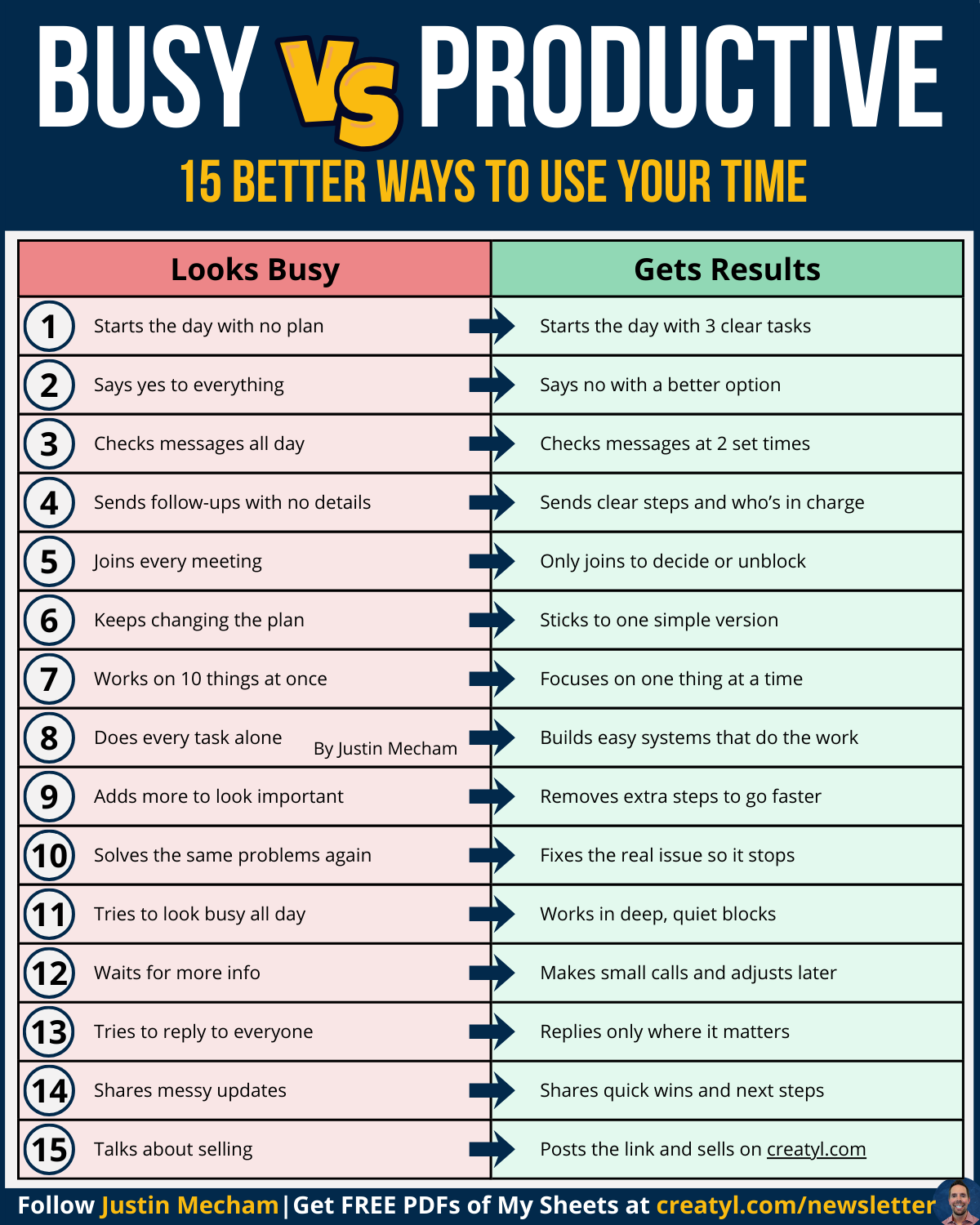
Download the Busy vs Productive Worksheet (PDF)
The worksheet that inspired this article is available as a one-page PDF you can download and use anytime.
Many people use it to reset their week, clean up their calendar, or help teams shift from constant activity to real progress.
It’s especially useful when work feels full but unfinished.
You can download the PDF here:
Sometimes, seeing the difference on paper is enough to change how you work tomorrow.