

Click Here to Download the PDF.
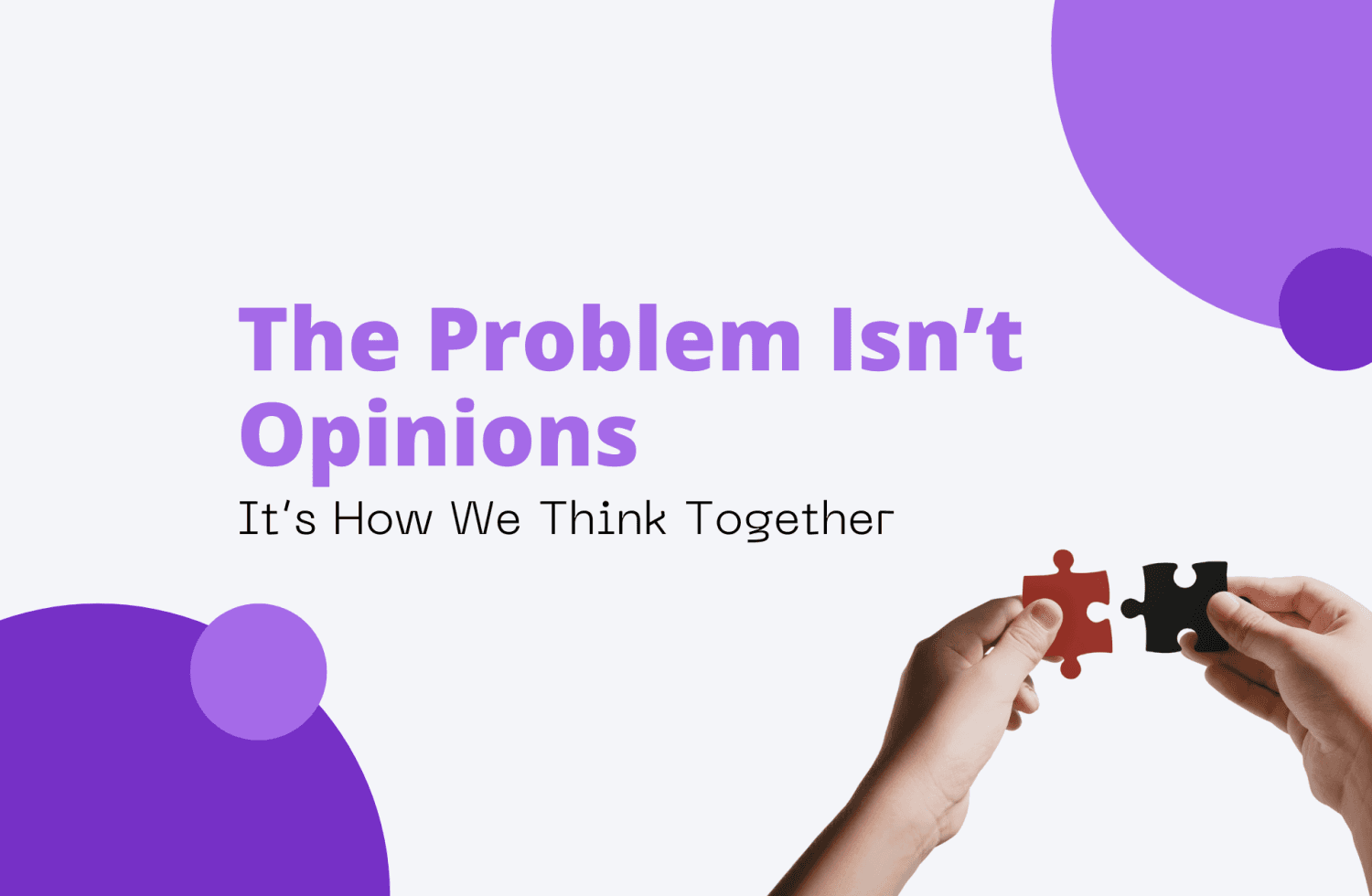
When Everyone Talks At Once, Nothing Moves
Most leaders say they want a team full of opinions.
Until they actually have one.
Then the meeting begins.
One person brings data.
Another shares a concern.
Someone jumps in with an idea.
Someone else immediately points out risks.
Before long, the room feels loud.
Facts mix with fear.
Ideas get buried by doubts.
Feelings collide with logic.
And the strange thing is this:
Everyone is trying to help.
But the conversation becomes tangled because every type of thinking is happening at the same time.
Debate grows.
Progress slows.
The issue is rarely the intelligence of the team.
The issue is structure.
That’s why the 6 Thinking Hats Method, developed by Dr. Edward de Bono, remains one of the most practical tools for group decision-making.
It doesn’t try to eliminate opinions.
It organizes them.
Instead of arguing about what to think, the team takes turns deciding how to think.
And that one shift changes everything.
Why Most Team Discussions Break Down
Before looking at the hats themselves, it helps to understand why many team conversations fail.
In most meetings, different thinking styles collide instantly.
One person is focused on facts.
Another is worried about risk.
Someone else is excited about potential.
All three perspectives are valid.
But because they arrive simultaneously, they compete instead of building on each other.
One person says, “Here’s the opportunity.”
Another responds, “That could fail.”
A third adds, “But the numbers look good.”
Now the room is reacting instead of progressing.
Teachable Moment:
The problem is not disagreement.
The problem is mixed thinking modes.
When you separate the modes, teams move faster and conflict becomes productive instead of chaotic.
That’s exactly what the six hats are designed to do.
The Six Thinking Hats
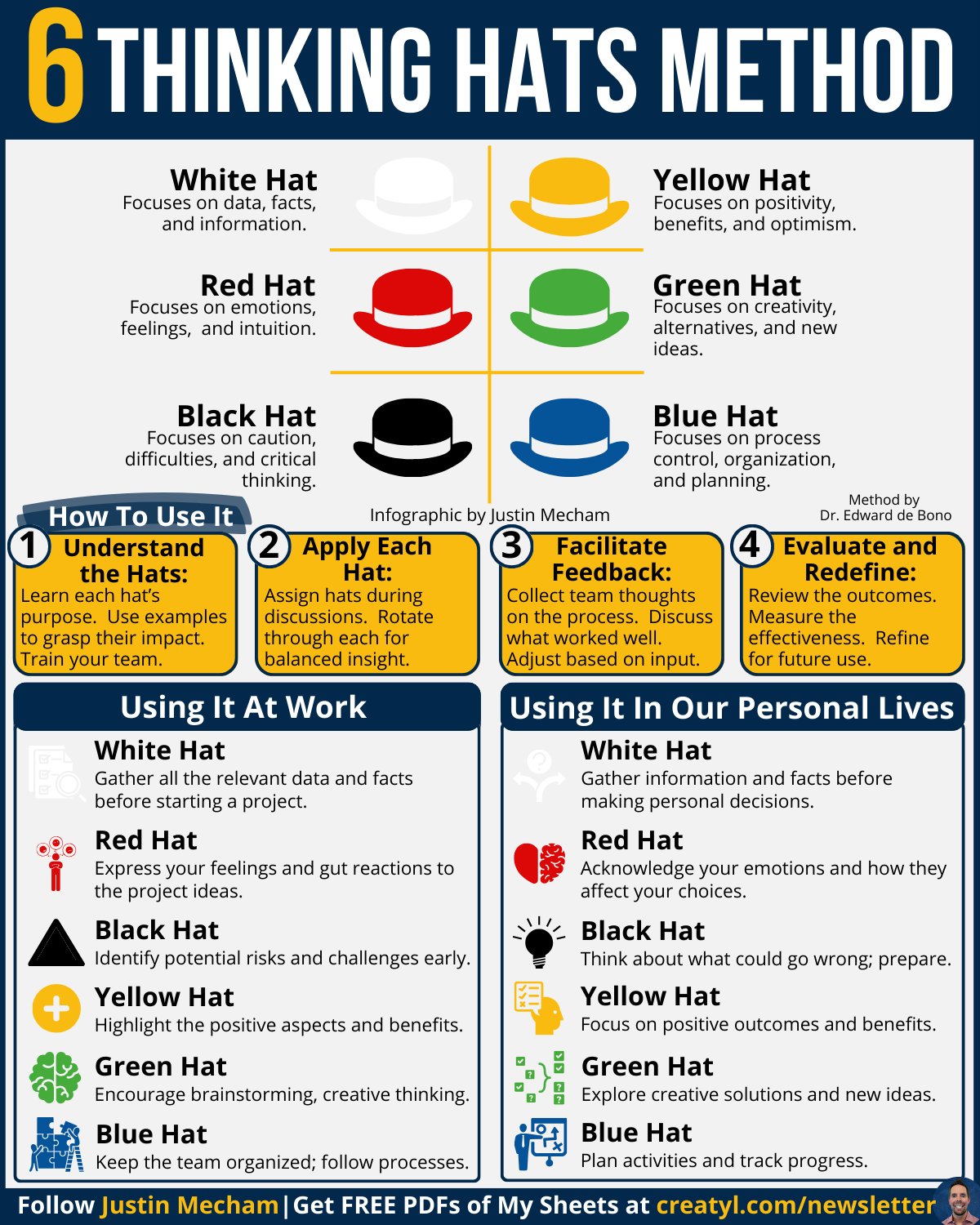
The method assigns a different “hat” to represent a different thinking style.
When a team wears the same hat together, everyone approaches the discussion from the same perspective.
This removes defensive debate and creates structured insight.
Let’s look at how each hat works in practice.
The White Hat
Start With Facts
The white hat focuses on information.
This is where the conversation begins.
Questions asked during this stage include:
What do we know?
What data supports this idea?
What information is missing?
No opinions. No reactions.
Just facts.
Teachable Moment:
Many meetings skip this step and move directly into debate.
When the facts aren’t clear, discussions quickly become emotional or speculative.
Action Strategy:
Before discussing a project or decision, gather:
- Relevant data
- Metrics
- Historical results
- Known constraints
Clarity begins with shared information.
The Red Hat
Acknowledge Emotions
The red hat allows emotions to be expressed without justification.
This might sound unusual in a professional setting, but it serves an important purpose.
Feelings influence decisions whether we acknowledge them or not.
Instead of pretending they don’t exist, the red hat brings them into the open.
Participants might say:
“This idea makes me uneasy.”
“I feel excited about the potential.”
“I’m skeptical.”
No explanation required.
Teachable Moment:
When emotions stay hidden, they often appear later as resistance.
When they are acknowledged early, they lose their power to disrupt the process.
Action Strategy:
Allow team members to briefly share gut reactions before analysis begins.
This clears the emotional layer so logic can follow.
The Black Hat
Identify Risks Early
The black hat represents caution.
This is where the team intentionally looks for problems.
Questions include:
What could go wrong?
What risks exist?
Where are the weak points?
Some leaders avoid this stage because they worry it will discourage creativity.
But the opposite is true.
When risks are explored intentionally, they stop appearing as sudden objections later.
Teachable Moment:
Risk analysis strengthens ideas.
It does not weaken them.
Action Strategy:
Encourage constructive criticism.
Focus on improving the idea rather than dismissing it.
The Yellow Hat
See The Opportunity
Where the black hat finds risk, the yellow hat looks for value.
This stage asks:
Why could this work?
What benefits might come from it?
Where is the upside?
Teams often underestimate the importance of deliberate optimism.
If a conversation spends too much time on risk, innovation stalls.
Teachable Moment:
Balanced thinking requires both caution and optimism.
Action Strategy:
After identifying risks, intentionally explore potential benefits.
Many ideas improve dramatically during this phase.
The Green Hat
Create New Possibilities
The green hat is where creativity expands.
Participants explore alternatives, improvements, and fresh approaches.
Questions include:
What other ways could we solve this?
What variation might work better?
What new idea builds on this one?
This stage encourages experimentation.
Even unusual suggestions are welcomed.
Teachable Moment:
Innovation rarely appears during criticism.
It appears when creativity is intentionally invited.
Action Strategy:
Use brainstorming techniques.
Encourage quantity of ideas before evaluating quality.
The Blue Hat
Guide The Process
The blue hat manages the discussion itself.
It is responsible for structure, timing, and decisions.
The person wearing the blue hat asks:
What stage are we in?
What hat should we wear next?
What conclusion are we reaching?
Without this role, conversations drift.
With it, meetings become purposeful.
Teachable Moment:
Clear thinking requires clear facilitation.
Action Strategy:
Assign a facilitator during important discussions to guide the hat sequence.
How To Use The Method In Real Meetings
The process can follow a simple order:
- White Hat — gather facts
- Red Hat — share reactions
- Black Hat — identify risks
- Yellow Hat — explore benefits
- Green Hat — generate ideas
- Blue Hat — organize decisions
This sequence keeps discussions balanced.
Teams move from understanding to evaluation to creativity to decision.
Instead of debating endlessly, they progress step by step.
A Real Workplace Example
Turning A Chaotic Meeting Into A Clear Decision
I once worked with a leadership team trying to decide whether to launch a new service offering.
Meetings about the topic were frustrating.
One person kept bringing data.
Another was worried about risk.
Someone else was enthusiastic about the opportunity.
Every meeting ended the same way.
No decision.
The issue wasn’t the idea.
It was the conversation.
Each person approached the discussion from a different perspective at the same time.
Optimism triggered skepticism.
Skepticism triggered defensiveness.
The conversation spiraled.
We introduced the Six Thinking Hats method.
First, we started with the white hat.
Everyone reviewed the same data together.
Next came the red hat.
Each leader shared their instinctive reaction without debate.
Then the black hat.
Risks were listed openly.
After that, the yellow hat.
Benefits and opportunities were explored.
Finally, the green hat produced creative solutions that addressed earlier risks.
With the blue hat guiding the process, the team reached a decision within a single meeting.
The idea moved forward with stronger planning than before.
The difference was not intelligence.
It was structure.
What Made It Work
Small Process Changes With Big Results
Four key shifts made the method effective:
- Thinking styles were separated instead of competing.
- Every perspective had a defined moment.
- The conversation followed a clear sequence.
- A facilitator guided the process.
When thinking is structured, decision-making accelerates.
The Deeper Shift That Matters
Teams often assume disagreement is a problem.
In reality, disagreement is valuable.
It reveals risks.
It sparks creativity.
It improves outcomes.
What causes frustration is not disagreement.
It is unstructured disagreement.
The Six Thinking Hats method slows down the thinking process just enough to make decisions clearer.
When teams take turns thinking in the same direction, conversations become productive instead of chaotic.
And the surprising result is this:
By slowing down how we think, we move faster on what we decide.
Clarity Is A Team Skill
Great decisions rarely come from one brilliant idea.
They come from a group thinking clearly together.
That requires more than intelligence.
It requires discipline in how conversations happen.
When teams learn to separate facts from feelings, risks from opportunities, and creativity from evaluation, something powerful happens.
People feel heard.
Ideas improve.
Decisions gain confidence.
Leadership then shifts from controlling the conversation to guiding the thinking.
And when thinking becomes structured, the room becomes calmer, sharper, and more productive.
Not because opinions disappeared.
But because they were organized.
Best Resources For Structured Thinking And Decision Making
Book: Six Thinking Hats — Edward de Bono
Why It Fits: The foundational book explaining the method and its practical use.
Book: Thinking, Fast and Slow — Daniel Kahneman
Why It Fits: A deep exploration of how human thinking works and how biases affect decisions.
Podcast: The Knowledge Project — Shane Parrish
Why It Fits: Conversations on mental models and decision-making strategies.
TED Talk: How Great Leaders Inspire Action — Simon Sinek
Why It Fits: Explains how structured thinking and clarity influence decision-making.
Tool: Miro — Founded by Andrey Khusid
Why It Fits: A visual collaboration platform that helps teams structure brainstorming and decision-making.
AI Tool: ChatGPT — OpenAI
Why It Fits: Useful for generating ideas, analyzing risks, and organizing thinking during planning sessions.
Download The “6 Thinking Hats Method” Infographic (PDF)
If you want a clear visual guide to the Six Thinking Hats process, download the PDF version of the infographic.
Use it during team discussions to keep thinking organized and decisions focused.