

Click Here to Download the PDF.
The Real Problem Isn’t Your Calendar
Most people think they are bad at managing time.
They are not.
They are bad at deciding.
That is why the day feels full but nothing meaningful moves.
You start reacting.
Emails come in.
Messages pop up.
Meetings get added.
And before you know it, the day is gone.
Not because you were lazy.
Because you never decided what mattered before the noise showed up.
Teachable Moment:
Time does not control your day.
Decisions do.
Why Busy Feels Productive (But Isn’t)
Being busy gives a false sense of progress.
You check things off.
You respond quickly.
You stay active.
But activity is not progress.
Progress comes from doing the right things first.
Most people let the loudest task win.
The urgent email.
The quick request.
The easy task.
And the important work gets pushed back.
Again and again.
Teachable Moment:
If you do not choose your priorities, your environment will choose them for you.
The Shift That Changes Everything
Productive people do one thing differently.
They decide their day before it begins.
They do not wait to see what happens.
They define what matters.
Then they protect it.
That is where every method you have seen actually starts.
Not with tools.
With clarity.
When You Need Focus: Control Your Attention
Focus is not about trying harder.
It is about removing options.
The Pomodoro Technique works because it limits choice.
One task.
One timer.
No switching.
You give your brain a boundary.
And inside that boundary, it performs better.
Try this in real life:
Pick one task that matters.
Set a timer for 25 minutes.
Close everything else.
You will get more done in that window than in hours of scattered effort.
When Everything Feels Urgent: Filter What Matters
The biggest stress at work is not workload.
It is unclear priority.
The Eisenhower Matrix solves this by forcing a decision.
Is it important?
Is it urgent?
Then act accordingly.
Do.
Schedule.
Delegate.
Delete.
Most people skip the last one.
That is the mistake.
Teachable Moment:
You do not need to do more.
You need to remove what does not matter.
When Your List Feels Overwhelming: Rank Ruthlessly
A long list creates pressure.
Because everything feels equal.
The ABCDE Method fixes that.
You label tasks by importance.
A tasks matter most.
B tasks matter, but later.
C tasks are optional.
D tasks can be delegated.
E tasks can be removed.
Then you act on A first.
Always.
Teachable Moment:
Clarity removes overwhelm.
Not effort.
When Your Day Feels Scattered: Give It Structure
Some days feel messy because they are.
Too many types of work.
Too many switches.
The 3-3-3 Method brings structure.
Three hours on your biggest task.
Three smaller urgent tasks.
Three maintenance tasks.
Now your day has shape.
And shape creates momentum.
When Small Tasks Pile Up: Clear Them Fast
Tiny tasks are dangerous.
Not because they are hard.
Because they stack.
The 2-Minute Rule removes them quickly.
If it takes less than two minutes, do it now.
No delay.
No list.
Just done.
Teachable Moment:
Small delays create big mental load.
When You Are Busy But Not Moving: Focus on Impact
The 80/20 Method is simple.
A small part of your work drives most of your results.
Your job is to find it.
Then spend more time there.
Less on everything else.
This is where most people struggle.
Because low-impact work feels easier.
Teachable Moment:
Easy work is often low value.
Important work often feels harder.
When You Avoid Big Tasks: Do Them First
The “Eat the Frog” method works for one reason.
It removes avoidance.
You start with the hardest task.
So the rest of the day feels lighter.
And you stop carrying it in your head.
When Your Mind Feels Full: Get It Out
Mental overload kills focus.
That is where Getting Things Done helps.
Write everything down.
Then:
Clarify what it means
Organize it
Act on it
Your brain is for thinking.
Not storing.
When Teams Feel Stuck: Make Work Visible
A Kanban board solves confusion.
Three simple columns:
To do
Doing
Done
Now everyone sees progress.
And problems show up early.
When You Keep Switching Tasks: Group Your Work
Task switching drains energy.
Batching fixes that.
Group similar tasks.
Emails together.
Calls together.
Creative work together.
Your brain stays in one mode longer.
And produces better work.
When You Are Doing Too Much: Cut Your Focus
The Warren Buffett 5/25 Rule is simple.
Write 25 goals.
Circle the top 5.
Ignore the other 20 completely.
This is where most people fail.
They try to do everything.
And end up doing nothing well.
When Projects Feel Messy: Decide Scope Early
The MSCW Method forces clarity.
Must have
Should have
Could have
Will not have
Now expectations are clear.
And scope stays controlled.
When Your Day Gets Taken Over: Protect Your Time
Time blocking gives every hour a purpose.
Not just meetings.
Real work too.
And you treat those blocks seriously.
Because if you do not, someone else will fill them.
When Tasks Keep Slipping: Limit Your Daily Load
The 1-3-5 Method keeps things realistic.
One big task
Three medium tasks
Five small tasks
That is enough.
More than that becomes noise.
When Everything Feels Important: Prioritize the Big Moves
The Pickle Jar Method shows a simple truth.
Big tasks go first.
Small ones fill the gaps.
If you reverse it, the big work never happens.
A Real Workplace Example
From Constant Busyness to Real Output
A team was working long hours but falling behind.
Everyone was busy.
But key projects were delayed.
The issue was not effort.
It was decision overload.
Everything felt urgent.
People jumped between tasks.
Meetings interrupted deep work.
Small tasks stacked and created stress.
The team was active all day.
But not moving forward.
I stepped in and simplified their system.
We started with the Eisenhower Matrix to filter priorities.
Then introduced time blocking for focused work.
Each team member used the 1-3-5 method daily.
We also added the 2-minute rule to clear small tasks quickly.
Within weeks, output improved.
Not because they worked more.
Because they decided better.
Why Most People Never Fix This
Because they keep searching for the perfect method.
Instead of committing to one.
Every method works.
If you use it consistently.
But switching systems every week creates friction.
And friction kills progress.
Teachable Moment:
The best system is the one you actually use.
Your Day Reflects Your Decisions
Most people do not lose time.
They lose control of it.
Not in one big moment.
But in small decisions.
What to start.
What to delay.
What to ignore.
These choices shape your day.
And your days shape your results.
When you stop reacting and start deciding, everything changes.
You feel less rushed.
More focused.
More in control.
Not because your workload disappeared.
But because your direction became clear.
And when your direction is clear, your time finally starts working for you.
Best Resources to Master Time and Decision-Making
Book: Deep Work — Cal Newport
Why It Fits: Shows how focused work creates real output in a distracted world.
Book: Getting Things Done — David Allen
Why It Fits: Provides a complete system for organizing tasks and reducing mental load.
Podcast: The Tim Ferriss Show — Tim Ferriss
Why It Fits: Breaks down how high performers manage time and decisions.
TED Talk: Inside the Mind of a Master Procrastinator — Tim Urban
Why It Fits: Explains why we delay and how to change behavior.
Tool: Trello — Atlassian
Why It Fits: Simple Kanban-style tool to manage tasks visually.
AI Tool: ChatGPT — OpenAI
Why It Fits: Helps prioritize tasks, simplify decisions, and plan your day clearly.
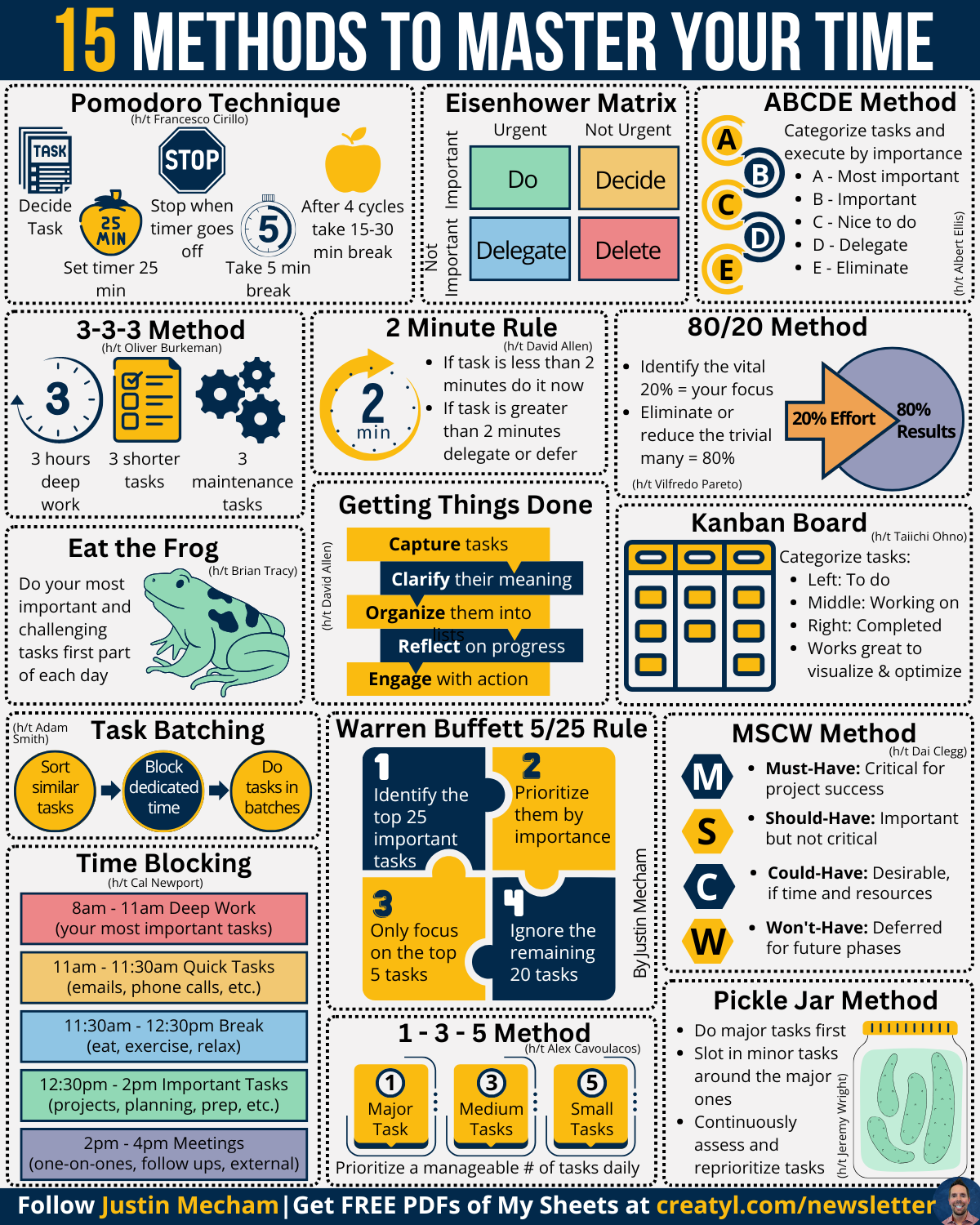
Download the “15 Methods to Master Your Time” Infographic (PDF)
If you want a simple, visual guide to help you decide better and use your time more effectively, download the infographic as a PDF.
Use it as a daily reference to choose the right method for your situation and stay consistent with what works.