

Click Here to Download the PDF.
Most Workplace Conflict Starts Long Before the Argument
Most workplace drama does not begin with someone yelling.
It does not begin with a massive betrayal, a public disagreement, or a dramatic confrontation in a meeting room.
It begins much earlier.
Usually in silence.
Usually inside someone’s head.
One unanswered message.
One missed meeting.
One strange tone.
One short reply.
And suddenly the brain starts building a story.
“They do not respect me.”
“They are ignoring me.”
“They must not care.”
“They are trying to make me look bad.”
The dangerous part is not that the brain creates stories.
That is normal.
The dangerous part is how quickly those stories begin feeling true.
And once a story feels true emotionally, people stop checking whether it is actually accurate.
That is how relationships quietly fracture inside teams.
Not because people are evil.
But because human beings are meaning-making machines.
The brain hates uncertainty.
So whenever there is a gap in information, it rushes to fill it.
Fast.
Usually with fear, insecurity, past experiences, assumptions, or incomplete evidence.
And then people react to those assumptions as if they are facts.
That is where trust begins breaking down.
Not from reality.
From interpretation.
Your Brain Is Not Recording Reality
It Is Interpreting It
One of the biggest misconceptions people have about communication is believing they experience situations objectively.
Most people do not.
They experience situations emotionally filtered through:
- past experiences
- stress
- insecurity
- assumptions
- fears
- expectations
- emotional triggers
- previous disappointments
That means two people can experience the exact same interaction and leave with completely different conclusions.
One person hears:
“They were busy.”
The other hears:
“They do not value me.”
Same event.
Different interpretation.
This matters deeply in workplaces because modern work environments are filled with incomplete information:
- short Slack messages
- delayed emails
- missed meetings
- virtual communication
- rushed conversations
- pressure
- deadlines
- unclear tone
The brain automatically tries to complete the missing context.
And unfortunately, stressed brains rarely fill gaps positively.
They fill them defensively.
That defensive storytelling creates most unnecessary tension inside organizations.
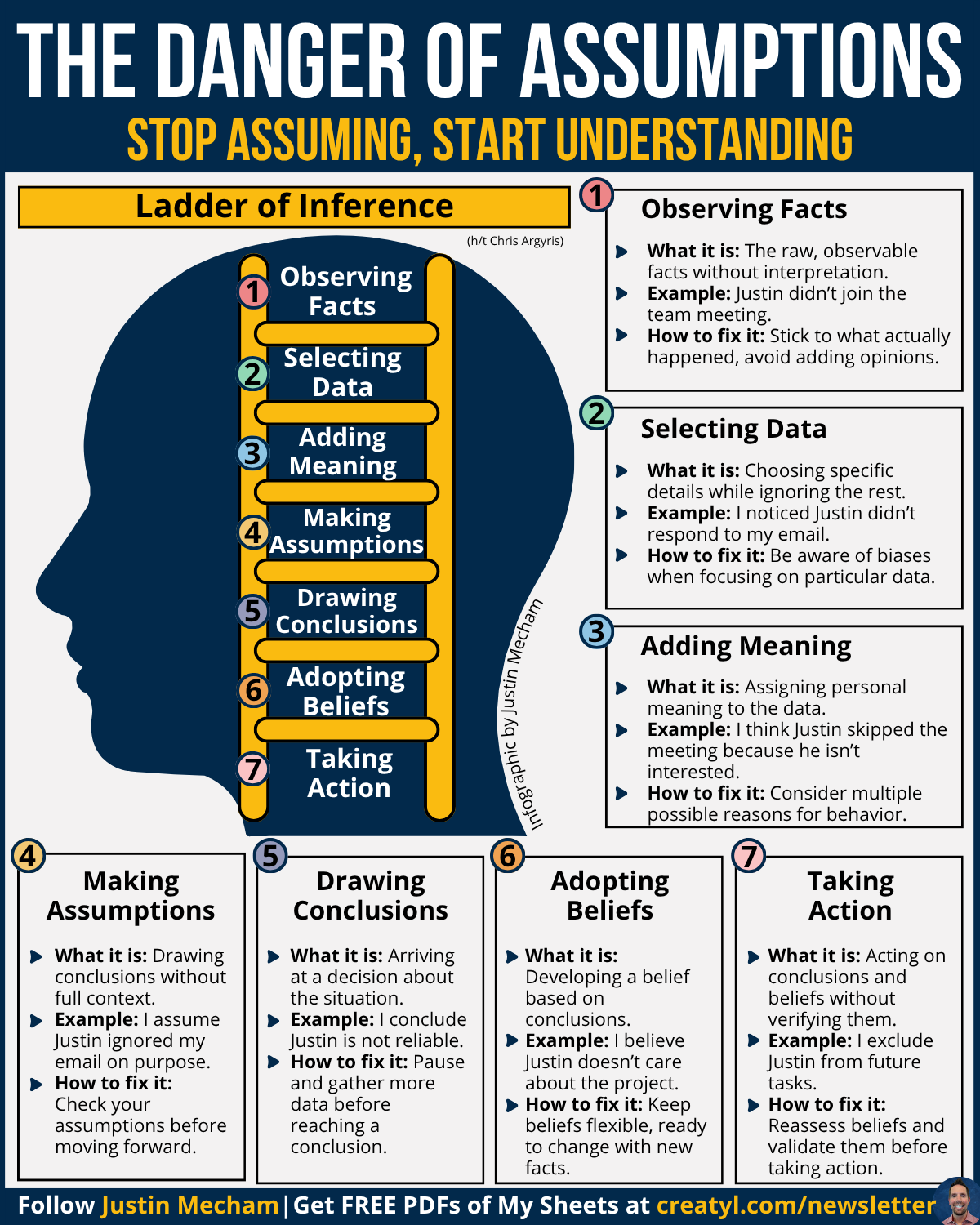
The Ladder of Inference
The Seven-Step Process Your Mind Climbs Automatically
The “Ladder of Inference,” originally developed by organizational theorist Chris Argyris, explains how people move from facts to emotional conclusions incredibly quickly.
Understanding this model changes the way people communicate forever.
Because once you see it happening, you begin catching your assumptions before they become conflict.
Let’s walk through it carefully.
Step 1: Observing the Facts
This is the raw event.
No interpretation.
No emotional spin.
No added meaning.
Just observable reality.
For example:
- Someone did not respond to your message.
- A coworker skipped a meeting.
- Your manager sounded brief during a conversation.
That is all you actually know.
But most people do not stay here very long.
The brain immediately starts climbing upward.
Step 2: Selecting the Data
Now the mind zooms in selectively.
It notices certain details while ignoring others.
For example:
- “They saw my message but did not answer.”
- “They looked annoyed.”
- “They interrupted me once.”
At the same time, the brain often ignores:
- they may have been overwhelmed
- they may have had another emergency
- they may not have processed the message fully
- they may have been distracted
- they may communicate differently under stress
This selective attention is incredibly human.
But it creates risk because people rarely realize how incomplete their mental picture actually is.
Step 3: Adding Meaning
Now the story begins.
The brain starts assigning emotional meaning to neutral facts.
“They skipped the meeting because they do not care.”
“They ignored my message on purpose.”
“They sounded short because they are upset with me.”
This is where emotions start attaching themselves to interpretation.
And once emotion enters the picture, objectivity becomes much harder.
Step 4: Making Assumptions
At this stage, guesses quietly become “truth.”
The brain fills in missing information automatically.
Without asking questions.
Without gathering evidence.
Without clarifying.
People begin assuming:
- intent
- motivation
- character
- emotional state
- loyalty
- respect level
All from incomplete information.
And because the assumptions feel emotionally convincing, people stop questioning them.
That is where misunderstandings accelerate.
Step 5: Drawing Conclusions
Now the brain labels the person.
“They are unreliable.”
“They are difficult.”
“They do not care.”
“They are disrespectful.”
“They are checked out.”
One moment becomes an identity judgment.
This is incredibly dangerous inside teams because labels influence future interactions.
Once someone is mentally labeled negatively, every future behavior becomes filtered through that belief.
Step 6: Adopting the Belief
At this point, the conclusion hardens into a lasting internal belief.
Now the story becomes:
“This is just who they are.”
That belief affects:
- trust
- communication
- collaboration
- openness
- willingness to include them
- future opportunities
And the original situation may have been nothing more than a missed email.
Step 7: Taking Action
Now behavior changes.
People:
- avoid conversations
- stop collaborating
- exclude others from projects
- withdraw trust
- become defensive
- communicate less openly
- distance themselves emotionally
And the other person often has no idea why.
The entire relationship changes because of a story that was never verified.
That is the real danger of assumptions.
Why Assumptions Feel So Real
Assumptions feel true because the brain prioritizes emotional certainty over uncertainty.
Uncertainty feels uncomfortable.
The mind wants resolution quickly.
So instead of waiting for facts, it creates explanations.
Unfortunately, the explanations people create are often influenced more by emotional history than current reality.
For example:
- Someone with past rejection may interpret silence as abandonment.
- Someone with trust issues may interpret delays as dishonesty.
- Someone under stress may interpret neutral behavior as criticism.
This is why emotionally mature people learn to separate:
- facts from
- interpretation
That skill changes leadership, teamwork, communication, and relationships completely.
A Real Workplace Example
How One Assumption Quietly Damaged Team Trust
A project manager noticed a senior employee becoming quieter during meetings and responding more slowly to messages.
The manager immediately assumed disengagement.
Internally, the story became:
“They are losing motivation.”
“They are not committed anymore.”
Without discussing it directly, the manager slowly stopped assigning that employee visible opportunities.
The employee noticed the shift quickly.
They felt excluded and undervalued.
What the manager did not know was that the employee had been quietly caring for a sick parent while managing a heavy workload privately.
The reduced communication had nothing to do with disengagement.
But because no clarifying conversation happened early, tension grew silently on both sides.
Trust weakened.
Performance conversations became awkward.
The employee eventually considered leaving the company.
Finally, a direct conversation happened.
Instead of leading with assumptions, the manager asked:
“I’ve noticed a few changes recently and wanted to check in before I make any assumptions. How are things going on your side?”
That single question changed everything.
The employee explained their situation honestly.
Together they adjusted workloads temporarily, clarified expectations, and rebuilt trust.
The breakthrough came not from a better strategy.
But from replacing assumptions with curiosity.
Why Curiosity Is One of the Most Underrated Leadership Skills
Strong leaders do not assume faster.
They ask better questions sooner.
That changes team culture completely.
Curious leaders:
- seek context before reacting
- clarify before judging
- ask instead of accuse
- separate emotion from evidence
- stay flexible when new information appears
Weak leadership often comes from rigid certainty.
Healthy leadership comes from intellectual humility.
The ability to say:
“I may not have the full picture yet.”
That sentence prevents enormous damage.
The 10-Second Reset Before You React
Before responding emotionally to a situation, pause and ask:
1. What actually happened?
Only facts.
No interpretation.
2. What story am I adding?
Identify the narrative forming in your mind.
3. What evidence do I actually have?
Not feelings.
Not guesses.
Actual evidence.
4. What else could be true?
Force the brain to consider alternative explanations.
5. What question should I ask before deciding?
Curiosity prevents unnecessary conflict.
This process sounds simple.
But emotionally regulated people practice it constantly.
Why Teams With High Trust Assume Less Negatively
Healthy teams still experience misunderstandings.
The difference is how they handle them.
Low-trust teams:
- personalize quickly
- avoid clarification
- gossip
- build stories silently
- interpret mistakes negatively
High-trust teams:
- ask directly
- clarify intentions
- assume positive intent first
- correct misunderstandings quickly
- communicate openly
That is why trust compounds.
The more trust exists, the less emotional storytelling takes over.
Practical Communication Habits That Reduce Assumptions
Ask Clarifying Questions Early
Instead of:
“Why are they acting like this?”
Ask:
“Can you help me understand what happened here?”
Small wording changes reduce defensiveness immediately.
Separate Intent From Impact
Sometimes people create negative impact without negative intent.
Those are different things.
Emotionally mature communication addresses impact without assuming malicious intent automatically.
Slow Down Emotional Reactions
Fast emotional reactions often come from incomplete information.
Pausing allows perspective to return.
Stop Mind Reading
No matter how emotionally convincing your assumption feels, you still cannot read minds.
Most people are carrying pressures you know nothing about.
Update Your View When New Information Appears
Emotionally rigid people cling to assumptions even after new evidence appears.
Emotionally healthy people adapt.
That flexibility protects relationships.
The Cost of Assumptions in Leadership
Assumptions quietly damage:
- morale
- innovation
- collaboration
- trust
- retention
- communication
- psychological safety
Because when people feel constantly misunderstood, they stop communicating honestly.
And once honest communication disappears, team performance slowly collapses underneath the surface.
Many toxic workplaces are not built from evil leadership.
They are built from unchecked assumptions repeated over time.
Most Conflicts Are Not Caused by Facts Alone
Most workplace conflict does not start with terrible people.
It starts with incomplete information mixed with emotional interpretation.
A gap appears.
The brain fills it.
The story hardens.
The relationship changes.
All without a single honest conversation.
That is why emotional intelligence matters so much in leadership and communication.
Not because emotionally intelligent people never assume.
Everyone assumes.
The difference is that emotionally intelligent people catch the story before it becomes permanent truth.
They pause.
They question.
They clarify.
They stay open long enough to discover they may not have had the full picture.
And that single habit changes everything.
Because trust is not destroyed by mistakes alone.
It is often destroyed by the stories people invent about those mistakes before they ever ask a single honest question.
Resources to Go Deeper
Book Recommendation
The Five Dysfunctions of a Team by Patrick Lencioni
An excellent exploration of trust, communication, accountability, and the hidden thinking patterns that damage team culture.
TED Talk Recommendation
Celeste Headlee – 10 Ways to Have a Better Conversation
A practical and thoughtful talk about listening, assumptions, communication habits, and human connection.
Podcast Recommendation
The Knowledge Project with Shane Parrish
Excellent conversations around decision-making, mental models, cognitive bias, and clearer thinking.
Reflection Exercise
The next time you feel emotionally triggered at work, write down:
- The raw fact
- The story your brain created
- Three alternative explanations
- One question you could ask instead of assuming
- One calmer response available to you
That practice alone can dramatically improve communication over time.
Download the “Danger of Assumptions” Infographic PDF
Use this infographic as a reminder to slow down your thinking, question your assumptions, and protect trust before stories become conflict.