

Click Here to Download the PDF.
The Problem Most Teams Never Say Out Loud
Most teams do not fall apart in obvious ways.
There is no big moment.
No single failure.
No clear breaking point.
Instead, things slowly drift.
Deadlines slip.
Meetings feel empty.
People stop speaking up.
And eventually, results fade.
It is easy to blame effort.
Or skill.
Or even the market.
But in almost every case, the real issue is deeper.
It is trust.
Not just trust as a feeling.
Trust as a system.
Why Talent Alone Never Builds a Strong Team
You can have a room full of smart people.
Experienced people.
Motivated people.
And still get poor results.
Because talent does not fix confusion.
It does not fix silence.
It does not fix avoidance.
Without trust, even the best people start to hold back.
They protect themselves instead of the work.
They stay quiet instead of being honest.
They do just enough instead of taking ownership.
Teachable Moment:
A team is not measured by who is on it.
It is measured by how they work together when things get hard.
The Hidden Chain Reaction That Breaks Teams
Most leaders try to fix what they can see.
Missed deadlines.
Low performance.
Lack of engagement.
But those are symptoms.
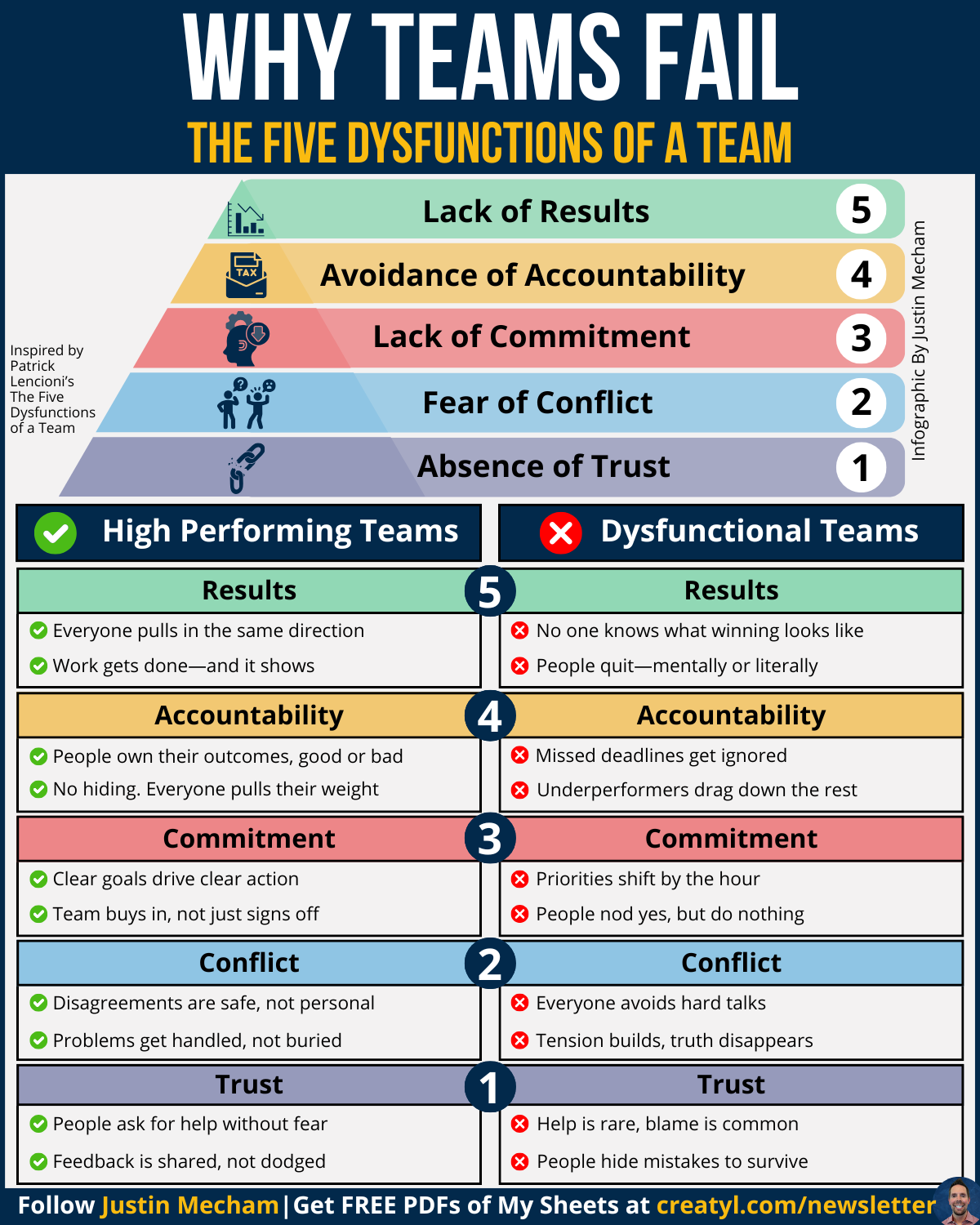
The real breakdown follows a pattern.
It starts at the bottom.
And builds upward.
1. Absence of Trust
This is where everything begins.
When trust is low:
People hide mistakes.
They avoid asking for help.
They protect their image.
The team looks fine on the surface.
But underneath, it is fragile.
Teachable Moment:
If people cannot be honest, nothing else can be fixed.
2. Fear of Conflict
When trust is missing, people avoid hard conversations.
They stay polite.
They agree in meetings.
But disagree in private.
Real issues never get addressed.
They get delayed.
Or buried.
Teachable Moment:
Silence in a team is not peace.
It is pressure building.
3. Lack of Commitment
Without open discussion, decisions feel unclear.
People nod yes.
But leave unsure.
So execution suffers.
Priorities shift.
Work stalls.
Teachable Moment:
People do not commit to what they do not fully understand or believe in.
4. Avoidance of Accountability
When commitment is weak, accountability disappears.
Deadlines slip.
Standards drop.
And no one calls it out.
Because no one feels ownership.
Teachable Moment:
Accountability is not about pressure.
It is about shared standards.
5. Lack of Results
At the top, results fade.
Not because people do not care.
But because everything below it is unstable.
And without clear results, the cycle repeats.
People disengage.
Or leave.
Teachable Moment:
Results are not the starting point.
They are the outcome of everything below them working.
What High-Performing Teams Do Differently
Strong teams are not perfect.
They are clear.
They do a few things consistently.
They build trust early.
They speak openly, even when it is uncomfortable.
They commit to clear goals.
They hold each other to standards.
And they track results that matter.
This creates momentum.
And momentum builds confidence.
Step-by-Step: Turning a Struggling Team Into a Strong One
This is where most leaders get it wrong.
They try to fix everything at once.
But real change happens in order.
Step 1: Rebuild Trust First
Start small.
Admit what is not working.
Encourage honesty.
Model it yourself.
If leaders are not open, the team will not be either.
Practical Actions:
Share one mistake and what you learned
Ask for input and actually listen
Reward honesty, not perfection
Step 2: Create Space for Real Conversations
Do not wait for conflict.
Invite it.
Make it safe to disagree.
Focus on the issue, not the person.
Practical Actions:
Ask: “What are we not saying right now?”
Let different views be heard fully
Close discussions with clear takeaways
Step 3: Make Decisions Clear
Every meeting should end with clarity.
Who owns what.
What success looks like.
When it is due.
No assumptions.
Practical Actions:
Write down decisions
Repeat them before ending the meeting
Confirm understanding
Step 4: Set Clear Accountability
Accountability should not feel like pressure.
It should feel expected.
Everyone knows what they own.
And everyone follows through.
Practical Actions:
Set visible goals
Track progress weekly
Address missed work quickly and directly
Step 5: Define and Track Real Results
If people do not know what winning looks like, they guess.
And guessing leads to inconsistency.
Make results visible.
Make them simple.
Make them shared.
Practical Actions:
Define 2–3 key outcomes
Review them regularly
Celebrate progress openly
A Real Workplace Example
From Silent Tension to a Team That Delivered Again
A team was missing deadlines and struggling to align.
On paper, everything looked fine.
But meetings were quiet.
Feedback was limited.
And results were slipping.
The issue was not effort.
It was avoidance.
People did not trust each other enough to speak honestly.
So problems were delayed.
Decisions were unclear.
And accountability was inconsistent.
Over time, frustration built.
But no one addressed it directly.
I stepped in and focused on trust first.
We started with open conversations.
Each team member shared what was not working.
Without blame.
Then we created space for real discussion.
Not rushed meetings.
Actual dialogue.
Next, we defined clear ownership for every project.
No overlap. No confusion.
We introduced simple weekly check-ins focused on progress and blockers.
Within weeks, the tone shifted.
People spoke up more.
Decisions became clearer.
Deadlines improved.
Not because the team changed.
Because the system did.
Why Most Teams Stay Stuck
Because they try to fix the top.
Results.
Performance.
Output.
But ignore the base.
Trust.
Without fixing the base, nothing holds.
And every improvement is temporary.
Trust Is Built in Small Moments, Not Big Efforts
Most teams are not broken.
They are misaligned.
Not because people do not care.
But because they do not feel safe enough to be honest.
Trust is not built in big speeches.
It is built in everyday moments.
When someone admits a mistake and is supported.
When someone speaks up and is heard.
When a leader listens instead of reacting.
These moments seem small.
But they change how people show up.
And how people show up changes everything.
Because when trust is real, people stop protecting themselves.
And start improving the work.
That is when teams move forward.
Not perfectly.
But consistently.
And that is what creates results that last.
Best Resources to Build Strong, High-Trust Teams
Book: The Five Dysfunctions of a Team — Patrick Lencioni
Why It Fits: Breaks down the exact structure of team failure and how to fix it.
Book: Leaders Eat Last — Simon Sinek
Why It Fits: Explains how trust and safety drive team performance.
Podcast: WorkLife — Adam Grant
Why It Fits: Explores how teams function and how to improve them in real settings.
TED Talk: How to Build (and Rebuild) Trust — Frances Frei
Why It Fits: Gives a clear framework for rebuilding trust in teams.
Tool: 15Five — David Hassell
Why It Fits: Helps teams track progress, feedback, and accountability in a simple way.
AI Tool: ChatGPT — OpenAI
Why It Fits: Helps leaders structure communication, clarify decisions, and improve team alignment.
Download the “Why Teams Fail” Infographic (PDF)
If you want a clear, visual breakdown of how teams break down and how to rebuild them step by step, download the infographic as a PDF.
Use it as a simple guide to strengthen trust, improve accountability, and create real results inside your team.