

Click Here to Download the PDF
Most teams don’t fall apart because people disagree.
They fall apart because people don’t know how to disagree.
Conflict is often treated like something to smooth over, shut down, or avoid entirely.
Many leaders believe harmony means everyone getting along, staying polite, and keeping things comfortable.
But comfort is not the same as trust.
In fact, some of the most damaged teams I’ve worked with looked calm on the surface.
Meetings were quiet. Feedback was careful.
No one raised their voice.
Underneath, resentment was building.
That’s the danger of misunderstanding conflict.
When it’s avoided or mishandled, it doesn’t disappear.
It just goes underground.
Why Conflict Feels So Risky at Work
Conflict feels personal, even when it isn’t meant to be.
People worry about how they’ll be perceived.
They worry about saying the wrong thing.
They worry about damaging relationships or their reputation.
So they stay quiet.
Or they soften their point so much it loses meaning.
Or they vent later instead of speaking directly.
Over time, teams stop addressing real issues.
Problems stay unresolved.
Tension leaks out in side comments, passive resistance, or sudden blowups that seem to come out of nowhere.
When conflict isn’t handled well, it teaches people one thing very clearly: it’s safer not to speak.
The Difference Between Productive Tension and Destructive Conflict
Not all conflict is equal.
Some conflict sharpens thinking.
Some conflict leads to better decisions.
Some conflict strengthens trust because people feel heard.
Other conflict does the opposite.
It turns discussions into power struggles.
It shifts focus from the issue to the person.
It leaves emotional residue that doesn’t disappear after the meeting ends.
The difference isn’t volume or passion.
It’s intention and behavior.
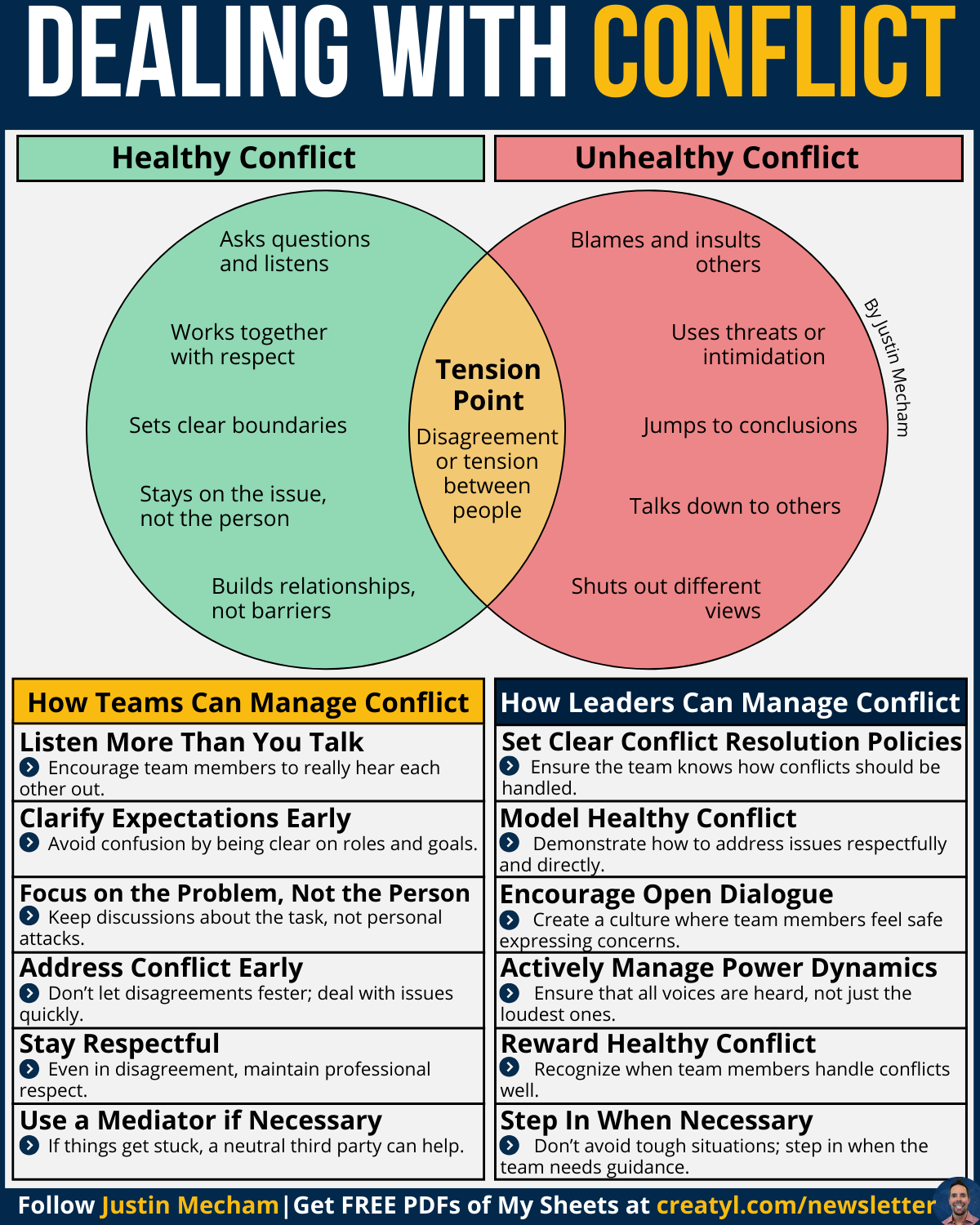
Healthy conflict stays rooted in respect, even when opinions differ.
Unhealthy conflict centers on winning, blaming, or shutting others down.
And once a team slips into unhealthy patterns, it becomes harder to pull back without deliberate effort.
How Unhealthy Conflict Quietly Damages Teams
Unhealthy conflict rarely announces itself as “toxic.”
It shows up as sarcasm.
As eye rolls.
As people jumping to conclusions instead of asking questions.
Feedback turns into judgment.
Disagreement turns into personal critique.
People stop sharing ideas that feel risky or unfinished.
Eventually, the loudest voices dominate while others disengage.
Decisions may still get made, but they’re weaker because they don’t reflect the full thinking of the group.
The cost isn’t just emotional. It’s strategic.
Teams miss blind spots.
Problems repeat.
Innovation slows.
And trust erodes one interaction at a time.
What Healthy Conflict Actually Looks Like in Practice
Healthy conflict doesn’t mean constant debate or friction.
It means people feel safe enough to challenge ideas without attacking each other.
Questions are asked instead of assumptions made.
Listening happens before responding.
Boundaries are clear, and respect stays intact.
People stay focused on the problem, not the person.
Disagreement becomes a way to get closer to the truth, not further from each other.
This kind of conflict doesn’t leave scars. It leaves clarity.
A Real Consulting Moment: When Silence Was the Warning Sign
I once worked with a team that prided itself on being “easy to work with.”
Meetings were calm.
No one argued.
Decisions were quick because no one pushed back.
At first glance, it looked healthy.
But performance was slipping. The same issues kept resurfacing.
And in one-on-one conversations, people admitted they didn’t feel heard.
They weren’t avoiding conflict because they didn’t care.
They were avoiding it because they didn’t feel safe.
The fix wasn’t encouraging more debate for the sake of debate.
It was teaching the team how to disagree without making it personal.
We set clear expectations around discussion.
We practiced asking questions instead of making assumptions.
We made it normal for leaders to invite opposing views instead of shutting them down.
Slowly, people spoke up.
And as they did, trust began to rebuild.
What Teams Can Do When Conflict Starts to Rise
Teams don’t need complex frameworks to manage conflict better.
They need clarity and consistency.
Listening matters more than reacting.
Clear roles reduce unnecessary friction.
Addressing issues early prevents them from growing teeth.
When discussions stall or emotions run high, bringing in a neutral voice can help reset the conversation.
Not to take sides, but to refocus the group on the shared goal.
The key is treating conflict as something to work through, not something to avoid.
What Leaders Must Do When Conflict Gets Hard
Leaders set the tone, whether they intend to or not.
When leaders avoid conflict, teams learn to avoid it too.
When leaders shut down disagreement, teams stop contributing.
When leaders model calm, respectful challenge, teams follow.
Keeping dialogue open isn’t about being permissive. It’s about being present.
Stepping in when conversations turn personal.
Making sure quieter voices are heard.
Showing, through action, that respect is non-negotiable.
What leaders allow doesn’t just shape behavior. It becomes culture.
The Part Most People Miss About Conflict
Conflict isn’t a sign that something is wrong.
It’s a signal that something matters.
Avoiding it doesn’t protect relationships. It weakens them.
Mishandling it doesn’t make problems go away. It delays them.
Teams that learn how to handle conflict well don’t have less tension.
They have clearer resolution.
And that makes all the difference.
Conflict Is a Skill, Not a Personality Trait
And Skills Can Be Learned
Some people are labeled “good with conflict,” and others aren’t.
That label is misleading.
Handling conflict well isn’t about being tough, loud, or confident.
It’s about staying grounded when things feel uncomfortable.
It’s about choosing curiosity over defense.
Clarity over control.
Respect over ego.
When teams learn this, conflict stops feeling like a threat.
It becomes part of how trust is built and maintained.
Not because everyone agrees.
But because everyone knows how to disagree without tearing the team apart.
Download the Conflict Worksheet That Inspired This Article (PDF)
The worksheet that inspired this article is available as a one-page PDF you can use with your team.
It helps groups recognize the difference between healthy and unhealthy conflict and gives them a shared language for navigating tense moments.
Many teams use it before difficult conversations, during retrospectives, or as a reset when tension has been building.
You can download the PDF here:
When conflict is handled well, it stops being something to fear and starts becoming something useful.