

Most side hustles don’t fail because people give up.
They fail because the work becomes too heavy to carry alongside real life.
A full-time job already takes energy.
Family, health, and daily responsibilities take the rest.
When a side hustle demands more time, more tools, more meetings, and more pressure, it quietly becomes impossible to sustain.
The truth most people don’t hear enough is this:
A side hustle only works if it stays simple.
Not simple in idea.
Simple in execution.
The seven rules below exist to keep a side hustle light enough to survive real life, while still being strong enough to create real results.
Why Simplicity Is the Real Advantage
People often assume side hustles succeed because of hustle, sacrifice, or extreme schedules.
In reality, the side hustles that last are the ones that remove friction.
They reduce decisions.
They limit scope.
They protect energy.
Instead of trying to build something impressive, they build something workable.
That difference determines whether a side hustle becomes steady income—or another unfinished idea.
Rule 1: Go Solo, Go Quick
Speed matters more than scale at the beginning.
Going solo removes delays caused by coordination, approvals, and alignment.
It allows decisions to happen immediately, which keeps momentum alive.
Launching quickly also limits overthinking.
When the goal is to ship in seven days, unnecessary features fall away naturally.
How to apply this
Choose something you can sell fast, not something that needs months of setup.
Set a one-week deadline for page, price, and first buyers.
Skip partnerships and meetings early on.
Speed doesn’t mean careless.
It means focused.
Rule 2: Focus on One Person, Not Everyone
Trying to help everyone leads to vague offers that help no one.
Side hustles work best when they are built around one clear type of person with one clear problem.
This focus makes writing easier, decisions faster, and offers clearer.
How to apply this
Choose one buyer you understand well.
Listen to how they describe their problem and use those exact words.
Sell them a fix, not a list of features.
If it sounds like their own thoughts, they pay attention.
Rule 3: Build Loud, Not Later
Waiting until something feels ready often means waiting too long.
Building in public creates accountability and early feedback.
It also removes the pressure to be perfect.
When people see progress, they feel part of the process.
How to apply this
Share what you’re working on before it’s finished.
Ask who wants early access.
Let early responses shape the final version.
People don’t buy polished ideas.
They buy outcomes they helped shape.
Rule 4: Make It Fit Your Real Life
Many side hustles fail because they are built like full-time jobs.
Copying creators who work all day creates plans that don’t survive evenings, weekends, or low-energy days.
The goal isn’t intensity.
It’s consistency.
How to apply this
Build something you can work on when tired.
Protect small focus blocks instead of chasing long sessions.
Choose formats that don’t require constant attention.
Progress that fits real life always outlasts big plans that don’t.
Rule 5: Stay in Charge of the Work
A side hustle should add control, not remove it.
Saying yes to every idea, request, or suggestion adds weight quickly.
That weight leads to burnout.
How to apply this
Say no to anything that makes the work heavier.
Avoid trading your evenings for other people’s deadlines.
Keep the offer simple until it pays you.
Control reduces stress, which keeps the side hustle alive longer.
Rule 6: Sell the Outcome, Not the Features
People don’t buy effort.
They buy relief.
Long feature lists often distract from the real value of an offer.
How to apply this
Focus on the result your buyer wants.
Use one clear page with problem, promise, proof, and price.
Launch before perfecting details.
If the outcome is clear, features matter less.
Rule 7: Don’t Do Things Twice
Repeating work wastes limited time.
Side hustles grow through systems, not constant effort.
How to apply this
Write steps once and reuse them.
Automate emails, payments, and delivery where possible.
Add help only when the work feels heavy.
Systems protect energy better than pushing harder.
A Real Workplace Example: When Simplicity Saved the Side Hustle
Problem
They were working full-time while trying to build a side hustle at night.
At first, progress felt exciting.
But soon, the work started piling up.
They were juggling multiple offers, rewriting pages, testing tools, and responding to feedback from too many directions.
Evenings disappeared into unfinished tasks.
The side hustle began to feel like a second job.
Agitation
Over time, motivation dropped.
They skipped sessions because starting felt heavy.
They questioned whether the idea was worth the effort.
Progress slowed, not because of lack of interest, but because the setup demanded too much.
The more complex the side hustle became, the less likely it was to survive.
Solution
They simplified everything using the seven rules.
They chose one small offer and paused all others.
They focused on one clear buyer and rewrote the promise using that person’s words.
They shared progress early instead of waiting.
They protected short focus blocks that fit their evenings.
They said no to ideas that added work.
They simplified the sales page to highlight one outcome.
They automated delivery so nothing had to be repeated.
Within weeks, progress felt lighter.
Work sessions were shorter but more effective.
The side hustle stopped competing with real life.
Momentum returned because the work finally fit the time available.
Tools That Support Lightweight Side Hustles
- The Lean Startup by Eric Ries explains why small, fast experiments reduce wasted effort.
- Essentialism by Greg McKeown reinforces focusing on less to achieve more.
- Notion helps organize ideas and steps in one place.
- creatyl supports building, selling, and delivering offers without complex setup.
Final Thought: Simple Paths Last Longer Than Big Plans
Why Side Hustles Win When They Stay Light
Side hustles don’t fail because people aren’t committed.
They fail because the work becomes too heavy to carry alongside real life.
A simple path removes friction.
It reduces decisions.
It protects energy.
When you focus on one person, one offer, and one clear outcome, progress becomes manageable.
Simple wins move the fastest because they don’t ask for more than you can give.
And over time, that steadiness is what turns a side hustle into something real.
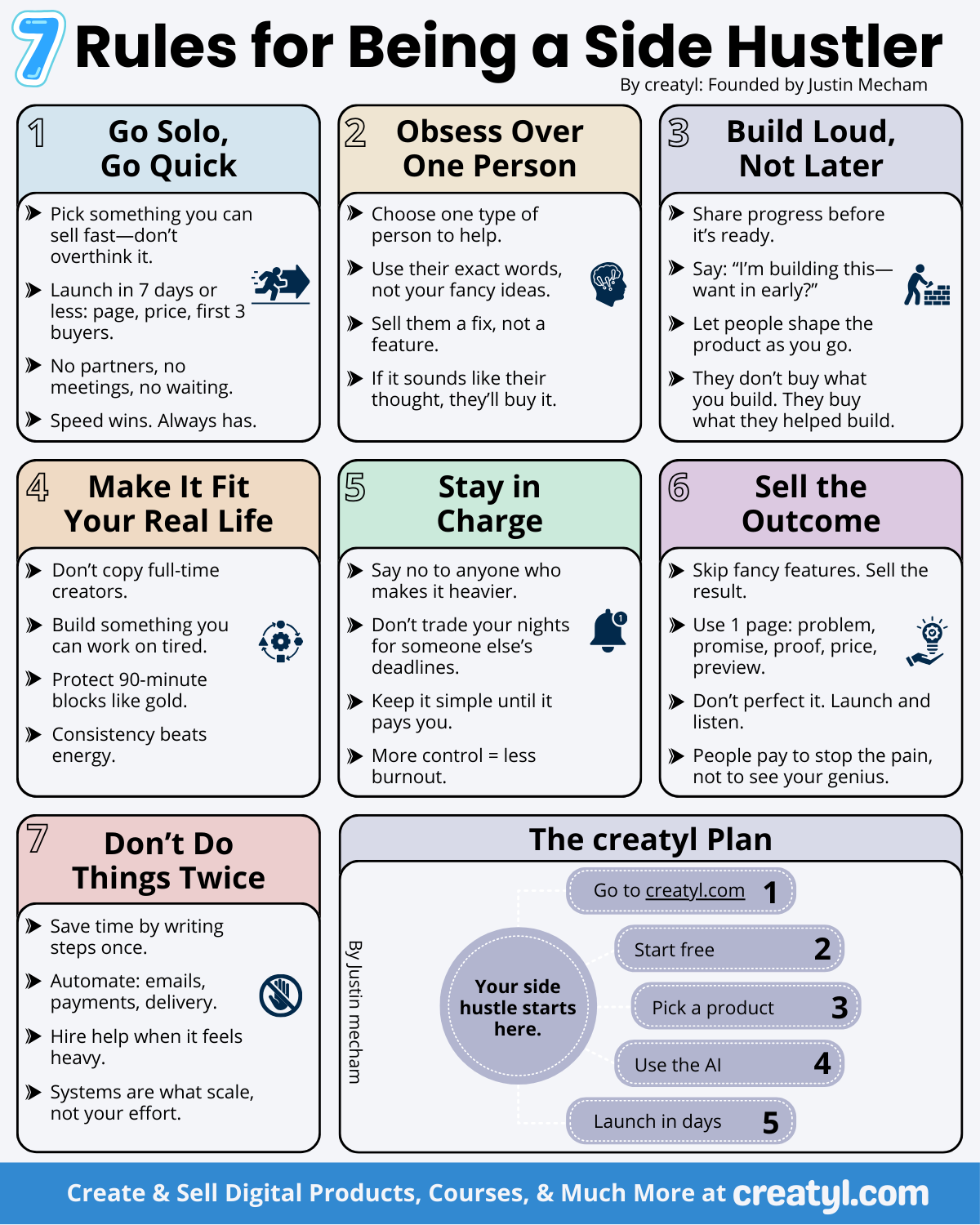
Download the “7 Rules for Being a Side Hustler” Infographic (PDF)
Some rules are easier to follow when you can see them clearly.
This infographic lays out the seven rules on one page, making it easier to stay focused on what matters and avoid adding unnecessary weight to your side hustle.
It’s a simple reference to return to whenever the work starts feeling heavier than it should.