

Click Here to Download the PDF.
Most people think they need a brand-new idea to start selling something online.
A fresh niche.
A clever hook.
A “perfect” course topic that feels impressive enough to charge for.
But that’s not what keeps people stuck.
What keeps people stuck is this quiet belief that their work doesn’t count.
That what they do every day is too normal.
Too obvious.
Too boring.
Too common.
They assume the only things worth teaching are the things that feel rare.
But the truth is, the most valuable courses are rarely built on rare knowledge.
They’re built on repeatable results.
They’re built on the systems you already use without thinking.
The steps you’ve done so many times you could explain them in your sleep.
The mistakes you’ve already learned how to avoid.
The shortcuts you’ve earned through real work, not theory.
That’s why this is so powerful:
You don’t need a brand-new idea.
You need to reuse what you already do.
Because your 9–5 is not just a job.
It’s a library of finished outcomes.
And those outcomes can become a course faster than most people realize.
This article is a deep breakdown of 10 weekend-ready course ideas hiding inside your workweek, along with real workplace examples, practical steps, and a clear way to ship without overthinking.
No perfection.
No long build.
No waiting.
Just a smarter way to use what you already have.
Why Most People Overcomplicate Course Creation
The biggest mistake new creators make is thinking a course has to be big.
They think it needs to be long.
They think it needs to cover everything.
They think it needs to feel like a university class.
So they start building a “complete” program, and two weeks later they burn out.
They don’t quit because they’re lazy.
They quit because they built something too heavy to carry.
A course does not need to be massive to be valuable.
In fact, most buyers prefer short courses.
They want a quick win.
They want clear steps.
They want something they can finish.
People are tired.
They’re busy.
They don’t want to feel like they bought homework.
They want progress.
That’s why the smartest course creators build something smaller first.
They build a weekend version.
Something simple enough to launch quickly, test demand, and improve later.
This is also why your 9–5 is such an advantage.
Because you’re not guessing.
You’re not inventing content.
You’re simply documenting what you already do.
And that is a completely different game.
The Real Secret: People Don’t Pay For Knowledge. They Pay For Relief.
This is the mindset shift that changes everything.
People don’t buy courses because they want information.
They buy because they want:
- to stop feeling confused
- to stop wasting time
- to stop making the same mistakes
- to stop feeling behind
- to finally get a result
They pay for the path.
Not the theory.
Not the background story.
Not the long explanation.
They pay for the “what to do next.”
So when you build your course, the goal isn’t to impress people with how much you know.
The goal is to make someone feel calmer after lesson one.
That’s how you build something people actually finish.
That’s how you build something people recommend.
That’s how your 9–5 becomes income.
10 Weekend-Ready Course Ideas Hiding In Your 9–5
Each of these ideas can become a short course with 4–6 lessons.
Not someday.
This weekend.
The key is picking one and keeping it small.
1) Turn Your 9–5 Into A How-To
Teach The Steps You Repeat At Work
Every job has repeatable processes.
Somebody sends an email.
A project starts.
A client gets onboarded.
A deadline gets set.
A problem shows up.
A solution happens.
And there’s usually one person who knows exactly what to do.
If that person is you, congratulations.
You already have a course.
The course isn’t “how to do your job.”
It’s “how to solve one part of your job that everyone struggles with.”
This could be:
- how you run meetings that don’t waste time
- how you write proposals that get approved
- how you manage projects without chaos
- how you organize tasks so nothing slips
- how you communicate bad news without drama
The course becomes valuable because it’s practical.
It’s not motivational.
It’s not vague.
It’s a repeatable system.
How To Build It Into A Course Fast
Lesson 1: What the process solves and who it’s for
Lesson 2: The exact steps in order
Lesson 3: The most common mistake and how to avoid it
Lesson 4: A checklist version people can reuse
Lesson 5: One real example walkthrough
Lesson 6: Troubleshooting problems people will hit
This type of course sells because it’s clear.
It’s a tool people can use immediately.
2) Teach Your First Big Win
Break Down One Real Success Into Copyable Steps
Most people have at least one “win” they’re proud of, but they don’t realize it can become a course.
They think, “That was just my job.”
Or, “I just got lucky.”
But wins are valuable because they contain proof.
A win means something worked.
And if something worked once, it can be explained, packaged, and repeated.
This is the perfect course idea for people who don’t know what to teach.
Because you don’t have to teach everything.
You teach one win.
The Simple Framework That Makes It Easy
Your course is basically:
Before: What the situation looked like
During: What steps you took
After: What changed and why it worked
That’s it.
People love before-and-after because it’s tangible.
It doesn’t feel like theory.
It feels like something they can follow.
3) Solve One Daily Pain
Teach The Problem People Keep Complaining About
If you want the easiest course idea, look for complaints.
Every workplace has repeating frustrations.
The same issue shows up every week.
People complain about it.
They joke about it.
They roll their eyes about it.
But nobody fixes it.
If you’ve ever solved one of those issues, that’s a course.
This could be:
- messy communication
- unclear handoffs
- clients not responding
- teams missing deadlines
- people forgetting tasks
- leaders not giving clear direction
- meetings that go nowhere
The reason this works is simple.
If people complain about it, they already care.
If they already care, they’re already emotionally invested.
You’re not trying to create demand.
Demand is already there.
You’re just offering relief.
How To Turn A Pain Into A Course
Lesson 1: Why this problem keeps happening
Lesson 2: The real root cause
Lesson 3: The quick fix people can do today
Lesson 4: The full system that prevents it
Lesson 5: A checklist and script bundle
Lesson 6: A real example
This is one of the fastest ways to create a course people want.
Because it solves something real.
4) Sell The Templates You Use
Package The Checklists, Scripts, And Trackers You Already Rely On
If you’ve ever created a spreadsheet that saved your sanity, you already have something sellable.
Templates are one of the easiest digital products because they remove friction.
People don’t have to “learn.”
They can just copy.
They buy templates because they want a shortcut.
And most people are surrounded by templates they don’t even recognize.
- onboarding checklists
- email scripts
- meeting agendas
- client trackers
- project planning sheets
- feedback forms
- KPI dashboards
- weekly planning systems
The best part is you don’t need to create these from scratch.
You already use them.
You just need to clean them up, explain them, and package them.
How To Turn Templates Into A Weekend Course
Lesson 1: What the templates are for
Lesson 2: How to use them step by step
Lesson 3: Common mistakes people make
Lesson 4: A real example walkthrough
Lesson 5: How to customize for different situations
This is a perfect offer because it’s simple, fast, and high value.
5) Turn Onboarding Into Lessons
Teach What You Use To Train New Hires Or Clients
If you’ve ever trained someone at work, you’ve already built course content.
Onboarding is basically teaching.
It’s explaining how things work.
It’s showing the process.
It’s helping someone avoid mistakes.
And if you already do that, your course is already written.
Most people underestimate how valuable onboarding knowledge is.
But onboarding content sells because it’s practical and specific.
People don’t want vague motivation.
They want to know what to do first.
That’s why onboarding-style courses perform so well.
They feel like a guide.
How To Structure It
Lesson 1: The first thing to understand
Lesson 2: The first task to do
Lesson 3: The common mistake beginners make
Lesson 4: How to communicate correctly
Lesson 5: How to check your work
Lesson 6: A quick recap system
If your job includes training others, you’re sitting on an easy course.
6) Record A Work With Me Session
Record Yourself Working Once And Reuse It
This is one of the smartest course formats because it requires less planning.
Instead of building a course by writing lessons, you build it by documenting real work.
You hit record while doing a real task.
You explain what you’re doing and why.
You narrate your decisions.
You point out what to avoid.
You show how you troubleshoot.
This format is powerful because it feels real.
People trust it.
They feel like they’re watching a behind-the-scenes walkthrough instead of being “taught.”
And because it’s real work, it’s easier to create.
How To Make It Clear And Useful
The trick is not recording everything.
Record one focused outcome.
For example:
- writing a proposal
- building a weekly plan
- designing a client offer
- organizing a project board
- setting up a simple system
- responding to a difficult email
- planning a content schedule
Then split the recording into lessons:
Lesson 1: setup
Lesson 2: decision process
Lesson 3: execution
Lesson 4: review and cleanup
Lesson 5: reusable checklist
This is how people create courses quickly without feeling like they need to be “a teacher.”
7) Teach A Before-And-After
Show What Changed, Why It Worked, And Give A Checklist
People love transformation.
Not in a dramatic sense.
In a practical sense.
They want to know:
What did you change?
What did you stop doing?
What did you start doing?
What happened after?
This is one of the strongest course formats because it’s outcome-based.
You’re not teaching theory.
You’re teaching change.
This is perfect for workplace skills because the before-and-after is easy to show.
Examples:
- messy workflow to clean workflow
- weak communication to clear communication
- inconsistent sales to steady sales
- chaotic onboarding to smooth onboarding
- unproductive meetings to fast meetings
- unclear team roles to clear ownership
How To Build The Course
Lesson 1: what life looked like before
Lesson 2: what was causing the issue
Lesson 3: what you changed first
Lesson 4: the full process
Lesson 5: checklist and scripts
Lesson 6: how to maintain the result
People buy this because they want the after.
And you’re giving them the path to get it.
8) One Tool, One Result
Teach One Tool From Start To Finish With A Clear Outcome
This is one of the easiest course ideas for people who feel overwhelmed.
Pick one tool you already use at work.
Teach it with one specific result.
Not “how to use Excel.”
That’s too broad.
Instead:
- how to use Excel to build a budget tracker
- how to use Notion to manage a project dashboard
- how to use Canva to build a simple product kit
- how to use Google Sheets to create a client tracker
- how to use ChatGPT to write onboarding scripts
The key is that the tool is not the selling point.
The result is the selling point.
People don’t want tools.
They want outcomes.
How To Structure It
Lesson 1: what you’re building
Lesson 2: setup
Lesson 3: the main build
Lesson 4: how to avoid common mistakes
Lesson 5: how to make it faster
Lesson 6: templates included
This sells well because it’s simple.
People can finish it quickly and feel progress fast.
9) Turn FAQs Into Lessons
Teach The Questions You Answer All The Time
This is the easiest course idea because your audience already wrote it for you.
If people constantly ask you the same questions, you don’t need to invent content.
You already have content.
Your course is simply:
Question → Answer → Example → Next step
That’s it.
This works especially well in workplaces where people always ask:
- “How do I respond to this email?”
- “How do I handle this client?”
- “How do I explain this to my boss?”
- “How do I set boundaries?”
- “How do I organize this project?”
- “How do I stop falling behind?”
FAQs are powerful because they come directly from real confusion.
And confusion is what people pay to fix.
How To Turn FAQs Into A Course
Pick 5–7 questions you answer constantly.
Each lesson becomes:
- what the question really means
- why the mistake happens
- what to do instead
- a script, template, or checklist
- a real example
This is one of the most relatable course formats because it feels like real life.
10) Launch It This Weekend
Pick One Idea And Ship
This is where most people hesitate.
They do the brainstorming.
They pick the topic.
They outline the lessons.
Then they stall.
Because shipping is where things become real.
And real is scary.
But here’s the truth:
Your first course is not supposed to be your masterpiece.
It’s supposed to be your first product.
A starting point.
Something that gets you moving.
Something that teaches you what people actually want.
The creators who win aren’t the ones who plan the longest.
They’re the ones who publish, learn, and improve.
The Weekend Launch Plan
Pick one idea.
Create 4–6 short lessons.
Set a simple price.
Publish it.
Share it.
That’s enough.
Not because you can’t do more.
But because shipping teaches you faster than planning ever will.
The Real Framework Behind These 10 Ideas
If you zoom out, all 10 ideas fall into three categories:
Category 1: Reuse What You Repeat
You already do it.
You already know it works.
Now you just explain it.
Category 2: Package What You Already Use
Your tools, templates, and scripts already solve problems.
People pay for shortcuts.
Category 3: Show Change, Not Theory
Transformation sells.
Results sell.
Before-and-after stories sell.
When you understand this, you stop asking, “What should I teach?”
You start asking the smarter question:
“What do I already do that people wish they knew how to do?”
That’s where the money is.
From Chaos To Clarity: 3 Real Workplace Stories That Prove This Works
Example 1: Turn What You Repeat Into A How-To
A Team Keeps Missing Deadlines Because Nobody Knows What “Done” Means
They’re working hard, but every project drags.
Tasks get handed off late, feedback takes forever, and the final week always feels like panic.
The Team Isn’t Lazy, They’re Unclear
People aren’t missing deadlines because they don’t care.
They’re missing deadlines because everyone has a different definition of what “finished” looks like.
One person thinks it’s done when the draft is written.
Another thinks it’s done when the client approves.
Another thinks it’s done when it’s published.
So work keeps looping.
Everyone keeps redoing tasks.
And the team slowly starts to feel like they’re failing, even though they’re doing their best.
They Build A Simple “Done Definition” System And Turn It Into A Mini Course
One person on the team realizes this is the same issue every single month.
So instead of complaining, they document their process.
They create a simple checklist that defines what “done” means at each stage.
Then they record short lessons explaining how to use it.
They also include a meeting agenda template that forces clarity at the start of every project.
Action Steps That Fixed It:
- They created a 5-step project kickoff checklist.
- They wrote a one-page “definition of done” sheet for each phase.
- They recorded a short walkthrough showing how to run a kickoff meeting.
- They turned it into a 5-lesson internal course for the team.
The result was immediate.
Projects stopped looping.
Meetings got shorter.
People felt calmer.
And what started as “just a workplace fix” became a course idea that could easily help other teams too.
Example 2: Sell The Templates You Already Use
A Manager Keeps Getting Pulled Into Every Small Decision
People message them constantly.
Approvals, questions, clarifications.
Every day feels like putting out fires.
The Team Isn’t Dependent, The System Is Missing
The manager starts to feel exhausted and irritated.
They can’t focus on real work because they’re constantly being interrupted.
The team feels frustrated too because they don’t know what to do without asking.
Everyone is stuck in a cycle where the manager becomes the bottleneck, and progress slows down.
They Package Their Templates And Turn Them Into A Short Course
Instead of trying to “manage better,” the manager does something smarter.
They collect the templates they already use: decision frameworks, approval checklists, escalation scripts, and weekly planning sheets.
Then they build a short internal course that teaches the team how to use those tools without needing constant permission.
Action Steps That Fixed It:
- They built a decision checklist: “If it’s this type of issue, do this.”
- They created an approval tracker so questions didn’t live in Slack.
- They wrote 3 scripts for common situations (client delays, scope changes, missed deadlines).
- They recorded 6 short lessons walking through each tool.
Within weeks, messages dropped.
The team became more confident.
The manager got time back.
And they realized something important: the templates were the product.
They didn’t need a new idea. They needed to package what they already used.
Example 3: Turn FAQs Into Bite-Size Lessons
New Employees Keep Asking The Same Questions Over And Over
The company hires quickly, but onboarding feels chaotic.
Every new hire asks the same things, and senior staff keep repeating the same explanations.
It’s Draining The Whole Team
The team starts to feel frustrated.
Not because they don’t want to help, but because it’s the same conversations every week.
People stop documenting things because it feels pointless.
New hires feel embarrassed because they don’t want to keep asking.
Mistakes happen.
Work slows down.
And the culture starts feeling tense.
They Turn FAQs Into A Micro Course
Instead of rewriting the onboarding manual, one person does something simple.
They list the 10 questions they get asked the most.
Then they group them into themes.
They record short lessons answering each question with examples, scripts, and simple “what to do next” steps.
Action Steps That Fixed It:
- They grouped the FAQs into 5 categories.
- They recorded one 5-minute lesson per category.
- They included templates and scripts inside each lesson.
- They added a one-page “first week checklist.”
New hires stopped feeling lost.
Senior staff stopped repeating themselves.
And the company suddenly had something valuable: a repeatable training product.
Recommended Resources For This Topic
High-Impact Picks That Match The Exact Skills In This Article
If you want to go deeper, these are strong resources that match the real skills behind this approach.
Book
The Mom Test — Rob Fitzpatrick
This is one of the best books for learning how to validate ideas properly.
It teaches you how to ask questions that get truth instead of polite encouragement.
If you’ve ever built something and felt confused why it didn’t sell, this book will show you exactly how to avoid that mistake.
TED Talk
The Power Of Vulnerability — Brené Brown
This talk is a reminder that action is often emotional, not logical. It explains why people hide behind perfection and preparation.
If you struggle to ship because you want it to be perfect, this is one of the most helpful talks to reset your mindset.
Podcast
Lenny’s Podcast — Hosted By Lenny Rachitsky
This podcast is packed with real builders and operators sharing what actually works.
It’s one of the best places to learn how products get shaped, tested, and packaged into offers people want.
AI Tool
ChatGPT — OpenAI
ChatGPT is powerful when you use it as a builder, not an entertainer.
It can help you turn your work into lessons, organize FAQs, structure course outlines, and create product paths that make buying easier.
Tool
SurveyMonkey — Founded By Ryan Finley, Chris Finley, And Dave Goldberg
If you want to validate demand quickly, SurveyMonkey is a simple way to collect feedback and spot patterns.
It makes validation easier because you’re not guessing based on random comments.
TV Show
Shark Tank — Created By Mark Burnett
Shark Tank is one of the clearest reminders that ideas don’t sell. Outcomes sell.
It’s a crash course in clarity, proof, and packaging.
Your Job Is Not “Just Your Job.” It’s Proof You Can Package.
The biggest lie people believe is that their 9–5 doesn’t count.
They tell themselves their work is too normal to teach.
Too common to sell. Too obvious to matter.
But what feels normal to you is often the exact thing someone else is desperate to learn.
Because you don’t realize how valuable your “normal” is until you watch someone else struggle with it.
That’s why the smartest move isn’t chasing a new idea.
It’s looking at what you already repeat, what you already fix, and what you already explain.
That’s where your first course lives.
The real opportunity is not in creating something massive.
It’s in packaging something useful. Something clear.
Something that solves one real problem and gives one real result.
When you build like this, you stop waiting for the perfect moment.
You stop waiting for confidence.
You stop waiting for the “right” idea.
You start building from proof.
And proof is powerful, because it doesn’t rely on motivation.
It relies on reality.
It reminds you that you’ve already delivered results before, and you can do it again.
It turns your experience into something repeatable.
Something shareable.
Something that can live outside your calendar and keep helping people without you constantly starting over.
Your first course doesn’t need to be impressive.
It needs to be finished. It needs to be useful. It needs to be real.
Because once you create one product from your real work, something shifts.
You stop seeing your job as a place you trade time for money.
You start seeing it as a place where you collect assets.
Skills. Systems. Proof. Lessons.
And when you start thinking that way, you don’t just build a course.
You build leverage.
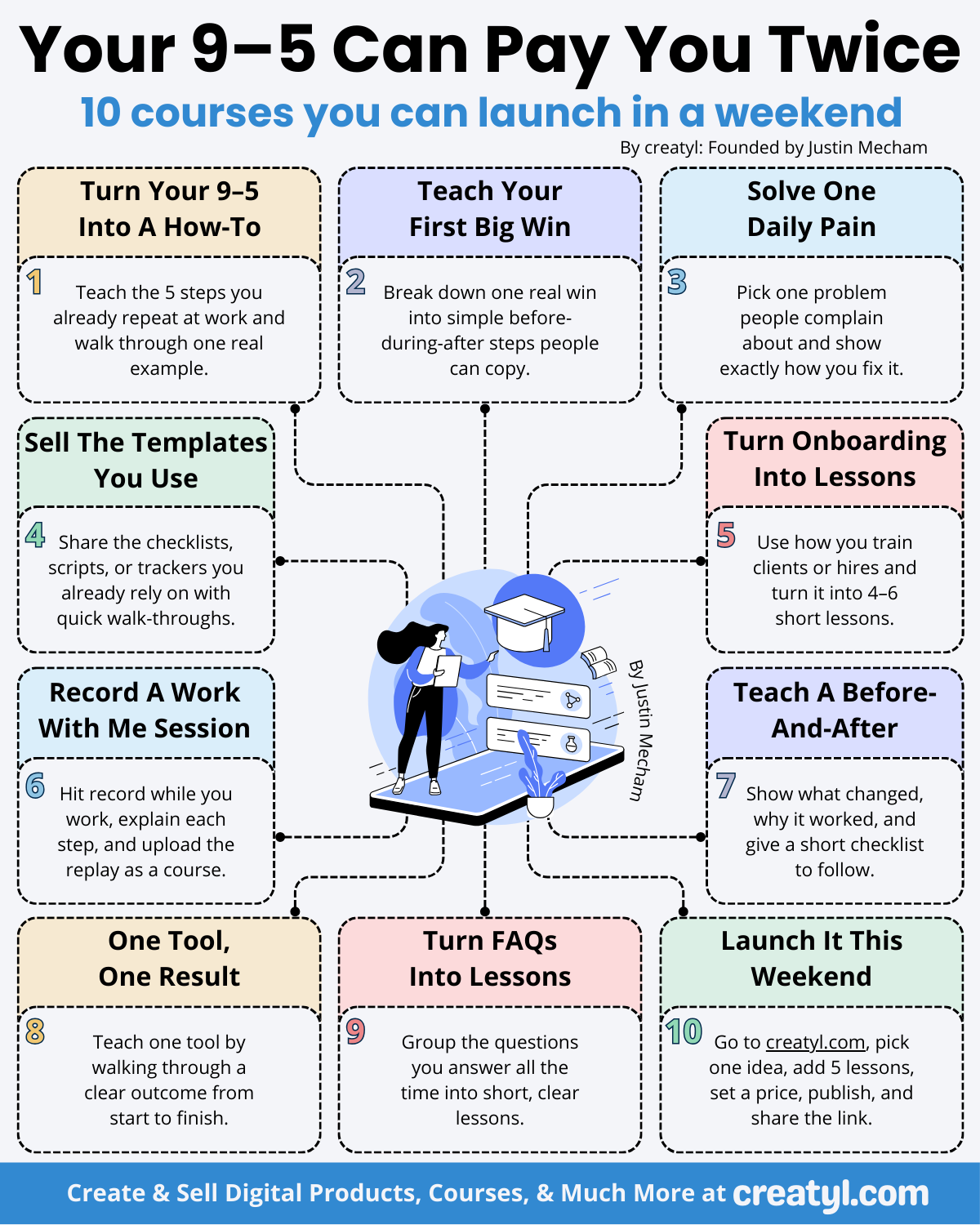
Download The Infographic (PDF)
If you want a simple visual version of everything covered here, download the full infographic as a PDF and keep it saved for quick reference.