

Click Here to Download the PDF.
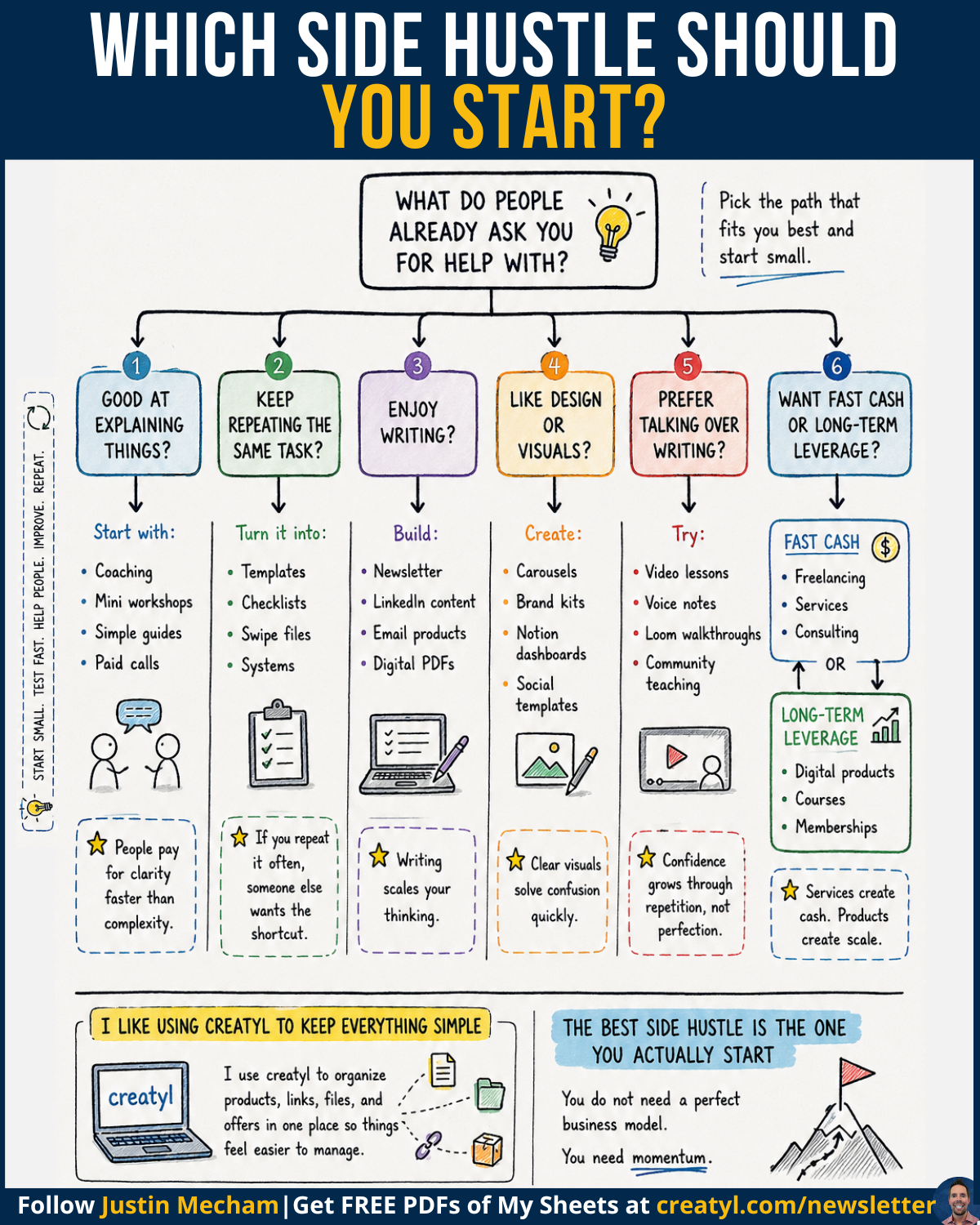
Most People Already Have a Side Hustle Idea
They Just Keep Ignoring It Because It Looks Too Simple
One of the biggest mistakes people make when trying to start a side hustle is assuming the answer must be hidden somewhere outside themselves.
So they scroll.
They watch creators online.
They study trends.
They buy courses.
They search for “the best side hustle in 2026.”
And while they are busy chasing complicated business models, they completely overlook the clearest opportunity already sitting in front of them:
The things people naturally ask them for help with.
That is usually where the real business starts.
Not in some revolutionary invention.
Not in a perfectly optimized funnel.
Not in an idea that makes strangers online say “wow.”
But in a problem people already associate with you.
The person friends ask for resume help may already have a coaching business hiding in plain sight.
The coworker constantly organizing systems may already have templates people would pay for.
The person always explaining difficult concepts clearly may already have a course inside them.
The problem is not lack of opportunity.
The problem is that many people dismiss their natural strengths because those strengths feel ordinary to them.
But what feels ordinary to you may feel incredibly valuable to someone else.
That changes how you should think about business entirely.
The Internet Has Convinced People That Businesses Must Look Complicated
Modern business culture often makes entrepreneurship look overwhelming.
People think they need:
- a huge audience
- advanced branding
- expensive software
- perfect content
- a complex website
- a detailed funnel
- years of preparation
Before they are “ready.”
But many successful digital businesses begin much smaller than people realize.
A simple checklist.
A short guide.
A paid consultation.
A useful template.
A mini workshop.
A one-hour walkthrough.
A small digital product solving one annoying problem.
That is how many real businesses begin.
The issue is not that people lack ideas.
The issue is that they overcomplicate execution.
And complexity kills momentum faster than failure does.
Your Best Clue Is Usually Repetition
Pay attention to the things people repeatedly ask you about.
That repetition matters.
Because repeated questions often point toward repeated pain.
And repeated pain usually creates demand.
People rarely ask for help randomly.
If people consistently come to you for:
- organization
- writing
- clarity
- communication
- systems
- design
- productivity
- emotional support
- strategy
- teaching
- fitness
- tech help
- content
- planning
You may already be sitting on a business opportunity without realizing it.
The strongest business ideas are often built around:
- skills you already use naturally
- problems you already solve repeatedly
- conversations you already have often
That is why the question:
“What do people already ask me for help with?”
is so powerful.
It bypasses fantasy.
And points toward evidence.
If You Explain Things Well, You Already Have a Monetizable Skill
Many people underestimate how valuable clarity is.
But confusion is expensive.
People pay to reduce:
- uncertainty
- overwhelm
- wasted time
- frustration
- complexity
That is why coaching, consulting, workshops, and guides work so well.
If you naturally:
- simplify ideas
- teach patiently
- break things down clearly
- help people understand difficult topics
You already possess a skill many businesses need.
And the best part?
You do not need to become a “guru.”
You simply need to help someone move from confusion to clarity faster.
That alone creates value.
Side Hustles That Fit Strong Explainers
You might explore:
- coaching calls
- mini workshops
- onboarding guides
- training PDFs
- accountability groups
- beginner tutorials
- skill walkthroughs
- live Q&A sessions
People pay for clarity much faster than they pay for complexity.
That is one of the biggest lessons many creators learn too late.
If You Repeat Tasks Constantly, You May Be Sitting on a Product Business
This is one of the most overlooked business opportunities online.
If you repeatedly:
- organize projects
- write emails
- manage workflows
- create spreadsheets
- plan launches
- structure meetings
- track systems
- document processes
You may already have something people would happily pay to shortcut.
Because repetition usually means:
- the process works
- the process saves time
- the process creates predictability
And many people do not want to build systems themselves.
They want proven ones they can adapt quickly.
That is why products like:
- templates
- checklists
- swipe files
- planners
- operating systems
- dashboards
- SOPs
- productivity trackers
Continue selling consistently.
You are not selling documents.
You are selling reduced friction.
Writing Is One of the Most Underrated Business Skills Online
Many people think writing is only useful for authors or journalists.
But writing is leverage.
Writing allows you to:
- teach at scale
- market ideas
- build trust
- attract opportunities
- create products
- clarify thinking
- develop authority
- grow an audience
And unlike many business models, writing scales without requiring constant live interaction.
A single useful written idea can:
- generate leads
- attract clients
- build community
- create product sales
- open career opportunities
For years.
Side Hustles That Fit Writers
You could build:
- newsletters
- digital PDFs
- email products
- LinkedIn content services
- ghostwriting offers
- educational guides
- niche reports
- online publications
Writing compounds quietly.
That is what makes it powerful.
Visual Thinkers Often Solve Problems Faster Than They Realize
Good visuals reduce confusion instantly.
People process visual information faster than large blocks of text.
That is why:
- carousels
- dashboards
- templates
- presentations
- diagrams
- visual systems
- design kits
Can become highly valuable products.
If you naturally:
- organize visually
- simplify visually
- communicate through layout
- create clear graphics
- design systems people can follow easily
You already possess a marketable strength.
Many businesses desperately need better communication through visuals.
Because confusion creates friction.
And friction kills action.
If You Prefer Talking Over Writing, That Is Not a Weakness
A lot of people avoid creating online because they think:
“I’m not a writer.”
But communication comes in many forms.
Some people communicate best:
- verbally
- conversationally
- through teaching
- through energy
- through demonstrations
- through live interaction
That can become:
- video lessons
- walkthroughs
- coaching
- voice-note consulting
- community teaching
- workshops
- memberships
Confidence rarely appears before action.
It grows because of repetition.
Most skilled communicators were awkward at first.
The difference is they continued anyway.
Fast Cash vs Long-Term Leverage
Most People Need to Understand the Difference
This is one of the most important side-hustle lessons people overlook.
Not all business models create the same kind of freedom.
Fast Cash Models
These include:
- freelancing
- consulting
- services
- agency work
Advantages:
- quicker income
- easier to start
- low upfront complexity
- direct customer interaction
Disadvantages:
- time-for-money dependency
- scaling limitations
- burnout risk if unmanaged
Long-Term Leverage Models
These include:
- digital products
- memberships
- courses
- templates
- educational products
Advantages:
- scalable income
- repeatable sales
- more flexibility
- less dependence on constant hours
Disadvantages:
- slower initial growth
- requires patience
- requires audience trust
Most people benefit from combining both strategically.
Services often create immediate cash flow.
Products create long-term scalability.
That combination matters.
The Biggest Reason People Never Start
It is not lack of ideas.
It is fear of imperfect execution.
People wait because they think:
- they need a niche first
- they need branding first
- they need confidence first
- they need more knowledge first
- they need permission first
But clarity often comes after movement.
Not before it.
Most successful side hustles evolve through:
- testing
- conversations
- iteration
- feedback
- repetition
Not perfect planning.
The goal is not getting everything right immediately.
The goal is learning quickly through real action.
A Real-Life Workplace Example
How One Small Skill Quietly Became a Real Business
A project manager constantly helped coworkers organize chaotic workflows.
People regularly asked:
- how they structured projects
- how they tracked tasks
- how they managed priorities
- how they created clear systems
The project manager never viewed this as valuable because it felt normal to them.
Meanwhile, coworkers viewed it as incredibly helpful.
Still, they ignored the opportunity for years because they believed:
“Nobody would pay for something this simple.”
Over time, frustration grew.
The project manager:
- felt stuck financially
- wanted extra income
- kept searching for “business ideas”
- consumed endless entrepreneurial content
- overcomplicated everything
All while sitting on a skill people already valued repeatedly.
The irony was painful.
The answer had been visible the entire time.
Instead of trying to launch a huge business, they created:
- a simple project-planning template
- a short walkthrough video
- a downloadable checklist
Then shared it with:
- coworkers
- LinkedIn connections
- small productivity communities
People bought it.
Not because it was revolutionary.
Because it solved a real problem clearly.
That first small product eventually expanded into:
- workshops
- consulting
- digital systems
- ongoing product sales
The business did not start with a massive idea.
It started with paying attention.
Your Side Hustle Does Not Need to Impress the Internet
This matters more than people realize.
Many people secretly choose business ideas based on:
- what sounds impressive
- what looks successful publicly
- what feels trendy online
Instead of choosing ideas that:
- fit their strengths
- match their energy
- solve real problems
- feel sustainable long term
The best business for you is not always the loudest one online.
It is the one you can consistently continue building.
Sustainability matters more than excitement spikes.
A Simple Decision Map to Start This Week
If you feel stuck, simplify everything.
Step 1: Write Down What People Already Ask You For
Look for:
- repeated questions
- repeated requests
- repeated compliments
- repeated problems you solve naturally
Patterns matter.
Step 2: Circle the Skill You Can Explain Fastest
Speed matters because clarity often signals competence.
What can you teach simply?
What feels natural?
Step 3: Choose One Format That Feels Easy
Do not force yourself into a format you hate.
Choose:
- writing
- teaching
- visuals
- templates
- coaching
- video
- systems
Based on your strengths.
Step 4: Build the Smallest Useful Version
Do not build a giant product first.
Start with:
- a checklist
- a mini guide
- one workshop
- one template
- one consultation offer
Small wins create momentum.
Step 5: Share It With Real Humans
This is the step most people avoid.
Because feedback feels vulnerable.
But real conversations create clarity faster than endless planning ever will.
Why Simplicity Wins More Than People Think
Simple businesses often outperform complicated ones because:
- buyers understand them faster
- creators sustain them longer
- execution becomes easier
- momentum builds quicker
Complicated businesses often fail under the weight of unnecessary moving parts.
Simple businesses survive because they stay usable.
That is one reason platforms like Creatyl resonate with creators.
Keeping products, links, files, and offers in one clean system reduces friction.
And reduced friction increases action.
Simple is not lazy.
Simple is scalable.
You Do Not Need the Perfect Side Hustle
Most people are not stuck because they lack ability.
They are stuck because they keep searching for certainty before starting.
But business clarity rarely appears in isolation.
It appears through movement.
Through testing.
Through helping.
Through observing what works.
Through solving one real problem for one real person.
The best side hustle is usually not hidden inside a complicated strategy.
It is hidden inside the things people already trust you for.
That is the clue.
That is the signal.
And often, that is the beginning of something much bigger than you realize.
You do not need:
- a perfect business model
- a huge audience
- a flawless launch
- permission from strangers online
You need:
- one useful idea
- one small offer
- one real problem
- one honest attempt
Start small.
Test fast.
Help people.
Improve.
Repeat.
That is how real businesses are built.
Resources to Explore Further
Book Recommendation
The $100 Startup by Chris Guillebeau
A practical guide showing how small skills and simple ideas can become profitable businesses.
TED Talk Recommendation
How Great Leaders Inspire Action – Simon Sinek
A powerful reminder that clarity and communication matter more than complexity.
Podcast Recommendation
The Futur Podcast
Excellent conversations around creativity, business positioning, freelancing, products, and scalable expertise.
Useful Exercise
Tonight, answer these five questions honestly:
- What do people already ask me for help with?
- Which problem do I solve naturally?
- What format feels easiest for me to create?
- What is the smallest useful version I could build?
- Who could I share it with this week?
The answers may reveal more opportunity than you think.
Download the “Which Side Hustle Should You Start?” Infographic PDF
Use this framework to identify strengths, choose the right business path, and start building something useful without overcomplicating the process.