

Click Here to Download the PDF.
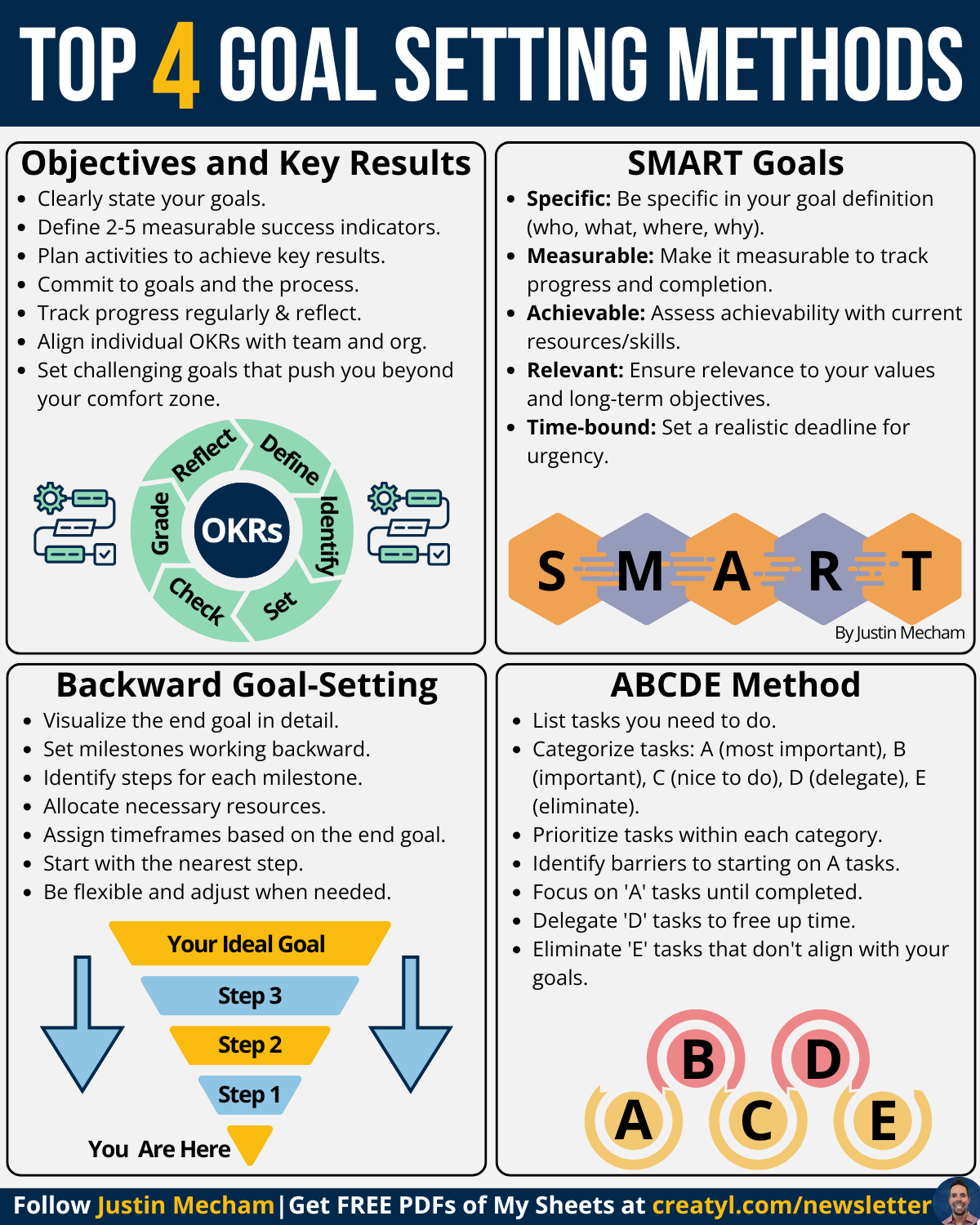
The Hard Truth About 2026 Goals: Effort Alone Won’t Save You
Every year, people start with good intentions.
They promise to focus more.
They plan to work harder.
They set ambitious targets and tell themselves this will be the year they finally follow through.
And yet, many goals quietly fall apart long before the year is over.
Not because people stop caring.
But because the system behind the goal doesn’t fit how they think or work.
Goals don’t need more pressure.
They need a structure that feels natural to use when life gets busy.
There isn’t one correct way to set goals.
There’s only the way that works with your brain instead of against it.
That’s why these four methods continue to work when others don’t.
Why Goal Setting Breaks Down So Easily
Most goal advice focuses on motivation.
Stay disciplined.
Push through resistance.
Hold yourself accountable.
But motivation is unreliable.
It fades when energy drops, schedules change, or progress feels slow.
What actually keeps goals alive is structure.
Structure removes guesswork.
It reduces mental load.
It tells you what to focus on when everything feels important at once.
The four methods below work because each one supports a different way of thinking.
OKRs: For Outcome Thinkers Who Want Direction Without Micromanaging
Some people shut down when goals get too detailed.
They don’t want to manage dozens of tasks or track every small step.
They want to know where they’re headed and whether progress is real.
That’s where OKRs work best.
OKRs start with one clear objective.
Not a long list.
One meaningful direction.
Then they add a few key results that prove movement toward that objective.
These results are measurable, but not overwhelming.
They act as signals instead of checklists.
OKRs work especially well if you:
- Think in outcomes, not tasks
- Want flexibility in how you get there
- Prefer simple check-ins over daily tracking
They create stretch without pressure.
SMART Goals: For Precision Thinkers Who Need Clarity to Act
Some people feel stuck when goals are vague.
They want specifics.
They want to know exactly what they’re aiming for and how progress will be measured.
SMART goals remove uncertainty by forcing clarity upfront.
Each goal answers:
- What exactly do I want
- How will I measure progress
- Is this realistic right now
- Why does it matter
- When is it due
This level of detail reduces hesitation.
It replaces anxiety with direction.
SMART goals work best if you:
- Feel stressed by unclear goals
- Like tracking progress
- Prefer defined timelines
Clarity here creates momentum.
Backward Goal-Setting: For Big Outcomes That Feel Far Away
Large goals often fail because they feel distant and abstract.
When the finish line feels too far, starting becomes hard.
Backward goal-setting flips the process.
Instead of asking what to do today, you start by picturing the finished result in detail.
Then you break it into milestones and work backward until the next step becomes obvious.
This method shrinks big goals into manageable moves.
Backward goals work best if you:
- Are working toward a long-term outcome
- Feel overwhelmed by the size of the goal
- Need help seeing where to begin
Big goals become workable when reversed.
ABCDE: For Overload Moments When Everything Feels Important
Sometimes the problem isn’t the goal itself.
It’s the noise around it.
When every task feels urgent, nothing moves forward.
The ABCDE method clears that noise fast.
Tasks are sorted into:
- A: moves the goal directly
- B: supports progress
- C: nice but optional
- D: delegated
- E: removed
This method doesn’t add work.
It removes distraction.
ABCDE works best when:
- You feel overwhelmed
- You’re stuck deciding what matters
- You need quick clarity
Mental space returns as soon as unnecessary tasks are removed.
How to Choose the Right Method for You
The best method is the one you’ll actually use.
If structure feels too rigid, start with OKRs.
If uncertainty slows you down, use SMART goals.
If the goal feels too big, go backward.
If everything feels urgent, sort with ABCDE.
The method should reduce friction, not create more.
A Real Workplace Example: When Goals Failed Because the System Didn’t Fit
They were part of a small team planning the year ahead inside a growing business.
They had clear ambitions and strong commitment.
But previous goals rarely made it past the first quarter.
Plans were either too vague to guide action or too detailed to keep up with.
People worked hard, but progress felt scattered.
As the year went on, frustration grew.
Some felt micromanaged by detailed task lists.
Others felt lost because goals were too high-level.
Check-ins became stressful instead of helpful.
Eventually, goals were quietly ignored because they felt unrealistic to maintain.
Effort was there.
The structure was wrong.
They stopped forcing one system on everyone.
Outcome thinkers adopted OKRs to track direction and progress.
Precision thinkers used SMART goals for their workstreams.
Large initiatives were planned backward to reduce overwhelm.
When work piled up, ABCDE was used to reset priorities.
Weekly check-ins focused on progress and adjustment, not judgment.
Within months:
- Goals stayed visible
- Progress felt manageable
- People adjusted instead of quitting
The work didn’t change much.
The system finally matched how people thought.
Tools That Support Clear Goal Setting
Measure What Matters explains how outcome-focused goals stay flexible and honest.
Atomic Habits reinforces small systems over pressure.
Notion helps track goals using multiple frameworks in one place.
Creatyl supports turning goals into simple, repeatable outputs that lead to results.
Goals Should Support You, Not Weigh You Down
Why the Right System Makes Consistency Possible
Most people don’t fail at goals because they lack discipline.
They fail because the system creates friction instead of support.
When goals match how you think, effort feels lighter.
Progress becomes visible.
Adjustments feel normal instead of discouraging.
Goals don’t need pressure to work.
They need a structure that fits real life.
If 2026 goals already feel heavy, it’s not a personal flaw.
It’s just the wrong system.
Download the “Top 4 Goal-Setting Methods” Infographic (PDF)
Some frameworks are easier to use when you can see them clearly.
This infographic lays out the four goal-setting methods on one page so you can choose the one that fits how you think and use it without overcomplicating the process.
Download the Top 4 Goal-Setting Methods infographic (PDF):
It’s a simple reference to return to whenever your goals start feeling heavier than they should.