


Click Here to Download the PDF.
There’s a quiet graveyard online, and it’s filled with unfinished digital products.
Half-built courses.
Clean Notion dashboards.
Templates sitting in Google Drive.
PDFs that were “almost ready.”
Membership sites that never opened.
Ideas that felt exciting at first, but slowly died in silence.
And the reason most of them failed isn’t because the creator wasn’t talented or smart.
It’s because the product never crossed the line that matters most.
It never reached real life.
Planning felt productive.
It felt safe. It felt smart. It felt like progress.
You can spend weeks outlining a product, mapping the funnel, debating the price, rewriting the sales page, tweaking the design, researching competitors, and telling yourself you’re being responsible.
But nothing changes until someone can actually use what you made.
Proof only shows up after action. Not before.
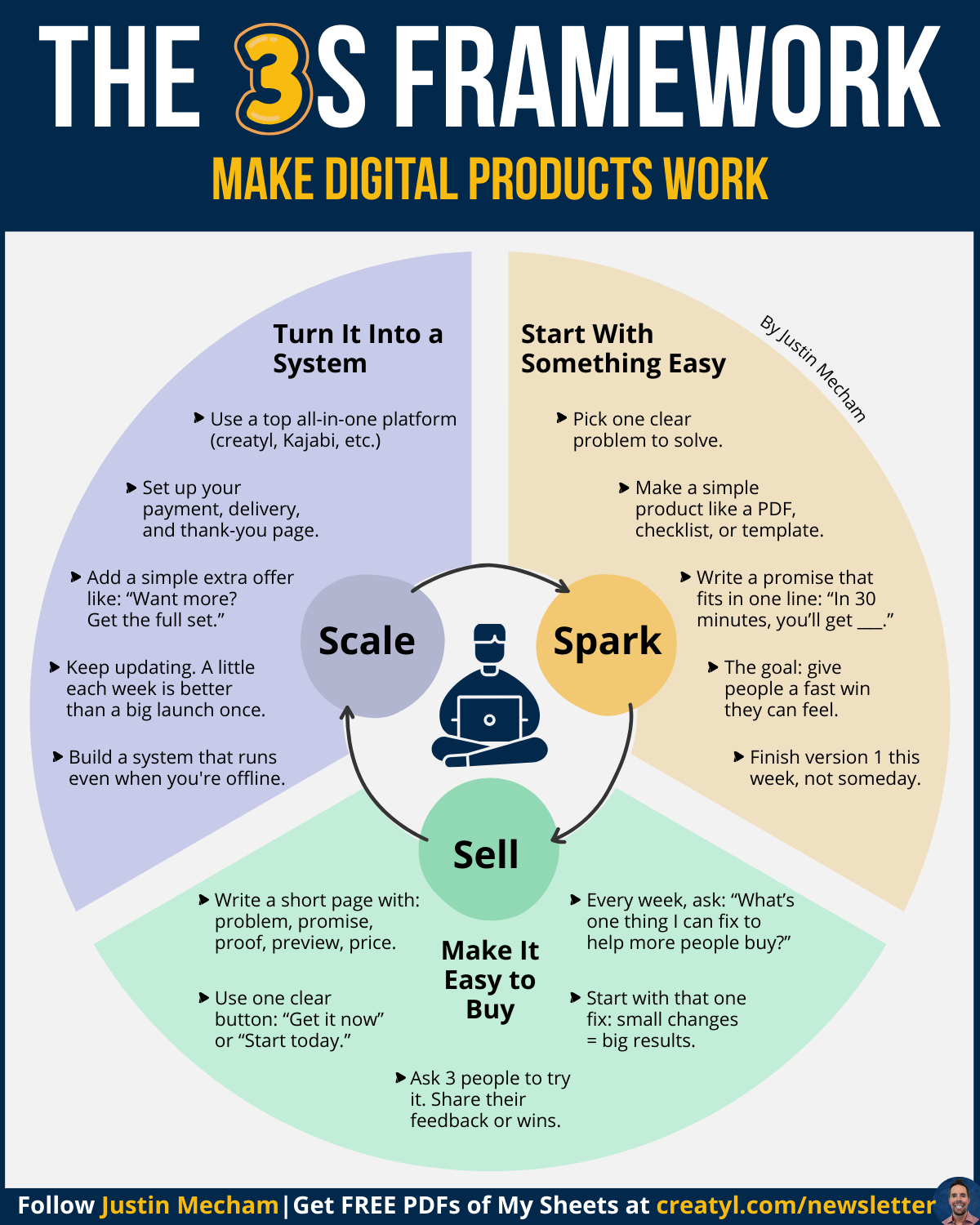
That’s why I use the 3S Framework.
Not because it’s complicated, but because it forces movement first.
Not more thinking. Not more prep. Movement. Spark. Sell. Scale.
It drags your idea out of your head and into the real world where it finally has a chance to become something real.
Why Planning Feels Good (And Why It Tricks Smart People)
Planning gives you control.
When you’re planning, everything still feels possible.
Your product is still perfect. Your audience still loves it.
Your launch still goes smoothly.
Nothing has challenged your idea yet.
Planning is clean.
Planning is comfortable.
Planning is quiet.
That’s why it becomes a trap.
Because the moment you ship something real, you lose the comfort of imagination.
Real people don’t respond the way your brain predicts.
They don’t read your page the way you thought they would.
They don’t always care about the part you worked hardest on.
They might ignore it.
They might click and leave.
They might say nothing at all.
Reality is messy.
So your mind does what it always does when it senses risk.
It pulls you back into safety.
Another outline.
Another strategy session.
Another pricing spreadsheet.
Another redesign.
Another round of research.
None of that is bad on its own.
The problem is when planning becomes a substitute for progress.
Planning can make you feel like you’re moving when you’re actually staying in the same place.
That’s why most digital products don’t fail in the market.
They fail in the draft folder.
They fail in the private stage.
They fail because the creator never gives reality a chance to answer.
The 3S Framework: A Simple Loop That Creates Proof
The 3S Framework isn’t a motivational idea.
It’s not a mindset trick.
It’s a system for turning ideas into outcomes.
And it’s built on one truth that most people avoid: you do not need confidence first.
You need contact first.
Contact with real people.
Contact with real behavior.
Contact with what actually works.
This framework is designed to get you that contact fast, without forcing you into a massive launch or a complicated build.
It works in three phases.
Spark: build something small on purpose.
Sell: make buying feel obvious and test it immediately.
Scale: turn what works into something repeatable.
The key is that you don’t “finish” this framework.
You cycle through it. Over and over.
Each loop gives you more clarity than any planning session ever will.
Because planning gives you ideas. Selling gives you facts.
Spark: Start Small On Purpose
Most people start with ambition.
They want a full course.
A full membership. A full system.
They want the product to feel big enough to matter.
But Spark starts somewhere else.
It starts with one complaint.
Not your idea. Not your expertise.
A complaint someone already says out loud.
The wrong question is: What digital product should I create?
The right question is: What problem do people keep repeating?
That’s where good products begin.
Not in your imagination, but in someone else’s frustration.
Step One: Collect Real Complaints
When I work with teams, I don’t start with brainstorming sessions.
Brainstorming is fine, but it usually creates fluffy ideas.
Things people think would be cool.
It rarely creates something people will pay for quickly.
Instead, I ask them to pull raw customer language.
Support tickets.
Customer service chats.
Sales call notes.
Email replies.
Comments.
DMs.
Internal Slack threads.
Anywhere people are venting.
We collect at least 20 complaints.
Not problems we guessed.
Problems people actually said.
Then we highlight the ones that show up repeatedly.
Repetition is demand.
If five different people are saying the same thing, that pain is real.
And if the pain is real, there is almost always a small product hiding inside it.
Step Two: Choose A Problem That Hurts Now
This is where most creators go wrong.
They choose problems that sound important but don’t feel urgent.
“Be more productive.”
“Build confidence.”
“Improve your leadership.”
Those are real goals, but they are too broad.
They don’t create a moment of purchase.
They don’t make someone feel like they need to solve it today.
A better problem is sharp. It’s immediate.
It’s the kind of pain that makes someone say, “I need a fix before Monday.”
Examples:
- I don’t know what to say when a client asks for a discount.
- I freeze in meetings and don’t know how to speak up.
- I keep missing deadlines because I can’t prioritize.
- I have a great idea but I can’t turn it into a clear offer.
Sharp problems lead to sharp products.
Step Three: Shrink The Fix Until It Feels Easy
This is the part that separates people who build from people who stay stuck.
Most creators want to build something “worthy.”
They want the product to feel like a big deal.
But the goal of Spark is not to impress people.
The goal is to create a fast win.
Fast wins build trust. Fast wins lower fear. Fast wins create momentum.
So instead of building a course, you build a tool.
A checklist. A script. A template. A one-page roadmap.
Something a person can use quickly.
A strong rule is this: if it takes longer than 10 minutes to use, it’s too big for version one.
Not because it’s bad.
Because big products invite perfectionism.
Small products invite action.
Step Four: Write A Promise A Real Person Understands
Most people write promises that sound like marketing.
They write vague claims like “Transform your workflow” or “Level up your life.”
That’s not a promise. That’s a slogan.
A real promise is clear and practical. It sounds like something you could tell a friend.
“In 30 minutes, you’ll have a weekly plan you can follow.”
“Write a sales message that doesn’t sound awkward.”
“Walk into your next meeting knowing exactly what to say.”
That level of clarity is what turns curiosity into action.
Step Five: Ship Version One This Week
This is not about rushing. It’s about honesty.
If you give yourself unlimited time, you will use it.
You will keep adjusting. You will keep polishing. You will keep waiting.
Shipping within a week forces you to keep it simple.
And simple is where proof begins.
Sell: Make Buying Feel Obvious
A lot of creators treat selling like something you do after the product is finished.
That’s backwards.
Selling is not the reward for building.
Selling is the part that tells you whether the building matters.
If Spark is about creating something real, Sell is about putting it in front of people in a way that feels easy to say yes to.
And here’s the truth: if buying feels confusing, people don’t buy.
Not because they hate you.
Not because they aren’t interested.
But because confusion creates hesitation, and hesitation kills action.
The One-Page Rule
One of the most effective changes I make for teams is cutting their sales page down.
Most sales pages are bloated.
They try to explain everything.
They try to convince everyone.
They bury the offer under too many words.
A clean sales page does the opposite. It removes thinking.
A strong early-stage page has five parts:
- One clear promise
- Who it’s for
- What they get (three bullets maximum)
- Simple proof
- One price and one button
That’s it.
No long founder story. No feature overload. No “this changed my life” paragraphs.
People don’t buy features. They buy relief.
The One Price Rule
Early on, you don’t need pricing tiers.
Pricing tiers are another form of hiding.
They feel strategic, but they create unnecessary decisions.
One offer. One price. Make the decision easy.
Your goal is not to squeeze the most money out of version one.
Your goal is to learn what people will pay for and why.
The One Button Rule
Your page should have one main action.
Not “join the waitlist” and “book a call” and “download the free guide.”
One button.
Get it now. Buy the template. Download the kit.
If people want it, they will click. If they don’t click, you just learned something valuable.
Ask Three People To Try It
This is where reality starts talking.
You do not need a big audience.
You need three real humans who match the problem you’re solving.
Send them the product. Watch what happens.
The biggest mistake creators make is asking for opinions.
Opinions are cheap. People will always be polite.
Instead, watch behavior.
Did they buy? Did they use it? Did they finish it? Did they come back with questions? Did they ask for the next step?
That is the only feedback that matters.
Because behavior doesn’t lie.
Listen. Adjust One Thing.
This is another place people get stuck.
They collect feedback and then rebuild everything.
That’s panic.
Instead, adjust one thing.
One line of the promise.
One bullet point.
One missing step.
One confusing part of the template.
Then test again.
Small changes. Fast cycles.
That is how real products are built.
Scale: Turn Effort Into A System
Scale is where most creators imagine the magic happens.
They picture scaling as ads, followers, and big launches.
But scale doesn’t start with marketing.
Scale starts with removing repeat work.
Repeat work burns creators out.
Repeat work is what turns a product into a stressful job.
If every sale requires you to manually send the file, that’s not a business.
That’s a task.
If every customer requires a custom explanation, that’s not scalable.
That’s emotional labor disguised as service.
Scale is where you build the machine.
Not a complex machine. A simple one.
Remove Repeat Work
When I help teams scale, we start with one question: what are we doing over and over?
Then we eliminate those steps.
We automate delivery.
We automate follow-up.
We create a thank-you page that answers the most common questions.
We create one clean email that tells people exactly what to do next.
The goal is simple: the product should deliver the same experience even when you are offline.
That is the difference between selling occasionally and selling consistently.
Set Up Pay, Delivery, And Follow-Up Once
This is where most creators waste time.
They rebuild their system every time they launch.
They change platforms. They redo checkout. They rewrite the same delivery email.
The real win is setting it once.
A simple payment link. A simple delivery flow. A simple follow-up email.
Once that is in place, your product stops being a stressful event and becomes a reliable loop.
Add A Small Next Step For Buyers
This is one of the smartest moves in the framework.
When someone buys a small product and it helps them, they are ready for the next step.
They are already trusting you.
They already believe you can solve the problem.
So instead of building a massive product from scratch, you build the next logical piece.
A small add-on. A deeper version. A bundle.
You don’t guess what that next step should be.
You listen to what buyers ask for.
That’s how your product line grows naturally, without forcing it.
Update A Little Each Week
This is how you win long-term.
Not with one big launch. With steady improvement.
One update per week is enough to keep the product improving without turning your life into chaos.
Small improvements compound.
And compounding is what creates long-term results.
Let It Run Without You Watching
This is the final goal of Scale.
Not fame. Not constant posting.
Freedom.
A system that works without constant attention.
A product that can sell while you’re busy doing other things.
A process that keeps delivering value without your presence.
That is the real reason systems matter.
The 72-Hour Proof Sprint: How I Got A Stuck Team Moving Fast
Let me make this real.
A team hired me because they were stuck in a loop that felt painfully familiar.
They had a product idea they believed in.
They had spent months building it.
They had meetings every week about “launch strategy.”
But nothing was happening.
They were building a digital product meant to help their customers solve a workflow issue.
On paper, it was impressive.
It had modules, templates, worksheets, onboarding sequences, and a long list of “bonus resources.”
They had invested a lot of time.
But the product wasn’t selling.
What made it worse was that they didn’t know why.
They kept saying, “We just need better marketing.” They were convinced the product was strong and the problem was exposure.
But marketing wasn’t the issue.
The issue was that they had no proof their product was solving a pain people felt urgently.
They were building based on assumptions, not real behavior.
Every week looked the same.
They planned. They revised. They added more features. They rewrote the welcome email again.
The product got bigger, but the confidence got smaller.
You could feel the tension.
Some people wanted to simplify, but others felt like simplifying would make the product look weak.
Leadership was watching.
Deadlines were slipping.
The longer it dragged on, the harder it became to ship anything at all.
The pressure became emotional.
That’s what happens when a product becomes a symbol.
It stops being a tool you test and becomes a statement about the team’s ability.
And when that happens, people stop taking smart risks.
They start taking safe ones.
I walked them through Spark, Sell, Scale in a tight three-day sprint.
Not because we were rushing, but because they needed reality.
Spark (Day 1): Build A Small Fix That Creates A Fast Win
First, I asked them to stop brainstorming and pull real customer language.
We went through support tickets and sales call notes and highlighted repeated complaints.
One phrase showed up constantly: “I don’t know what to do first.”
That was our entry point.
Not a vague productivity issue. A clear priority issue.
So we built one tool that solved that pain.
Not a full course. Not a membership.
A one-page weekly priority planner with a simple system.
It asked users to:
- identify the top three outcomes for the week
- choose one daily action tied to each outcome
- set one “stop doing” rule
- plan a short weekly review
They built it in one afternoon.
No perfection.
Just a clean tool that solved a real pain.
Sell (Day 2): Make Buying Feel Obvious
The next day, we wrote the sales page.
One promise: “In 15 minutes, you’ll know exactly what to work on this week.”
Three bullets.
One price.
One button.
Then I had them run the three-person test. They reached out to people who matched the pain.
Within 24 hours, two people bought.
One buyer replied with something even more valuable than a purchase: “This is exactly what I needed. I wish I had this every Monday.”
That sentence was proof.
It wasn’t polite feedback. It was a real reaction to a real solution.
Scale (Day 3): Turn The Win Into A System
Now that we had proof, we built the system.
We automated delivery.
We created a thank-you page with clear instructions.
We added a follow-up email two days later asking one question: “What part felt unclear or hard to use?”
That one email gave the team more clarity than a month of internal meetings.
Then we added a small next step.
A companion template for team planning.
That add-on sold almost as well as the original.
Not because it was genius. Because it was built from real demand.
Once this team had proof, everything shifted.
Confidence returned.
Meetings became productive again.
The product stopped being a stressful project and started becoming a clear system.
That is what happens when you stop guessing and start testing.
What Made It Work: The Small Decisions That Created Big Change
This wasn’t luck.
There were three decisions that changed everything.
1. I Forced A Deadline That Made Planning Impossible
A tight deadline forces honesty. When you have one week, you stop pretending you can build everything. You choose what matters. And that choice creates clarity.
2. I Kept The Offer Simple So Buyers Didn’t Have To Think
People don’t buy when they’re confused. A short page, one price, and one button removes friction. It turns buying into a clean yes or no.
3. I Measured Behavior, Not Compliments
The team was used to hearing nice feedback. But nice feedback doesn’t build a business. Behavior does. Did they buy? Did they use it? Did they come back asking for more? That’s the data that matters.
The Deeper Shift That Matters
This framework is not really about digital products.
It’s about fear.
Fear is what keeps people stuck.
Fear of wasting time.
Fear of building the wrong thing.
Fear of looking foolish.
Fear of being ignored.
Small digital products lower that fear.
They lower it for you because the commitment is small.
They lower it for the buyer because the risk is small.
Selling early creates clarity because it forces reality to answer.
Not your friends. Not your inner circle. Not your imagination.
Systems turn effort into results because they remove dependence on mood.
A system works when you feel confident, and it works when you feel tired.
That’s what separates creators who get lucky once from creators who build something steady.
If you’re stuck, it’s rarely because you need more ideas.
It’s because you are waiting for certainty that only action can give you.
The Courage To Ship Is The Real Skill
Most people think digital products are about creativity.
They assume the winners are the ones with the best ideas, the best design, or the best marketing.
But after watching creators and teams build over and over again, I’ve seen something different.
The real separator is not talent.
It’s the courage to ship something small before you feel ready.
That moment right before you share your work is the hardest part.
It’s where the mind starts negotiating.
It tells you the product needs one more feature.
One more revision. One more week. One more improvement before it’s safe.
But the truth is, the product will never feel safe in your head.
Because safety does not come from preparation. It comes from proof.
Proof is what gives you real confidence.
Not the fake kind you talk yourself into, but the kind you earn.
The kind that comes from watching a real person use your work and say, “This helped.”
That’s when everything changes.
You stop building in isolation. You stop guessing. You stop carrying the heavy weight of endless possibility.
And you start building with direction.
And direction is one of the rarest things in business.
Spark, Sell, Scale is not a formula for quick money.
It’s a way to build trust with reality.
It teaches you to stop treating your idea like a fragile dream and start treating it like a tool that can improve.
Because when your work becomes real, it stops being something you protect.
It becomes something you grow.
And the most powerful part is this: you don’t need to be perfect to begin.
You don’t need a huge audience. You don’t need a complicated product.
You just need one clear problem.
One simple promise. One small tool someone can use quickly.
That is enough to create movement.
And once you have movement, you have the only thing planning can never give you.
Momentum.
Download The 3S Framework Infographic (PDF)
If you want a clear visual reference of everything covered in this article, you can download the full 3S Framework infographic as a PDF.
It breaks down Spark, Sell, and Scale into a simple loop you can follow step by step while building your own digital product.