


Click Here to Download the PDF.
Most People Think Saying Sorry Is Polite.
It’s Often Just A Quiet Way Of Shrinking.
If you say “Sorry” a lot, it usually comes from a good place.
You want to be kind.
You want to keep things smooth.
You don’t want to come off demanding.
You want people to feel comfortable around you.
But here’s the problem no one warns you about: Repeated apologies train people how to treat you.
Not because people are bad.
Because people are busy.
They pick up signals fast.
And “sorry” is a signal.
Over time, it can sound like: I’m unsure. I’m interrupting. I’m taking up space I haven’t earned.
The painful part is that most “sorry” moments are not mistakes.
They’re habits.
Auto-pilot lines we learned to use as social padding.
We type it before we even think.
We say it before we even check whether we did anything wrong.
And slowly, without meaning to, teach others not to take our words as seriously as we want them to.
This isn’t about being harsh.
It’s not about being cold.
It’s about being clear.
Because clarity is kind.
It saves time. It reduces confusion. It makes work easier for everyone.
Confidence isn’t louder words. It’s clearer ones.
Why Sorry Becomes A Problem In Work Settings
“Saying sorry” looks small, but it has a big effect in professional spaces.
It changes the power in the conversation.
It makes your request sound optional.
It makes your boundary sound like a preference.
It makes your follow-up sound like you’re being a bother instead of doing your job.
And It doesn’t just affect how others hear you. It affects how you hear yourself.
If you apologize every time you ask a question, you start feeling like questions are a burden.
If you apologize every time you need clarity, you start feeling like clarity is a luxury.
If you apologize every time you follow up, you start feeling like accountability is rude.
That’s the real cost. You don’t just lose respect externally. You lose internal permission.
So the goal here is not to remove kindness.
The goal is to stop apologizing for things that are not wrong.
The Two Types Of Sorry
Most people don’t separate these, so they use “sorry” for everything.
1) Real Responsibility Sorry
This one matters. Keep it.
Use it when you caused harm, broke trust, missed a commitment, or created a real problem.
A real responsibility sorry is followed by a fix.
It’s simple. Direct. No drama.
2) Social Padding Sorry
This one is the issue.
It shows up when nothing is actually wrong.
Sorry for asking.
Sorry for checking.
Sorry for the delay (even when you weren’t the delay).
Sorry I don’t know.
Sorry if this is silly.
Sorry to follow up.
Sorry for taking your time.
This “sorry” is not responsibility. It’s permission seeking.
And it weakens your message, even if your tone is warm.
The solution is not to remove warmth.
The solution is to swap apology language for clear language.
The Swap System: Stop Apologizing. Start Communicating Like A Leader
This is the heart of the reset.
You don’t need a personality change.
You need a script change.
You keep your calm tone.
You keep your respect.
You just remove the self-minimizing part.
Below are the common work situations where “sorry” sneaks in, and what to say instead.
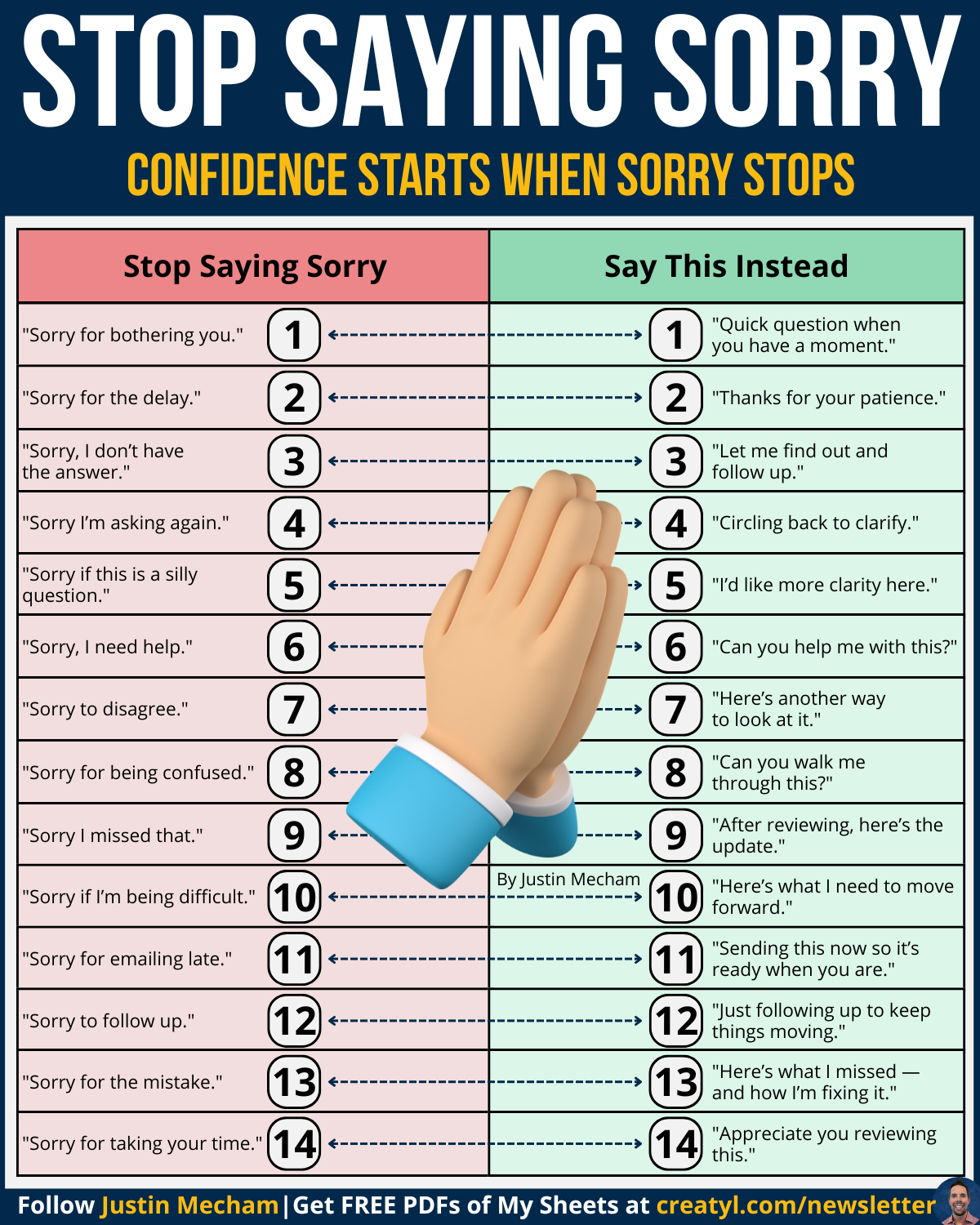
These match the infographic you shared, but I’m going to go deeper so it becomes usable in real moments.
1) Stop Apologizing For Asking
Instead Say: Quick question when you have a moment.
Why It Works: You’re being respectful of their time without acting like your question is a burden.
Make It Stronger: Add the goal so they know why it matters.
Example: Quick question when you have a moment. I want to make sure I’m aligned before I send this.
2) Stop Apologizing For Timing
Instead Say: Thanks for your patience.
Why It Works: You acknowledge the wait without placing yourself beneath them.
Make It Stronger: Add what happens next.
Example: Thanks for your patience. I’ll have the final update to you by 3 PM.
3) Stop Apologizing For Not Knowing
Instead Say: Let me find out and follow up.
Why It Works: It shows ownership, not insecurity.
Make It Stronger: Add the follow-up time.
Example: Let me find out and follow up. I’ll come back to you today with the answer.
4) Stop Apologizing For Asking Again
Instead Say: Circling back to clarify.
Why It Works: It frames the follow-up as good work, not annoyance.
Make It Stronger: Make your ask specific.
Example: Circling back to clarify one detail. Do we want option A or B?
5) Stop Apologizing For Wanting Clarity
Instead Say: I’d like more clarity here.
Why It Works: Clarity prevents mistakes. This is leadership, not neediness.
Make It Stronger: Ask one precise question.
Example: I’d like more clarity here. What does success look like by Friday?
6) Stop Apologizing For Needing Help
Instead Say: Can you help me with this?
Why It Works: Strong teams ask for help early. That’s competence.
Make It Stronger: Specify what kind of help.
Example: Can you help me with this? I need a second set of eyes on the final draft.
7) Stop Apologizing For Disagreeing
Instead Say: Here’s another way to look at it.
Why It Works: It keeps the tone calm while still holding your point.
Make It Stronger: Link it to the goal, not your ego.
Example: Here’s another way to look at it. If we do it this way, we reduce rework next week.
8) Stop Apologizing For Being Confused
Instead Say: Can you walk me through this?
Why It Works: Confusion is information. It means the process needs clarity.
Make It Stronger: Name where you got lost.
Example: Can you walk me through this? I’m clear on steps one and two, but not on who owns step three.
9) Stop Apologizing For Missing Something
Instead Say: After reviewing, here’s the update.
Why It Works: It shifts the focus to the solution.
Make It Stronger: Add what changes now.
Example: After reviewing, here’s the update. We’re adjusting the timeline and I’ll send the new dates today.
10) Stop Apologizing For Being “Difficult”
Instead Say: Here’s what I need to move forward.
Why It Works: Needs are not “difficult.” They’re requirements.
Make It Stronger: Offer two options if helpful.
Example: Here’s what I need to move forward. Either approval on this version, or clear edits by end of day.
11) Stop Apologizing For Emailing Late
Instead Say: Sending this now so it’s ready when you are.
Why It Works: No self-blame, no drama, still respectful.
Make It Stronger: Add the reason if needed.
Example: Sending this now so it’s ready when you are. I wanted to confirm the numbers first.
12) Stop Apologizing For Following Up
Instead Say: Just following up to keep things moving.
Why It Works: Follow-up is accountability. It keeps projects alive.
Make It Stronger: Add the decision you need.
Example: Just following up to keep things moving. Can you confirm which direction we’re taking?
13) Stop Apologizing For A Mistake
Instead Say: Here’s what I missed and how I’m fixing it.
Why It Works: This is the strongest form of accountability.
Make It Stronger: Add the prevention step.
Example: Here’s what I missed and how I’m fixing it. I’m also adding a quick check so it doesn’t happen again.
14) Stop Apologizing For Taking Space
Instead Say: Appreciate you reviewing this.
Why It Works: It respects the exchange without shrinking you.
Make It Stronger: Keep it simple.
Example: Appreciate you reviewing this. Your input helps me finalize it cleanly.
The Simple Reset That Actually Sticks
Most advice says, “Stop saying sorry.” That doesn’t work because habits don’t disappear. They get replaced.
Here’s the reset I teach because it’s easy to use in real time:
Step 1: Spot The Trigger
Notice the moments where “sorry” shows up most. For many people, it’s these four: asking, following up, disagreeing, and not knowing.
Step 2: Pause For One Breath
You don’t need a long pause. You just need enough space to choose a different line.
Step 3: Swap In A Clarity Line
Pick one of the swaps above. Keep it calm. Keep it simple.
Step 4: Add One Specific Detail
This is the upgrade most people skip. Specific details create authority.
Instead of: I’d like more clarity.
Say: I’d like more clarity on the deadline. Is it Friday or Monday?
Step 5: Keep Your Tone Warm, Not Apologetic
Warmth is not the same as shrinking. You can be direct and still be respectful. The key is calm language, not extra softness.
How I Helped A Team Replace Sorry With Clear Communication
A team brought me in because projects kept stalling.
Deadlines slipped, handoffs were messy, and decisions stayed “open” far too long.
On the surface, it looked like a workflow issue.
But after sitting in a few meetings, I noticed something more subtle.
Their communication was full of quiet apologies.
Sorry to bother you.
Sorry to follow up.
Sorry if this is a silly question.
Sorry, I’m confused.
Sorry, I don’t have that yet.
Sorry for taking your time.
No one was doing anything wrong.
They were good people.
They were trying to be polite.
But the constant apologizing was changing how messages landed.
Requests sounded optional.
Follow-ups sounded like interruptions.
Clarifying questions sounded like insecurity.
And when someone needed a decision, they softened it so much the urgency disappeared.
Over time, the team started paying a real price.
The loudest voices began owning the room, not because they were better, but because they were clearer.
Quieter team members stopped asking questions early, because they didn’t want to “be a bother.”
Small issues stayed hidden until they became big issues.
Work got redone because nobody felt comfortable pushing for clarity upfront.
Even worse, the team’s reputation started to shift.
Stakeholders didn’t say it directly, but you could feel it.
People stopped treating timelines as real.
They stopped treating follow-ups as meaningful.
They assumed the team would “figure it out eventually.”
That kind of subtle loss of confidence is brutal because it doesn’t happen in one moment.
It happens through a thousand small moments where someone doesn’t stand fully behind their own message.
I didn’t tell them to “be more confident.”
That’s vague and unhelpful.
I gave them a simple language system and we practiced it until it became normal.
First, we picked four apology patterns that were causing the most damage: asking, following up, not knowing, and pushing for clarity.
Then we created a shared swap list the whole team used.
Not as a rule, but as a default.
Here’s what changed immediately:
- We replaced “Sorry to follow up” with “Following up to keep this moving.”
- Action Tip: Every follow-up included a clear question and a clear next step.
- Example: Following up to keep this moving. Can you confirm option A or B so I can finalize today?
- We replaced “Sorry, I don’t have the answer” with “Let me find out and follow up by [time].”
- Action Tip: No one left a question hanging without a time-bound follow-up.
- Example: Let me find out and follow up by 2 PM with the exact number.
- We replaced “Sorry if this is a silly question” with “I want to make sure I’m aligned.”
- Action Tip: They asked questions earlier, when fixes were cheap.
- Example: I want to make sure I’m aligned. Is the goal speed, cost, or quality on this one?
- We replaced “Sorry, I need help” with “Can you help me with this part?”
- Action Tip: Help requests became specific, so people could respond faster.
- Example: Can you help me with this part? I need a second opinion on the risks before I send it.
We also added one team habit that made the language stick: a two-minute clarity check at the end of meetings.
Each person had to leave with three things: what they own, what success looks like, and when the next decision happens.
Within two weeks, the team’s work sped up.
Not because they worked harder.
Because they stopped cushioning every message.
They got clearer. They asked sooner.
They followed up without shame.
They treated clarity like a professional standard instead of a personal weakness.
And the best part was the tone stayed kind.
The team didn’t become sharp or cold.
They simply stopped apologizing for being competent adults doing real work.
What Made It Work
The Small Decisions That Changed Everything
- We targeted the highest-impact “sorry” moments instead of trying to fix everything. Asking, follow-up, not knowing, clarity. Those four move projects forward or stall them.
- We replaced apology language with time, ownership, and specificity. That combination creates trust fast.
- We practiced the swaps in real messages, not theory. People rewrote emails and Slack notes using the swaps until the new wording felt normal.
- We kept the tone calm and human. Direct does not mean rude. Clear does not mean harsh.
The Deeper Shift That Matters
Most people think respect comes from being liked. In work, respect usually comes from being clear.
Clarity tells people you value time.
Clarity tells people you can be trusted with responsibility.
Clarity tells people you’re not guessing.
Clarity tells people you stand behind your words.
Apologies have a place.
Real mistakes deserve real ownership.
But apologizing for asking, clarifying, following up, or needing information trains others to treat your needs as optional.
The goal is not to remove kindness. The goal is to stop shrinking in situations where you’re simply doing your job.
Because when you communicate clearly, you don’t just change how others respond to you.
You change how you carry yourself.
You stop acting like you’re borrowing space.
You start acting like you belong in it.
Clear Words Are A Form Of Self-Respect
The most surprising thing about this shift is how personal it feels.
Changing a few phrases can feel small, but it touches something deep.
It touches the part of you that learned, somewhere along the way, that being easy to be around mattered more than being taken seriously.
It touches the habit of softening your voice so you don’t create tension.
It touches the fear that if you speak plainly, someone will judge you.
But here’s what becomes true when you practice this long enough: clarity doesn’t make you harder to work with.
It makes you easier.
It makes your expectations visible.
It makes your timelines real.
It makes your requests actionable.
It makes your boundaries understandable.
It reduces hidden frustration because people aren’t guessing what you meant.
And it does something even bigger than that. It changes your relationship with yourself.
Because every time you remove an apology that isn’t needed, you send yourself a quiet message: I don’t have to shrink to be respectful.
I can be calm and clear at the same time.
I can take up space without turning it into a debate.
That is confidence in its most useful form.
Not loud.
Not performative.
Not perfect.
Just steady.
Just clear.
Just real.
Best Resources For This Topic
The Most Useful Picks For Clear Communication And Stronger Presence
Book: The Assertiveness Workbook — Randy J. Paterson
Why It Fits: Practical language and real-life scripts for direct, respectful communication.
TED Talk: Your Body Language May Shape Who You Are — Amy Cuddy
Why It Fits: A simple way to think about presence and how small cues change how you show up.
Podcast: The Look & Sound of Leadership — Tom Henschel
Why It Fits: Short, actionable coaching episodes on communication that earns trust.
Radio/Show: Hidden Brain — Shankar Vedantam
Why It Fits: Human behavior explained in a way that makes everyday communication habits easier to change.
AI Tool: Grammarly — Alex Shevchenko, Max Lytvyn, Dmytro Lider
Why It Fits: Helps you remove accidental softness, tighten sentences, and sound clear without sounding harsh.
Tool: Loom — Joe Thomas, Shahed Khan, Vinay Hiremath
Why It Fits: When a message keeps getting misunderstood, a 60-second video can bring clarity fast.
Movie: Moneyball — Michael Lewis (Book), Bennett Miller (Director)
Why It Fits: A grounded look at calm conviction, clear thinking, and staying steady when others doubt you.
TV Show: Ted Lasso — Bill Lawrence, Jason Sudeikis, Brendan Hunt, Joe Kelly
Why It Fits: A useful study in warmth with boundaries, and direct communication without losing humanity.
Download The Infographic (PDF)
If you want the “Stop Saying Sorry” infographic as a simple reference you can keep open while you write emails and messages, download the PDF version here.