

Click Here to Download the PDF.
I Wasted Years Chasing New Ideas. The Money Showed Up When I Simplified.
There’s a phase almost every creator goes through.
You get excited about ideas.
New angles.
New niches.
New platforms.
New business models.
You open notes on your phone and start listing them.
You sketch out plans.
You tell yourself, “This one feels different.”
For a few days, it feels like momentum.
Then you hit friction.
You don’t know exactly who it’s for.
You’re not sure what to charge.
You start wondering if it’s “big enough.”
You see someone else doing something similar and second-guess yourself.
So you pivot.
You tweak.
You brainstorm again.
It feels productive. It feels ambitious. It feels like you’re moving.
But you’re not.
You’re circling.
Here’s the hard truth I missed for too long:
Ideas are not the problem.
Clarity is.
Most people think income comes from big ideas.
Original ideas. Smart ideas. Complicated ideas.
It usually comes from simple ideas explained clearly to the right person.
Once I saw that, everything changed.
The Lie That Keeps You Stuck
There’s a quiet belief that says: “If I just find the right idea, everything will click.”
So you keep searching.
But the search becomes an excuse.
Because as long as you’re still searching for the perfect idea, you don’t have to test anything.
You don’t have to put something in front of real people.
You don’t have to risk hearing silence.
You can stay in potential.
And potential feels good.
But income doesn’t come from potential.
It comes from packaged clarity.
Once I stepped back, I realized something simple and almost uncomfortable:
Almost every online business fits into a few clear paths.
Nothing fancy.
Nothing hidden.
Just choices.
The Six Clear Paths Most Online Businesses Follow
If you strip away the branding and hype, most digital businesses fall into one of these lanes.
Understanding this removes pressure.
It shows you that you don’t need something revolutionary.
You need something usable.
Let’s break them down properly.
1) Build And Sell Digital Products
This is one of the simplest models available.
You create something once. People download it and use it.
That’s it.
Templates.
Planners.
Workbooks.
Checklists.
Spreadsheets.
Resume templates.
Content calendars.
Budget planners.
Client onboarding forms.
Instagram story templates.
The mistake most people make is overcomplicating the product.
They think it has to be huge.
It doesn’t.
It has to solve one clear problem.
If people constantly ask you, “How do you organize your week?” you can package your weekly planning system into a simple planner.
If people ask, “How do you write your client proposals?” you can turn your proposal structure into a template.
Action Lesson: Start by listing the questions people ask you repeatedly.
If you’ve answered the same question more than five times, there’s likely a product inside it.
The power of digital products is leverage.
You build once. You sell repeatedly.
But it only works when the problem is clear and the outcome is specific.
2) Teach What You Know (Short Courses, One Problem)
You don’t need to build a massive course library.
In fact, most big courses fail because they try to solve everything.
The stronger move is teaching one problem clearly.
How to start freelancing.
How to price services.
How to get your first three clients.
How to use a tool better.
How to write better emails.
How to land your first podcast guest.
One problem. One outcome.
The best short courses are focused.
They don’t overwhelm. They walk someone from confusion to clarity in a narrow lane.
Action Lesson: Ask yourself, “What can I explain in 60 minutes that would save someone months of trial and error?”
That’s your starting point.
You don’t need to be the world’s top expert. You need to be one step ahead of someone who’s stuck.
3) Offer Coaching (Focused Help, Real Outcomes)
Coaching is one of the fastest ways to turn skill into income.
But it becomes messy when you try to help everyone with everything.
Clear coaching works like this:
You define who it’s for.
You define the problem.
You define the outcome.
Life coaching.
Business coaching.
Career coaching.
Confidence coaching.
Leadership coaching.
Health coaching.
The word doesn’t matter. The outcome does.
“I help new managers run confident team meetings.”
“I help freelancers price their services properly.”
“I help creators turn skills into digital products.”
That clarity is what makes people say yes.
Action Lesson: Write one sentence that finishes this line: “I help ___ achieve ___ without ___.” If that sentence feels fuzzy, your offer will be fuzzy.
4) Provide Services (Done For Them Or With Them)
Some people don’t want to learn how to do it.
They want it done.
Services are powerful because they require less upfront building and more execution.
Audits.
Reviews.
Strategy calls.
Design work.
Editing.
LinkedIn profile optimization.
Resume reviews.
Email marketing audits.
Website reviews.
This model works best when you turn your service into a defined package.
Not “marketing help.”
But “90-minute LinkedIn profile audit with action plan.”
Specific beats broad every time.
Action Lesson: Take what you already do informally for friends or colleagues and turn it into a structured offer with a clear deliverable.
5) Build A Group (Community And Support)
People don’t just want information.
They want connection.
Communities, masterminds, and accountability circles work because they solve a deeper problem: isolation.
Freelancers want other freelancers.
Creators want other creators.
New business owners want to talk to people who understand the pressure.
The mistake here is trying to make the group about “everything.”
Strong communities are built around a shared goal.
Writers finishing their first book.
New entrepreneurs launching their first offer.
Women building service-based businesses.
Creators growing their first 1,000 followers.
Action Lesson: Define the transformation of the group. What changes after six months inside?
6) Earn Monthly Income (Membership Model)
Memberships reward consistency.
If you can show up regularly and deliver value, recurring income becomes possible.
Weekly coaching calls.
Private community access.
Exclusive templates.
Monthly workshops.
Accountability check-ins.
The key is rhythm.
People don’t stay for random content. They stay for predictable value.
Action Lesson: If you’re considering a membership, outline what members get every week and every month.
If you can’t describe that clearly, simplify.
7) Collect Leads First (Build Before You Sell)
Sometimes the smartest move is not to sell immediately.
It’s to collect attention first.
Simple free tools.
Guides.
Worksheets.
Templates.
Checklists.
Email swipe files.
These lead magnets attract the right people into your world.
But they only work when they solve a real, narrow problem.
A generic “Ultimate Guide” rarely converts.
A “10-Step Client Onboarding Checklist” does.
Action Lesson: Your free offer should be so useful that someone would have paid for it.
The Three Questions That Unlock Clarity
If you’re stuck, don’t ask, “What big idea should I build?”
Ask:
- What do people ask me repeatedly?
- What can I package once instead of explaining ten times?
- What solves one problem clearly?
Clarity doesn’t come from brainstorming harder. It comes from observing patterns.
Look at your conversations.
Look at your DMs.
Look at your inbox.
The business is usually hiding in plain sight.
How Simplifying Turned A Scattered Creator Into A Clear Offer
I worked with a creator who had over 40 content ideas and zero consistent income.
They were smart. Talented. Hardworking.
But every few weeks, they shifted focus.
First it was a course.
Then it was a community.
Then it was a podcast.
Then it was a productivity app idea.
They weren’t lazy. They were overwhelmed by possibility.
The result? No clear offer. No repeatable income.
The more ideas they explored, the less confident they felt.
They saw others succeeding and assumed they needed something more original.
More impressive. More complex.
But complexity slowed everything down.
They kept building from scratch.
They kept switching lanes.
They kept restarting momentum.
Emotionally, it was draining. Financially, it was unstable.
We simplified.
Step one: We listed the questions they received most often.
One question stood out: “How did you land your first freelance clients?”
That became the focus.
Instead of building a massive freelancing academy, we created one short course:
“How To Land Your First 3 Clients.”
It included:
- A simple outreach script
- A pricing starter guide
- A follow-up template
- A 30-day action plan
That’s it.
We wrote one clear sales page. One promise. One price.
They sold it to their small audience.
It worked.
Then we scaled it slowly. We added a live Q&A.
Then a small private group. Then a higher-level coaching option for graduates.
The breakthrough didn’t come from a better idea.
It came from choosing one.
Clarity created momentum. Momentum created income.
What Made It Work
The Small Decisions That Changed Everything
- We stopped chasing originality and started chasing usefulness.
- We narrowed the outcome to one specific win.
- We built a small offer before expanding.
- We improved based on feedback instead of pivoting randomly.
The creator didn’t become smarter.
They became clearer.
The Deeper Shift That Matters
Most people overestimate the value of ideas and underestimate the value of clarity.
You don’t need something the world has never seen.
You need something the right person understands instantly.
Clarity makes buying easy.
Clarity reduces hesitation.
Clarity builds trust.
And when people trust you, they pay you.
The internet doesn’t reward complexity. It rewards usefulness.
If someone reads your offer and thinks, “This is exactly what I need,” you win.
If they read it and think, “I’m not sure who this is for,” you lose.
That’s not about talent.
That’s about focus.
Simplicity Is A Business Advantage
The longer you stay in the world of ideas, the more intimidating business feels.
You start believing you need something revolutionary to succeed.
Something bigger than what already exists.
But the truth is quieter than that.
Income usually comes from solving one clear problem for one clear group in one clear way.
It comes from repetition. From consistency. From being understood.
Simplicity is not small thinking. It’s disciplined thinking.
It’s deciding that instead of chasing ten ideas, you will build one properly.
It’s choosing clarity over excitement.
It’s trusting that usefulness beats novelty.
When you simplify, you reduce friction for yourself and for your buyer.
You stop reinventing.
You stop restarting.
You stop comparing.
You start building.
And when you build in a straight line instead of circles, results compound.
That’s when things start to feel less chaotic and more controlled.
Not because you found the perfect idea.
Because you finally gave one clear idea enough focus to grow.
Best Resources For This Topic
Popular And Highly Rated Picks On Building Simple, Profitable Ideas
Book: The Lean Startup — Eric Ries
Why It Fits: A practical framework for testing small ideas quickly and building based on real feedback.
TED Talk: How To Start A Movement — Derek Sivers
Why It Fits: A short, clear reminder that action beats planning.
Podcast: How I Built This — Guy Raz
Why It Fits: Real stories of simple ideas executed clearly and consistently.
Tool: Gumroad — Sahil Lavingia
Why It Fits: A straightforward platform for selling digital products without complexity.
AI Tool: ChatGPT — OpenAI
Why It Fits: Helps refine clarity, outline offers, and tighten messaging quickly.
Movie: The Social Network — Directed by David Fincher
Why It Fits: A look at how execution often matters more than originality.
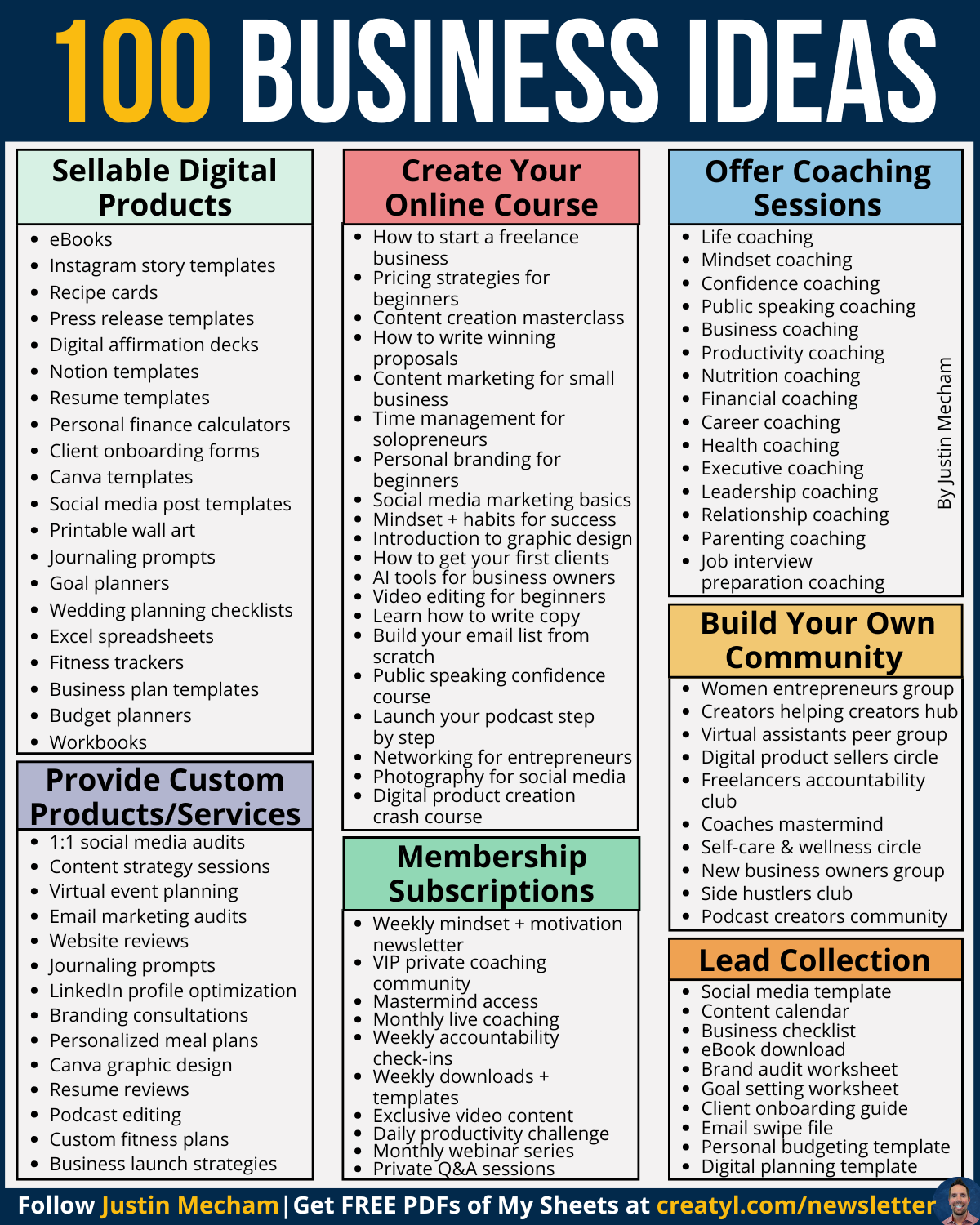
Download The 100 Business Ideas Infographic (PDF)
If you want the full “100 Business Ideas” infographic as a visual reference while choosing your path, download the PDF version here.
It lays out the six core paths clearly so you can decide and move.