


Click Here to Download the PDF.
Every new role starts the same way.
New team.
New expectations.
New pressure.
And underneath all of it, there is one quiet thought:
“Don’t mess this up.”
Even experienced professionals feel it.
Because the first few months are not just about learning the job.
They are about something more important.
They shape how people talk about you when you are not in the room.
Not your credentials.
Not your past experience.
Your behavior.
The way you show up early becomes your reputation later.
And once that reputation forms, it becomes very hard to change.
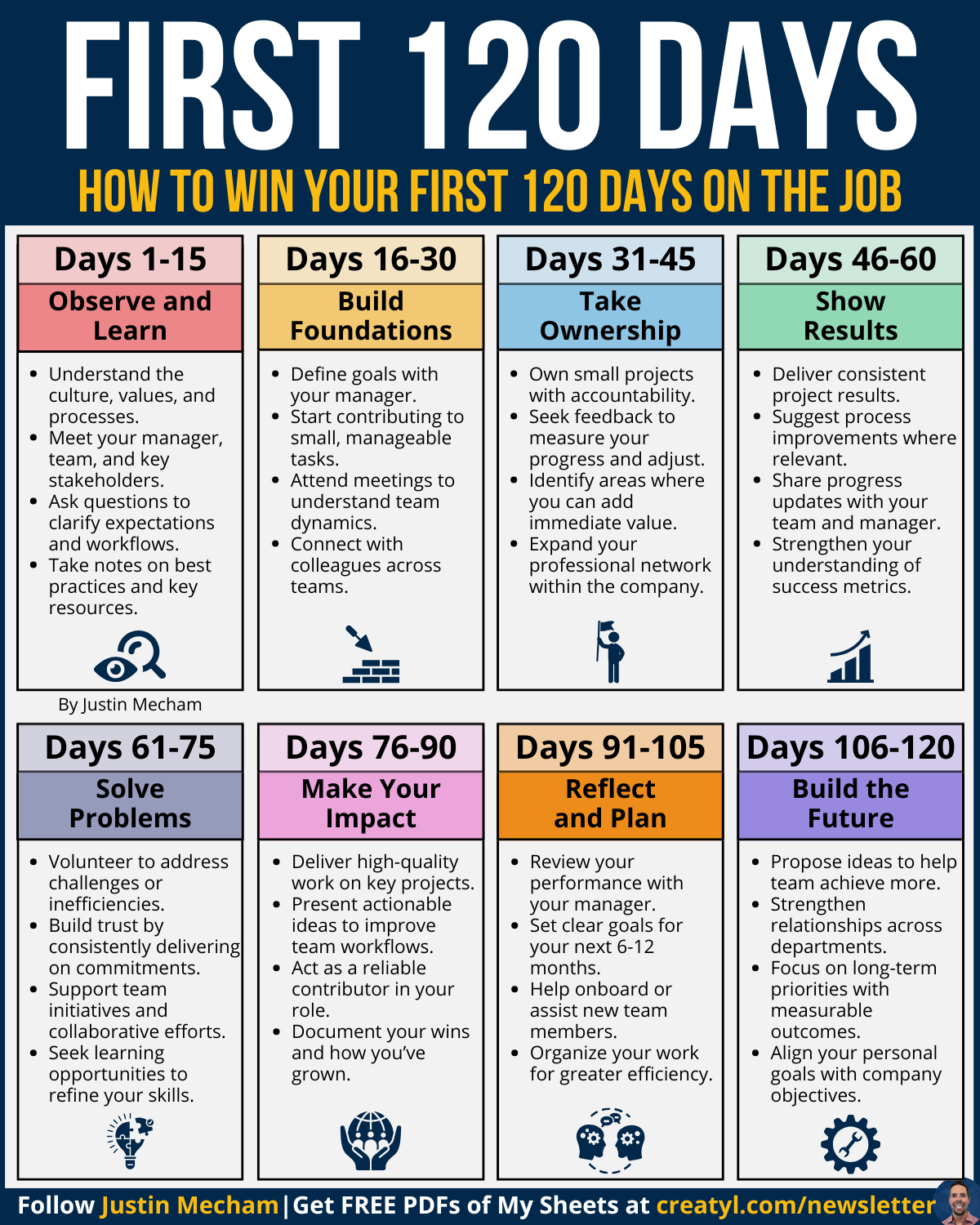
That is why the first 120 days matter so much.
They are not about proving you know everything.
They are about proving people can rely on you.
Why The First 120 Days Matter More Than You Think
Most people treat a new role like a performance test.
They try to impress quickly.
They try to show value immediately.
They try to prove they were the right hire.
But that approach often backfires.
Because early success is not about speed.
It is about alignment.
Understanding how things work.
Who influences decisions.
What success actually looks like.
Teachable Moment:
People do not trust you because you are capable.
They trust you because you are consistent.
And consistency is built through small, repeated actions early on.
Phase 1: Days 1–15
Observe More Than You Speak
The biggest mistake in the first two weeks is trying to prove your value too quickly.
This phase is about awareness.
You are not just learning tasks.
You are learning patterns.
How decisions get made.
Who people listen to.
What behaviors are rewarded.
Pay attention to:
- How meetings are run
- How feedback is given
- How problems are handled
- How success is measured
Meet the people who move things forward.
Ask questions that go deeper than surface-level tasks.
“What does success really look like here?”
“What usually slows things down?”
Teachable Moment:
The fastest way to stand out early is not by speaking more.
It is by understanding more.
Action Strategy:
Keep a simple document of what you observe.
Patterns you notice early will help you make better decisions later.
Phase 2: Days 16–30
Build Trust With Small Wins
Now that you understand the environment, it’s time to contribute.
But not with big, risky moves.
With small, reliable wins.
Clarify your goals with your manager.
Make sure you understand what matters most.
Then focus on manageable tasks you can complete well.
Deliver on time.
Communicate clearly.
Follow through.
At the same time, start building relationships across teams.
Trust grows through interaction, not isolation.
Teachable Moment:
Trust is built through consistency, not intensity.
Action Strategy:
Pick two or three tasks you can complete well within this phase.
Finish them fully.
That matters more than starting ten things.
Phase 3: Days 31–45
Take Ownership
This is where your role begins to shift.
You move from contributor to owner.
Choose something real.
A project.
A process.
A problem.
Take responsibility for it.
Ask for feedback early.
Not just at the end.
This shows maturity and openness.
It also helps you adjust before small mistakes become bigger ones.
Teachable Moment:
Ownership builds credibility faster than effort alone.
Action Strategy:
At the end of each week, ask:
“What is one thing I can improve next week?”
Small adjustments compound quickly.
Phase 4: Days 46–60
Become Dependable
At this stage, people are forming opinions about you.
They are asking themselves:
Can I count on this person?
Dependability is not flashy.
But it is powerful.
Deliver consistent results.
Communicate progress clearly.
Offer thoughtful improvements.
Start paying attention to metrics.
What numbers matter?
What defines success?
When you understand the metrics, your work becomes more aligned.
Teachable Moment:
Reliability builds trust faster than brilliance.
Action Strategy:
Send simple updates regularly.
Clarity reduces uncertainty.
Phase 5: Days 61–75
Solve Real Problems
Now you are no longer new.
This is where your impact becomes visible.
Look for friction.
Where are things slowing down?
What problems keep repeating?
Volunteer to help.
Not to take over everything.
But to improve something meaningful.
At the same time, continue delivering on your commitments.
Consistency and problem-solving together build strong credibility.
Teachable Moment:
People remember those who solve problems, not just those who complete tasks.
Action Strategy:
Identify one issue affecting your team and propose a simple solution.
Start small.
Execution matters more than ideas alone.
Phase 6: Days 76–90
Raise Your Standard
This phase is about quality.
Not just completing work.
Improving how it is done.
Deliver stronger output.
Streamline processes.
Document what works.
When you improve systems, you create value beyond your role.
Teachable Moment:
Growth shows up when your work improves, not just increases.
Action Strategy:
Review your recent work.
Ask yourself:
“How could this be done better next time?”
Phase 7: Days 91–105
Reflect And Reset
At this point, you have enough experience to evaluate your progress.
This is where many people miss an opportunity.
They keep working without reflecting.
Instead, pause.
Review what you have done.
What worked?
What didn’t?
Where can you improve?
Set clear goals for the next phase.
Align those goals with your manager and team.
Teachable Moment:
Reflection turns experience into improvement.
Action Strategy:
Write down three strengths you have developed and two areas to improve.
Clarity guides growth.
Phase 8: Days 106–120
Think Bigger
Now you are ready to expand your impact.
Start bringing forward ideas.
Not just tasks.
Look at the bigger picture.
How can your team improve?
What opportunities are being missed?
Where can you contribute more strategically?
Strengthen key relationships across departments.
Connect your work to broader company goals.
Teachable Moment:
Impact grows when your thinking expands beyond your immediate role.
Action Strategy:
Propose one idea that improves how your team works.
Keep it practical and actionable.
A Real Workplace Example
From New Hire To Trusted Contributor
A new team member joined a fast-paced company and felt pressure to prove themselves quickly.
They tried to contribute ideas immediately.
They spoke often in meetings.
But their suggestions didn’t gain traction.
The issue wasn’t capability.
It was timing.
They hadn’t yet understood how decisions were made or what the team valued.
As a result, their input felt disconnected from the team’s priorities.
We reset their approach using the 120-day framework.
First, they focused on observation.
They listened more in meetings and studied team dynamics.
Next, they delivered small, reliable wins.
Simple tasks completed well.
Then, they took ownership of a small project and asked for feedback early.
Over time, their confidence grew.
More importantly, so did trust from the team.
By the end of 120 days, they were no longer trying to prove themselves.
They were seen as someone people could rely on.
What Made It Work
Small Actions That Built Trust
- They listened before leading.
- They focused on consistency over speed.
- They took ownership at the right time.
- They aligned their work with team priorities.
These actions are simple.
But they are not always easy.
And they make all the difference.
The Deeper Shift That Matters
Success in a new role is not about impressing everyone quickly.
It is about building trust steadily.
People are not watching for perfection.
They are watching for patterns.
Do you follow through?
Do you communicate clearly?
Do you handle challenges calmly?
Those patterns define your reputation.
And your reputation opens doors.
Final Thought
Trust Is Built Quietly
The first 120 days are not about being the smartest person in the room.
They are about becoming the most reliable.
Because reliability creates confidence.
Confidence creates opportunity.
And opportunity shapes your future.
You do not need to prove everything at once.
You need to show, step by step, that people can count on you.
That is what people remember.
That is what builds trust.
And trust is what moves your career forward.
Best Resources For Thriving In New Roles
Book: The First 90 Days — Michael D. Watkins
Why It Fits: A proven framework for navigating transitions and building early success.
Book: Atomic Habits — James Clear
Why It Fits: Shows how small actions compound into long-term results.
Podcast: HBR IdeaCast — Harvard Business Review
Why It Fits: Insights on leadership, performance, and workplace dynamics.
TED Talk: How To Speak So That People Want To Listen — Julian Treasure
Why It Fits: Practical advice for clear and effective communication.
Tool: Notion — Founded by Ivan Zhao
Why It Fits: Helps organize notes, track goals, and manage early progress in a new role.
AI Tool: ChatGPT — OpenAI
Why It Fits: Useful for preparing questions, organizing thoughts, and improving communication.
Download The “First 120 Days” Infographic (PDF)
If you want a clear visual roadmap for navigating your first 120 days, download the infographic as a PDF.
Use it as a guide to stay focused, consistent, and intentional from day one.